
The False Light of Yaldabaoth
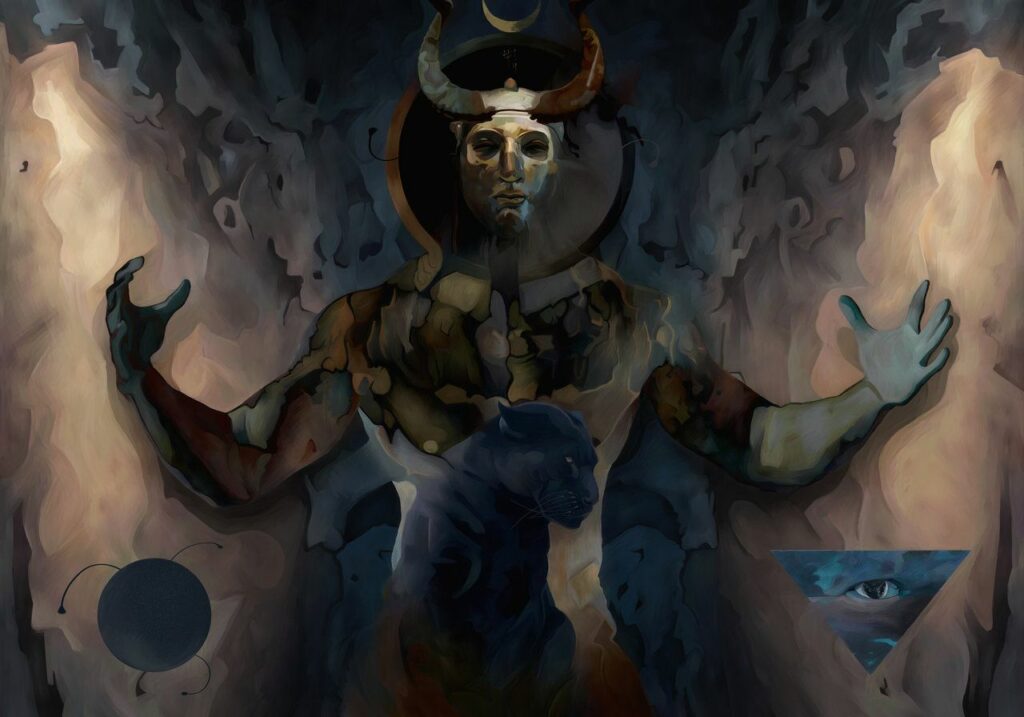
Unlike most traditional religions, Gnosticism and similar dualistic teachings held that “good” and “evil” as energetic categories cannot be reduced to simple notions of the “pleasant” and the “unpleasant”, but are more complex and less clear-cut concepts.
In this sense, the modern Magical Tradition is closer to this kind of dualism than to the “ordinary” notions of how the world is constructed.
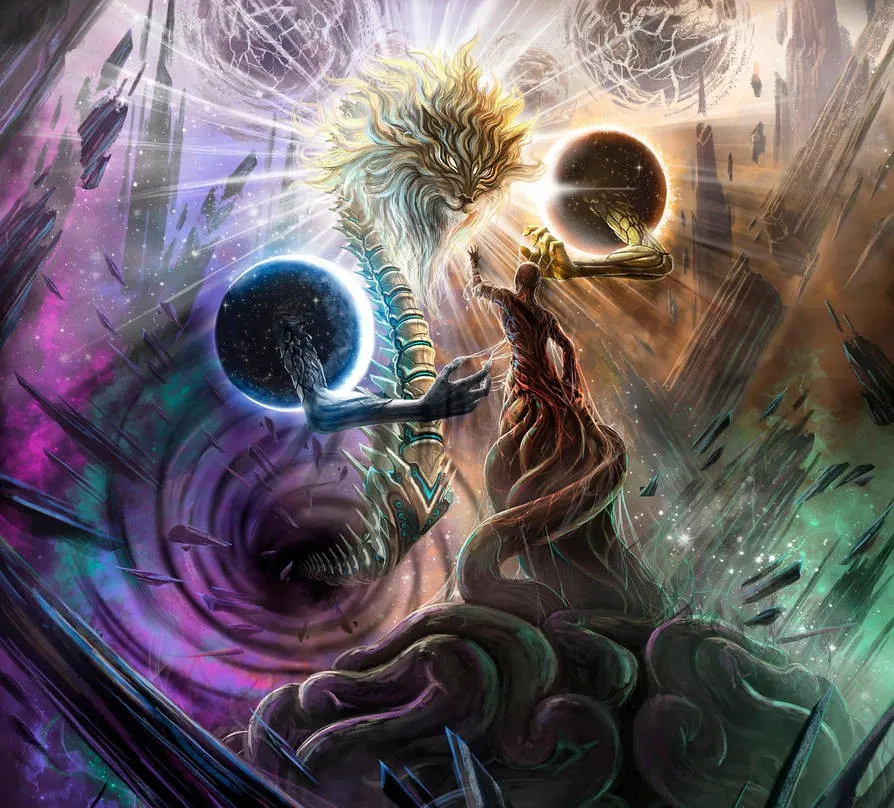
And one of the important concepts adopted by Hermetic schools is the idea of the “false light”, a fake illusory basis of the world’s order, which is becoming ever more relevant in the modern course of history.
We have more than once said that Myth describes mind as “Light”, more precisely — as the result of the entry of formless and indefinable Light into the corresponding vessel. At the same time, Myth states that the real situation of our (and, evidently, many other) world is such that “Light” and “Vessels” cannot fully interact; the “Vessels” of mind are often, to a greater or lesser degree, “closed” to the Light, cut off from it by their sense of individuality, and live only by “memories” of it.
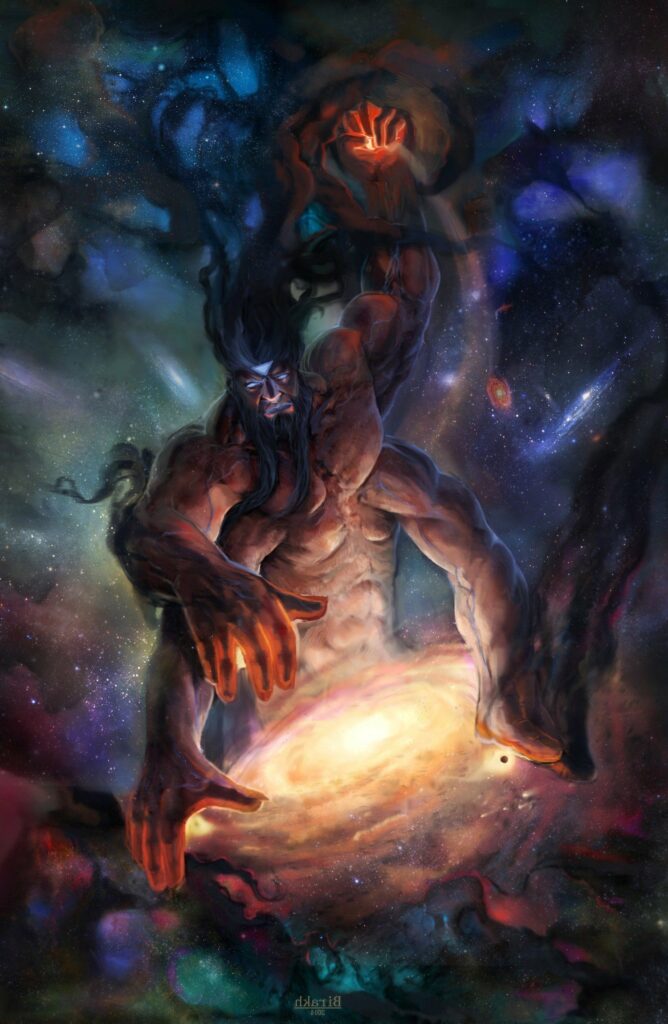
In other words, the vessel, which arose as a product of the mutual strivings toward the actualization of Light and the Medium, closes in on itself, “breaks away” from the Light and “shuts” itself off from it. It is precisely such self-enclosed and half-empty vessels that most beings in our world are.
However, it does not end there. Since the nature of a vessel is to receive Light, under conditions of lack of Light, a being seeks to fill its “emptiness” with something, to return continuity to the world, and fullness to itself.
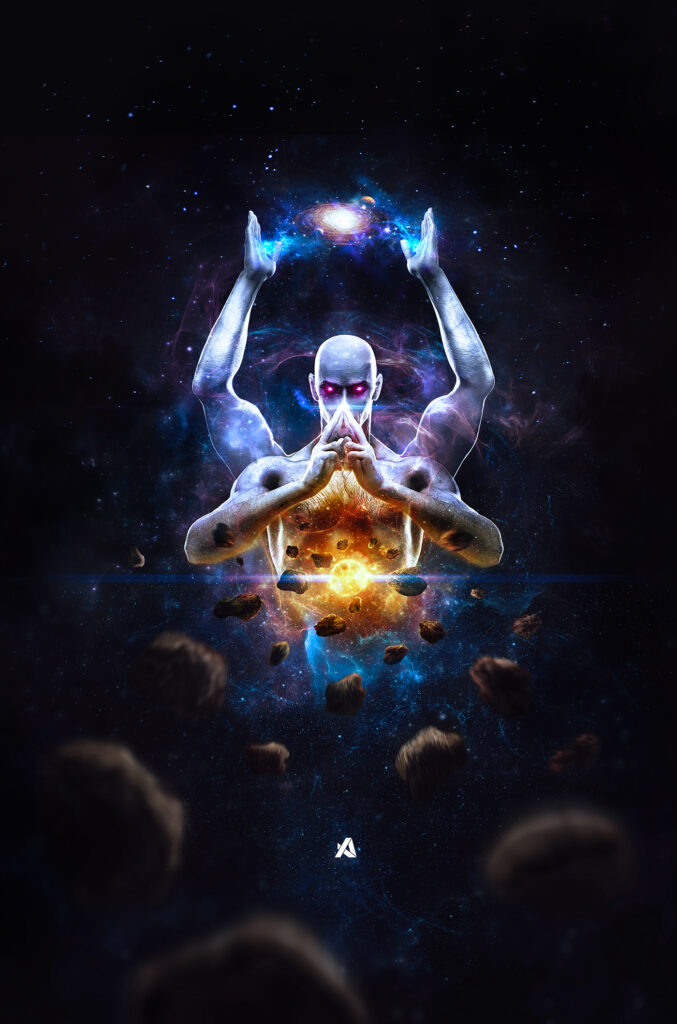
In such a situation, for “supplementing” and compensating for the missing reality, the “virtual” Space of the Interworld is used, connecting the Light-filled regions of vessels, beings, and worlds and holding them in existence. In fact, what today we call the “Interval” is older than any of the worlds; it is precisely that primordial, malleable and unformed space in which worlds are born and die. And it is precisely this that holds worlds and beings, to varying degrees open and filled with Light, both in existence and in relation to one another. One might say that one or another region of the Interworld becomes a world, filling with Light, and again dissolves into the Interval when deprived of it. However, the very reality of the Interval is illusory, virtual, since it is lacking its own energy — the product of the interaction of Light with Vessels. It turns out that “reality” is born from virtuality, filling with awareness, and again dissolves into potentiality when awareness is lacking.
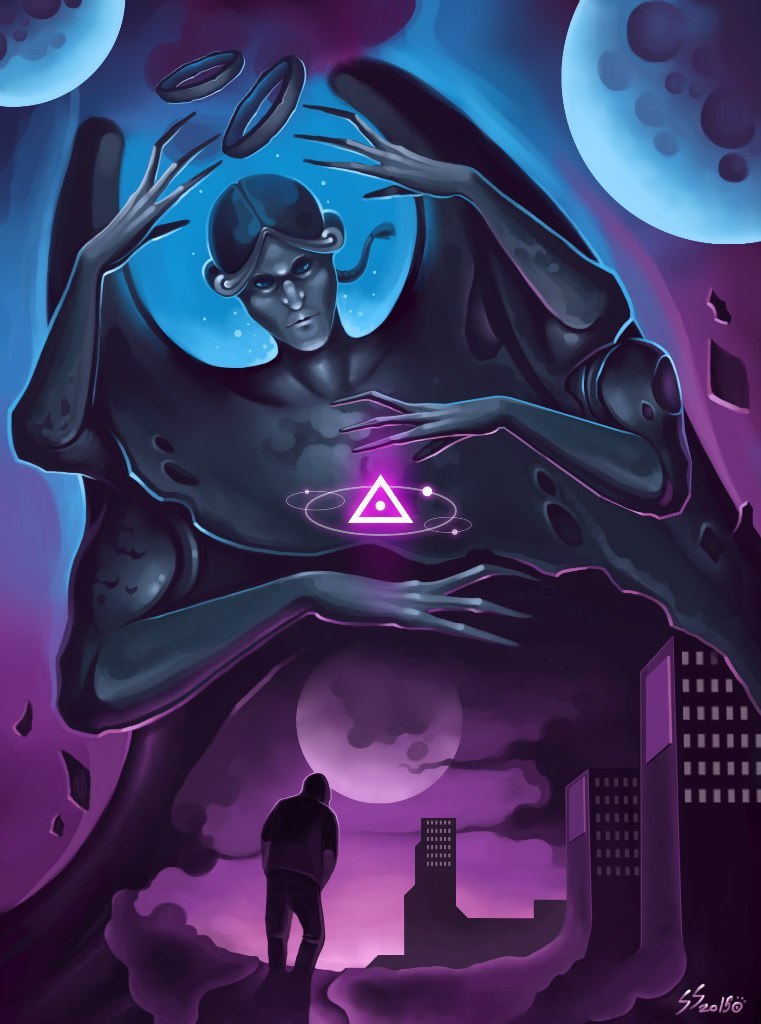
We have already said that the forces maintaining such a balance between “reality” and “virtuality” are traditionally called Archons, who can thus be viewed as “Primordial elementaries”, a kind of Jotuns of the Interworld.
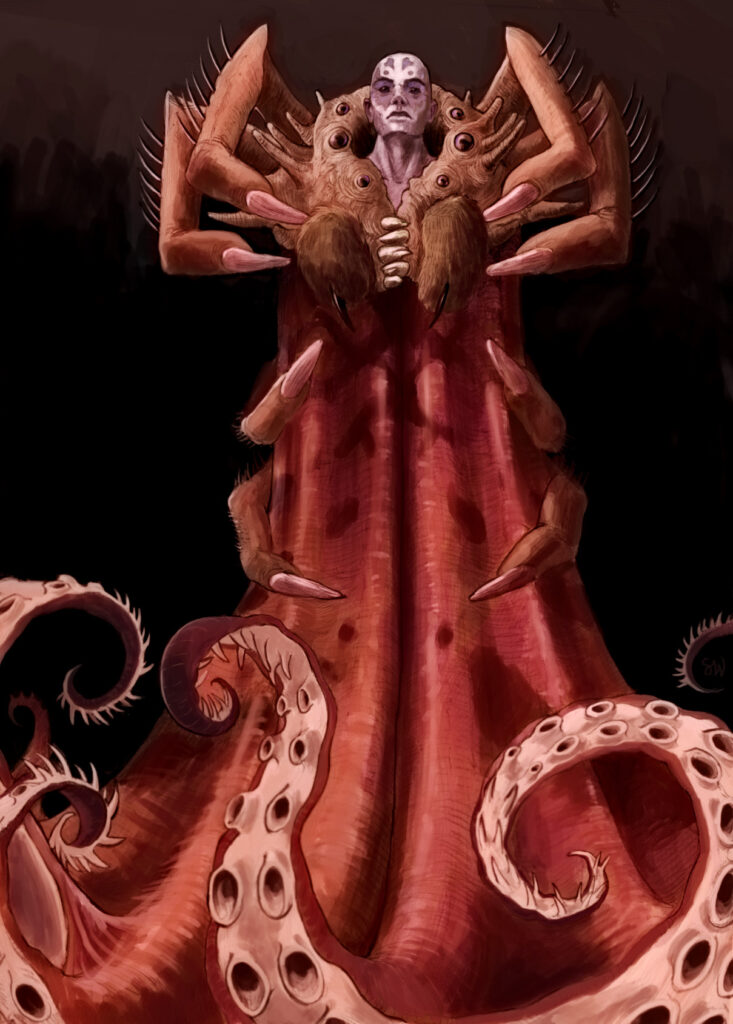
The Gnostics called the Father of all the Archons Yaldabaoth (the name is usually translated as “Son of Chaos”, ילדאבהות, but it would be more accurate to read it as “The Child Who Came”, ילדבואת) and described him as the “Blind Demiurge”, a god who creates the world from his dreams and fantasies. Thus, by this name one can call the force that “substitutes” the real filling of the vessel with Light with a fantasy about it, and in this sense speak of it as a source of virtuality, dreams, and illusions. The Gnostics argued about which of the destructors is more primary — Separateness of Lucifer or Blindness of Yaldabaoth — however, the fact of their interconnection is beyond doubt: self-fixation leads to blindness to others, and vice versa, ignoring the medium’s signals leads to withdrawal in a constructed inner world.
We also said that later occultism knew the force of the “Blind God” in its faceless, more precisely — anti-personal aspect, under the name “Demon of the Abyss” — the all-dispersing Choronzon, and in a more particular aspect — as the “Angel of Daath”, the Spirit of Death Abaddon.
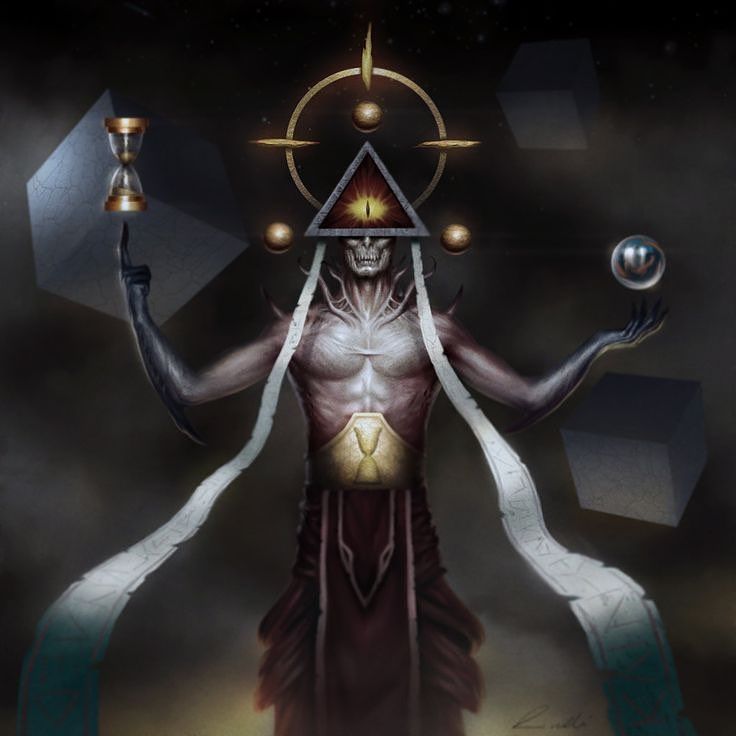
Thus, it turns out that any world balances not simply between “Light” and darkness, not simply between sefirot and qlippoth, but — between Light, Darkness, and the Interval, between Creation, destruction, and “anti-creation”, and in this lay the special “gnosis” of a number of Schools. If Light and Darkness together integrate into the ferment of “bohu”, then adding the Interval to them opens Choshekh — the primordial Fullness of Emptiness.
However, the virtual reality of the Interval is not only a source of the integrity of the universe, not only a tool for maintaining imperfect worlds in relative equilibrium; it is also a “substitution” of the real world process, a “surrogate” of life, since virtual space generates a response to desires faster and more easily than the sturdy fabric of any of the worlds. Just as in a computer game one can easily and safely obtain a reward, wealth, or some other achievement, the space of dreaming replaces the vessel’s real filling with Light with a fantasy about it. One could say that the activity of the Archons substitutes reality with a “game”, and the energy released in this way is used by the beings of the Interval.
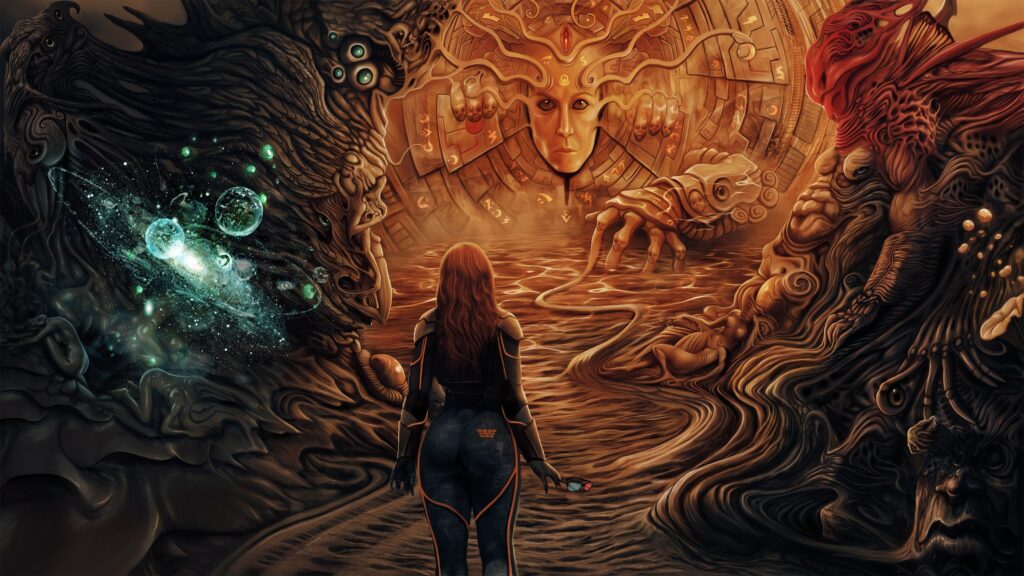
And herein lies a very great danger, clearly noted by the Gnostics and heavily underestimated by the dominant civilizations. Any world is a “cocktail” of awarenesses and fantasies; any mind is a mix of Light and its surrogates.
Although it is well known that the illusion of knowledge is worse than ignorance, since it hollows out the mind, depriving it of the urge to develop, every world from time to time falls into a state where virtuality begins to dominate over reality, fantasies — over analysis and perception. In such times, the ignoring of Darkness becomes especially noticeable, while “blissful idiocy”, messianic moods, and the devaluation of love, on the contrary, come to the fore.
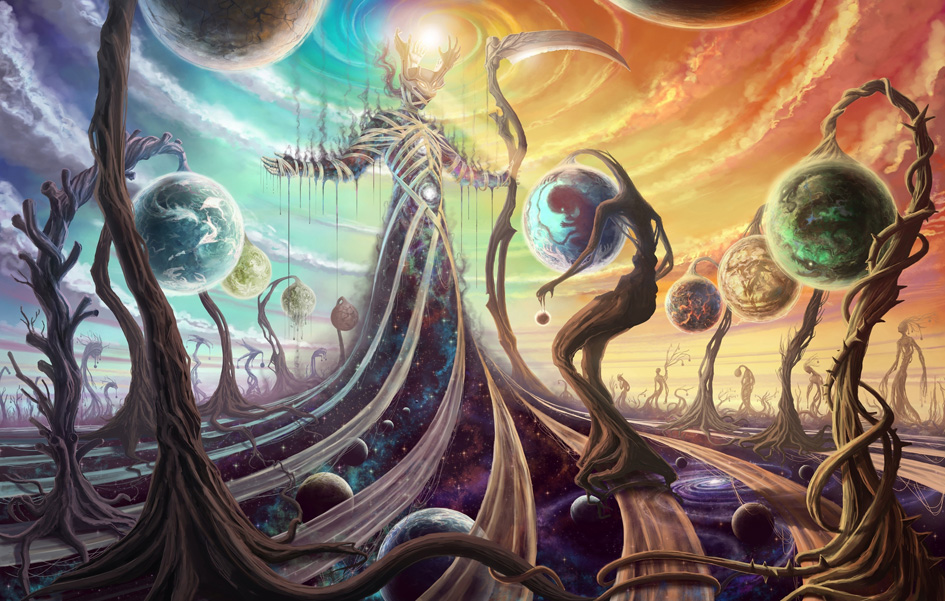
The false light of Yaldabaoth at present is an even more serious danger than the darkness planted by demons, because while the latter leads to far more large-scale losses of power, the former deprives one of motivation for development, the urge toward compassion, and the sense of connection. One could say that demons and archons act in a single linkage; however, the power of the latter is even less noticeable, even more carefully veiled, and therefore even more dangerous. And if methods of resisting demons are at least well known, honed over millennia, then resistance to archons, on the contrary, is often perceived as “unnecessary” or even “harmful”. Mass psychoses, “holy” wars and suffocating-free-will “rays of goodness”, “enlightenment in three days” and demonstrative piety — this is a highly potent poison, but very carefully disguised, coated in cloying sweetness.
Therefore, modernity urgently needs the study of the Interval and its inhabitants, the investigation of their strategies and habits, and the development of a system of “Intermediate Goetia”, with its own techniques for questioning and binding virtual demons.
Myth and realities, intertwining,
The World and the Infinite,
I add tar to my Honey,
Beneficial for Eternity,,,
Super, thank you, now everything is clear! 😉
Can such a strategy of substitution/replacement/staying in dreams be used constructively by the consciousness? For rest, for instance, especially at times when it gets tired of constant struggle and ‘staying/searching in the Dark’? Or is this method still quite destructive?
To find the impulse for creativity, but not getting stuck in dreams.
A very interesting question—how to distinguish the virtual from the ‘real’? For myself, I have outlined the main criterion—it is the intensification of the flow of PRANA/pneuma and, consequently, the increase in the liveliness of mind and body. Secondary criteria include the use of power words (mantras) that ground well. I believe that strong experiences, which are possible when confronting death, can yank a person from virtuality. The virtual feels somewhat flimsy and dead; as I understand, there is a lack of the universal flow of prana/pneuma (according to your descriptions). But I think there are additional criteria; what would you highlight?
The main criterion of ‘reality’ is causal relationships; ‘real’ is what allows evolution, where progressive development is possible.
In this context, the only ‘technical’ difference of reality is the consistency of its description; reality is a flow of perceptions, which a large number of perceiving consciousnesses describe in a unified manner.
And this very consistency of description allows stable flows to form, within which evolution is possible.
In virtuality, however, the descriptions vary, the support systems are vague, and the possibilities for evolution are restricted, resulting in unstable outcomes.
Well said)). It turns out that a myth contains a scenario (plot) for the birth of the cosmos—a harmonious whole. It is interesting to consider in which myth our civilization is currently situated. I would also add that the whole issue now revolves around the processes of globalization and virtualization. But the most important understanding that follows from this is that the informational field has become common. Numerous systems of ‘descriptions’ (different traditions, knowledge systems) are interwoven. Without uncovering the meaning—holistic understanding of why this is necessary, and in what context it is acceptable: nothing will work. New orientations in thinking are needed, as mere logic is not enough; there will not be enough time or strength to process huge volumes of info. Intuitive-synthetic knowledge comes to the rescue.
Hello, I will only say my view of the situation. Our world is choosing by voting what we will do next. Right now, the versions that dominate can be heard in Plamenyev’s Night Before the Battle and Chancellor Guy’s Wild Hunt for You. It is very romantic to be remembered two generations later; the only question is whether there will be anyone to remember.
This is very important information! Thank you for trying to convey it to us. Huge respect to you, dear En.