Qliphoth — the Husk of the Cosmos
Among the terms we’ve mentioned, the word “Qliphoth” often appears. Let us clarify the traditional meaning attached to this concept.
The Aramaic word “qliphoth” has a numerological value of 626 and literally means “shells” or “husks” (and also — to shell, to strip of a husk).
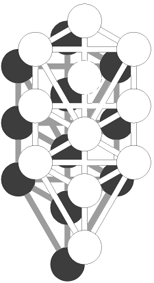
The original concept of the Qliphoth is closely linked to the Tree of the Sefirot. It is held that each Sefira has a reflection — a qlippa. However, contrary to common belief, the Qliphoth are not “anti-Sefirot.” Romantically inclined demon-worshippers introduce an element of veneration and a peculiar idealization of everything that stands in opposition (overtly or covertly) to the main current of Creation, and through such reinterpretation the concept of the Qliphoth effectively becomes a demonic “anti-universe.” This tendency was initiated early on by the notorious I. Regardie, who interpreted the obscure texts of the Golden Dawn in his own way. In reality, the matter is more prosaic — and darker.
Traditional magic draws a distinction between involutive and qliphothic entities. Involutive forces (for example, the ministering “fallen” spirits of the Copper Vessel) serve Creation’s overall design, performing certain functions (in particular, aiding the evolution of the material world), whereas qliphothic forces are wholly destructive.
At the same time, the Tree of the Sefirot, being a means by which Light diffuses through the Vessels, is not fully transparent to Light: it blocks part of it, or, as is said, it “casts a shadow.” Within this shadow two components are identified. The first component is a remnant of Light — an “element of Light in the shadow,” and the second is the absence of Light — an “element of Darkness in the shadow.” Depending on the level of the Sefira, the shadow may be thicker or thinner, and the proportion of its two constituents changes accordingly.
Therefore Kabbalists divide the Qliphoth into “Klippa Noga” — the “Shining Klippa“, i.e. objects that can potentially be used to fill the Vessels with Light, and three kinds of “impure qlippoth” — things utterly unfit for the world’s creative process. These three klippot are, in a sense, counter-elements to the Primal Elements and are called “ruah se’arah” — a tumultuous wind (the destructive aspect of Air), “anan gadol” — a great cloud (that is, a storm-cloud, the destructive aspect of the principle of Water), and “esh mitlachachat” — a consuming fire (the destructive principle of Fire). Involutive, “fallen” ministering spirits belong to Klippa Noga, while the qliphothic actual entities constitute the “impure” — that is, utterly Light-deprived — qlippoth.
If the Spirits of the Vessel and the like represent inverted vortices, then the forces of the Qliphoth are distorted, “corrupted” vortexes.
What, then, is the cause of their appearance? The distortion of the vortexes occurs as a result of attempts by the Vessels to seize more Light than they can hold. This leads to the “shattering” of those Vessels, and what remains of them is called an empty “shell.”
In other words, when a being attempts to seize forcibly a power not meant for it, its Vortex, being incapable of assimilating such an “alien” Power, becomes deformed, and the Power is lost. A “hollow” vortex is formed — that is, effectively, a “memory” of the vortex that once existed but was destroyed.
Thus these shells are usually presented as destructive, selfish, and, to a certain degree, attractive elements of the world’s creation. They are the “dark side,” the shadow of destruction cast by the Creating Light. In Crowley’s words, “The Abyss is the void of being; it is felt through all possible forms, where each is equally empty, each therefore evil in the single sense of the word — because it exists. Every possible form is meaningless and thirsts to become real. These forms whirl insensibly in a random multitude like dust-laden demons, and each accidental joining of parts proclaims itself an individuality and screams ‘I am I!’, while knowing that its parts have no true connection. And the slightest agitation disperses the delusion, just as a horseman, meeting a dust-laden demon, drives it into the dusty storm to the ground.”
It is utterly pointless to seek positive aspects in the Qliphoth. They are called “shells” precisely because they exist only to prevent the Light from filling the Vessels — in other words, to hinder the reunion of the “spiritual” nature with the “material.” The forces of the Qliphoth are exclusively destructive; and whereas positive evil is a force directed against the current of evolution, negative evil is simply resistance to any movement — destruction for destruction’s sake. Deprived of their own Light, their own power, and without even the possibility of obtaining it, the spirits of the Qliphoth are obligate predators. The only way for them to obtain power is to take it from another Vessel, and they immediately lose it because their own vessels are cracked, full of holes. Thus the Qliphoth are the principle of attraction distorted and driven to absolute absurdity, a principle that originally belonged to the immanent milieu.
Every conscious being is surrounded by a host of qliphothic beings that feed on its emanations. Such spirits consume malice, aggression, fear, sorrow, lust, and other chaos-producing emanations of beings. They often provoke beings to intensify their emissions, yet qliphothic spirits can never be satisfied, and they endlessly destroy everything around them in a vain attempt to obtain what does not belong to them.
If it is completely useless to seek positive sides, then why does the World of Klippot exist at all?
Klippot is not a world in its own right; it is precisely the “husk,” the waste that inevitably remains in any matter, including the matter of Creation.
Is there something that destroys them, or do they disappear over time, being replaced by new ones?
Unfortunately, the number of klippot not only does not decrease over time, but, on the contrary, increases due to the transition, casting off from the Stream of Force of the sephirotic entities.
I know one girl who spent some time practicing klippotic practices. Unfortunately, she did this without proper preparation – which resulted first in nightmares where SOMETHING consumed all surrounding existence (almost like in the movie “Langoliers” by S. King), then in instability of the psyche, and then… I don’t even want to talk about it, to be honest, but it all ended badly, and the consequences will last for more than one year. Moral: if you’re not sure – DON’T CLIMB, and everything written above about the nature of these entities is pure truth.
If the klippot is outside the Stream of Power, then where do they get the strength not only to be but also to act?
All this power has been stolen, taken, or fought back from beings inhabiting the worlds of the Stream.
And what does the drawing with 11 spheres signify?
The Tree of Life, which includes the sphere of Da’at.
Can the Sefirot and Klippot be called biners?
“Does it mean that the spirits of Klippot can also consume the demons of the Copper Vessel in exactly the same way?”
The Demons of the Copper Vessel, particularly Gaap, are merely manifestations of the ancient dark deity Maimon. Gaap and Amaymon represent the power of the deity associated with the “Black Kabbalah.”
Why don’t involutionary spirits turn into purely clipotic ones? After all, they are also predators?
They turn when their degradation reaches its maximum.
If we consider the microcosm through the system of sephiroth, it turns out that there must also be ‘klippot of the microcosm.’ Is there a difference in this regard from the macrocosmic question? How is this considered in magic?
Of course, there are demons and klippot in the psychocosm. We discussed this issue: https://enmerkar.com/en/myth/where-do-monsters-live
To be honest, I didn’t find anything in Regardie that could serve as a basis for various kinds of Dark Doctrines. But Kenneth Grant – that’s the real godfather of what is called “The Left-Hand Path” (not in a tantric sense, but in a modern Western understanding of this term), the demonic anti-universe “Universe B”. He is precisely the originator of all this idealization of the Klippot. Traditionally, the Tree of Sefirot is primary, while the Klippot is secondary. Like a shadow is secondary to the object. In Grant’s reinterpretation, everything is the other way around. The Tree of Sefirot (that face part with which the Golden Dawn and A.’.A.’. work) is just a facade. The real side – shadow (the gate to which is Da’at). The face side exists insofar as the reverse side does not exist (is not manifested in being, in reality). But the negative side is real, while the face side is illusory. And so on – blah-blah-blah Ancients, blah-blah-blah Cthulhu, blah-blah-blah Lovecraft.
Where do these clipotic beings reside? Can they freely circle around humans, and can a mage enter their world and return?
For a mage, entering their world and coming back is dangerous for life. They cannot freely circle around humans. Only if the human is ‘prepared’ to enter their world will these clipotic beings meet him. Humans are necessary for the worlds of klipot as food.
How to fight them? If we do not generate any emotions at all, then they have nothing to feed on, and they will not touch the being? Or can we somehow reverse their vector, maybe close them off somehow? And what are these husk-entities afraid of?
Power is the measure of the vessel being filled with light – can clipotic entities grow stronger depending on the extracted power, beyond their vessel’s maximum capacity, since they are still broken?
The Qliphothic worlds are a Universe of level B with energy resonating differently from our Universe, governed by the primordial ruler of darkness Samael (the equivalent of the Demiurge in our world), and his younger crown Asmodeus serves a role akin to that of an executor in our world, advancing his interests. This is no husk of our world; it is a world entirely distinct from our own, and much more primordial, for at the beginning, there was no light.
Thank you for the article