
Nahash and Reintegration

In our conversations about loneliness, we said that it has a macrocosmic, transcendental character.
We also mentioned that the cause leading to this fragmentation was a cosmogonic event called “the Breaking of the Vessels“, “Shvirat HaKelim“.
Let us begin by examining this “breaking” itself.
This idea arises when describing the order of realization of the Absolute’s potentials, their filling with awareness, that is, their translation into actuality. We have already understood that this process is described as the “entry of Light into the Vessel“. Initially, Light is the integral mind of the Absolute, and the Vessel is the aggregate of its potencies. Naturally, as soon as the Light enters the Vessel, their properties seek balance: the Vessel acquires an expansive quality and expels the Light. In order for this not to happen, the expelling force of the Vessel must be less than the incoming force of the Light, ideally — incommensurably less (only in that case will the maximum amount of Light, having entered the Vessel, be retained there). It is precisely this necessity that is described as the “Breaking of the Vessels” — so that Light might be held back in a Vessel, it does not enter an integral Vessel but a multitude of distinct vessels. Such differential vessels are called the “Energies” of the cosmos, or, in Eastern terms, “dharmas“.
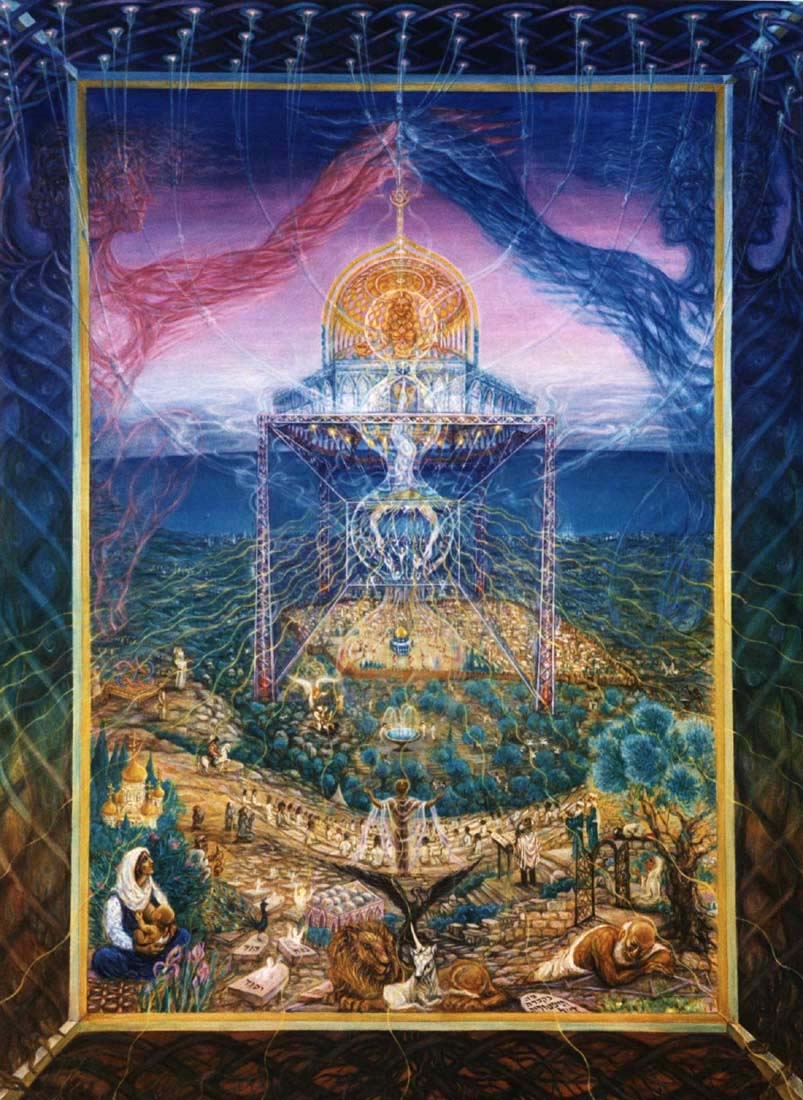
The same concept found expression in the notion of the Great Goddess, one in the many, and the Great Father, many in unity.
In fact, the Breaking of the Vessels is a process that precedes creation, and it is precisely this process that creates the very possibility of creation: the field of Potencies of the Absolute subject to actualization in the world. Creation itself is the formation of consciousness-bearing structures — structures that carry out this actualization by filling Potencies with actual content. For this, the integral mind of the Absolute also splits into multiple Monads — individual aspects of that mind, each filling the Energies with Light in its own differential aspect.
Worlds are built on the Breaking of the Vessels, which is an essential precondition of creation.
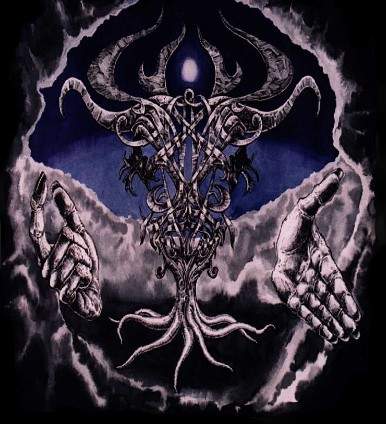
Two important consequences resulted from the Breaking of the Vessels. Firstly, it led to the creation of individual minds — “selves” — living beings, humans among them. Secondly, gaps, or “interspaces“, formed between the Energies; integral unity gave way to differential unity, and darkness entered the world.
It is evident that the Energies, as parts of the “shattered” original Vessel, strive to reunite, and the Monads share that same striving. These two impulses are inseparable, mutually complementing and conditioning the forces that arise. At the same time, the Energies, being essentially attractive elements (since before they are filled with awareness, each energy is an “elemental Vessel,” that is, an elemental attraction) tend to merge independently of the Monads’ union. Therefore, there must be a force that prevents this merging, a force that preserves the differentiation of the Vessels. This Force, being a manifestation of the Principle of the Threshold, received the name Nahash (“the Deprived“).
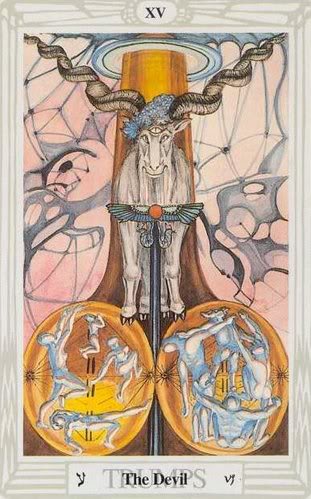
Nahash is the “fallen”, distorted variant of the Light of Individuality — Yechida — which, from self-assertion, turns into a force of estrangement. This force, while absolutely necessary for maintaining the cohesion of the cosmos, is nevertheless subjectively perceived by any mind as hostile, since it prevents a return to the original, “pre-birth” state. It was this Force that later gave rise to notions of the “devil“, having mixed with the idea of the Qliphoth, and expressed itself in the image of the “Father of Evil” — Lucifer. In that form, the idea of “breaking” is reflected in the 15th Arcana of the Tarot.
Thus we understand that the world’s differentiation is a wholly necessary property. Yet this is so only from the viewpoint of the Vessels, for which any union is a fusion, as soap bubbles coalesce, increasing their volume. For the mind, and for the Monad as the bearer of that mind, the picture looks rather different.
Since Monads are aspects of the Absolute’s cognitive activity, their union does not necessarily lead to fusion; on the contrary, fusion is possible only when the mind fades, not in the case of its development and expansion. This idea underlies the gnostic concept of the Pleroma, “merging without mixing”, later developed into the Rosicrucian doctrine of Reintegration.
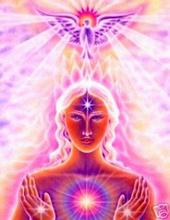
“Reintegrated Brothers of the Rose‑Cross” are disembodied beings who have entered the Pleroma in full, preserving individuality and creative activity. It is precisely individuality, for personality dissolves in the very striving for Reintegration: that striving brings about the disappearance of personal desires and passions; the reintegrated Rosicrucian is a conscious, individual part, consciously sharing the volitional impulses of the World Man within a particular sphere of his being.
In principle, the process of evolution, in its course, is directed toward precisely such a Reintegration, which occurs simultaneously and in parallel with an expansion of awareness. Overcoming the dividing force of Nahash is the Rosicrucians’ goal, and their Way gradually overcomes that division.
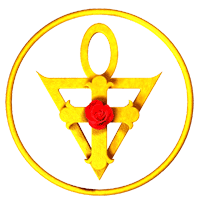
The very symbol of the Rose and the Cross, by both of its constituent elements, expresses the reintegration of the being into the center of that state and the full flowering of its individual capacities from that center; thus, it aptly denotes the restoration of the “original state” or, in other words, the completion of Initiation into the “minor mysteries“. Reintegration for Rosicrucians takes place in several stages: first, the human being himself is reintegrated, since he too is fragmented into body, soul, mind, etc., and only then do the separate “selves that have reintegrated” unite in the World Man and continue to act as evolutionary creative forces, accelerating the evolution of other beings.
It is hard to say how harmonious Rosicrucian ideology truly was — it very often misled its adepts, who, instead of developing awareness and bringing it to the maximum required for entry into the Pleroma, calmed it, like Buddhist bodhisattvas, turning from active agents, expansive creators, into attractive principles that call the world back into a pre‑manifest state.
Traditionally-minded Magi always regarded the Brothers of the Rose and Cross ambivalently — on the one hand revering their piety and wisdom, on the other rejecting the passivity into which they so often fell. Yet what is important is precisely the possibility of overcoming fragmentation, found and elaborated by them, for the Magus entry into the Pleroma is also a goal and a means of avoiding a return to the cycle of Gilgul.
Some things are certainly controversial, but still worth pondering. It’s also quite interesting the allusion to the creation of the Philosopher’s Stone as a result of the union of Salt, Sulfur, and Mercury. But apparently, it is somewhat misunderstood; the state in which the one who completed the Doing should be. After all, the completion of Doing is not Aleph, but Tau. And such a simple thing as freedom from compulsory Gilgul can already be achieved at the stage of Aleph. What is different is that for the Doing to be fully accomplished, one still has to incarnate in the Material World, even when being Liberated. 😉
One should not transfer the values and paths of one Myth to another. How and what the Rosicrucians achieved, what they strived for is one thing. How you see it (or how I see it) is entirely different. For me, the Rosicrucian worldview does not coincide with my Path, yet I would not call it ‘wrong’. As a holistic Myth, it is quite effective and for someone, presumably it is their Path. As for ‘achievement’ and ‘exit from gilgul’ – I also consider these to be different goals, and the Rosicrucian myth does not see this exit as the ultimate goal; their task is indeed to facilitate the evolution of humanity, but unlike the Eastern Path of the bodhisattva, the Reintegrated Rosicrucians should not incarnate again and impact the physical world from the Interworld.
Why is there such a desire to avoid the cycle of gilgul?
Because in the Gilgul, self-identity is lost.
What does self-identity mean? Who identifies whom with whom? After all, the personality is destroyed, but the individuality of the Monad cannot be lost.
The personality is destroyed precisely because it is disidentified from individuality. Accordingly, self-identity is the identity of oneself (the personality) with one’s nature (individuality).
How do vessels perceive the separating force of Nahash as hostile, if they themselves do not possess consciousness, but are merely differentiated potentials? Or does Nahash continue to act on the vessels even after the light of consciousness has entered them?
A vessel that has not accepted the Light is an abstraction, convenient for the process of knowledge, but having no relation to reality, since in reality the vessel and the Light arise simultaneously, and all forces acting on the vessel act on it during its acceptance of the Light.
It’s no wonder they say, those who seek…
I have a lot of work to do. I need to reread your entire blog, Enmerkar!
I have already stopped hoping that I can find what this sign means: the symbol of the Rose and the Cross.
I found it on the teacher’s disk (for potential embroidery on the canvas).
This symbol worked wonders with me 🙂
I didn’t know what was happening, I just knew that everything was right and needed to be. For several days, I couldn’t tear my gaze away from it. The energy emanating from it and its effect were incredibly powerful.
The influence appears to be similar to what you describe, Enmerkar. I have my own understanding of entering the Pleroma, as I was shown. But I can confirm that regarding passivity. For just a few days now, I catch myself that (the influence of the symbol of the Rose and the Cross happened a couple of months ago), I have a complete lack of desire to move. I cannot explain it by fatigue, laziness, or external interference (though they do exist). I feel this is something different, but what?
And today is a gift.
Thank you, Enmerkar.
Now I know what to do 🙂