
Demon of the Abyss
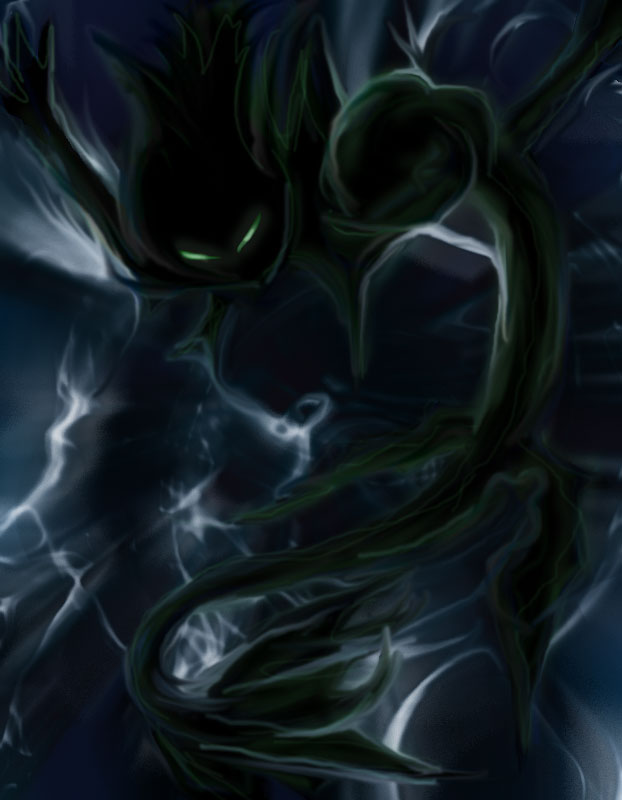
The great power of opposition, manifesting in the Cosmos as the Gatekeeper, in the world-process as the Serpent of the Abyss, and in the aspect of energies as the serpent Nakhash, manifests in the Psychocosmos as the Demon of the Abyss.
Gnostics called this power Ialdabaoth, John Dee — Coronzon, and Crowley — Choronzon (Crowley altered Dee’s spelling to change the numerical value of the name — according to Dee the Demon’s number is 365, while for Crowley it is 333); to Buddhists it was known as Mara — “Father of Illusions.”
According to Gnostic belief, Ialdabaoth is a blind creator, unaware of what he does, cast out of the Pleroma into the abyss, and filled it. Such a depiction, of course, somewhat simplifies the concept of the Demon of Dispersion by personifying it (and thus already violating the very principle of the negation of creation), yet within the Gnostic myth it fittingly describes its nature — the nature of the negation of form. In this sense, the Demon of the Abyss is an anti-Logos. Removing that personification shows the name aimed to designate precisely the Power of Opposition — the Power of the Abyss.
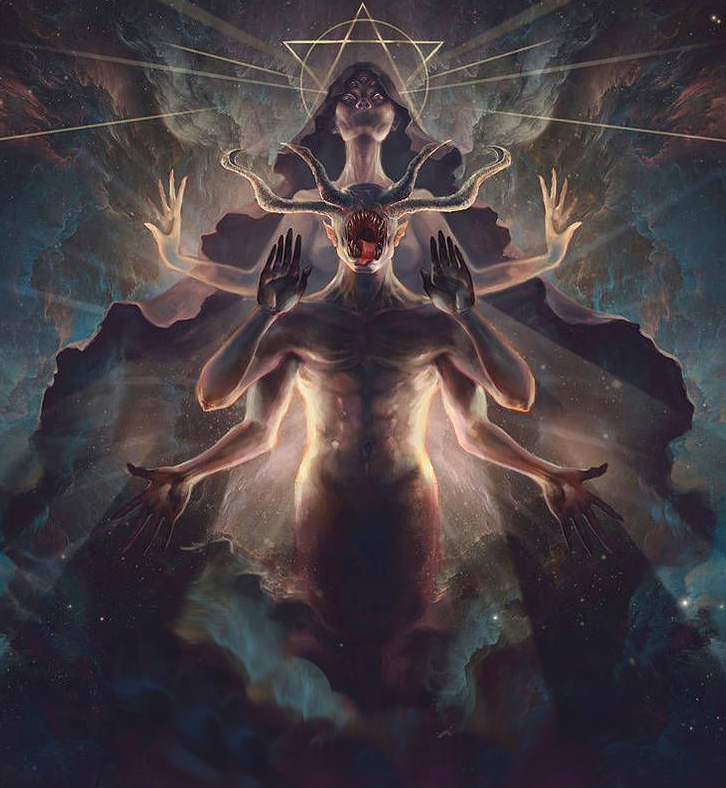
In Dee’s diaries, in an entry about a conversation with “angels” concerning the expulsion of Adam from the Garden of Eden, it reads:
«But Coronzon (the name of that mighty devil), envying human bliss and perceiving that part of human essence was transient and imperfect compared to his own nature, began to attack humans and overwhelm them…».
According to Crowley,
«Choronzon is dispersion»,
«The name of the Dweller of the Abyss is Choronzon, but in truth he is not individual. The abyss is empty of being; it is filled with all manner of forms, each of which is equally empty; each therefore is evil in the only true sense of that word — because it is meaningless, evil, and thirsts to become real».
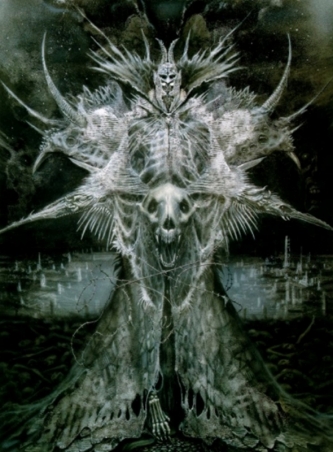
The idea that a force prevents awareness — and opposes creation in its psychocosmic aspect — is quite ancient.
As early as Sumerian times, priests found a force, dark and unincarnate, dwelling in darkness and the void. They named it Nam-tarru (“the cutter”, “the slitter”), and this image later became a symbol of the inevitability of death. From the name, it is clear that the force’s main characteristic is division and dispersion (Crowley concurs).
Nam-tarru brought death by forcing a person to confront their deeds, which then destroyed them. In other words, the power of the Demon of the Abyss reverses the flow of the mind, from outside to inside, periphery to center, leading the mind to extinction.
Later, “namtarru” came to name a whole hierarchy of liminal beings, merging their image with the Ferryman of Souls; the sense ‘dweller of the abyss’ remains today.
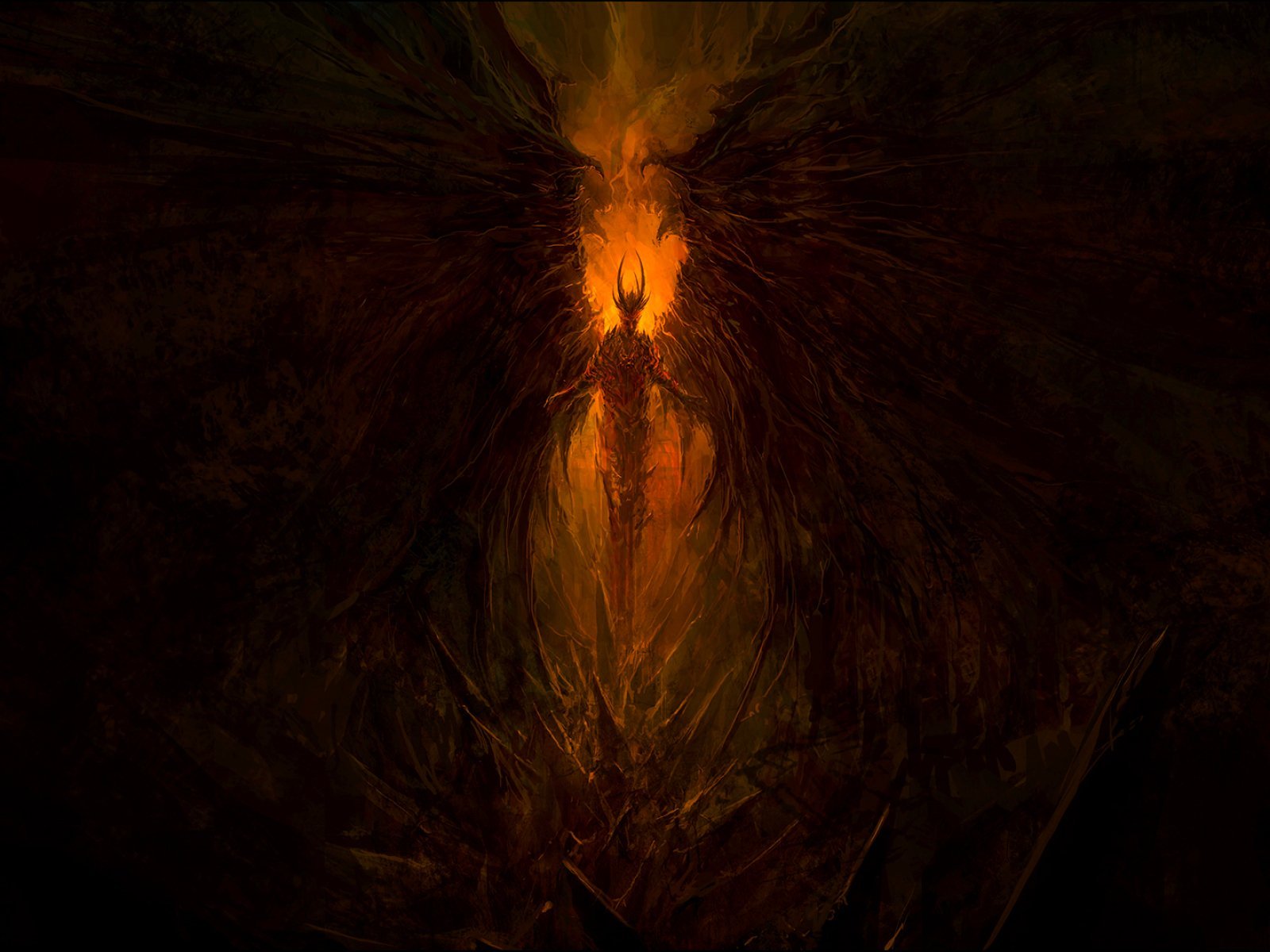
Be that as it may, the Demon of the Abyss chiefly negates the mind’s value and integrity. It is the very force that keeps energies in a state of fragmentation (shvirat), and it prevents the mind from realizing its potentials. One could say that the Demon of the Abyss is an echo borne from the Breaking of the Vessels; it is the memory of that shattering and its obsessive repetition.
Let us repeat that the Power of the Abyss is utterly faceless, even anti-personal, denying the very principle of personhood and individuality, yet fully active. Confrontation with it often leads to dissolution of personality and self-annihilation.
On the one hand, the Demon of the Abyss is necessary for development; without it the mind would, in a single leap, encompass all Adir’s energies and reach fullness immediately and then shatter. But on the other hand, for that very reason, this Demon is the mind’s enemy and obstacle. On one side, it provides the gradient that drives the mind, but on the other, it creates an Abyss one can fall into.
The mind encounters the Demon of the Abyss whenever it is ready to make a decisive step toward expansion. As soon as one system collapses and another must replace it, a moment of emptiness arises; the Cutter dwells there. In that emptiness, the mind confronts itself, undistracted by “external” images, and that confrontation can be mortally dangerous. In fact, being “one-on-one with oneself” is not as splendid as is sometimes said. Moreover, the personality, like the ouroboros, is capable of consuming itself, since the binaries that gave rise to it can mutually neutralize. An impression of impotence, insignificance, and bewilderment arises.
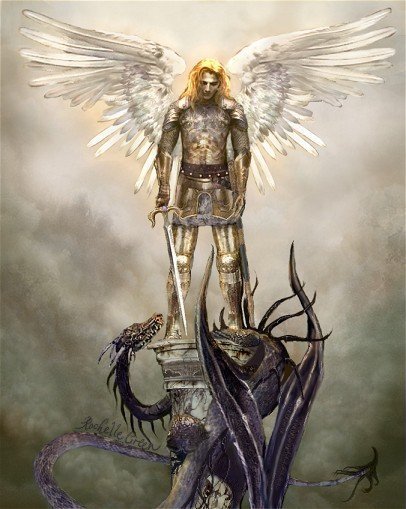
In other words, the power of the Demon of the Abyss pairs each element of the mind with its binary analogue, whereby opposites absorb one another. The overall picture is distorted beyond recognition: some elements of the mind remain as they were, while others are replaced by their binary analogues. The result is a wholly destructive tableau. Every motive of the personality will find in the Abyss its anti-motive; every action its counteraction. And the mind that observes this becomes paralyzed. Moreover, all this confrontation arises from the Psychocosmos itself. Thus the Demon sets the personality against itself, and scarcely any enemy is more dangerous than such an “alter ego.”
Darkness and despair seize the mind that has met its contradictions and has no escape. And instead of drawing strength from the difference of potentials, the confrontation of binaries under the influence of the Demon of the Abyss pushes the mind toward disintegration. The Demon’s lie is precisely in presenting contradiction and division as ultimate reality — in tossing the mind between the poles of the binary instead of synthesizing them.
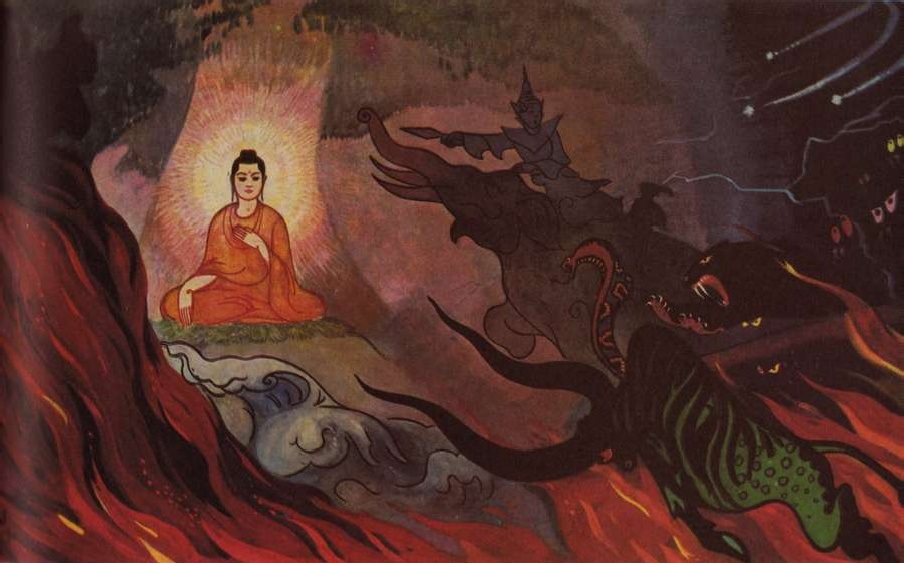
However, it is evident that victory over the Demon lies in wholeness. If the binary is balanced through synthesis, if the power of division is counterbalanced by the power of union — the reign of the Abyss collapses and the Demon retreats.
It is no accident that the victory over Mara was the final step Prince Siddhartha took to become the Buddha: the mind overcomes its fragmentation and thereby attains Enlightenment.
However, if in the dark depths of the Psychocosmos there resides a hidden power of unity, its birth brings new life. When from the depths of darkness something is born that joins separated elements — ready to destroy each other — into a harmonious composition, the Abyss is overcome. When the triad triumphs over the binary, the Power of division is transformed from a source of death into a source of fulfillment. Thus, not the erasure of internal contradictions but their harmonious reconciliation is the way to overcome the Abyss.
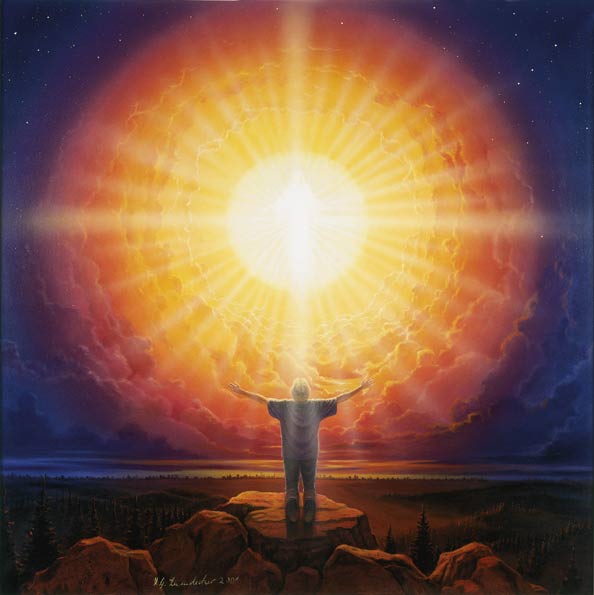
There is an opinion that Choronzon is a power of rather active denial than positive destruction. Crowley viewed Choronzon as the embodiment of monstrous forces of cosmic chaos; a contradictory essence that takes every idea it encounters to its own, indescribable state of chaotic and changeable Nothingness. It was characteristic of Crowley to consider this force mainly as one that leads to confusion, dispersal, and lack of control. Perhaps there is some connection between Choronzon and the Parasite of Consciousness.
When a student undergoes initiation, they encounter the demon of the Abyss. Only by overcoming its force of disintegration do they reach a new level, right?
Does Leviathan relate to this power?
What happens to a person if they cannot escape from the abyss? Do they commit suicide?
In the best case, they will end up in a mental hospital.
Here’s what I thought about the topic of the article.
Since the universe is constantly expanding, the degree of universal entropy is also constantly increasing. And in order for worlds not to be dissolved by this entropy, not to be dispersed by Haranzon or Ialdabaoth, there must exist forces of equal power that contribute to the emergence and growth of consciousness, which can maintain the barrier of worlds against the ever-pressing forces of non-being. In other words, at all levels of the hierarchy of creation, there must be forces interested in the emergence and strengthening of various forms of consciousness to counteract the entropy of existence—after all, this battle never ceases.
And the supreme predator that devours consciousness doesn’t quite fit into the scheme of universal economics—this is a clear violation of some important cosmic law. Consciousness should be one of the greatest values, as the aggregate measure of consciousness in the universe must influence the existence of all worlds, just as each tree on the planet contributes to the existence of the atmosphere. Perhaps consciousness is some kind of universal currency that people mine throughout their lives, while the archons merely continually change the mining algorithms to the most efficient ones. And where this currency of consciousness is subsequently spent is an interesting question.
Consciousness is a process. All worlds and beings collectively make up Universal Consciousness. The most valuable thing in the worlds is energy in its various manifestations.
I’ll tell you a story. In the early 2000s, a war broke out in the worlds when another sphere attacked ours. We won the war. Most of those who defended the Sphere died. It was defended by those whose children are now trying to build connections between the Source and other worlds. If we had lost, this world would no longer exist. Due to our victory, the merging of the Spheres is now taking place, and this is affecting the processes of this world, expressed in the restructuring of reality. Regarding the “supreme predator,” I haven’t heard of such a thing. To me, it sounds like a fairy tale. Yes, there is a hierarchy of forces. There are the dark ones who protect this world and the light ones who advocate for its collapse. Ialdabaoth is a demon from the group of worlds of hell, also known as the Demon of the Great Abyss, not for some fantastical comparisons with consciousness and its depths, but for the real power he holds in the realm of worlds arranged in the form of a giant vortex. They say if you drop an object into it, it will fall to the bottom of the worlds for about three thousand years.
P.S. Right now, we are fighting in the merging with the great chaos for the existence of our sphere, and I hope everything will be okay. This is about your desire to support the existence of consciousness and the processes that are taking place, of which people know nothing—and it’s a pity.
Thank you, Master. It seems that the meeting with him happened again. Everything is good.