
The World Serpent — Enemy of Creation
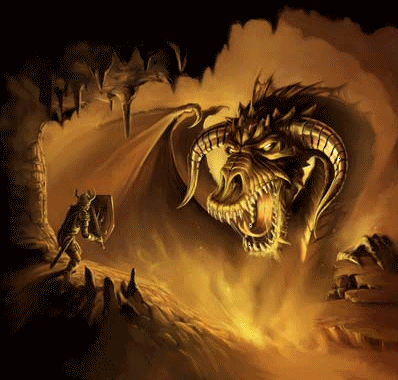
“My lord! The sky has poured its seed on the yellow‑green earth!
Ninurta! She has borne Asag, who shows no reverence —
A child not nursed by a mother but suckled by wild beasts!
My lord! This fatherless spawn, destroyer of mountains!”
The remarkable thing is that mythologies across different cultures include the same motif — the god’s victory over the Dragon. Apop, Typhon and Jormungand, Vritra and the Black Serpent resisted the gods’ ordering influence on the world.
Apparently, people first encountered this in ancient Sumer, where in the underworld Kur there dwelt a dreadful monster — the winged dragon Asag. He often emerged from the netherworld and swept over the land like a whirlwind, spreading disease and debility, poisoning the air with his pestilential breath.
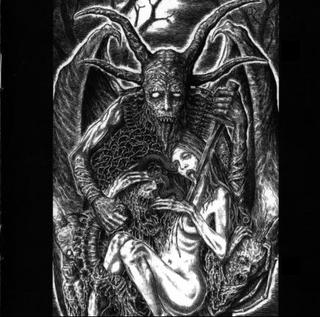
At his command stone warriors began to raid and ravage cities, throwing inhabitants into terror and even the gods into a state of shock. Trees and grasses proclaimed Asag their king, and humankind yielded to the demon’s will. He annexed foreign lands to his empire one by one, until a hero worthy of facing the giant was found. Asag had wings and could appear where he was least expected. Even the bravest of gods — Ninurta — feared engaging the monster in combat.
In the sacred city of Nippur the god Ninurta, son of Enlil, sat on the throne with his father. One day his weapon Sharur, whose gleam was terrifying, addressed its master. It urged Ninurta to free the world from the winged dragon Asag, who dwelt in the mountains to the east. Sharur describes the calamities wrought by this spawn of the netherworld and asks its master to confront the monster. Ninurta rushed fearlessly into battle, but the fight with Asag proved no simple matter. At times the hero was forced to retreat. Finally, on Enlil’s advice, the hero subdued the dust‑whirl raised by the dragon with rain and a flood and slew Asag, who sank back into Kur. All gods and men praised the victor.
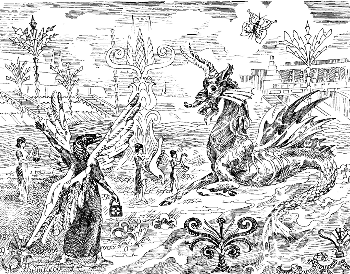
But then something terrible happened: by Asag’s will bitter, salty waters poured from the Abyss of Kur and began to fill rivers, lakes, hollows and ravines. No fresh water remained on earth. People and animals suffered from thirst; fields and orchards could not be irrigated. “Famine was cruel, nothing grew. The fields were not watered. No one dug trenches. In all countries the fresh green vanished; only weeds grew everywhere.”
Yet wise Ninurta found a way out. He piled great stones to form a wall that fenced Sumer from the netherworld so that the waters of the netherworld could not rise to the surface. Rivers filled with clean water, grain once more ripened in the fields, and all living things praised Ninurta. At that time the goddess Ninmah grieved that her beloved son Ninurta, busy with battles and exploits, had forgotten his mother. So she decided to go to him herself. Because Ninmah did not shrink from the hardships of the journey and did not fear battle, Ninurta gave her the mountain Hursag and blessed her with every sort of herb and tree, and with gold, silver and copper.
Then Ninurta assigned fates to various stones. Those that had sided with Asag, including granite and basalt, received the god’s curse; other stones, such as diorite, received Ninurta’s blessing.
But the battle did not end there. Ninurta sent Sharur to scout, and the weapon, overwhelmed by the number and strength of the foes, advised retreat. Ninurta paid no heed and prepared for combat. Asag raised a whirlwind — columns of dust that began to suffocate Ninurta. Meanwhile Sharur flew to Nippur to seek Enlil’s aid and begged for aid. The gods despaired, but Enlil counseled sweeping away the dust‑whirl with torrents of water — rain and a flood. Ninurta prevailed and killed Asag as Enlil had instructed — seizing him by the shoulder and piercing his liver. The gods and Sharur hailed the victor.
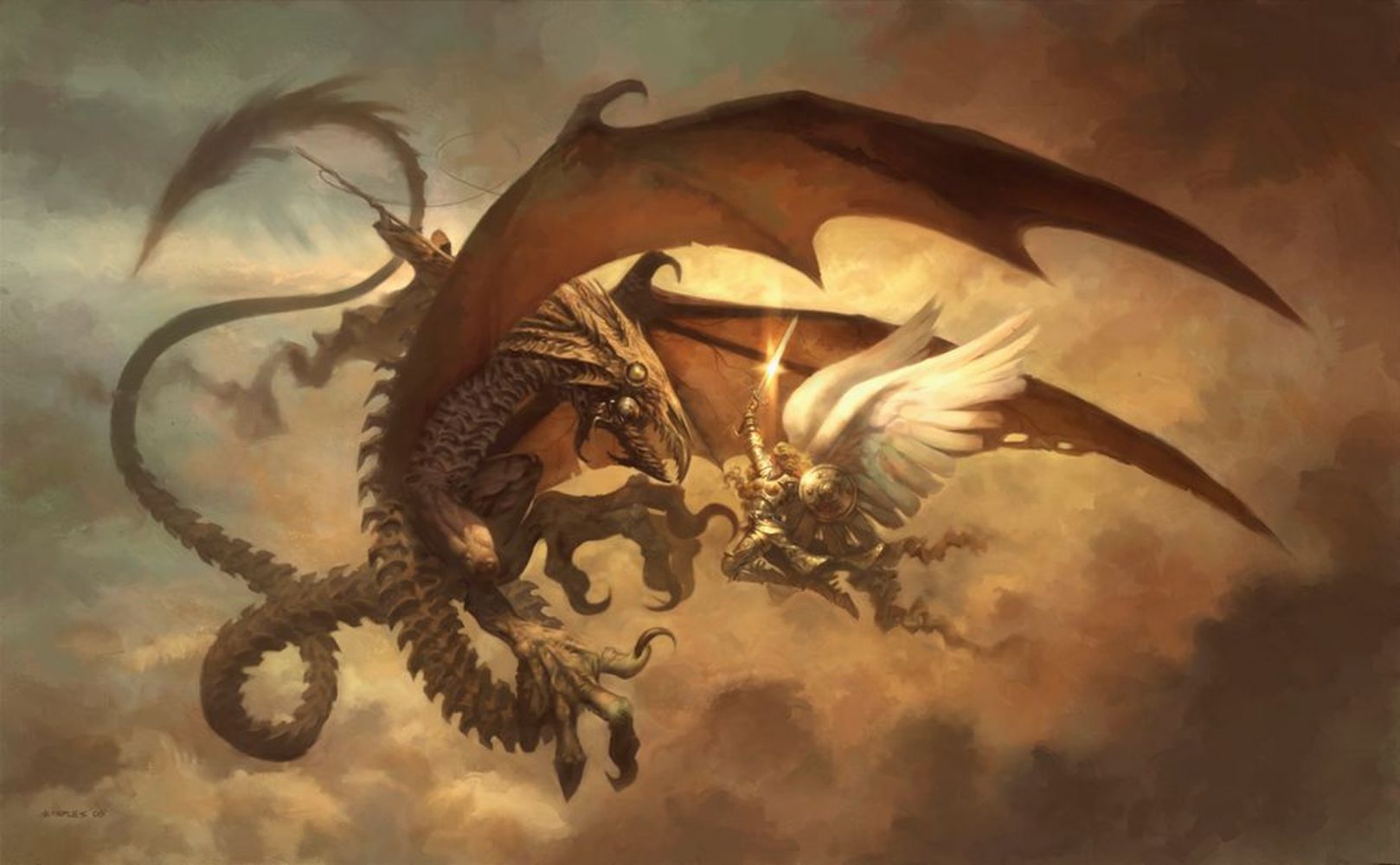
The figure of Asag was reinterpreted in later Sumerian and Akkadian mythology as a demon who brings disease. The dark womb of the earth in the guise of Asag (Akkadian Asakku) spewed forth sickness and plague; in particular Asag was thought to send tuberculosis (consumption), eye diseases, toothache and headache, problems of women in childbirth, and a child’s disturbed sleep.
In general, Asakku was associated mainly with ailments of the head, and in incantations he is mentioned precisely in that sense.
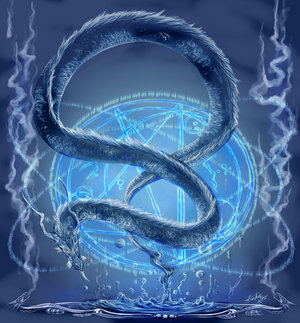
It was probably these notions of Asag that underlay Jewish conceptions of Leviathan — a great underwater, fire‑breathing monster with huge eyes from whose nostrils steam issues, a double row of the sharpest teeth flashing in a vast maw, and a long thin neck crowned by an enormous elongated head. Leviathan — the “twisting beast” — is an image that came from Babylon and Canaan as the personification of all the forces of evil. It is said that God created Leviathan “to play with”; it had many heads; it was destroyed by God in prehistoric times.
In Ugaritic mythology Leviathan (Lotan or Lātanu), embodying the forces of the watery realm, contends with the deities Baal and Anat. Leviathan may also be connected with Tiamat, who in Babylonian myth personified the sea and whom the god Marduk cleaves in two when he divides the upper and lower waters.
Apocalyptic literature, apocrypha and pseudepigrapha, as well as the Aggadah, offer a series of hyperbolic descriptions of Leviathan’s prodigious size and strength.
“And I said, Baruch, to the angel: ‘I will ask you one thing, lord: since you told me the dragon drinks from the sea a cubit at a draught, tell me: how deep is its belly?’
And the angel said: ‘Its belly is Sheol, and as much lead as can be thrown by three hundred men, so is its belly...” (The Apocalypse of Baruch, 5:1–2)
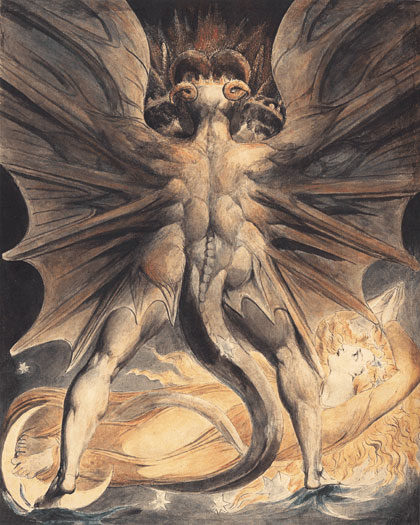
According to the First Apocalypse of Baruch, its flesh “in that time [that is ‘in the end of days’] will be food for all who remain,” and the author of the First (Ethiopic) Book of Enoch affirms that in eschatological times “there will be… a female tannin called Leviathan…”. Interpreting Job 40:30, the amora Johanan bar Nappaha predicts that from the flesh of Leviathan, slain by the archangel Gabriel, God will prepare a feast for the righteous, who will enjoy it while seated in a tent made from Leviathan’s skin.
According to another Aggadic tradition, Leviathan will fight a “wild ox,” and both will perish in the battle.
In Kabbalistic literature Leviathan symbolizes the forces of evil and vice.
Of all the solar tales of Egypt, the most numerous are those that recount the sun’s struggle with its enemies. These stories go back to the earliest times. Mentions of the sun’s battle with its serpent enemy already appear in the Pyramid Texts:
“Ra ascends against you,
Horus draws his nine bows
Against this spirit that comes forth from the earth,
With its head cut off,
With its tail severed!
O serpent Jeser!..
Turn back, be cast down!..
Shu stands on your coils!
Turn back, be cast down!”
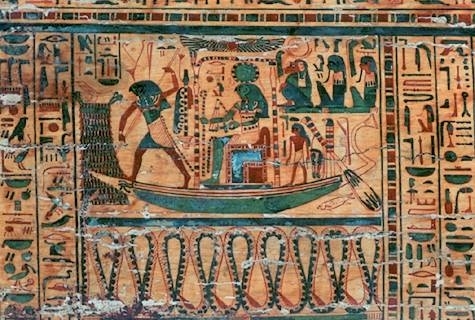
It seems the most widespread of this group of tales was the myth of Ra’s combat with the great serpent of the netherworld — Apop, a version of which follows below. Gradually Apop becomes in Egyptian religious literature the collective image of the Sun’s enemies. He is the constant target of the curses of solar hymns and magical rites, and it is no accident that the myth of Apop’s overthrow survives most fully both in textual form (for example in the Book of the Dead) and in numerous illustrations.
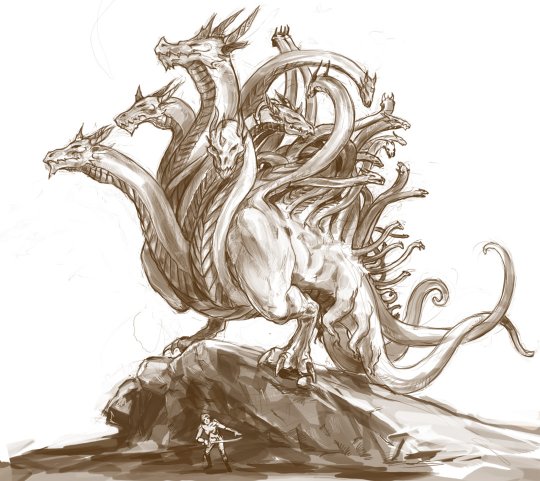
It is likely that the figure of Typhon has the same origin.
The myth about him is widely known.
“..A hundred‑headed monster — Typhon,
Born of the earth. He rose against all the gods:
A hiss and howl from his jaws
Threatened Zeus’s throne, and from his eyes
Flashed the fire of a raging Gorgon,
But Zeus’s sleepless arrow —
The blazing thunderbolt — struck him down
For this vaunting. To his heart
He was burned, and thunder destroyed
All the strength within him. Now with powerless body
He lies spread beneath the roots of Etna,
Near the blue strait,
And mountains press upon his breast; on them
Sits Hephaestus, forging his iron,
But from the black depth will burst forth
A devouring stream of flame
And will lay waste the broad fields
Of fertile Sicily…“
(Aeschylus, Prometheus Bound)
Later Typhon was equated with the Egyptian Set — the god of the sirocco, death, desolation, solar and lunar eclipses and other misfortunes.
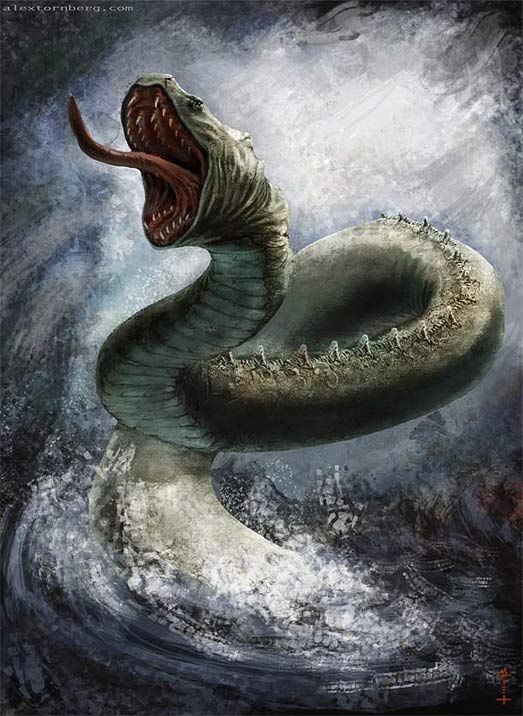
No less famous is Jormungand, the “Midgard Serpent” or “World Serpent” of Norse mythology, also called the Midgard Worm (Midgardsormr).
Thus the struggle of Leviathan, Asag and other monsters with the god serves as the subject of widely spread ancient myths about the primordial enmity between the god and the forces of chaos, which a god must overcome to create an ordered universe.
But what lies behind this myth — is it merely an archetype, or, like all myths, does it also allow a literal interpretation? In other words — does the World Serpent actually exist?
… the recently mentioned Ouroboros is also a World Serpent, however, it symbolizes eternity and renewal, not destruction … yes, the closure in Ouroboros happens through biting, but this destruction is necessary, albeit painful … analogous to Hagalaz or the 16th card of the Major Arcana of Tarot. At the same time, as is clearly seen on the Tarot card, destruction is initiated from Above (Heaven) … the Absolute destroys the Relativity it has created. In legends, it is indeed Heroes who kill the Dragon (and not vice versa); the Dragon itself symbolizes what exists (is created), what is bad (not true), and must die (for the sake of achieving Truth … through iterative means).
If it is indeed an enemy of creation, then it is only guilty for being created (by someone) and still existing … but the world is filled with such dragons 🙂
The symbolism of snakes is very diverse and multifaceted. It is not worth lumping all snakes together. Although there are indeed common elements among them. However, to explore the symbolism of a specific character more deeply, it should be observed in its own right, as well as in its immediate context)
For example, let’s take Jormungandr, mentioned in the article, also known as Midgard’s serpent. Many interpretations can be made, but few will have true practical value. Therefore, let’s refer to the well-known correspondence according to which any mythology describes archetypes of our consciousness, mechanisms of our psyche, the structure of our being.
So, we have Midgard – the middle world. This is nothing other than our everyday perception, the first attention, or Malkuth of the Kabbalists. In this case, what then is Midgard’s serpent, the entire world encircling itself and biting its tail? In mythology, this character has a clearly negative assessment. It is not hard to guess that he is the boundary of our world, closed in a ring on itself. And if we refer to the Toltec tradition, we can give a more precise definition of this character. Jormungandr is nothing other than ‘chains of self-reflection’ that confine our perception to the mundane world.
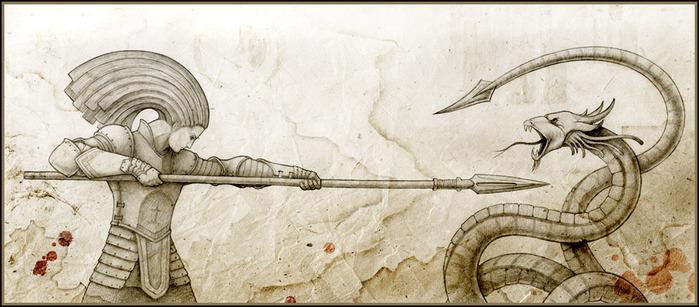
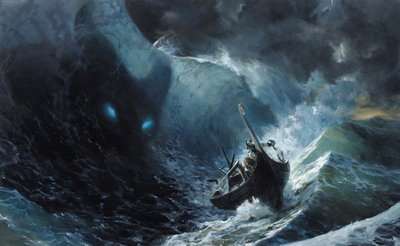
From this, the symbolism of the hero-warrior fighting with this serpent is clear. Look at the picture in the article, where the warrior on the left is battling his self-reflection on the right with the help of a straight unyielding spear of intention, honed by discipline and control.
At the same time, the image of Midgard’s serpent is not only negative. At a certain stage of the development of our consciousness, it is simply necessary. Since it acts as a protector from ourselves, not allowing our consciousness to expand beyond Midgard.
In my opinion, it is not entirely accurate to say that mythology ‘describes the psyche’. Mythology exists for itself and by itself; rather, the psyche corresponds to the same mythological models as the events ‘during It’.
Moreover, the analogy of Malkuth with ‘everyday consciousness’ is also not entirely appropriate, as Malkuth is ‘the desire to receive’; it is not all consciousness, in which all other Sefirot can be found.
Overall, thanks for the interesting and substantive comment.
Did Assacra name himself thus out of worship (veneration, which was used by His Mentor) of Asakku?…
The theme is generally correct: the positive meaning of Tartar, as well as that of Set-Savaoth-Typhon-Azatoth, exists. One just needs to find it.
It seems there is another character that can be identified with this serpent. This is Choronzon, who is the void, behind whose masks there is nothing. The malice of Choronzon is not the malice of being; it is a property of malice because he is ‘proud of himself – ‘I am I’, having no true self. And those who have fallen under my power – slaves of the Blind, who have grown proud of themselves to become Enlightened. There is no center there, no, only Dispersal’ – this is how Crowley describes Choronzon in ‘Vision and Voice’
Perhaps, the Demon of the Abyss can indeed be somewhat associated with the World Serpent. But in my opinion, Choronzon is still a slightly different force. The serpent opposes creation; Choronzon denies it.
Yes, I did not catch this subtle distinction. There is an opinion that Choronzon is a force of rather active denial than positive destruction.
If you allow me, Enmerkar, an example from another myth. Perhaps it will be useful and interesting to the blog participants.
This is a fragment from M. Harner’s book “The Way of the Shaman, or Shamanic Practice”.
“People were friendly towards me, but did not want to share their secrets. Finally, they told me that if I really wanted to know, I must drink the sacred drink of the shamans, prepared with the help of the powers of the ‘spirit of wine’.
First my hands, then my legs, and then my whole body seemed to turn into solid concrete. I couldn’t move or speak. I paid attention to my brain. I physically felt how it divided into four separate levels. At the very top was the observer and manager, who was aware of the state of my body and responsible for keeping my heart beating. He was the perceiver, a spectator of those visions, which seemed to be just my hallucinations. At the second level, I felt a numb layer, which seemed to be disconnected by the potion – it was as if it was absent. The next level was the source of my visions, including the ship of the soul.
Now I was completely sure that I was dying. When I tried to come to terms with fate, from the lower, fourth level of the brain new visions began to arise and some knowledge arrived. I was ‘told’ that this knowledge was opening to me because I was dying and therefore ‘safe’. I was informed that secrets were being revealed to me, kept for the dying and the dead. (These are the same parasites of consciousness that are so afraid that their secret will be revealed and they will be cast out.)
I could barely distinguish those who were ‘speaking’ to me: gigantic reptiles, lazily lying in the deepest depths of my brain – where it transitioned to the spine.
Then, as if in a movie, I saw the Earth as it was long ago, before life appeared on it. I saw the ocean, bare land, and the bright blue sky. Then from the sky fell hundreds of black specks and landed on the bare surface of the planet. I saw that these ‘specks’ were large, shiny, black beings with short, thick wings like those of a pterosaur and huge whale-like bodies. They flew down, exhausted from their journey, and rested below for a long time. In some language, they explained to me that they had come from space. They came to Earth seeking refuge from an enemy.
I learned that these ancient beings are among all the forms of life they created, including humans. We, humans, are only vessels and servants of these beings. Thus, they can speak to me from within me.
Suddenly, I felt my human essence that distinguished me from my ancient reptilian ancestors. I began to fight against returning to them. Each beat of my heart was a victory.
I needed a ‘guardian’ who could defeat the dragons, and I desperately tried to summon a powerful being capable of protecting me from these terrible reptilian dragons. One of them appeared before me – and at that moment the Indian opened my mouth and poured antidote into it. Gradually, the dragons retreated into the abyss.
Two missionaries read to me from the Book of Revelation: ‘…And there was war in heaven. Michael and his angels fought against the dragon. And the dragon and his angels fought, but did not prevail; neither was their place found any more in heaven. And the great dragon was cast out, that old serpent, called the Devil and Satan, which deceiveth the whole world; he was cast out into the earth, and his angels were cast out with him.’
Now I wanted to talk to the greatest of all the experts in the supernatural among the Indians, a blind shaman, who sent me on a journey into the spirit world. I told that there were gigantic black animals, like bats the size of houses, which said that they were the true rulers of the world.
He stared at me with his unseeing eyes and said with a smile: ‘Oh, THEY ALWAYS SAY THAT. BUT THEY ARE RULERS ONLY OF THE EXTERNAL DARKNESS.’
The first thought that came to mind while reading the article is the disgusting image of the Ouroboros, the eternal symbol of the eternal inexorable circle, the eternal bottomless devourer of surges of life force and energy, a symbol of mockery over the limitations and weakness of man. Burn it. And – go beyond your limits. The second. The 15th Tarot arcana, one of its names is Typhon. Snakes everywhere. Cut off his, Typhon’s, head. The third. The World Serpent, as well as the “individual” one, exists. “The World Serpent is the enemy of Creation,” as written in the title. ) Therefore, most likely, any subsequent victory over it (regardless of which Hero) should be viewed as our collective victory, and, as far as possible, contribute to this battle. )
“Ra rises against you, Horus draws his nine bows against this spirit, coming forth from the earth, with a severed head, with a severed tail! O serpent Jeser!.. Return, fall down!.. Shu stands upon your rings! Return, fall down!” Dear Enmerkar, do you think Pharaoh Djoser and “the serpent Jeser” have anything in common?
“Djoser” means “sacred,” and Apophis, in this sense, as the “dark double” of Ra, certainly deserves this title.
Thank you for the answer. By the way… “there will be… tanin-female, called Leviathan…” “תנין” (pronounced – “tanin”) in Hebrew means “crocodile”. How could one not recall Korney Chukovsky: “…And in the Great River, A Crocodile Lies, And in its teeth, Not fire burns, – A red sun, A stolen sun.” Not in the brow, but in the eye. ) Esotericism from childhood. ) And one more analogy: “…the hundred-headed monster – Typhon, Born of the earth. He rose against all the gods: Sibilance and hiss from his jaws Threatened the throne of Zeus, and from his eyes Burned the fire of the frenzied Gorgon, But the sleepless arrow of Zeus – The blazing lightning struck him For this boast. To his heart He was scorched, and thunder killed All the power in him. Now with a powerless body He is spread under the roots of Etna, Not far from the blue strait, And the mountains press his chest…” Not far from the city of Kemer in Turkey, there is a mountain from which, for many centuries (as described) flames have spontaneously erupted. There is a legend that the hero Bellerophon killed the monster Chimera (daughter of Typhon and Echidna) there. The word “Kemer” closely resonates with the word “Chimera.” And the way of its burial – with the way of Typhon’s burial: “…And the mountains press his chest…” And if “Etna” is today’s volcano, do not all the other volcanoes (giants?) represent the burials of other terrible and powerful creations, temporarily buried underground, awakening from time to time, and battles with which we have yet to face?