
Lord of the Wind
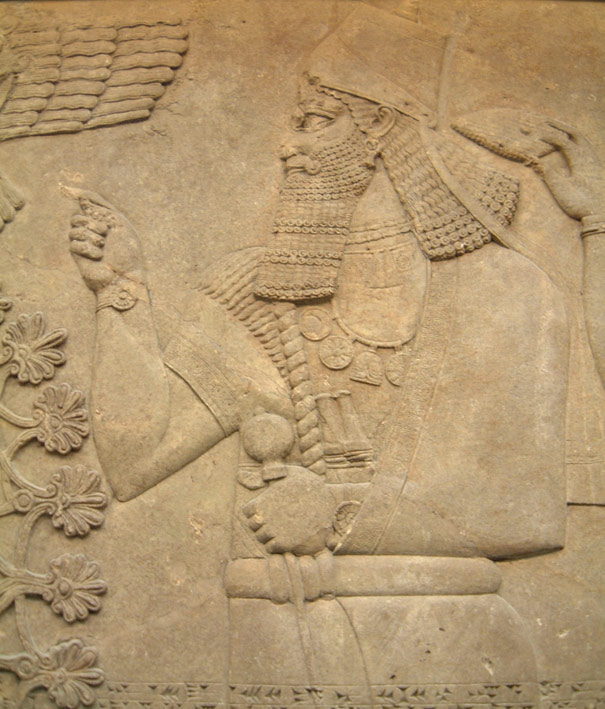
Thousands of years before the Vikings, at the far end of the earth, people worshipped a god who, like the Great Aesir, was associated with storm and inspiration.
“Enlil! His mighty cries are everywhere, his sacred words!
What comes from his mouth is inviolable; what he has decreed is given for all time.
He lifts his gaze — he makes the mountains tremble!
He radiates light — it pierces the mountains!
Father Enlil sits enthroned, majestic in the holy sanctuary, in the mighty sanctuary!...”
(“Hymn to Enlil”)
Enlil (lit. “Lord of the Wind”, in Akkadian — “Ellil”) — in Sumerian mythology one of the Triad of great gods (alongside Anu (the Sky) and Ea (the Sea)). By birth, Enlil was the son of Anu (the sky) and the goddess Ki (the earth).
According to the myths, which likened Enlil to a roaring wind and a wild bull, he manifested a particular hostility toward humans: he sent plague, drought, salinization of the fields and, as the final affront, a worldwide deluge from which only Utnapishtim was saved, having built an ark at the gods’ counsel. Enlil, who was often irritated by the noise and bustle of human life, in his wrath sent storms, tempests, and terrible calamities even the flood.
According to Sumerian myth, on the mountain of Earth and Heaven, An begot the Anunnaki. The Anunnaki were the youngest of the gods. They were to serve the elder gods without question. Among the elder gods, the craftiest was Nunbarshagunu. She decided to make the eldest of the gods, Enlil, her son‑in‑law and to rule the world through him, for which she presented her daughter Ninlil to him. Enlil noticed Ninlil and was taken with her. Yet she did not respond to his courtship. Then Enlil seized her by force, put her in a boat, and carried her away. The gods were outraged by Enlil’s indecent act. They seized their lord and banished him to Kur Kuda (the underworld). And Enlil went into the netherworld. But the fair Ninlil, pregnant with the future moon‑god Nanna, declared resolutely that she loved the one who harmed her and would follow him into exile.
Enlil feared that if his son were born in the gloomy world of the dead, he would not be able to ascend to the heavens as was his destiny. So the god devised a cunning plan. He knew the laws of the underworld. In order for anyone to leave the “land of no return,” someone had to take their place. Thus, if Enlil wanted to bring his family back to the upper world, he had to find three volunteers willing to remain forever in the realm of darkness.
Enlil took the form of the underworld gatekeeper and lay in wait for Ninlil. She soon came to the gates, saw the guardian, and began to explain the purpose of her visit. Enlil, in the guise of the gatekeeper, said he would let her pass only if she slept with him. The goddess agreed, and she conceived the god Nergal — Meslamtea. Ninlil moved on, arrived at the underworld riverbank, and there met Enlil in the form of the river’s master. After she lay with him she conceived the god Ninazu. To cross the river the goddess had to yield to the ferryman as well.
Thus Enlil’s plan succeeded, and three of his sons remained in the underworld, which allowed their elder brother Nanna to become the moon‑god and ascend to the heavens. Enlil and Nanna did not remain long in the lower world either. Having atoned for their guilt, they returned to Nippur, where Enlil once again became head of the gods. According to the myth, on earth Enlil created the day, he gave life to all the plants, and he invented the hoe and the plow — the first implements of the farmer.
Hymns to Enlil repeat that it is impossible for humans or gods to see Enlil, impossible to grasp his essence or to guess his designs. At the same time, Enlil was a god of wisdom:
“How does the mighty god manifest his power, how does he bring his designs to fruition? By the Word! Your incomparable Word! It is mighty! It is like the heavens! It is like a cloud!”
With the name Enlil the Sumerians linked the notions of force, will, might, and life‑energy. However, in difficult situations Enlil often turned to his younger brother Enki for counsel. Among the elemental forces, Enlil was associated with the wind, which with equal ease could bring rain clouds to water the fields, scorching desert air, or a devastating hurricane. It was precisely the capricious movements of air masses and the unpredictable river floods that the Sumerians regarded as manifestations of the temper of the greatest god — Enlil.
Unlike the Egyptians, the inhabitants of Mesopotamia did not exalt the sun god: he was not even a son but a grandson of Enlil since the regular mechanical movement of the luminary across the sky does not fit the image of a living, wilful deity whose will and designs cannot be foretold.
In Akkad Enlil received the epithet Bel (Semitic — “lord”, “master”). In Assyria, he was identified with their supreme deity Ashur, and in Babylon with Marduk. Over time the word “enlil” became a common noun meaning ‘lordship’ or ‘dominion’.
Thus, the image of Enlil — a headstrong and wrathful lord‑god — was the first historically recorded human encounter with the forces of inspiration, spontaneity, and frenzy.
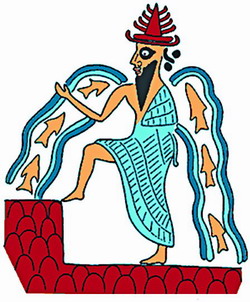
How I dislike angry gods. They do whatever they want with us based on their mood!
If it annoys them that noise and bustle of human life exist, they shouldn’t dwell in our lands! Just problems from these gods. They created humans and then get angry with them.
By the way, they act no more morally than humans. It’s just frustrating that such tyrants have full authority.