Worlds
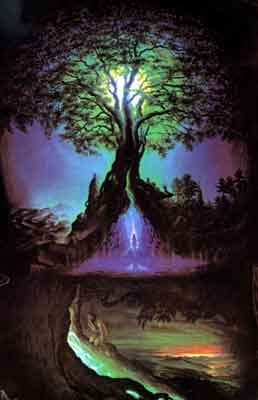
Worlds of pagan myth are, first and foremost, products of the mind of their inhabitants. This is understandable: the very description of a world brings that world into being. We live amid descriptions, we work with descriptions, and we seldom stop to ask how well our descriptions correspond to the facts we observe.
Therefore, by “world” we mean a system of interconnected descriptions created by certain beings and forming, as a whole, a closed, coherent picture relatively independent of other such pictures.
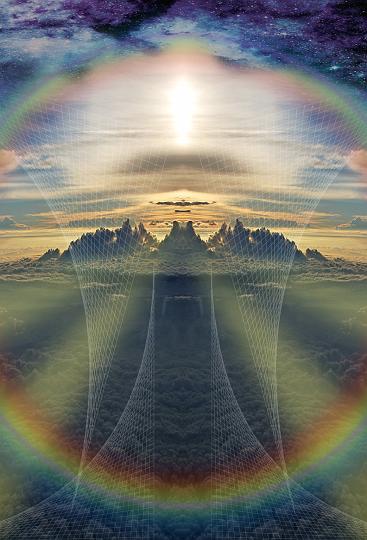
In other words, a world is an integrated mental image of part of reality as reflected in the mind, whose elements are bound by common principles of perception and therefore complement, require, and presuppose one another. This pattern of relations among the individual elements of the perceivable whole is called the laws of existence of that world.
In order to become aware of, or, in other words, to create its world, the mind selects from all energies blocks closely connected to each other and includes them in its description, “ignoring” all other energies.
Because a world’s description is closed — that is, it refers to itself — worlds are separated from one another precisely by a veil of perception.

The transition between worlds is viewed primarily as a change of description, a change in consciousness; therefore journeys — say, those of a shaman or a seidr sorcerer — undertaken in trance, an altered state of consciousness, are regarded as entirely real movements.
In such movements, the helpers are beings that exist beyond the description: for example Odin’s eight‑legged steed Sleipnir, the ship Naglfar (built from the nails of the dead), and so on.
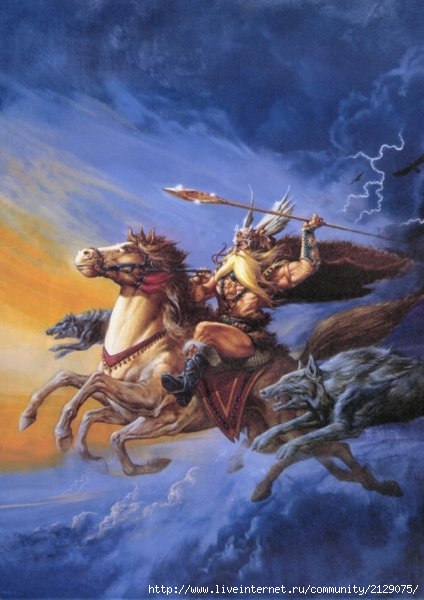
Of course, movement between worlds is impeded primarily by the principle of their organization and self‑sufficiency. This principle is symbolized by the figure of the Gatekeeper (for example, Heimdall among the Scandinavians, Veles among the Slavs, the Dagda among the Celts), who, on the one hand, keeps the worlds separate and, at the same time, sustains life within them.
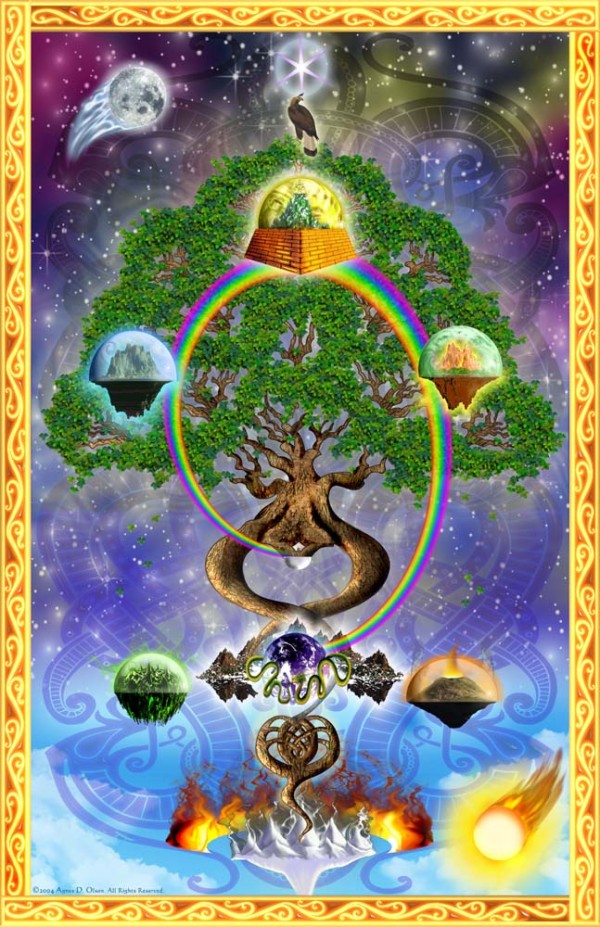
As mentioned, the stagnation of worlds is also prevented by a being that ensures their interconnectedness, and by the existence of Entrances, Portals, and a Bridge between worlds. Both Portals and the Bridge are understood precisely as places where awareness shifts that keep the worlds in place.
As far as I know, Scandinavian mythology describes the existence of 9 worlds. Are there parallels, in your opinion, between them and the 9 planets of the solar system as we know them?
In my view, such parallels are unlikely to be appropriate, as they refer to different matters, and mere numerical similarity is not a reason for analogy. Besides, whether there are 9 planets is still a question 🙂
Can you tell more about the bridge between worlds?
In Northern mythology, worlds are connected by the bridge Bifröst (‘shaking space’), which people see as a rainbow. In fact, it concerns points of free glide of consciousness across worlds through the ‘shaking’ space of the interworld.
I can clarify the situation somewhat, depending on how far you intend to go. In general, any bridge and any arch of your habitual world can become a portal.
Have you heard about the fairy tales of the Samara Luka? There, threads through which a person passes to another world often appear above the Samara Luka. It’s interesting what this is.
“It resembles the connections of the egregores of worlds; theoretically, one can ‘glide’ along them.”
“Why only in theory? One can glide through the streams of time in reality, and one can also see probable events.”
When the boundaries between worlds thin out and perception expands, it is impossible to return to the previous state – what it was before this experience. The world becomes different, and this is a serious blow to the psyche.
Recently told… a teenage girl, suddenly entering the children’s room where her little sister was, suddenly saw an unfamiliar and incomprehensible creature above her sister’s crib, she was in shock… the parents didn’t believe her, began to treat her as if she were sick, the girl closed herself off – a psychological trauma is inevitable, and it is unknown whether this girl will be able to overcome the consequences of the trauma on her own, if her closest people are not inclined to help her… it’s very hard not to lose spirit and not become a bitter being or a snail in a shell.
If you allow, I will give an example from experience. Once, I really wanted to climb into the attic of an old childhood house – the pipes of the heating system, the floor was covered with ash from burned coal, swings were tied to the ceiling beam. I was about 10 years old… I felt a slight danger, looked around, but found no confirmation of danger, climbed onto the swing and started to sway… the rope creaked… suddenly I felt bad, an awful fear gripped me, swinging at speed on the swings I saw what exactly was the feeling of danger, I couldn’t jump down – it was too high, the only thing I could do – was to close my eyes and wait until the swings stopped… in fact, there was a change in perception.
Just standing and looking is a habitual action, swinging on the swings and watching is an unusual action, and at that moment something switched in perception and beings became visible… new elements, new interactions are added to the picture of the world, or a person strives to barricade themselves from them, referring to the traumatic influence.
Subjective experience is not an objective reality, until new elements become elements of the worldview of more than one person, that is, the synchronous inclusion of new elements in the worldview of a group of people lays the foundation for another system of descriptions.
In fact, in the synchronous perception of elements and connections by a group of people not inherent to the closed description of the habitual world, a passage opens up to the outside of this world, outside the closed description. By learning a new way of perceiving elements uncommon to the habitual world, a person creates descriptions and interacts with them… there is no guarantee that a person has not “lost their mind” – psychiatric patients, for example, also have their own system of descriptions and interpret signals arriving in consciousness through the sensory organs according to it.
Some, having once learned to perceive something different and denying it, years later confess that “everyone sees it”, but just try not to give it significance.
What then is reality? According to what criteria can we describe elements and relationships more closely to reality?
What happens to the Force as a result of a particular action? – if we base ourselves on the answers to this question, it is obvious that reality is what is “close to the body” – what is directly reflected on the physical body. If suddenly a tooth hurts, you drop everything and run to the dentist – the tooth that hurts is the reality.
If one being attempts to provoke another to certain actions through deception and the other succumbs and acts according to someone else’s plan, then it embodies the illusion into reality, allowing a distorted perception to influence its physical body – this is how the illusory world enters our lives and the answer to the question – What happens to the Force? – is that it leaves.
I noticed that destructive forces try, aside from dispersing energy, to provoke the waste of time in vain… previously there was not enough time for anything, now there is enough time for what I didn’t have enough of before, but there is still not enough time for what is truly important, and when I try to redirect my activity – somewhere inside, in consciousness, there is a strong counteraction aimed at dulling control, as if I am my own enemy.
The distortion of perception occurs constantly in everyday existence, and when attempting to interact with beings from other worlds there is no guarantee at all that the interaction is at all close to reality, that is, that the system of relationships outlined in the Microcosm corresponds to the system of relationships of the Macrocosm.