The Mind of the Interspace
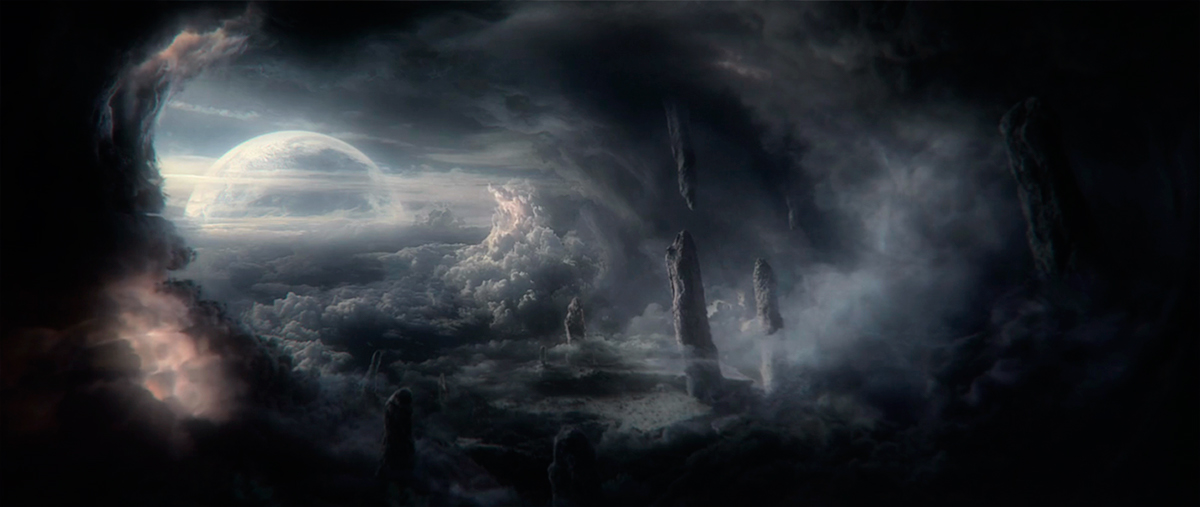
We have already discussed more than once that the Magical Myth draws a clear distinction between two fundamental states in which any mind may find itself, and, accordingly, two kinds of spaces that compose its object-field: “worlds” and the “Interworld.”
“World” denotes a mind’s field of perception in a stable state, when the energies within its focus, the eidolon, are ordered and their system is harmonized and complete. In other words, ‘world’ means a state of mind and a space in which certain laws, arising from its logic, are in effect, making it relatively stable and highly predictable. At the same time, this “inner regularity” of each world makes it intrinsically bounded and finite (even when it is immeasurably vast): a world extends as far as the laws that create it hold true, and transitioning between worlds requires a leap in perception — overcoming the Threshold, a principled change of descriptive scheme. It is clear that for most beings — types of mind — such a transition is very difficult or altogether impossible without their own dissolution.

“Interworld,” or the “Interspace” (Bardo, Limbo, Utgard, Duat), denotes a state of mind and space that lacks wholeness and completeness, and therefore lacks stability. If the focus (the eidolon) for some reason abandons the stable block of energies that form the picture of any world, it does not immediately find another stable block, and for a time it remains in an unstable unfinished state called the Interspace. (This is why the Tradition asserts that the transition from one world to another, including the passage from one life to the next, always occurs through the Interworld.)
Unable to “assemble” a whole, a stable, internally structured world from the energies present in its field, a mind “fills” the logical and energetic lacunae with ‘virtual’ images — that is, with its own “fictions” — which do not depend on the inner nature of the perceived energies but on the Environment’s homogeneous potential field, serving as both substrate and ‘cement’ for fragments of “energetically charged” perceptions. That is, the Interspace is a set of energetic and psychic structures belonging to different worlds, times, and timelines, gathered and provisionally ‘glued’ together by the pliable medium of the potential Ground; moreover, outside the mind that perceives it the Interspace is utterly unordered and merely potential, and acquires conditional reality only through the efforts of awareness. It is clear that, by incorporating elements of all possible realities, the space of the Interspace is without limits or boundaries, “filling” all probabilities and possibilities of manifestation.

We discussed that the “intermediate” state of mind arises in various beings that are limited in one way or another in the fullness of perception and access to energy sources. At the same time, since the “glue” of the Interworld is the Environment, it appears as a homogeneous space, though lacking stability and predictability. Incidentally, it is precisely the “Waters of potentiality” that integrate the Interspace which are often experienced as otherworldly rivers and currents, one of the characteristic elements of the Interspace’s geography and the most convenient means of traversing it.
Because a mind can find itself in an interspace state under different circumstances, deprived of a firm support in a world — in dreaming, in the afterlife, in trance, etc. — it is very important for it to understand this state’s features and object field. We have already noted that among these features the instability and energetic poverty of the Interworld are especially important. The first causes rapid dissipation of the mind’s resources, and the second causes it to be surrounded by many consumers of that energy.
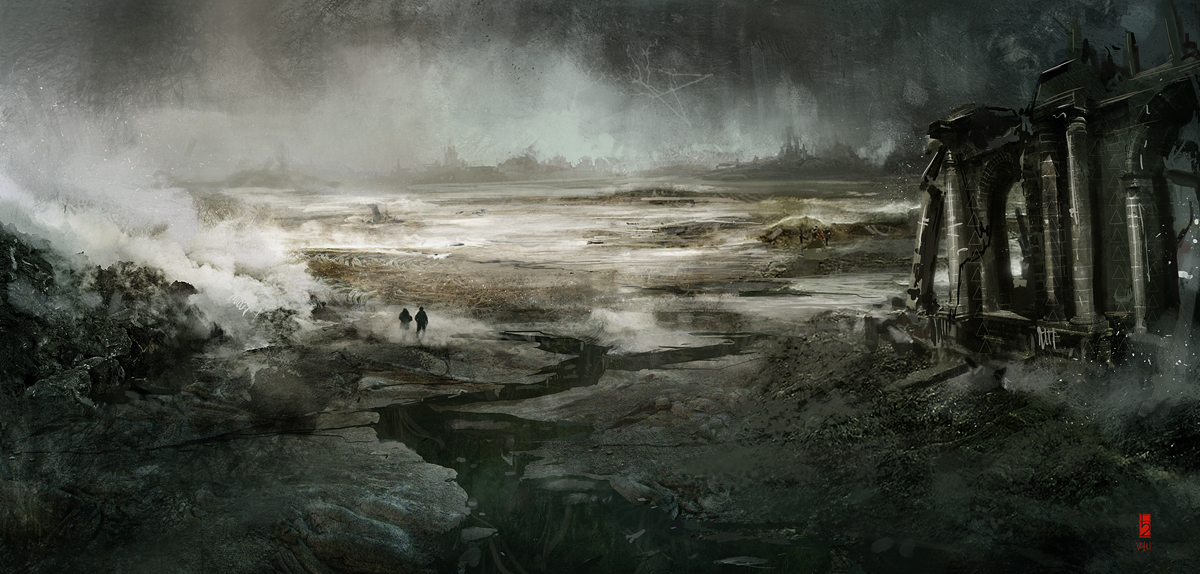
It is important to understand that perceiving the Interspace is not a “physical” relocation into a new state, but a change in functioning of the mind, and the Interworld is largely a virtual, “invented” space, sustained largely by the “fantasies” of the beings within it. The Interspace is far more plastic than any world; it is far more malleable, but the dissolution of one’s own image of mind is also more intense there. In other words, in this state the greater difficulty is not only holding a stable mental object field, but also maintaining one’s self-description; in the interspace it is hard to retain not only an image of the “surrounding world” but also an image of oneself. Without additional energy from generative spaces, this task seems altogether insoluble, and therefore, as we have already discussed, the Interworld houses obligate predators, and conversely — a being lingering in the Interspace faces energy hunger, which pushes it either to exit for a stable world or to prey on others. Thus, having exhausted its energy from its previous incarnation, an Elementer “automatically” and naturally moves its mind into a new incarnation (or becomes an utukku). Note that the same problem arises for many practitioners of “lucid dreaming” or “astral travel,” who do not always consciously seek additional energy sources for their voyages into the Interspace.
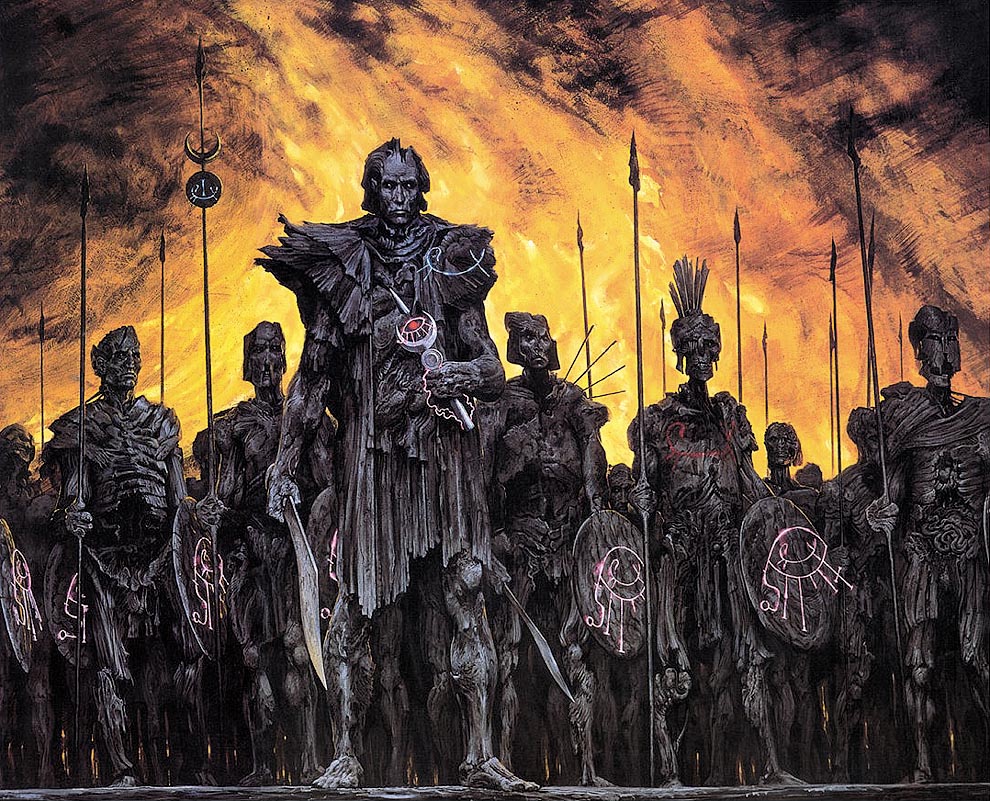
Another important characteristic of the Interworld’s space and of the mind within it is the close interrelation between their states. All the “Books of the Dead” and other texts devoted to descriptions of the Interspace unequivocally assert that the character of objects in it is determined by the state of the perceiving mind: from the same block of energies one mind constructs a peaceful or favorable image, while a mind in a destructive state perceives it as threatening or dangerous. In this sense one can say that most of the dangers of the Interspace originate in the minds of its inhabitants. However, the reverse situation is possible as well, when predators disguise themselves as plausible images and thereby lull victims’ vigilance to gain easier access.
In any case, the intermediate state of mind is something every being encounters, and the success of such contacts depends on how well informed and prepared they are. Losing one’s energy in the Interworld is not the worst outcome of contact with it; in that case the enervated mind will be cast out into a new life in a world. Becoming a predator in the Interspace poses the real danger, for in that state a mind that has lost control may remain for a very long time, becoming increasingly embittered and demonic.
‘It should be noted that the same problem arises for many practicing ‘lucid dreaming’ or ‘astral travel’, who also do not always consciously seek additional sources of energy and resources for their journeys into the Interval.’ Dear Enmerkar, could you please explain what benefits (or correct goals) a person engaged in astral travels should set for themselves? And what is not quite clear in the meaning of your quote (see above)? If you engage in lucid dreaming and astral exits, do you deplete your energy resource? And how does this affect consciousness then? (After all, this cannot be compared to being in Limbo and disembodying after the death of subtle bodies)? Thank you for your answers.
As soon as a practitioner embarks on the Path of development, overcoming the initial stages of the Seeker and the Zealot, they find themselves at the level of the Philosopher, the main feature of which is the thirst for knowledge and research fervor. In fact, for many, the conscious Path begins precisely at this stage, and therefore many beginners strive to gain as much diverse experience as possible, exploring various unusual states, and both Lucid Dreaming and ‘Astral Travels’ turn out to be such widespread experiences. However, often, instead of gaining the necessary experience, realizing it, and extracting the available lessons from it – moving further, travelers ‘get stuck’ in it, becoming ‘astral drug addicts’ or dependent psychonauts. And then, of course, first and foremost, the problem of energy shortage arises, and consequently there is a race for it.
Now I understand!! Thank you very much!!