
Exteriorizations of the Mind and “Astral Travel”
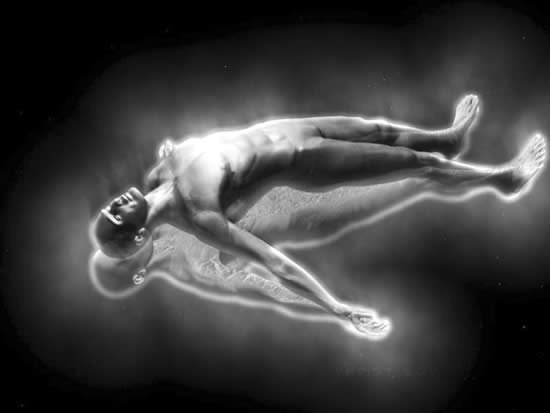
Almost a quarter of the adult population of the Western world has experienced an out-of-body episode at least once in their lives. Descriptions of this phenomenon, also known as “astral projection”, “astral travel”, “exteriorization”, are known from ancient times. Even in modern psychology, out-of-body experiences are not regarded as paranormal. In most cases, an out-of-body experience arises spontaneously; often during periods of severe trauma and stress, during crisis visions when the dying project themselves outside the body and observe the living. Many people possess the ability to induce a projection at will.
At the same time, a distinction is often drawn between two kinds of out-of-body experience — exteriorization of the mind and sensory exteriorization — both related to the same process: a partial or complete disconnection of the mind from its physical body. The difference between the two is that the exteriorization of the mind has a psychocosmic character, whereas sensory exteriorization begins with material manifestations and often leads to the appearance of a material phantom. In the first case, there is a kind of “gaze” through space and time, while in the second — the actual “exit of the body”.

As noted earlier, it was precisely sensory exteriorization that was an important part of practice for many Magi because it allowed them to free themselves from the “yoke of the body” and to acquire a “lightness” often regarded as the goal of aspiration.
Even today, many quasi-magical schools promise to teach “astral travel” and even claim that “in fact, the astral body is our true living ‘Self’, and the physical body is only a shell”…
Nevertheless, the traditional view of both the nature of the out-of-body experience and its place in human evolution is somewhat different.
The magical myth explains the phenomenon of sensory exteriorization by the transfer of the mind into the vedogon, formed on the basis of Body of life and the fractured Body of Sensations.
Specifically, under the influence of extreme factors or special training, a “splitting” occurs in the Body of Sensations, similar to that which exists in the “Dense” body, resulting in increased sensitivity, which is perceived as an “out-of-body exit”.

At the same time, the division of the Body of Sensations (understood as an aspect of the Telesmi of the Conductor of awareness) is considered an evolutionarily necessary stage toward which, in fact, all humanity is moving. Western Magi hold that just as the division of the Conductor of the Physical plane allowed the mind to separate the notions of “life” and “activity”, so the division of the Conductor of the Plane of Sensations will also allow “coarse” sensations to be separated from “subtle” ones, and thus serves as a factor in ordering the Psychocosm and, accordingly, in expanding awareness.
That is, over time human evolution should arrive at a point where “out-of-body experience” becomes a normal part of life, just as “ordinary” dreams are part of life now.
Nevertheless, Western Magi, being strictly rational beings, never tried to predict or anticipate evolution and mostly were more concerned with their own Way than with the fates of the macrocosmic process. From this standpoint, they observed that the capacity for sensory exteriorization, like many other capacities, may be more or less developed and by itself does not lead to an accumulation of power. In other words, from a strictly practical perspective, some things are more easily perceived from the vedogon, but the possibility of activity in that state is fairly limited because by losing support from the physical plane, the mind also loses the advantages that incarnation provided.

Moreover, sensory exteriorization, as is well known, is extremely dangerous: on the one hand, because of the possibility of “possessions” (Ibbur), and on the other, because of losses of Power caused by the instability of the split in the Body of Sensations. The latter requires a brief clarification. Being vortex-like, the Body of Sensations is highly mutable, and, deprived of support in the Physical plane, can be damaged by larvae and by any instruments that transform vortices (such as the “magical rapier”, “Paracelsus’s Trident”, etc.).
Therefore, in Traditional Magic, training in exteriorization, while part of the general preparation of a Magus, did not occupy the unique place which is often attributed to it.
This is further explained by the fact that even those effects which activity in the vedogon makes possible can be achieved just as well by an exteriorized mind.

During the exteriorization of the mind, a person does not feel that he is outside his body or his space. On the contrary, he feels that his space expands, becoming larger, and that the range of perceptions is broader and more vivid. No euphoria arises; vulnerability does not increase. There is the sense that a door has opened which had “locked” from perception an area of space previously inaccessible. Moreover, in this case, the mind adapts quickly to the changes. Simultaneously with the expansion of space, there occurs a greater awareness, and, consequently, more power and self-confidence.
The Western Magus does not indulge in “astral adventures”, “lucid dreams”, etc., though he uses them when they are effective. Aimed at expanding awareness and achieving control over power, he always chooses the most expedient course of action.

Are astral exits from the body to real places and astral exits from the body with a full set of sensations but in some invented places equivalent? Is the danger greater in real places? And where am I when I really feel everything but in a place of my own invention?
There are certainly more dangers in other worlds, although it is also quite possible to lose one’s power here and pick up an ibbur.
…The Western magician is not into “astral adventures”… but what is the Western magician into?
The Western magician does not ‘get carried away’ at all. He firmly and unwaveringly walks along his Path.
When exteriorizing consciousness, is the inner dialogue absent or simply unheard?
In the exteriorization of consciousness, an internal dialogue occurs. “Audibility” depends on the quality of the changes that have occurred and are occurring.
I would like to add that the expansion of the exteriorization of consciousness also allows one to clearly hear their inner voice. Sometimes it advises so explicitly that it becomes discomforting. You write a lot about the call of the heart and such, but I have never encountered a definition of Intuition. What is it or who is it? The call of the heart… who is that? Who is within me?
The call of the heart is an ‘inner nudge’ for realizations, actions, manifestations. In different myths, this is called differently.
“Losing the support of the physical plane, consciousness also loses those advantages that embodiment gave it.”
What advantages does embodiment provide?
Reliance on the physical plane allows the most effective transformation of the potentials of matter into the actuality of spirit, that is, in fact, most effectively increasing the soul. It is well-known that both gods and other higher beings must be born as humans to have a chance for maximum self-realization.
Hello, Enmerkar. By “exteriorization of consciousness,” do you mean meditation?
Hello. The term “meditation,” “reflection” – is very broad and includes, perhaps, all approaches/techniques taking place against a backdrop of relative passivity of the body and weakening of its reactions to the stimuli of the “simple” surrounding environment. So, in this sense, of course, practices of exteriorizing consciousness can be related to meditation. However, most often, “meditation” is understood to be various forms of concentration, unidirectionality of consciousness, either in an active or passive form. From this perspective, exteriorization does not quite fit into such frameworks and is closer to the practices of “lucid dreaming,” near-death experiences, and similar. In any case, it is a matter of consciousness temporarily “detaching” from a rigid reliance on this physical body and “embarking” on an independent journey, or, to be more precise, being projected into remote points in time/space or even alien spaces. Depending on the specific approach, such a flow of consciousness may either rely on the etheric body or body of feelings, or body of thought, or freely project itself based on the energy at its disposal. The duration and stability of projection is determined precisely by the amount of this energy.
Hello! It is very accurately noted that a portion of energy is necessary. Unlike many forms of meditation, where activity can be minimal, energy expended is significantly lower. In fact, in virtually any form of exteriorization, the energy outflow can be overwhelming, but the understanding-consciousness brought back is sometimes worth it (though not always). But the point is not even this. A lot of energy is spent, but what kind? Life energy? So, it turns out that training in exteriorization during life, can it help after death? After all, with the death of the body, there are no non-predatory ways to obtain energy anymore. Or are there some? And then, for an effective process of movement through the Between-Worlds, are there any other skills needed? After all, everyone faces the Final Battle!
Overall, I come to such a conclusion. If in this life one maximally works through the shadow and so on, then death will not be a catastrophe; it can be considered simply a transformation. So there is no need to fear it! After death, Ghal will be “helped” to disembody, and if everything is worked through and one does not cling to the world, then perhaps disembodiment will not be that painful. And then the Hierophants will lead to the next, more blessed incarnation (if the right vector of movement is created during life). As for the memory being erased, like that of a mankur, that could even be good; there are many things one would even like to forget, if not almost everything… Memory creates the illusion of a private “I” and only hinders liberation. Thus, in the time left, one must fully focus on life, not death, concentrating entirely on preparing for the next incarnation. Working through the shadow, neutralizing binders, severing ties with demons, etc.