Alternative Realities
In our discussion of the space of dreaming we noted that the difference between “actual” and “virtual” realities consists only in the number of individual acts of awareness sustaining those descriptions of the world. We also observed that the Tradition treats the cosmos as an infinite field of potentials, a field of probabilities, actualized only when and to the extent they come into contact with consciousness.
Thus, the superposition of an absolutely homogeneous, unified yet merely potential medium and an absolutely differentiated, formless and insubstantial mind gives rise to the whole ensemble of actual reality.
Let us try to unpack this conception.
We have already said that the Great Spirit, the Absolute, existing beyond being and non-being (hence named Ain-Soph — the unknowable), manifests as absolute fullness/emptiness — Choshekh. Choshekh is the extreme point to some degree accessible to awareness, even though it lies beyond dual categories. This primordial darkness manifests as “bohu” — “emptiness” — and “or” — “light”. The “emptiness” is perceived as an infinite field of potentials, the cosmic environment, while “light” is the principle of Awareness, the drive toward their realization. The impact of “light” upon “bohu” generates within that emptiness a set of “vessels” (kelim) — potentials ready for actualization. The subsequent “entry” of “light” into the “vessels” is understood as the cosmic process, which ultimately strives for the full meeting of “or” and “bohu” and their union in fullness — the pleroma (the “gmar tikun”), which in this sense is the same Choshekh. At the same time, it is clear that this entire process exists only from a relative, limited viewpoint, since the Absolute itself can be equally regarded as never having left a state of unity and unmanifestness, as having fully actualized itself, or as being in the process of actualization — for the Great Spirit each of these states is merely one of its possibilities. Accordingly, one can with equal plausibility speak of worlds and beings as an “illusion” that never existed, as pleroma, as emptiness, and as a process, a becoming. At the same time, because any description implies a describer, for each such relative mind — however conditioned it is, being inside the description and part of it — the world appears as continuity, becoming, and development.
In other words, understanding unity and seeing nonduality, the Magus nevertheless operates with categories of multiplicity and duality — not because he regards them as ultimately real, but because he acts within them.
From the standpoint of relative mind the world appears as an aggregate of energies — potentials of the medium filled by awareness that actualizes them. Different energies and their complexes enter into various interactions with one another, and the laws of these interactions are described in the most general sense as “logos”, or more specifically as “eidos”, “me”.
In other words, any individual mind (that is, any individual stream of “light”) more or less “picks out” from the universal fullness of the unmanifest (bohu, the Environment) certain probabilities, certain potentials, much as a flashlight’s beam “picks out” objects from the dark in a room, bringing them to life. It is precisely this “illuminated” portion of the environment that constitutes the reality in which that mind acts. Thus one can say that awareness itself creates its reality, including the form of its own manifestation.
It is clear, moreover, that each individual manifestation of mind can contact other manifestations, other streams of light, to the extent that those streams illuminate the same energies. Thus, although all is “light” and all is “darkness”, although the world is one and undivided, empty and full, it is perceived as differentiated, with varying degrees of emptiness and fullness, and this differentiation is likewise produced by streams of awareness focused on different energies.
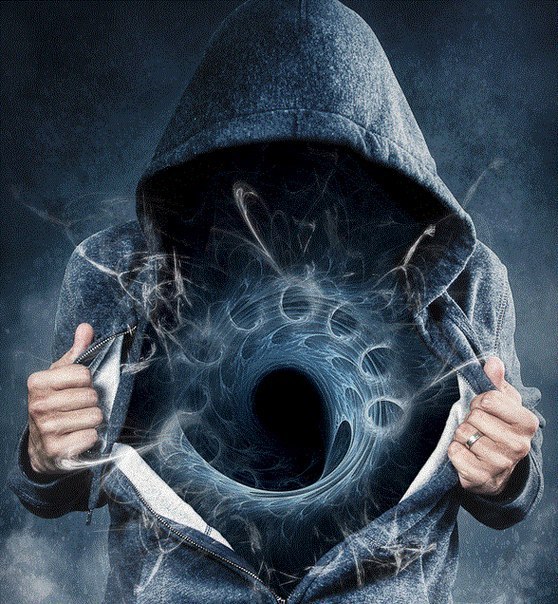
Furthermore, depending on the number and stability of the streams of awareness permeating a given assemblage of energies (“illuminating a given region of darkness”), the resulting picture may be more or less stable — more or less “actual” or “virtual”. We have already said that “stable” pictures, sustained by a larger number of streams of awareness operating within them, Magic calls “worlds”, while the whole aggregate of labile, mutable, unstable pictures is called the “Interworld”. Obviously, both aggregates — the multitude of “actual” and “virtual” spaces — are formally infinite and superposed so that there is no “emptiness”, no “interspace” between them, and any energy, any potentiality, any probability is actualized by some stream of awareness or another.
What has been said has important practical consequences for Magic.
First, the Magi understand that we can interact only with those beings with whom we share the same worldview; therefore — by expanding our description we expand the range of possible interactions. This law works both ways — we can add interactions by expanding our worldview, and we can expand our picture by entering into new interactions. This is the key to Ceremonial Magic.
Second, the Magi see that the world is the result of contact between the environment and consciousness, and therefore mind can invoke from the environment any manifestations and probabilities. This is the key to Nominative Magic.
Third, the Magi realize that contact between objects is identical to contact between minds. This is the key to Contagious Magic.
Fourth, the Magi know that all worlds lie directly before them, there is nowhere they must “go” to reach them — they only need to enter. And here lies the key to the Magic of portals.
Perceiving the world as both source and product of awareness, Magic opens possibilities for revolutionary ways of developing awareness, for escaping limitation and conditioning and its identification with absolute awareness.
Hello! What do you believe, is the natural evolution of consciousness – after all, a kind of separation (search for some unconditional freedom) or, conversely, study and integration into the existing flows of wills? You have mentioned that such a dichotomy can be avoided, spoke of the Pleroma, merging without mixing, but still from my point of view, such a difference in description affects the very rules of the game, for example, a shaman includes himself in a certain picture of the world, expands the circle of his interactions, but does this as if in return, engaging in the existing flow on credit conditions and with obligations (the same transmission of Power, for example). On the other hand, ‘pure’ consciousness in its cognition lacks the dynamics and points of support that the shamanic flow provides, but also has no obligations imposed by it. And if we take it in general, then the world in the visible assembly is the same flow with its obligations, etc. And here I see the question – is our movement (as I want to believe, conscious) freedom of will or simply the sum of derivatives of our flow? Because if there is freedom of will, then it should be something unconditional, as if detached from everything.
Freedom can be viewed from two positions – as freedom from and freedom for. If we strive for ‘freedom from’ anything – we engage the primary force of repulsion; if we strive for ‘freedom for’ – the force of attraction comes into play. But both forces are different sides of the same coin. Striving for maximal differentiation, separation, independence – we ultimately find ourselves slaves to this craving; one might say that the striving for such freedom consumes itself, degenerating into dependency on repulsion. In other words – we begin to cling to the repulsion, and therefore find ourselves under the power of attraction. Likewise, attraction, brought to its maximum, spills over into the repulsion of non-possession – we want no longer to acquire, but to get rid of non-acquisition. Freedom in the Magical understanding of the word is the possibility of choice – the possibility of both separation and inclusion, without primacy of either. Only when consciousness is free to be separated or involved, when it can switch from one state to another at any moment without any obstacles or delays – is it truly liberated. Thus, this is our ‘natural movement’ – this movement towards such a freedom which includes freedom from the necessity to be free. Accordingly, the ‘rules of the game’ here are very simple – we recognize ourselves as part and as whole simultaneously; as product and as creator, as source and as goal. We realize desires because in this way we liberate ourselves from the necessity to realize them, without falling into dependency on the necessity of their containment. We develop consciousness because in this way we liberate ourselves from the necessity of limiting consciousness, without becoming dependent on the necessity of its expansion.
Interesting, thank you 🙂
Great article and comments. Saved to bookmarks. Thank you.