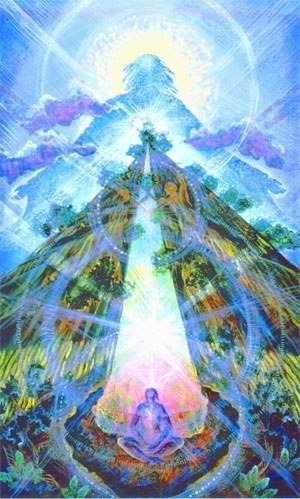
“The Divine Darkness is that inaccessible Light in which, as Scripture says, God dwells. And because it is invisible and inaccessible on account of its exceedingly bright supernatural radiance, it can be reached only by one who, having renounced all knowledge and sight, plunges wholly into this Darkness”
Dionysius the Areopagite
The Biblical account of Creation begins with the assertion that, when Nothingness was divided into the Creative ‘Heaven’ and immanent ‘Earth’, “above” the abyss (“tehom”) there was “darkness” (Choshekh).
As mentioned, the Tradition clearly and unequivocally distinguishes the notion of Outer Darkness (properly — “Choshekh”) as lying beyond reality, from the inner darkness, the “shell” (Qliphoth). To stress this distinction, translators often render the shell itself as “darkness,” while Choshekh is translated as Darkness, or, more recently — apparently under the influence of Eastern notions of Emptiness (“Shunyata”) — translated as ‘nothing’ or ‘void’. The ancient Egyptians depicted this deepest region, from which the primeval ocean Nun — the ocean of potencies — is born, as the Absolute abyss hetemit.
Indeed, the concept of Divine Darkness, introduced by the Neoplatonists to describe what is above being and non-being, above monism and duality, fairly accurately conveys attempts to describe that which is by definition indescribable — that which lies ‘above’ even the sea of potentials that forms the deep foundation of the cosmos.
Although the quotation from pseudo-Dionysius above comes close to touching the experience of Choshekh itself (that experience excludes the notion of ‘immersion’ into Darkness, since at that level there is neither immersion nor one who immerses), it nevertheless helps to convey that this Darkness transcends the dualities of light and dark, of knowledge and ignorance.
Choshekh is not yet emptiness in the strict sense (the Tradition calls the field of potentials, the primordial Chaos, the original Dream, and its unformed space — “Interspace“, often identified with the “abyss” — by the name “bohu” (בֹּהוּ); the unformedness is described as “tohu” (תֹהוּ)) — it is an indivisible fullness-emptiness that contains both the potentials of existence and the potentials of non-existence, both the possibility of creation and non-creation, both unity and multiplicity.
One may say that Choshekh is the state in which the Absolute abides “before” or “above” the moment when the possibilities of manifestation and self-knowledge appear within it.
Thus the process of creation passes through stages: Choshekh — ‘absolute void’; bohu — ‘void with potential to be filled’; tohu — chaos; finally, tikkun — ordering.
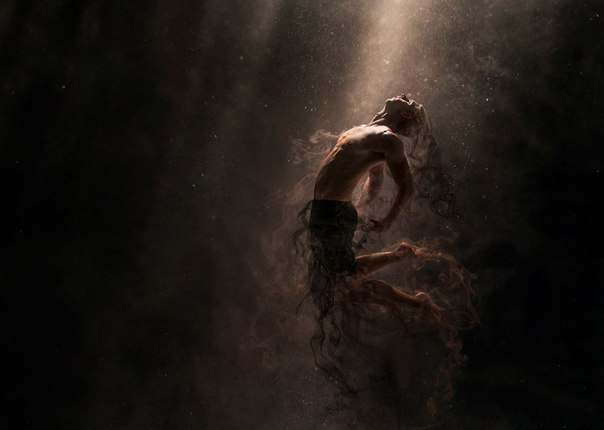
From this state, one possibility is, “Heaven and Earth” manifest, and “Earth” — the actualized reality — is at first “formless and void” (tohu va bohu). This potential field includes both potentials ready for realization and suppressed potencies (the Shadow). It is clear that the Shadow can be both a source of creativity and an all-consuming destructive force — depending on the way one looks at it and into it. It follows that Light (Or) functions more as the binary counterpart, whereas Choshekh contains both Light and its absence (“The Divine Darkness is an inaccessible Light”). The Shadow, the nether-world as potential reality, is perceived by the Magus as a field to be worked through, a level one must not be afraid to stand face to face with the enemy, where one can find both the causes of one’s defeats and the sources of one’s victories.
The understanding that above the binary Light–Dark there exists an integrating state — Choshekh — is vitally important for Magic as the Way of overcoming duality through the neutralization of binaries. The Magus strives not merely for Light; nor simply seeks self-identification and self-realization — he strives for freedom, to go beyond all limits and boundaries. Moving from realization to realization, from awareness to awareness, the Magus learns to neutralize and integrate binaries; his mind penetrates being more deeply, raising the level of his wholeness, integration, and pleromatic fullness. Thus the Magus learns to develop his totality, awakening in himself first faint insights and then ever deeper immersion in the primal state of Choshekh (or, as Buddhists say — dharmadhatu), which completely removes all limitations (including the limit on removing limits). Traveling the Ouroboros from head to tail, transforming reality, the Magus transforms himself, within that reality, arriving at the same state of absolute fullness that is also complete emptiness, into which, from the opposite side, contemplatives break through by fracturing mental boundaries and discovering its nonseparateness from everything and nothing.
Well, I see an article that analyzes Breyshit so thoroughly for the first time. Regarding Hoshiks – for some reason, I never focused on this; it’s fascinating!
It’s not entirely clear how this can be useful to a Western magician. Unless for general erudition.
How about you tackle the topic of human origins? All this ‘his’, ‘their’, the confusion is terrible; it’s not clear at all! And regarding the plural of Elohim.
In general, ‘genesis by Breyshit – flight analysis’ would be a wonderful topic. In demand.
Well, I see an article that analyzes Breyshit so thoroughly for the first time. Regarding Hoshiks – for some reason, I never focused on this; it’s fascinating!
It’s not entirely clear how this can be useful to a Western magician. Unless for general erudition.
How about you tackle the topic of human origins? All this ‘his’, ‘their’, the confusion is terrible; it’s not clear at all! And regarding the plural of Elohim.
In general, ‘genesis by Breyshit – flight analysis’ would be a wonderful topic. In demand.
If there is something that cannot be described, then what are the grounds for believing that it exists?
Absolutely correct. None)