
Realizations of the Magus
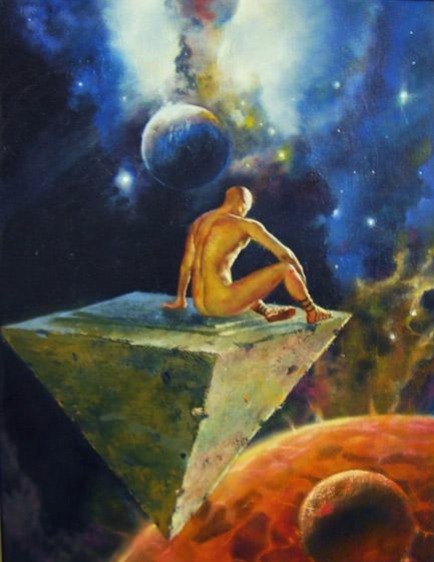
The development and expansion of consciousness as a subject-object unity can occur either by transforming its subjective component — that is, the conscious part — or by transforming the object-field, the object of awareness .
In earlier conversations we mentioned that Magic is, above all, the path of active deeds, the path of realization through action. In other words, the Magus transforms his mind primarily by influencing the environment, the field to which that mind is directed. At the same time, the Myth we describe regards the purpose and foundation of every manifested existence as the cosmos’s self-knowledge in its individual aspects. At first glance it may seem obscure how the Magus’s striving for unconstrained actions can contribute to the self-knowledge of the Great Spirit.
On the one hand, there arises the impression that realization of desires contributes to turning potential reality into actuality, and thus to the unfolding of the cosmic process. This, of course, is true. Yet here we confront the difficulty of defining desire itself, the difficulty of distinguishing desires from whims, needs, and caprices; only with a clear understanding of what is to be realized and why can one speak of expanding the mind through the realization of desires. It is perfectly clear that the absence of a manifestation at a given moment does not mean the nonexistence of that which can (and therefore strives to) manifest. Unfortunately, all too often “purification” or “getting rid” of negative qualities or inclinations is reduced to their suppression, non-manifestation, relegation from actuality to potentiality. Nevertheless, any potential reality always seeks to actualize, and the longer it is deprived of that opportunity, the more forcefully it will later break free. And the Magus’s actions are such actualizations: the doing of what must be done, the manifestation of what must be revealed. Moreover, by manifestation we mean the translation of an object from the unified noumenal realm, a “thing-in-itself”, into cognition’s aspects and energies. We have said that for precisely this reason the Magus does not restrain himself, does not suppress his impulses, although — and this is extremely important — he strives to control their emergence. Thus, on the one hand, the Magus’s realizations are directed toward the actualization of his potentials, the fulfillment of his ripened desires, and thereby toward providing a basis for his development. However, the meaning and purpose of magical activity are not exhausted by mere actualization. As mentioned, by “magical realization” we mean any meaningful, purposeful, and structured action, regardless of how “ordinary” or, conversely, ornate such an action may appear. At the same time, the realization of the Magus’s desires constitutes an interconnected chain of actions, because the Way of development presupposes “chain” events — that is, ones in which each action follows necessarily from the previous and just as necessarily continues into the next. In other words, each realization not only completes a stage but also lays the possibility for further development. Thus the Magus engages in the “building of the Wyrd” and even in the evolution of his Orlög. The Magus knows himself precisely in his realizations. They open not only opportunities for self-control, the development and ordering of the mind, but also allow him to consciously and purposefully shape the Way of further evolution, laying the foundations for subsequent actualizations. In fact, the point is that a conscious, controlled flow of realizations — which is the Magus’s life — represents the most effective Way of his development (let us agree that this is true only for those for whom this Way is truly harmonious) precisely because, first, it brings the Wyrd into the greatest possible correspondence with the Orlög, and second, it corrects the Orlög itself, even transcends its bounds. The realization of desires by the Magus, therefore, is his self-knowledge. What the Magus does is aimed at revealing and actualizing the essential aspects of his mind, manifesting his individuality, and developing awareness. “Realization for the sake of realization” is utterly meaningless because, when removed from the Way’s context, it can contribute either to development or to degeneration. “Realization for the sake of awareness” implies a clear understanding of what the Magus does, why, to what end the Magus does this, which potentials he actualizes and what seeds he sows. With such understanding, the Magus’s life becomes an alchemical process of transmuting his being from a limited embodied existence into the infinite and eternal consciousness of the Great Spirit.
I can=wants=needs
Identity
In the context of the multitude of structural variations accumulated over the centuries
Is it?
And what is BEHIND this?
Hello! You are talking about choosing and creating your own vector of the Path, which may be relevant for a Mage who has achieved significant Power, but what if implementations are directed without any general calculation, just to maintain and develop their magical perception of the world, their doors and windows of Power? That is, acting based on their impeccable nature and desire to become a bit stronger, but is it bad without such a distant target? Many traditions describe a complete transition from a human to a magical system of description/perception of the world after which the Mage begins to ‘see’ and I think is capable of managing their actions so skillfully, but this requires personal Power, and those who are trying to achieve such a transition need to at least occasionally try to look beyond the boundary to feel where to go?
Any realization has three aspects.
The first is the obvious results of the realization – the embodiment of its fruits in the current world.
The second – by principle of similarity, any realization serves as a ritual for subsequent realization.
The third – follows from the second – the realization is a consequence of an earlier ritual (a simpler realization) in the past.
Considering that each realization has all three aspects, we encounter an infinite pyramid of realizations where the past connects through the present to the future.
Enmerkar has repeatedly emphasized that a magician has no non-magical actions. Any action of a magician – from key realizations on the path to scratching an ear – is a ritual and a consequence of earlier rituals.
In life, this means that even a step taken on the Earth with meaning and awareness of its ritual power (for example, with the Seal of Freshness and Purity) can realize the magician’s intention and embody it.
The repeated actions of a magician, where he hones the ritual, are called Practice. Practice integrates singular rituals into a multiplicity vortex, amplifying it many times over.
The temporal aspect of realization is particularly remarkable when the intention is embodied within a single day, while the resources for embodying this intention were reserved years ago and through the practices and rituals of completely different magicians – as a byproduct of their actions.
Maintaining the multitude of reflections of realization through projecting all their aspects into the future is quite a difficult task for the mind, so it will be enough to be guided by magical intuition – through Inspiration turning the nose of the Boat of Realization towards the axis of maximum Probability. One must believe in magical intuition. 🙂 The growth of the Power of Awareness – is a beacon indicating that the realization is going correctly.
The importance of the growth of the Power of Awareness also lies in the fact that it expands the number of energetic matrices of Realizations in the Magician and, as a consequence, allows embodying what was previously inaccessible. The principle of balance (principle of partnership, principle of sacrifice) also holds great significance. The balance of the Power of Awareness of the magician with the Complexity of the Realization provides the optimal path. The absence of Balance can be temporarily compensated by long Practice, Borrowing of Power, the Core of Life’s Power, Sacrifice, and Selflessness.
Doctor! Can you give a specific example based on the text “The temporal aspect of realization is especially remarkable when the intention is embodied within a single day, while the resources for embodying this intention were reserved years ago and through the practices and rituals of completely different magicians – as a byproduct of their actions”?
I think this way: if you take something, you should give something back. Your comment appeared either accidentally or inevitably after my question about not understanding the meaning of magical realization and how it differs from non-magical realization. More precisely, I don’t understand the pathos surrounding this topic. Well, magical realization—so what? If a person is a magician, it’s unlikely to interest them as a topic of expression. Regarding the given conditions, the existing properties of the system, as far as I know people, we relate to them calmly, we don’t talk about them, and we don’t particularly notice them.
I’ve set aside the topic of realization for now. But from your comment, I thought the following: this is still a process to be explored, but what is, is. I clearly observed my reaction to your multi-layered logic made up of, in my opinion, impeccable components. Impeccable in the sense that anyone with any worldview would agree that this is so. Indeed, all the individual statements are separate conclusions and seem not to contradict the world. And from them, there’s a beautiful construction. It’s amazing. I looked at it as if it were an unseen building.
But I derived a conclusion that is not about realization but about my own thinking. For some reason, it works at the intersection of perspectives. I need someone else’s opinion on a question to be able to make my own conclusion—not to support my view, but specifically for understanding. I know myself quite well and I realize where I have gaps—in the ability to neatly categorize and structure. Here, I precisely experience incompleteness. I can sense the lack of harmony very well and I’ve even learned to articulate it in the form of a question. For now, I can’t quite separate and arrange everything like that. If I ask a question myself, I will circle around, gather data, compile it, and dwell on it for a long time before circling back. On the other hand, if someone lays everything out like that, I can quickly and in a matter of seconds reassemble everything into a cohesive whole.
It was amusing to feel the missing part of my thinking like that and my reaction to the fact that this part can come from outside. And to see all of this as a process.