
The Emergence of Desires

The notion of the Way is the central axis of the entire Western myth.
We have said many times that the Way is a system of coordinated actions whose vector coincides with the overall direction of an individual’s development and connects all its elements. Thus, to say that a person (or any other being) is on the Way means, first, that the being is developing (that is, moving from a less conscious to a more conscious state), and, second, it develops in its own individual way — that is, passing through stages determined by the peculiarities of its Monad, its orlög.
This means that every step on the Way follows from choices made at the previous moment and determines the new choices and the new chances that arise at the next stage.
Namely, whenever certain potencies of a being are actualized, new possibilities open up for it, and therefore — an attraction between actual and potential realities in its mind arises. And such an attraction, as the Myth already shows, is called desire.

The considerations above allow us to draw a conclusion of great practical importance — the emergence of a desire is the actualization of certain attractions determined by the very logic of the Way.
That is, desires, although free, are not arbitrary.
We have already said many times that the Magus controls himself, and we have emphasized that this control is not a form of self-limitation.
This means that the arising of every desire is the appearance of a striving to actualize certain potencies, and therefore — any desire that arises (if it is truly a desire, and not a whim) must be realized. Failure to realize a desire is a refusal to actualize potencies, and thus a refusal to convert potential energy into actuality. If this conversion does not take place, the excess of the resulting unexpended energy destroys the whole system.
The question here is to what extent the realization of a desire remains within the framework of the Way.
If, at the preceding stage, wrong choices were made (that is, choices not in accordance with the orlög), they lead to the emergence of attractions to new disharmonious pulls on that being’s essence, and therefore — to “incorrect” desires. At the same time, of course, such a desire still must be realized, which in turn will lead to an even greater distance from one’s Way and from Power. This is why even a small deviation from the Way quickly results in significant estrangement and an avalanche-like escalation of disharmonizing influences. This is especially noticeable in “lost” Magi — having seemingly made an insignificant mistake, the student often finds himself in the blink of an eye far from himself and his Power. And returning to the Way is a very hard, long road.

Thus, the emergence of desire is, in essence, the manifestation of an attraction that potentially existed in that Monad’s field of possibilities. But since the Monad is an aspect of infinity, the number of its potencies is limitless, and what matters is not so much the mere possibility as the order of realization, the harmonious growth of the mind — that is, the timeliness and propriety of each actualization at a given level. The same desire arising at different stages can be either constructive or destructive for the system, since it sets off chains of distant consequences.
It follows that the most important point is the formation and launching of the “right” programs — sequences of actualizations — and also the interception and redirection of disharmonious attractions.
In other words, everything that happens to the mind from the stage of actualization onward is to a large extent invariant, because the choice — to realize and advance (even if in the wrong direction) or not to realize — and thus be destroyed from within — is, strictly speaking, no choice at all.
Accordingly, the direction of the flows must occur even before their “rise” toward actualization, deep in potential reality. And the choices that can really be spoken of are made there, in the world of potentiality.
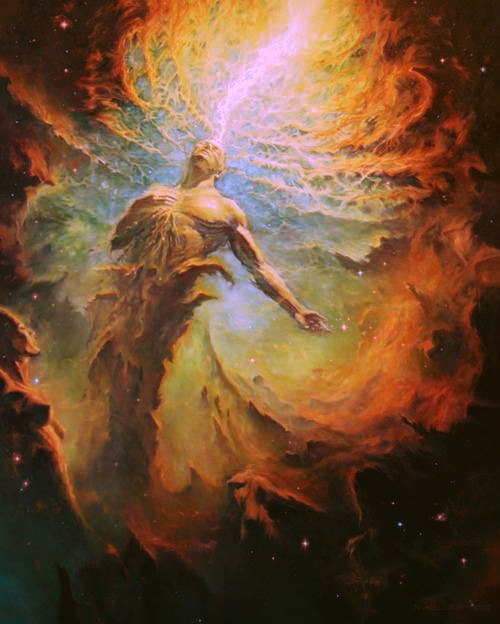
The Kabbalistic system describes this state quite precisely: true creation takes place only in the World of Archetypes — Atziluth, where the Creator acts directly. In all the subsequent worlds — Briah, Yetzirah — free will no longer exists; there is only a “mechanical” formalization of creative ideas by angelic “ministering” forces, and, finally, their full manifestation, their “realization” in the worlds of Assiah and A-Ze. That which is “born” in Atziluth must be embodied in A-Ze. And the “order” of creation, of course, has considerable significance.
On the microcosmic level, the task of the developing mind is precisely the proper formation of primary impulses — primary attractions. And this is exactly what is called “control,” and it is precisely here that microcosmic free will manifests itself.
Accordingly, the mind begins sustained development only when it gains access to its primal ground and begins, at first by solitary illuminations, and then ever more clearly, to shape its realizations. In fact, initiatory practices employed by many Traditions are aimed exactly at the primary penetration of the mind into its depths, forging a way from the outer levels to the atziluthic heights of the psychocosm.

As always, the article clarifies such a complex topic wonderfully!
I only have one reflection-question.
Although after realizing a desire, it seems everything is invariant, it must be implemented, but can the desire be changed by addressing its roots? As I understand it, the same potential can be actualized (as they say, ‘materialized’) into completely different desires. That is, reaching the ‘root’ — to the potentials-attractions in the psychocosmos — can we then direct the vector of desire towards another equivalent ‘object’? A dull example: a person wants to pick locks; understanding the ‘root cause’ of this action, that person may stop being a ‘lock picker’ and become a good locksmith. Something like that.
What has already begun the process of realization cannot be canceled or corrected. One can only, by tracking the desire and its ‘roots’, prevent it from arising in the future. This is precisely what is visible in the example you provided.
Very interesting. So, the fulfillment of desire can be perceived as fate. There are cases when it takes years for the desire to be realized. Everything is forgotten. Then you look, and here it is, the realization. And you seem to not need this realization anymore.
When speaking about desire, it makes sense to talk not about a singular desire but about a field of desires. Often, alongside some desires, others also exist. And not all desires turn out to be compatible with each other. In this case, Cognitive Dissonance arises — one part wants one thing, while another part wants something else. An ordinary person’s field of desires is quite banal – to make a career, buy a car, create a family, etc. For a person following a magical path, the field of desires is somewhat different – to master the body, emotions, thoughts, desires, to master asanas with pranayama, and finally, to achieve Knowledge and Conversation with the Guardian Angel. At the same time, it is possible that in the background of one field of desires, there exists some other field of desires. One can even speak of the existence of some internal traitor – a set of desires incompatible with the ‘general line’. Perhaps many ‘lost magicians’ are those who could not identify their ‘traitor’ in time to name and expel it.
I regard the refusal of an extremely destructive desire as a worthy choice. In some cases, it is much wiser to independently destroy the micro-world, controlling this process, than to fulfill a desire and be unable to cope with stronger destructive desires of other individuals. In most cases, the realization of destructive desires turns out to be quite useful.
With the author’s permission, I express disagreement with the point of view regarding the impossibility of canceling/correcting the process of desire realization. It is possible to cancel and correct.
I develop the example with the lock picker.
Suppose a person did not change their desire and went to the object. On the way, they stumbled, broke their nose, considered it a bad sign, changed their mind, and subsequently reviewed their desire. The implementation of the desire is canceled.
A second example. A person gathered a team of lock pickers and they went to the object. The person falls, breaks their nose, considers it a bad sign, immediately decides to quit, and announces this aloud. The team opposes; they have a different attitude. The person refuses to go to the object. The team is serious. The team decides to fine the one who refused.
The person canceled their desire but paid the price.
Conclusion: it is relatively easy to cancel one’s own desire in which no other individuals are involved. On the contrary, usually, the cancellation of a desire is very difficult and fraught with obvious consequences if social structures are involved in the realization.
However, practice shows that it is much simpler to prevent the emergence of such desires whose realization will have to be canceled.
In general, there it is also necessary to define the boundary where desire begins. Here’s a simple example. Two men are working the same shift. One of them makes a mistake and, as a result, hears a lot of new and interesting things about himself from his partner. This new and interesting thing affected his sense of self-importance so much that he wanted to physically punish his partner for a while. But then, at the end of the workday, both partners went to a diner, had some drinks and snacks, and that was it. The daytime incident is exhausted. Was the desire for physical punishment a desire? Most likely not. Most likely, it’s just an emotion. And the man would have never acted on this desire. Now, another example. Someone did a nasty thing to their friend, distorting their entire subsequent life. And now, this friend has stored up hatred for years, nurtured thoughts of revenge, etc., and there could be no question of forgiveness from his side. His desire for revenge was uncompromising and excluded any thoughts of reconciliation. It was stoic and never weakened even for a moment. This can already be considered a desire. And here, indeed, it is one of two – either this person will kill their enemy, or their hatred will destroy them.
The boundary between desire and emotion or whim is not quantitative. It is qualitative and principled. A desire is that which comes from the depths of one’s being and is not a direct reaction to surrounding conditions. That is, these conditions can certainly be a reason for the manifestation of desire, but they are not its cause. Desire is a manifestation of the very nature of the being, stemming from its preceding path and opening up new further possibilities.
In your example – if the lock picker does not have an internal inclination towards thievery, he can refuse the imposed way of behaving. But if a person is already inherently evil and vengeful, then it does not matter to them whom to take revenge on, and the specific object of revenge is merely a pretext for expressing inner attraction.
Desire comes from the depths of being. But it must be formatted. The mental level must be engaged for a clear understanding of the desire (I don’t know about men; they are silent on this topic, but with women, it often happens that she wants something and can’t understand what it is, and that’s no joke) analysis and choice of possible ways of implementation. It is at this moment that the intellect is capable of analyzing possible consequences (both positive and negative) and pulverizing those desires that may have negative repercussions. However, for this, one must be extremely honest with oneself and not be deluded: what if it works.
A desire that has not undergone ‘intellectual processing’ may remain merely at the level of desire. Something like a mirage.
“I don’t know about men; they are silent on this topic, but with women, it often happens that she wants something and can’t understand what it is, and that’s no joke”
Men experience this too. But for some reason, it is usually women who are braver to admit it. 🙂
Hello!
I would like to share my recent experience. As Marina said, there are times when there are conflicting desires within — like a tangle of threads, like the cacophony of a marketplace, where there are many different voices, and you cannot decipher what you really want. Recently, I managed to understand a problem that tormented me for several years. I was helped by the book by Jean Shinoda Bolen “Gods in Every Woman.” The idea is that within you are different parts, each with its own goals, tasks, and ways. These are different archetypes that can be seen as different potentials through which your path can be realized. The solution was to get to know each part, understand it, and hear its desire. Then the inner noise and uproar turn into a civilized conversation, advice. Then it becomes clear who supports your desire, who opposes it, who is abstaining and why. If everyone’s voice is given the right to express itself and is listened to, one can make considered decisions more consciously. After this, you experience the sensation of liberation; it became easy.
For “At the Beginning of the Path”. Thank you so much for the hint about the book “Goddesses in Every Woman.” Although you recommended this book not for me personally, after your words, I wanted to find it and read it. Indeed, it is a wonderful book. Clear, concise, practical. In my opinion, one of the best books regarding female psychology. By analyzing the presence of the main archetypes of Goddesses within myself, I was able to somewhat realize my own motives and reactions that used to surprise me. A woman is quite a complicated being who does not always understand why she behaves this way and asks herself: “why do I react so inadequately to seemingly ordinary things?” “What is wrong with me?” I often asked myself such questions. Now I have placed all “my Goddesses” in their places, and inside me, something like a rational order has formed (for the first time in many years). I am very grateful to you for your help. Once again, thank you very much for the wonderful suggestion.
For Lena Rider: great! So great that such knowledge spreads and helps us! Allow me to recommend my favorite book about women – “Women Who Run with the Wolves” by Clarissa Pinkola Estés. It’s an analysis of the female path (all stages of a woman’s maturity, problems, and successes in life) through myths and tales. As I understand now, it was this book that prepared me to partially understand and accept the ideas of Another Magic. I’m happy for you! By the way, they say there is a continuation of the work by Jean Shinoda Bolen called “Gods in Every Man”.
“Desire is that which comes from the depths of being…” Perhaps this is true, as it was with Beethoven. The desire to compose music didn’t leave him even when he went deaf. What could be more catastrophic for a musician? But evidently, the desire to create melodies originated from the depths of his being. And external conditions (such as love, sadness, or loneliness) only changed the emotional coloring. I would like to learn to walk my Path steadfastly and diligently, regardless of external conditions and ‘internal traitors’ (I really liked this term). Great gratitude to Enmerkar, as always, for the article.
Desire comes from the depths of existence. How to get there though? Are there ways other than the ‘initiation events practiced by the traditions’? If the time has come to open access to the information about Magic and Myth presented in this blog, then when will there be a time to know the answer to my first question?
Recently, being in the mountains for the first time, the most extreme part wasn’t the ascent, nor the duilf, but rather coping with the desire to take a step forward when you’re standing on the edge of a peak. (Here the language denotes this edge of a peak, not a chasm.) What was that? If it was a desire, whose was it? It was clearly not appropriate or relevant for the physical body.
Then in the meditation exercise, which I couldn’t reach, there were incredible images. One of them resembled the first illustration of this article, only the road was ancient and rocky. And I saw myself taking the first step on this road. So that’s the realization of a desire!
Speaking simply, the main thing when desires arise is to understand – is it your desire, or did parasites help (regardless if they are internal or external).
It seems to me that an inner desire, coming from the depths of the microcosm, cannot be intrusive. It is sort of ‘flowing’, soft.
Whereas the one that comes from parasites tries to convince and prove that fulfilling this desire is vitally necessary for you.
Maybe this is where the essence lies; parasites can reach you when you’ve previously made a wrong choice and strayed from the Path.
Then we owe a debt of gratitude to the parasites.
In this case, it is essential to look at where the earlier mistake was made, the poor choice that led to the possibility of the imposition of desires by parasites.
Thank you, Enmerkar. Your articles make one think and search for answers.
One needs to ‘test’. If everything is true, then this is a very good way to check one’s state: are you there? 🙂
I might be wrong, but it seems to me that, no matter how destructive it may be, one must take into account all sides of the possible consequences of a desire when choosing to renounce it. This is especially true if the desire involves another person. It is impossible to predict how that desire will resonate in the person it is connected to and what the consequences will be. Therefore, one must be cautious with desires, especially for magicians.