
Can We, Whenever We Want?

One of the most difficult concepts in Magic is a concept that seems trivial in everyday life — the notion of Desire.
Indeed, the idea of desire as the driving force of the world-process lies at the heart of Thelemic Magic. At the same time, distinguishing between the apparently similar concepts of «desire», «intention» and «will» often proves very difficult, and their semantic fields frequently intersect or are confused.
Nevertheless, clarity of action and clarity of thought are closely connected: only someone who thinks clearly can act clearly, and for a Magus clarity of action ensures effectiveness.
Therefore we must clarify what the Tradition means by these terms.
The Magical Myth calls desire the cosmic principle of unity. We have already discussed that the World-process consists in the fragmentation of the Absolute’s integral consciousness for the purpose of self-knowledge in the totality of its aspects, and then the restoration of that unity, made actual. It is clear that potential and actual being exist in a binary relation, that is, they attract each other, and only their separation provides the power needed for the world process.
The participants in this process are embodied in the Three Great Principles: the binary’s tendency toward neutralization — i.e., the power of world unity — manifests as the Principle of Feeling; the differentiating principle, which singles out individual elements in order to actualize them — manifests as the Principle of Intelligence; and the Power that arises from their separation, the world’s driving force — manifests as the Principle of Will. In other words, Will is feeling directed by intelligence.
We have already said that at the level of a concrete being, will is the ability of a being to organize, i.e., to order and direct its desires.
From the above it is clear that the Magical myth calls Desire the power of attraction arising between two states of a single system — between more and less developed states. For example, the attraction of the “hungry” state to the “sated” is the desire to eat; the attraction of the “weak” to the “strong” is the desire for Power, and so on. Being a manifestation of the Principle of Feeling, Desire as such is unstructured; it merely marks the process of union, but does not include paths to realizing that union. An ordered desire is the power of unification directed along a specific path — this is Will. Naturally, the process of direction itself requires calculating the route — the Principle of Intelligence.
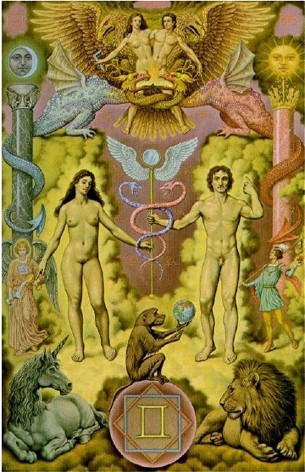
Thus any realization includes all three elements of this triad — the passive attraction (desire), active understanding (intelligence), and neutral movement (will). This aggregate, underlying any actualization, is called intention. That is to say, intention is desire balanced by intelligence through will.
We also mentioned that this process of realization takes the cyclic form of a vortex born of the quaternary law.
Now we return to the question with which we began — is realization possible just because it is desired? Desire unbalanced by intelligence is only one of the poles of the binary, which cannot remain stable on its own. To return the system to stability, a second pole is necessary. And if that pole does not become intelligence, or if the balancing power of intelligence yields to the driving force of desire, then desire is balanced by fear. Indeed, usually the desire to acquire something is accompanied by fear of not obtaining it. Since desire by its nature is passive (as a manifestation of the power of unity), fear assumes the active role in the formation of the vortex. This means that contrary to its purpose, this vortex will be directed not toward achieving the desired result, but toward failing to achieve it (that is, toward whatever the fear is aimed at). And this gives rise to the well-known formula — the more strongly we want something, the harder it is for us to get it.
The way out of this situation is also obvious: desire must be balanced by intelligence. Then the driving force “I want it so” is replaced by the balancing force “it must be so.” The formation of such a stable vortex is called forming an intention. And if a vortex is formed by intention, then its realization depends only on the power of its creator.
Thus, the basis for achieving effective results in Magic is considered to be the skill of forming intention — that is, the ability to create balanced programs which, being endowed with Power, lead to the attainment of the desired result.

Does balancing desire with reason mean creating a plan for realizing this desire (thinking about how to achieve it), or is there another approach?
Not quite. It means seeing the place of this action within the overall system of events, its connections and consequences.
Good article, it is not for nothing that they say if you really want something, you can achieve it all!
I really liked the site, thank you. It is just relevant to my situation right now. And just the question: desire exists in the presence of a goal. Then the desire to realize it will be the driving force, and the actions aimed at it will make up the Path to achieve this goal and realize the desire. And this path is life. What if there’s no goal? In the most direct sense of the word – none. It has always been there before; there were many of them, they inspired, filled with enthusiasm, drove me up at 6 in the morning… But now it turned out that it is not there. None? What to do?
If there were no goal, you wouldn’t be writing this – you would simply cease to exist. The goal to be, to exist, to have existence – is already a goal 🙂 And to achieve this goal, you breathe, eat, and drink… However, this goal is not yours; it is the goal of the universe.
Another thing is more ‘private’ goals. Having these goals, striving for them means realizing your self, your individuality, so you will either have to acquire goals or dissolve in the facelessness of the world…
Thank you for the information posted here. Following what I’ve read, I have a question. Perhaps you know what Vöid is. Can you say anything on this matter? If this cannot be discussed here, then by email. I would be very grateful for any information.
I hardly think I can say anything new – I’m not strong in Eastern representations. According to Hindu psychophysiology, a ‘void’ is a break in the flow of energies through the channels of the ‘energy body.’ Hindus believe that this ‘break’ is the reason for the illusion of the real world. I believe that by ‘getting stuck’ in this empty area, the life force of Kundalini ‘twists,’ creating reality. Formally, this resembles the Western representation of Da’at, but I would not make direct parallels.
Thank you, Enmerkar. If you happen to have anything else on this matter, I would be grateful.
I have a very strong desire to achieve a certain goal accompanied by an equally strong brake fear (most likely the fear of ‘not meeting’ the case if it is achieved). As a result, these scales are balanced. A deadlock, zero. What steps should be taken: to change the goal, or to reduce its scale, or to deal with the fear? What ‘treatment’ is there?
Enna. Based on the article above, there are two options: either want less or think more. Try to reduce desire to a state of absence of fear, and then think about how to achieve the goal specifically.
And to balance with Mind means to develop a plan, understand what resources are needed, etc. (i.e., what is called HSR (well-defined outcome) in NLP)?
Hope, thank you. You lend a shoulder when I feel a vacuum.
🙂 I only sometimes share my experiences and thoughts. But if you wish, you can write to me. Eknakaron@i.ua
What does a magician do with a desire if there is no possibility for its realization?