
Individuality and Separateness
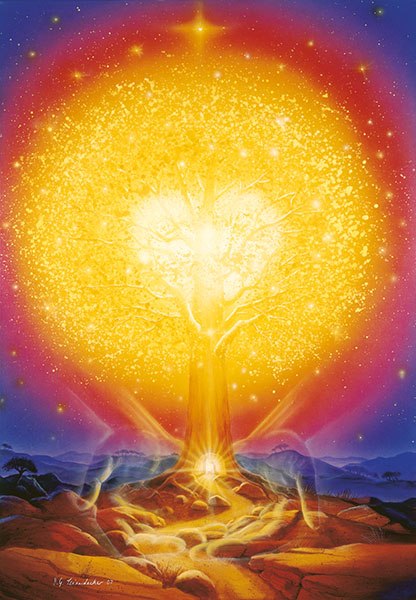
Manifested being is the threshold between the indivisible unity of the Great Spirit, which constitutes the potential ground of being, and an infinite number of aspects through which it knows itself via self-knowledge.
This transition — from integral unity to differentiated multiplicity — is, in fact, the initial act of creation — it consists in the birth of a primordial duality: a multitude of subjects of self-knowledge — Monads — and a multitude of objects of that knowledge — energies.
Note that even this primary act of creation is not a “decay” or a “fragmentation” of the Great Spirit as such, but only brings its supra-being and supraconsciousness into an “active” phase. In other words, by reflecting on itself, the Great Spirit seems to “gaze” into its separate aspects, and each such individual “gaze”, each “focusing of attention”, serves as an individual aspect of it — a unit of knowledge — an individual Monad.
From this perspective it is clear that each Monad is not a part of the Great Spirit — in which there can be no fragmentation — but the Great Spirit itself in one of its infinite aspects, in one of its infinite perspectives on itself.
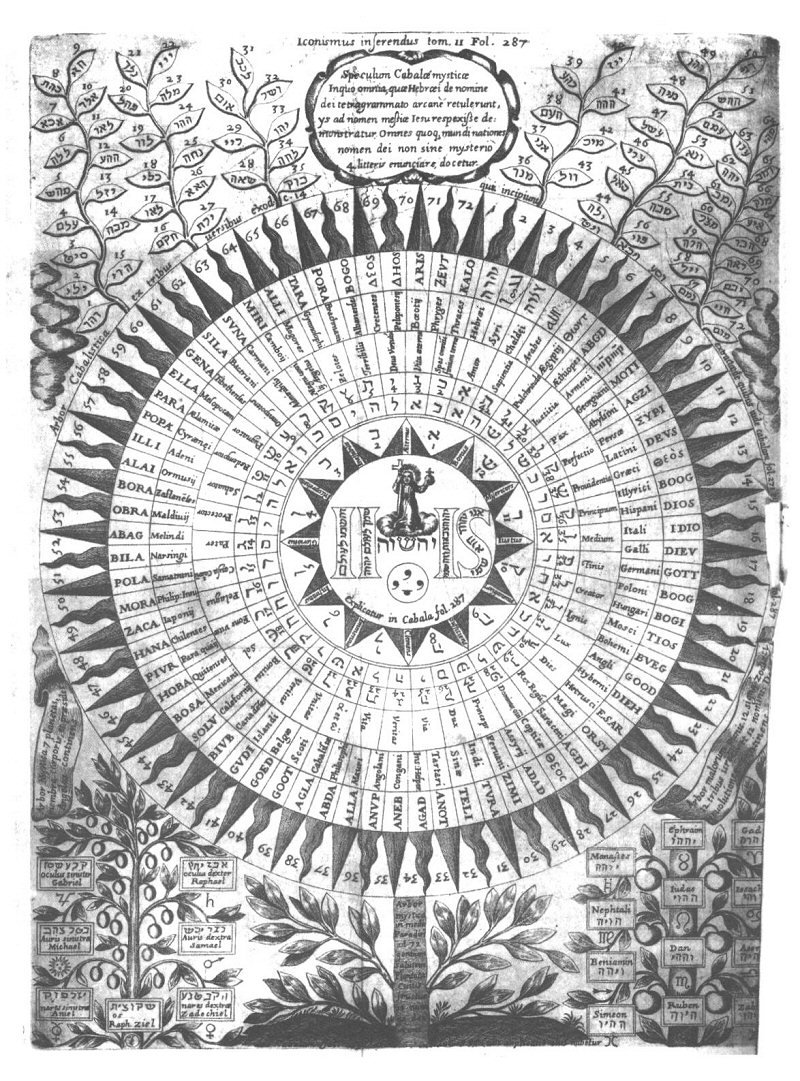
From the standpoint of magical myth, both the idea of the Great Spirit as “God” — that is, an all-wise and omnipotent being — and the idea of it as a faceless Force forming the “ground” of the cosmos are incomplete. Magic proceeds from the conception of the Great Spirit as lying beyond personality and impersonality, being and non-being, consciousness and unconsciousness, transcending all dualities and all attributes. Therefore, when we speak of processes occurring in and through it, we only conventionally hint at something beyond any definiteness. Accordingly, when one comes to the next stage — “obscuration” — there should be no impression that the Great Spirit itself is “obscured,” that some imperfection or incompleteness arises in it. Nevertheless, each particular “gaze” of the Great Spirit upon itself, each element of its self-knowledge, must, on the one hand, be complete in itself, and, on the other hand, separate from other gazes, so as to illuminate, reflect, and actualize precisely that aggregate of aspects of the One toward which it is directed. It is this “narrowing of the field of vision”, on the one hand entirely natural and necessary, and on the other hand leading to the neglect of fullness and unity, — that is called “obscuration”, and the force that sustains such individual gazes is called Nakhash — the force of Fragmentation.
We repeat that the primary differentiation takes place in potential being merely as a possibility, the Great Spirit’s Desire to know itself. The move toward actual self-knowledge is accompanied by further differentiation, and each Monad actualizes itself through an infinite number of incarnations, since it, as an aspect of the Great Spirit, likewise has infinitely many aspects and potencies to be realized.
Therefore each individual being (“self”) is, in relation to its “own” Monad, the same kind of differential aspect as that Monad is in relation to the Great Spirit. It is clear that all these levels of differentiation are conditional, since they are only instruments of the World process of Self-Knowledge, the filling of being — with consciousness — and, strictly speaking, from the absolute point of view only the integral supraconsciousness of the Great Spirit is real.
At the same time each “separate” manifested being turns out to be merely an individual gaze of the Great Spirit upon a certain aggregate of its aspects, and yet this gaze maintains its separateness, often “overdoing” its separation, withdrawing from other “gazes”, entering into struggle with them and setting itself against other aspects of the same Unity.
Just as the Great Spirit expresses itself in an infinite number of individual Monads, each Monad manifests itself as a succession of beings (selves), each self as a series of personalities, and each personality as a stream of discrete psychic states.
The individual mind, the “ego”, by all means sustains its “existence” at all levels, from a discrete state up to selfhood, opposing itself to the “other”, separating from “others”, indulging in suffering (for suffering allows separateness to be maintained — the One does not suffer), and the reason for this, of course, is its deep sense of its own ephemerality, temporality, mortality.
Individuality as a necessary condition of self-knowledge does not imply separateness, and understanding this fact is extremely important for the Magus. On the one hand, the Magus does not allow himself to be merged, dissolved into the Unity, absorbed by the Unity, since that would disrupt the process of actualization, the Great Spirit’s self-knowledge. But on the other hand, the Magus does not fall into the trap of separateness; he does not enter into a destructive Luciferian opposition of himself as a unit against world wholeness. It is precisely this conception that forms the notion of the Pleroma — “union without mixing” — describing the actual, operative existence of the world’s fullness.
The Magus develops and manifests his individuality, balancing its “centrifugal” tendencies with the all-unifying force of love. The Magus is what he must be by nature — an individual unit of the World process, neither a “cog in the machine” nor the “navel of the world”, but the Great Spirit in one of the infinite number of its aspects, neither less than infinity, nor larger than a point.
Hello! You wrote that magic is not an evolutionary but a revolutionary path, but this view defines a magician as simply a maximally harmonious being; what is revolutionary about it?
Hello! First of all, ‘harmonious being’ is not that simple, and secondly, this view defines the magician’s basic outlook, not the pattern of their actions. The pattern of a magician’s actions is that, upon recognizing the infinite Path to actualizing their potentials, realizing their place on this Path, they attempt to traverse this Path not simply – slowly evolving, developing, but to develop such intensity, such effectiveness, that they fill themselves with the light of awareness at once, in minimal time, ideally – in one lifetime.
It seems to me that it’s very difficult to fill oneself with the light of awareness in one life. Many, very many have forgotten what the Spirit is… Identified with shells.
Indeed, very few have managed, very few; the temptation to fall for distractors is very great, and one must be very skilled at distinguishing the voice of desires from the sweet words of demons.
Being a ‘Harmonious Being’ is indeed not easy because for others it becomes disharmonious.
Being a harmonious being implies harmony around oneself, ‘for others.’
Thank you! In general terms, I understand the meaning. It helped me to align my internal understanding of relationships between objects. I will delve deeper while engaging in the process of self-discovery.
Interesting article, thank you. After reading, I had an association about magicians and the Spirit: spermatozoa rushing to fertilize… what? They are completely separate but are part of the system. What can arise from the merging of the Magician and the Spirit?
That which looks similar and has the maximum identical resemblance is prone to merging. I believe human individuality, which is a certain level of developed consciousness, like everything around it, has similarities that ensure merging and a transition to a new level of soul development.
Is there knowledge in Western Myth or any other about ways to connect with one’s individuality without losing one’s personality and bringing the Monad into an active state?
What you describe resonates with “The Magic of Immortality” by Burislav Servest.
Loss of personality is akin to loss of memory, however, a tabula rasa – a “clean slate” of the consciousness of a newborn baby, even if in an adult body, is, in my opinion, not the best result of development……………………….. The essence is not to get rid of the personality – the essence is to transform and harmonize it. Not to uproot the Ego as something bad and perverse, but to cleanse it of destructive influences and recognize the Ego as a part of the personality that is in contact with the external world through perception. After all, if there is nothing to perceive, there will be no perception and awareness.
Yes, it resonates with MB, and I know you from the CS forum, even though you haven’t appeared there for a long time 🙂
Overall, I agree with you. For the personality to be able to fully accept/manifest its Individuality without collapsing in the process, it must become harmonious, stable, and whole.
Hello! I have a few questions) How to motivate oneself to take some actions from a feeling of undividedness with the world? If the sun tickles the belly, birds are singing, and everything is good, why move somewhere and suffer? Or to move doesn’t mean to suffer? Or am I wrong in how I understand the feeling of undividedness? What is “ego”? Is it a collection of personalities? Let’s say, it seems to me I’m afraid to part with the personality that suffers because then it feels like I will stop moving, and stopping movement is something like death. On the other hand, this movement is more like back and forth.
Hello.
1) Undividedness with the world is not only unity with its pleasant moments but also with its complexities and pain. It is impossible to feel unity only with part of the qualities or processes; that would not be unity, but selective perception.
2) “Ego” is not the personality itself, but the confidence in its reality; it is the feeling of “I am precisely this”, that is – the division of the world into “I” and “not-I”. However, if such a division does not occur, then only “I am” remains, without indications of what can be considered “me.” Then the feeling of presence and observation arises – “sambhogakaya”, which can then manifest in actions devoid of egoistic direction (or, more precisely, spreading egoism much wider than just on an individual personality).
Enmerkar, thank you for the clarification. Allow me to express my feeling:
Moving and living does not mean suffering. Suffering is suggested by the external system (i.e. supposedly Life is overcoming, suffering, difficulties, etc.). You can simply live and enjoy living, and that is normal. Perhaps you perceive the Forces of Life and Life in a pure form (enjoying it, smiling at the sun, people, singing birds), that is, you are simply glad
of existence itself, and that is normal. Appreciate this in yourself, share your feeling with loved ones, and this, perhaps, is your Gift and your “movement.”