
Mind and the Illusion of Personality

We have already mentioned the important distinction in a magical description of the world between the concepts of “personality,” “selfhood,” and “individuality.” The first is a temporary product, formed at a particular moment in a particular incarnation; the second is the axis that unites separate personalities into a common flow; and the third is a characteristic of the Monad, traceable through the entire sequence of its incarnations.
It is essential that the formation of personalities is influenced by the Parasite of consciousness, and also that, contrary to common belief, Magic denies the continuity of personality throughout an incarnation.
To clarify this point, we must first determine what actually unites a being into a single system. That integrating element, of course, is consciousness as a process and awareness as a quality.
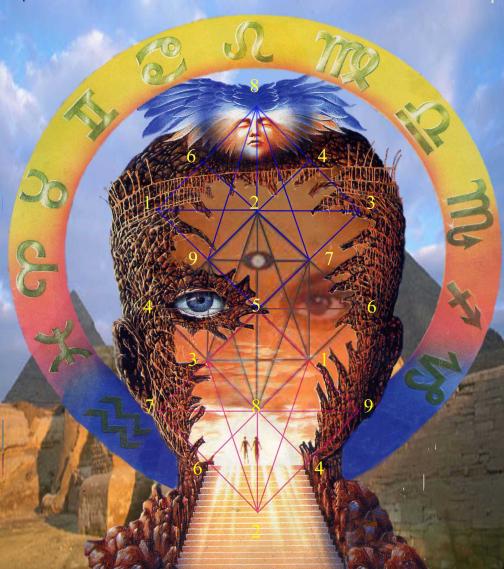
The Magi consider the mind to be the system’s capacity to interact with its parts — in other words, the capacity to single out its aspects as objects for interaction. In this context it is clear that different levels of mind differ precisely in the breadth of elements they encompass, ranging from the differential consciousness of a single energy, in which part and whole are identical, to the integral consciousness of the Absolute, including the interaction of an infinite number of elements.
As mentioned, consciousness grows as the Monad’s potentials are actualized, effectively as the number of interacting elements increases.
Depending on which elements the mind encompasses at a given moment, it manifests in different states. Such states are called personalities. Thus, Magic regards a personality as the system’s current mode of interaction with itself and with surrounding systems. This view implies that personality is a function of the system; it depends on the system and its organization. A change in the system inevitably leads to a change in its modes of interaction, leading to changes in personality. Indeed, a being is a complex system composed of many interacting elements. It is clear that a change in any element, or the addition of a new element, reorganizes the whole system and thus alters personalities.
Individual personalities are bound by a sense of self — the split into ‘I’ and ‘other’ — which is the cause of personalities manifesting within the essentially homogeneous principle of consciousness.
What has been said carries several important consequences. One of them is the discontinuity of personality, manifesting as a stream — specifically as subpersonalities — that replace one another during a being’s life of a given selfhood. A person is accustomed to perceiving themselves as continuous and encounters discontinuity of personality, which confuses them. Questions arise: «how could I have acted that way?». In fact, one personality acted, and another reaps the consequences of its activity. At the same time, the formation of a new personality is driven by individuality and colored by individuality. Moreover, we have already said that the number of interacting personalities increases further when time’s relativity is considered. For clarity, let us call such temporal personalities “differential,” and their whole simply ‘Personality’. It then becomes apparent that only the Monad’s individuality binds them into a Personality. The force of the Monad — its individuality — binds them. The fewer external influences Personality senses, the more integrated it is, and the less differential personalities diverge.
Another important consequence is that personality changes occur within the Psychocosmos, where, besides the personalities themselves, Predators reside, feeding on energy dissipated by awareness. Naturally, they try to ensure that the new personality is no more effective than the old. They usually succeed.

But this is also where the opportunity to hunt Predators arises: at moments of personality change, Predators activate, trying to impose their rules on the new personality. At that moment, only they are still outside the emerging personality, and therefore — they are easy to notice. That is, by directing attention to the formation process of a differential personality, one can notice external influences trying to steer its formation into a different channel, to alter its structure somewhat, or to fragment it.
In turn, the foregoing leads to the conclusion that one must monitor the process of differential personality change in order to hunt the Psychocosmos Predators and to pursue Personality integrity. In other words, as soon as a person feels a sharp inner change — a mood shift, a desire arising, or, conversely, its fulfillment — they should immediately turn their attention inward and prevent Predators, so clearly visible at that moment, from joining Psychocosmos reorganization. The situation is complicated by the fact that the Predators do not sit idly by, and it is usually at such moments of reorganization that attention is drawn outward, preventing the process of differential personality change. But changing this orientation is within the power of anyone who wishes it.
Thank you for continuing this topic… Very interesting!
It’s a pity that there is no PRACTICAL information.
You help to see the enemy, but I also want to have a sword in my hands 🙂
A sword cannot be handed over through the internet 🙂
If a person unconsciously changes their personality, does that mean they forget everything about their previous personality?
No, they do not forget, since these personalities are united by the power of individuality.
I accidentally stumbled upon your site today and I am reading post after post, I can’t tear myself away. Although I have read about many things before, repetition has never hurt anyone. Many thoughts resonate with mine. Thank you!
Good day. I enjoyed reading the article, but unfortunately, I didn’t understand much :). We change over time, and each such change can be called a separate sub-personality (what a word…):) Or can each state, whether it be joy, sadness, or something else, also be called a separate personality? Then a sharp change in mood would indicate a change in sub-personality? Still, I don’t understand how one can track predators during the transition. If everything goes its own way, then a change in state (mood) eventually accompanies a drain of energy, as a result of the work of Predators. This means I need to track what exactly at that moment causes energy loss. However, the change of mood itself does not happen by itself. External events usually trigger it. This is precisely what attention is directed toward. So I absolutely don’t get what exactly I need to focus this attention on :).
Not every mood change is accompanied by a reorganization of the composition, that is, a change in differential personality, however, any significant change is accompanied by it. And it is completely correct that at this moment consciousness is directed outward – and this is the mistake. When an external factor acts on the system, causing its change, consciousness is directed at this factor only during its action, and then it can immediately turn inward. But in truth, it usually continues to look after the factor for a long time, waving goodbye to it with a handkerchief. And this is precisely what the Predators exploit to take control over the new state of the system.
So if an event left an indelible mark that contributed to a change in mood, our consciousness tends to dwell on this fact, recalling it with indignation or, on the contrary, joyful experiences, creating certain emotions regarding it. What happens at that moment? Or is this kind of ‘dwelling on the situation’ the job of the predators?
It’s not that the consciousness itself is inclined to this; rather, this inclination is cultivated in it. And this ‘dwelling’ is a maneuver to divert attention from the ongoing internal intervention.
So what is the essence of this intervention? 🙂 If I understand correctly that if certain things are prevented, then the new personality will be more effective than the previous one. But I can’t quite grasp what it is about 🙂 Can you provide an example? PLZ 🙂
Precisely, and it is necessary to ensure that the new personality is more effective than the previous one. And for this, it is precisely necessary to assimilate the experience of the previous one so that it serves as a foundation for the next. This is how the (or rather should be) global process goes: each realization serves as the basis for the next realization. And what do we have in reality?
Personalities change both in ‘victories’ and in ‘defeats’. The correct approach is to assimilate the valuable aspects that guaranteed this victory in case of a win and understand the reasons for defeat to avoid repeating it. And that’s it. Both victory and defeat are just substrates for analysis.
And what do we have in reality? In case of victory – consciousness revels in thoughts of its greatness, uniqueness, and all kinds of magnificence. In case of defeat – thoughts about how all are bastards (or how unfair the world is). In neither case is a lesson learned, nor is a foundation created. The new personality continues to make old mistakes, continues to lose power, continues to be a cash cow for the parasite of consciousness.
I accept such a distinction between personality and individuality. About the “special handwriting of the development of individuality” – I did not understand. Special thanks for this comment!! When it is explained like this, everything is clear))
What are the signs of predators when they are active?
🙂 The urge to instill that red is blue and green is purple. Predators substitute the system of values. At the same time, a person in the initial moment always knows what ‘color’ it is. And when they start to convince him otherwise – it means something is off.
Thank you 🙂 I thought somewhat differently. There were several unclear moments, now the entire mosaic of this aspect is assembled in my mind 🙂
But is the assembly point not buried here? I am aware that KK messed up, but still, if we draw parallels. The interaction of individuality (system) with various aspects through the creation of form (personality). Or the movement of the point of luminosity along the threads of energies within the cocoon (ugh, KK has invented a lot) … imho quite similar, Further, as DH taught, ‘in the movement of the TS lies the power of Magic’, because its mobility allows us to use the energy released during its movement … again, where the power is released, there are ‘the stricken’. In this situation, there are two and a half outcomes: a) the power is preserved and increases the strength of consciousness (the new personality is more effective), b) the power dissipates in favor of predators, there are also options, such as ‘not all power dissipates’, as the shift of TS also requires power, a negative balance may result (the new personality is weaker than the previous one) Based on the fact that personality = function (consciousness, aspect) = function (strength/breadth of consciousness, position of TS), we get a certain ‘geometric place of points’ with the oscillation of the first and second parameters, each of which is a separate personality, and together they comprise an embodied personality.
First of all, I never said that someone messed up 🙂 Secondly, there is certainly a lot of power in KK’s books. Thirdly, Traditional Magic includes a concept quite close to the notion of ‘assembly point’. Just in my articles, I try to convey the very Myth that I possess, rather than comment on what I’ve read in the literature – there are plenty of such comments without me.
By the way, something else comes to mind … the less Power there is, the harder it is to shift the TS, the more the mask of differential personality sticks, the less and more determined the surrounding reality becomes, in such a situation, only a strong shock to the whole being can produce a change in personality … the less power, the harder it is to fend off the assaults of ‘insolent faces’, ultimately, the strength of consciousness narrows like shagreen leather to a critical state, where it can no longer bring new experiences of awareness, thus the existence of the cocoon (embodiment) loses meaning for the one who formed it (on the one hand, this is the so-called Eagle, on the other, this is the Monad) … logically leading to the disintegration of the being/embodiment and the reworking of life experience/awareness. This is the so-called default path of the ‘egg of the milk wool bird’. Another path consists of gradually increasing Power, thereby expanding consciousness (broadening interacting aspects) and increasing control over both the released energy of the TS shift and the movement of the TS itself. The more Power there is, the more multifaceted the personality becomes, the richer the world with which it interacts, and gradually loses its deterministic nature, Magic appears in the world, at first it is only felt, then comes the ability to see events a second before they happen, then to see their flow in all their branching complexity. Control over the movement allows changing Masks at will, not just when dictated by external influence. Ultimately, this process leads to a complete awareness of all possibilities available in this embodiment, i.e., expansion of luminosity to the extreme limits. But in any case, at the end of the path, a point is reached when the potential of embodiment (or the ability to acquire awareness) approaches 0. A moment of disintegration occurs, in which the embodied being has a certain kinetic Power charge … and this Power charge is used in the last Dance with Death. This is the so-called Warrior’s path. Each always has a very small chance to choose the second Path, but not everyone who chooses will be able to follow it to the End. To endure defeats and carry victories – to remain on the Path.
And I’m not saying that you said so 🙂 and the question was about the validity of the analogy …
Can it be said that points of no return, bifurcation points are certain milestones separating differentiated personalities? After all, a person before and after these points is, in some way – perhaps very important in them – another.
Yes, it can be. But personalities can change not only at these points.
If differential personalities differ little – with minor influences from outside – doesn’t that imply little evolution of the Personality? The greater the leap, the more changes within – the more these differential personalities differ from one another, the bigger the step in evolution. Isn’t that so?
Evolution can go both ‘in depth’ and ‘in breadth’ – as in deepening awareness and in its expansion. The deepening of awareness is conducted by different incarnations, while the expansion is done by different personalities within one incarnation.
If differential personalities change a lot, and this happens over a lifetime, then where is the individuality of the monad? It would be more logical to assume that differential personalities should differ little from one another – to match their monad. But then where is the evolution?
It is difficult to understand the Individuality of the monad from a single incarnation, but probably possible. After all, the individuality of oneself is also the ‘mission’ of this my incarnation, the task, meaning, and purpose of it. This is so, Enmerkar? What could these signs be? (Maybe you wrote about this; I haven’t read it yet, then I apologize)
The path of incarnations certainly corresponds to individuality. But individuality is a characteristic of the monad itself, an aspect in which it reflects the Absolute. In a separate incarnation, individuality is a way of development, inherent specifically to this monad, its unique ‘handwriting.’
Enmerkar, thank you for your articles.
How can one remember their past incarnations?
When does the shift in personality specifically occur, at the moment an idea or understanding arises? Or is this concept served by the already begun change in consciousness? The acquisition of some information and the beginning of understanding?
And how can one relate the change of personality to the neutralization of the biner Being-consciousness. “To be is more important than to know how to be.” For example, to prevent parasites, one must continue to develop the understood concept… not let it be accepted as unreasonable and develop in every way? What exactly are the parasites’ efforts directed at? The emergence of inertia at that moment? Doubts. Or does everything depend on the goal?
Here, it is also necessary to consider such concepts as “to know,” “attention.” And not to confuse them with “external influence.” After all, the emergence of personality occurs under the influence of Something.
It is true that conscious rearrangement of personality is an effective way to detect parasites and their methods of “operation.” Deliberate extraction of certain elements from the structure of personality by doubting their authenticity forces the consciousness parasites to stir and expose themselves. As soon as part of the self-perception (about personality) is put into doubt, the parasites are forced to openly and explicitly try to protect the illusion created by them. Moreover, the more often such manipulations are carried out, the more methods of parasite infiltration into the personality structure one can learn about.
Please tell me, should the influence of lunar phases on changes in the psycho-cosmos (mainly for women) also contribute to increased effectiveness?
Awareness of how to act correctly depending on the phase, etc., may contribute to increased effectiveness. The lunar phases by themselves can create imbalance and cause loss (of strength) if there is no proper control.
Personality as the current mode of interaction of the system with itself and with other systems. Change, introducing a new element leads to a reorganization of the system and a change of personalities.
……………………………………………………………………………
In the context of the moment here and now, it is hard to grasp the difference between the current personality and the personality that no longer exists.
I remembered a case from life. Once I visited my childhood friend whom I hadn’t seen in five years. We were talking and at some point I caught that she was reacting strangely to my words, looking at me as if she didn’t recognize me. She expected different words, different emotional reactions. It was awkward for us to have a conversation. It was as if we became completely foreign to each other, although a few years ago we were close friends. And the conversation turned out to be only about the past………and gradually….in my consciousness that image of myself, as I was before, began to surface. My friend said: you were like this and did that and that, and indeed I remembered, that I was like she described, but that image of myself I had long forgotten, and upon remembering, I was surprised by the difference between my former self and my current self (I don’t mean to say I became better or worse, I just became different)………I wanted to tell her: “I have changed”, but…..no matter how loudly I would scream about it, she wouldn’t hear me. We no longer visited each other, because there was nothing in common between us in the present, and what was common from the past ceased to be relevant.
People keep a stationary image-label, a list of qualities, words, and emotional reactions of the people around. And it is almost impossible to prove or explain that you have changed, that now you are different. Often you can hear that family, acquaintances do not want to acknowledge that a person has chosen a different path, and fiercely resist and try to drive the person back into the framework of the habitual image-label. But if he stands his ground and does not intend to become what others want to see him as, he literally falls out of society. The birth of a new personality makes it impossible to exist in the former society. The only thing you can do to avoid drawing heightened attention from those around you is to mirror back the reactions they expect to receive in response and avoid close communication if there is no acute necessity for it.
With each subsequent reorganization of the system, changing the way the system interacts with itself and others, you understand more and more – It is impossible to return to Ixtlan, to the world in which the description of you reflected in other people ceased to correspond to you. It’s as if everyone is going in one direction and you are going in another. And then you realize that truly close people can only be those with whom you walk in the same direction, along a similar Path.
Until one day you find yourself alone on your Path and meet someone who is going in a completely different direction, and the only thing you have in common is the desire for love, to give and to receive. And no one else. And then the structure of your own Path crumbles. Because in all travelers on the great road lives the Great Spirit. And this is one of its lessons that cannot be missed. No, of course, you can dig in your heels and die, but it cannot be missed, the lesson on how to love the opposite correctly.
A change in personality can occur due to an extraordinary event initiated (intentionally or unintentionally) by another being. Something sharply dies within you and you become different… or it may ripen from within over a long time. To illustrate: for a snake to shed its old skin, a new one must form underneath. The old one starts to feel foreign and unworthy. It is in such a process of prolonged maturation of a new personality that it is very important to track the influence of the predators of the Psychocosmos. Even if by this point a certain ‘bouquet’ of demons is already defined and there is practically nothing for them to latch onto, there are inevitably influences from other predators, much more sophisticated and operating more ‘softly’, like Lucifer.
I’m curious about the logic of these conclusions—where does such direct knowledge come from—observations and personal experience or is it a product of reasoning and explanations of a situation that is unsatisfactory? The whole article is about how in the moment of restructuring consciousness, there are plenty wanting to tailor it to their taste. And this isn’t exactly some kind of magic with rituals; it’s quite ordinary life, which is also magic—every time we argue with someone and our attention is shifted outside, the same thing happens. And no guests would present themselves like that—they usually appear like our own personal thoughts. The check is whether they correspond to our individuality or not. And not so subtly as replacing red with green, but often in a question—will you kill the person you are arguing with if there are no consequences? While concerning the magical path, evidently from personal strength, all guests become prominent and real. For instance, I experienced and saw something that tore photos off the walls at the moment there was clarification about my attitude toward my appearance. She dreamed of all this, but the photos from the walls were indeed torn off. Or during my significant scuffle with a person of Christian tendencies (with whom, at least, one can sometimes converse, as they consider themselves rational, even if flawed), during our conversation, when he really wanted to bring me back to my ‘place,’ a furious preacher appeared in our office and introduced himself as our new director. They can be seen both externally and internally if you know yourself.
Does it make sense to breed theoretical conclusions unrelated to experience? Regarding the desire to kill (for example, those with whom you argue)—this desire is NOT human—it is alien; however, it is perceived as one’s own thoughts and wishes. It is impossible to expunge this desire from oneself with mere reasoning.
Nothing dies in anyone. The shedding process in a mage occurs due to interaction with new energies, thereby changing the mage’s composition. Regarding attitudes toward the happenings: as a result of working with energies, the mage’s attitude toward the surrounding changes. To simplify, the energies change the mage’s orientation. For example, by working with Geltiš, one becomes capable of calmly killing those around them. Experience, as a change in composition imposes responsibility.
I smiled a lot at the words ‘the mage’s composition changes’ 🙂 For me, the story is not about tranquility but about alignment with myself. I do not wish to kill in any manner. The removal of desires that are not entirely mine. And it seems the question has expanded to reading programs. Any initiation resembles reading and installing a program. Just like when working with anyone. I observed and spent a long time with a whole cluster accounting for the programs of various entities, including those referred to as demons in this blog. Simply because people think this is part of the world. It results in a very interesting consciousness—a kaleidoscope. It’s even hard to tell who lives there. In my view, we’re discussing two different processes—transformation of the psychocosmos aimed at removing something, and here ‘dying’ is a normal stage, and conscious addition of new qualities to an already existing system. Perhaps in this case, dying isn’t necessarily required, though that’s not a fact (I haven’t researched that issue yet).
“By working with Geltiš, you will be able to calmly kill those around you.” – I pondered your words, Numen… I don’t know what Geltiš is, likely a term related to one of the teachings or schools. To kill those around you, one just needs the will. But this does not arise from thin air… I remembered adolescence and the deepest grievances. The pain from grievances, when you can’t think of anything else, gives rise to a passionate desire to do something to make the pain go away because living with it is unbearable. Pain generates the desire to kill, in the sense of restoring justice and punishing the offender. And the Spirit of Vengeance, the executioner-revenge seeker, steps onto the Consciousness arena where the life of the current moment unfolds. In this case, there is no need to seek inspiration for realization, as the entire cosmos surrounding the Subject is saturated with the energy of passionate desire for revenge. And the Subject prepares to take the decisive Step; within the body, the Ninth wave arises and sweeps away all obstacles on the path to the goal. This is an irresistible Force, powerfully emanating from within, akin to sharp sexual desire… The Subject BELIEVES that if the offender is ground to dust, they, the Subject, will feel better, and the pain will release… THIS IS AN ILLUSION, but it seems so believable… and… the Subject realizes “their” desire. Differently, of course… some take up arms. For those who wield Magic, weapons are unnecessary because they themselves are the weapon. A far more perfect instrument than knives and guns since the Executor will not face reproach from anyone… As far as I understand, Numen, you read this somewhere—’calmly killing those around you,’ and then wrote it here, but you have not calmly slain those around you, or you wouldn’t have noted it here… If the desire to experience and understand what really happens in the moment of taking one being’s life from another has already sprouted within the Subject for various reasons, even if it’s in the Shadow and the Subject cannot honestly acknowledge it, this desire will strive for realization, and realization will certainly offer situations, as per the Law of Attraction: “What is within is without.” One can, of course, justify this desire within themselves with the wish of the Great Spirit, but it is worth recalling that even if the Great Spirit wished to feel and comprehend such a moment, He has already done this countless times. Countless lives have been lost since the dawn of creation… When I lived in a village for two years, I had to watch how animals destined for food were killed. It hurt to see this, and I thought that one could kill them in such a way that they didn’t even understand they were dying. I wanted to ‘properly’ slaughter a chicken so that it wouldn’t suffer. But for this, skill is necessary. The first time, killing calmly doesn’t work; adrenaline surges madly into the blood… a question arose… Was my desire to ease suffering truly a desire to inflict suffering? … The answer to this question can only be obtained later, by analyzing and sorting through one’s feelings… You see, the chicken knows perfectly well what the moment of truth is; its heart begins to beat wildly, and the tremor of my hand, a novice in this matter, transmits to its body, and it shivers in unison with me. I terribly doubt and fear killing it, but the decision is made; thus, it must be executed. Then, with one movement, its convulsing body, blood flowing under pressure, the gradual fading of muscle contractions. Then scald, pluck, dismember, and determine what goes into the soup and what to give to the dog. Harmonious coexistence of predators in practical execution. The act of killing evoked feelings of disgust in my body. I managed to do this, I don’t precisely remember, for two or three birds, but then I realized that this desire was alien to me… but that’s not all… Yet, you watch a whole being—the living entity; it does something, manifests itself, processes are occurring within it. And you realize that right now, you will have to take this being’s body for food, turn it inside out. I felt nauseated by the sight and smell of the killed and turned inside out chickens. Understanding really set in that I no longer wish to eat meat, I refuse to raise animals to take their bodies for food. The deaths of those chickens were a lesson for me, allowing me to discover something about myself that I had not known before… Regarding the butchers who regularly kill pigs, cows… A Seal has been placed upon them (this is hard to express in words, yet the Seal exists, moreover, on all). They do not know how to work with Geltiš; they kill calmly, it is their paid skill. Looking into the eyes of a butcher, I see that he calmly can kill and butcher a human body just as he does with a pig. He doesn’t deliberately wish to do this, but if necessary, he can do it without a second thought… Numen, one could suggest to a person who desires to experience and understand the Act of killing to kill, butcher, and eat a chicken. In doing so, they would realize their desire and it will disappear. If the chicken doesn’t suffice and the desire doesn’t disappear, then this is not a desire for understanding. This is a inclination to kill, a desire to inflict suffering, imposed, skillfully suggested by the hellish executioner Alastor.
Geltiš is one of the energies related to the magic of space. My previous comment discussed how the energies with which a mage interacts change them. The type of forces the mage interacts with determines the nature of their activity. The magical principles do not always align with the principles of human society or morality.
A mage comes into the world of magical principles with their own, don’t you think?) In my opinion, that’s called a path. It’s worth knowing all the forces of the world because they are within us and in the world. But there is a difference between calmly killing and knowing oneself; there is a difference between one who calmly kills and holding that power in hands. If not about magic but about life, which is also magic, I have a work colleague, and I can kill him with one word. I know why he would be immediately fired. He has debts and a wife in maternity leave, but that is not the point. The point is that I kill no one. He creates setups and circuses because his logic feels danger. I can say that at the moment when I could say that word repeatedly, and it’s not just a possibility; he creates the situation himself, I just watch silently. I have no inflated ego regarding this; he doesn’t pose a direct threat to my existence, and I simply look calmly. That’s a path. And I’m even learning how to behave in such matters, because by understanding the principle of interaction, one learns all other similar interactions, even with different stakes.
The principles of the mage that you speak of are the rules of the mage’s game, their system by which they develop. But there are Laws of Creation which the mage must know, and which those living in the Sphere adhere to, violation of which leads to dire consequences. It is precisely these principles that I spoke about. For example: there is no good without evil. To appreciate good, one must see evil. To develop the spirit, overcoming obstacles, striving, and fighting for something is necessary.
I agree with everything, and it’s all true. There is also a light desire to understand what the Laws of Creation and the Sphere are – you write about it so weightily. It seems that this is something significant, and you know and have checked it and live accordingly. I understand that the Laws of the World exist, but whether there is a documented source or a person possessed of complete knowledge, I didn’t know. Although in the world, all sorts of things happen, and previous descriptions help to learn faster. Not to reinvent the wheel. Descriptions, after all, come from someone’s head, and for example, having read about something and wishing to see precisely that rather than learning how it actually is, we most often see what we want to see—everyone knows those stories of physicists about the observer’s influence on the outcome of the experiment. Just as I don’t want to reinvent the wheel anew, I also do not wish to follow in others’ footsteps believing that there can be nothing besides wheels. Because it never used to be the case.
Can it be that the emergence of certain distractors in a person’s personality is initiated by the individual’s “individuality” and is not just a consequence of predator influence? Note. Under the influence of some distractors, certain parts of the current personality are destroyed. Other distractors and the necessity to overcome them set the direction of its evolution. As a result, the current personality, largely shaped due to random environmental influences during a person’s growth, is brought into alignment with the monad and thus with the personalities of its past carriers. Or does it not work that way?