Eidolon — the Screen of the Mind
We have already discussed that the most important force explaining and shaping the world process is mind.
We also said that mind as a process is a means of translating Potencies (of the Absolute, Monads) into an actualized state.
At the same time, it is obvious that the mind, at every moment of its existence, encompasses only a limited range of potencies — the energies of Adir.
This limitation is connected with the necessary relation between the actualized (aware), the actual (as aware), and the non-aware (potential) modes of being, which arose in the course of the “Breaking of the Vessels“. Since awareness cannot encompass the sum of potencies (because the actualization of potencies gives them an expansive quality), it is always limited; it always manifests as attention.
Attention is the dynamic side of the mind that determines the degree to which it is oriented toward certain elements (objects) and its concentration on them to ensure their fullest actualization and reflection. In other words, the mind never embraces all the energies available to it, but focuses only on a narrow subset of them. However, attention is a process, carried by a special “focusing element” of the mind.
This “focus of the mind” is traditionally called Eidolon (Ancient Greek ειδωλον — a copy), in Kabbalah — Masach (“screen” — the canopy that covered the Ark of the Covenant), and in modern Latin American mythology — the “Point of Assembly“. (In late Greek mythology and modern occultism the eidolon came to be used to name the “etheric double” of a person, but originally the concept meant precisely the mind’s ability to form a picture of the world — the “matrix of the mind”.)
According to ancient Greek thought, non-being is not separate from being but is constantly present within it, being not absolute but conditional. It is precisely this contingency of being that the eidolon makes possible; its function is to create “images” that are only loosely connected to reality.
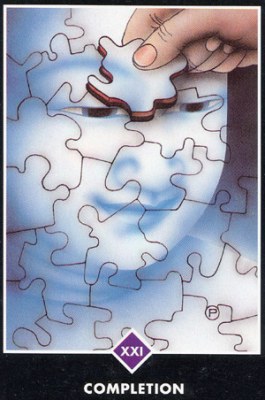
The eidolon is precisely the screen onto which the mind “projects” the image of the world it creates. According to Plato, some reflections have no original, nothing that they reflect. It is in this view that the idea takes root that the pictures arising in the mind are merely a product of description — that is, they are arbitrary. And the “mechanism” that produces these images and pictures is the eidolon.
At the same time, it would be wrong to suppose that the pictures produced by the eidolon are mere phantoms. For in a merely illusory world reflection and creation would be impossible, and therefore development would be impossible.
Therefore the eidolon creates pictures in a non-random way, on the basis of blocks of energies — potencies — formed in the World Environment.
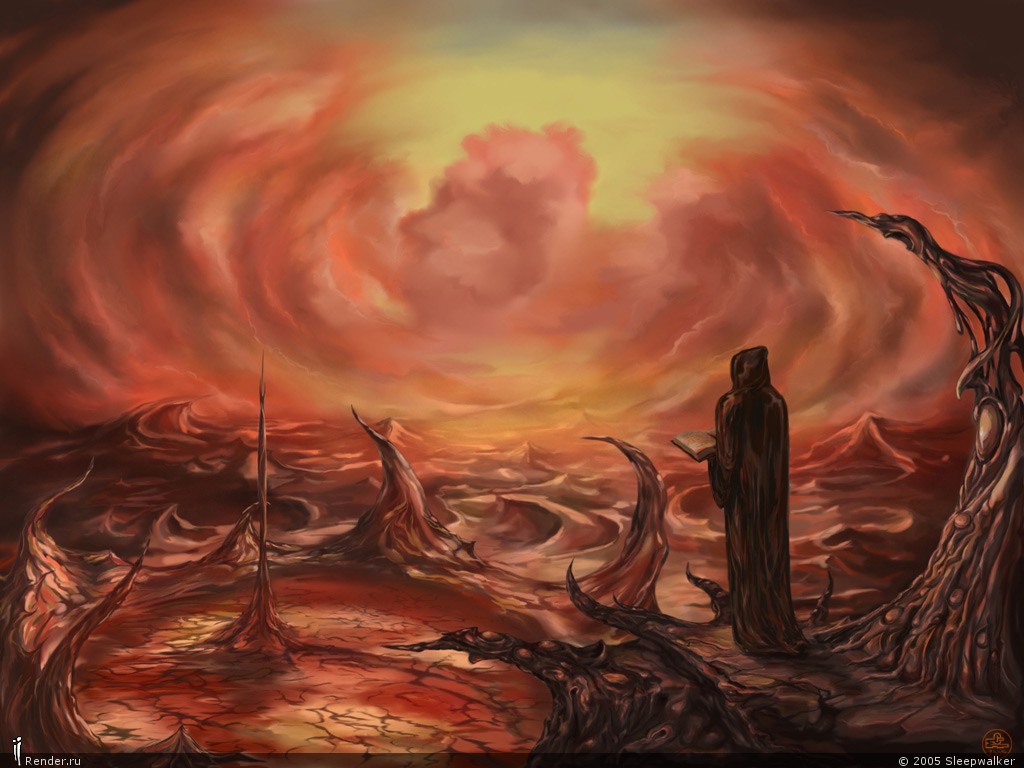
Thus the “picture of the world” formed in the mind is the result, on the one hand, of certain blocks of energies passing through the eidolon, and, on the other, of imparting conditional continuity to those blocks that arise from the representational activity of the mind.
The Magi understand that the world can be changed without violating the will of its makers (the Creator) precisely because changing the world is changing its picture. Such plasticity of the world, however, is not infinite.
In other words, for the Magus the world is not entirely real, but not merely illusory either. Magic proceeds from the fact that everything we perceive is a product of description, but this description is not entirely mistaken; it is based on the potencies of reality, although it is usually distorted by external influences on the mind.
But how to change the Eidolon if there is feedback between it and the energy blocks?
It’s not the eidolon that changes; it’s what it ‘shows’ that changes.
And how to actively (deliberately, consciously) change what it shows?
To do this, you need to change the focus of attention – shifting it away from stable, familiar objects to less noticeable objects in an ordinary state, located at the periphery of attention. By shifting attention to them, consciousness shifts the eidolon, encompassing new energies, and by shifting attention back to the periphery, the eidolon moves even further, and so on.
…on objects in an ordinary state that are hardly noticeable, lying on the periphery of attention… Is this about the white shimmering hairs…:)
Every differentiated emotion, feeling has a color. The overall matrix (the background of the eidolon), too. You can simply remove the background, step beyond it (beyond the boundaries of duality), and then the pure cosmos surrounds you, while the rays for capturing the image pass through me. There is nothing there. One can return behind the veil. Here the picture is being created.
How can one remove the background and go beyond it? Is this done mentally, by concentrating attention, changing perception? I do not quite understand this. I would be grateful for explanations. Perhaps there is something I do not understand.
Hello! I am completely confused, you called “Eidolon” a point of assembly, but also a screen… From the perspective of ‘Castanedianism,’ a point of assembly is a kind of mechanism, and what you described is somewhat a ‘modality of time’, which is precisely the screen that one can exit, a bundle of energy fields, located in the perception zone of human beings, now conditioned by the social confinement within the syntax. The point of assembly is simply a lasso grabbing emanations and gathering them into a denser flow. Don’t think that I am trying to act smart, I don’t know much and that’s why I wanted to clarify. Thank you!
… as I understood from your description “Consciousness” is the point of assembly. “consciousness as a process represents a way of translating Potentials (Absolute, Monad) into an actual state.
At the same time, it is obvious that consciousness at every moment of its existence encompasses only a limited circle of such potentials…
The assembly point is the focal point of consciousness; it works exactly like the focal point in a lens. The Eidolon, as a mechanism, seemingly includes the focal point plus the screen onto which the projection is cast. This projection is called the PKM.
In the end, is the art of managing the edolon reduced to focusing on the desired object and concentrating on its actualization? It’s easier to imagine than to accomplish…
You do this every day, bringing your urgent requests to the SCREEN of your computer and receiving various responses to them. )
Here’s the translation to English:
“I would add the following here:
The eidolon creates images not randomly, but based on blocks of energies – potentials formed in the World Environment.
…
The more interconnected these blocks are, the more orderly and harmonious the picture of the world becomes, the reflection of which consciousness observes on the screen…
And an important factor here is the =degree of interconnectedness= of the pattern (which consists of blocks).
The more interconnected the blocks are, the clearer and more sober the consciousness.”
“…otherwise, how to connect these blocks into a digestible, harmonious, structured pattern is quite another matter… ;)”
Hello Enmerkar. In your articles, Power vs. Love and Between Light and Warmth, two methods of development are described. Upon entering the flow, a certain synchronization with the world is described. State in which you are carried away; certainly, there are many pitfalls in this path, etc. I am concerned about the question of an alternative path. Your quote: ‘it is important to preserve one’s absolute selfness, difference, pinpointedness, otherwise one will not be able to form that pinpoint effect that will shift one of the reference points of the Universe.’ Does what you say indicate that this is about concentration skills as described in this article? Is this skill fundamental in terms of the efficiency of operating reference points, be it runes or something else? And also, if my conclusions are correct, is the technology of controlling the field of attention itself important? For example, in Eastern traditions, one can find a similar concept, with one difference: it is not about the screen but about the point where that well-known attention is held. Since the Western path is more focused on realization, and the Eastern on contemplation, does the specificity of attention fixation play a role in practice, i.e., is there a difference in how attention is focused when realizing through reference points?
Any consciousness can be described in two ways, which, although they are just different points of view, nevertheless imply a different way of action. On one hand, consciousness is a flow. A flow of mental processes, perceptions, their processing, reactions to them, and so forth. On the other hand, consciousness is a point of attention, a beam of light penetrating the uniform darkness of being, highlighting from this uniformity objects and phenomena. If we consider consciousness as a flow – we are in the ‘Dionysian’, sensually-creative element, and therefore the main tool becomes inspiration. In such a realization system, things happen ‘by themselves,’ but without extra energy, additional efforts – they are not sustainable. If, however, we try to view consciousness as a differentiating activity – it is more convenient for us to use an ‘Apollonian’ system, relying on reason. In such a description, one can achieve more stable, fundamental realizations, but energy is spent on their actualization and requires engaging ‘crystallization points,’ supports. So the whole question reduces to how it is easier for us to apply energy – to maintain what has already been created or to engage in the creation itself.