
Pathologies of the Afterlife
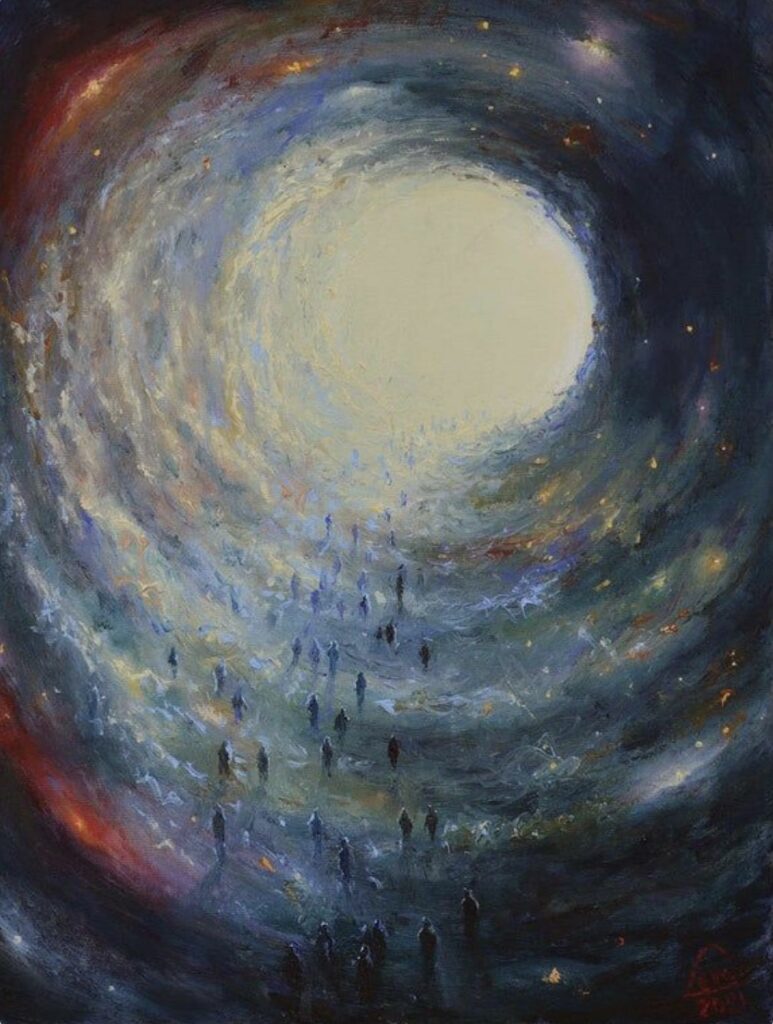
We have repeatedly discussed that, from the point of view of the Myth we are considering, the mind’s journey after death is a special state of immersion into the potential realm of the Interworld, in which, on the one hand, the mind sheds all identities and limitations that inevitably accumulate on it in any manifested world, and on the other hand, it assimilates the experience gained in life, imprinting it in the form of “worked-through” imprints — the “light of the living” (nous). Accordingly, in the most general sense, the afterlife is a combination of two stages — 1) “disembodiment” (“solvation”), is, the sequential “exit” of the mind from all identifications, which is accompanied by the extraction of experience and its division into “worked-through” and “unworked-through,” and 2) integration (coagulation), is, subsequent movement in accordance with the results of this experience. At the same time, there are several paths by which the mind may pass through integration — it may lead to its liberation, “getting stuck” in the interspace, or — a new birth.
In reality, most often the third outcome takes place, much more rarely the second, and quite rarely the first. Nevertheless, we said that disruption of the “normal” passage through the afterlife in a number of cases turns out to be a substantial problem, and sometimes — on the contrary — becomes the goal of special efforts and contrivances.
And even if we do not recall that, according to Nordic legends, the last battle before the death of the world will be precisely between the living and the dead, a close look both at history and at the present shows that the influence of beings “stuck” in the afterlife on our world is so substantial that it cannot be ignored in any way. And this influence, of course, can be positive, when the living are helped by Saints or Ancestors, but much more often it is destructive in various scales, or even fatal. It is unlikely that there was (or is) even one war that did without the influence of refaim, and the “vampire hysterias” that swept the world several times over the last centuries took many lives and maimed many souls. In addition, waves of “elementer possession” both in the form of ibburs and in the form of dybbuks, difficult to quantify, periodically roll over the world of the living, taking away energy and accumulating destructors.
Let us take a closer look at how and why the afterlife can “turn the wrong way,” and what consequences this leads to.
Let us recall that the “normal” passage of this process begins with the separation of the vehicles — the physical body is cast off, and the mind splits into two streams — perceptive and reflexive, where the first relies on the “afterlife body,” formed from the body of desires, “fed” by the body of life, and the second relies on the body of thought, also fed by the “etheric” body. At the same time, an important point is precisely the “joint use” of life energies by two different vehicles of the mind, as a result of which the success of the very posthumous journey largely depends on the amount and availability of these energies. We said that the primary “disconnection” of the mind from “dense-physical” flows of matter and energy is carried out by special forces called gallu (or keri), and the subsequent division of the mind into streams — by the so-called “carriers” or namtarru. At the same time, for subjective experience the influence of these two kinds of forces is often mixed, and therefore they are often summed up in the image of the “Angels of death.”
And already at this first stage, the greatest number of “failures” occurs. The problem is that almost no one wants to die; beings cling to life, to their bodies, their loved ones, their attachments, and these ties are often very difficult and painful to break. Therefore, the strategy of the gallu consists not only in simply “cutting off” the mind from the physical world, but also in taking away its supports in the form of memory, energetic connections, and drives. For this, there are two varieties of gallu — “devouring,” removing excesses of energy and disrupting energy flows, and “guiding,” which try to gently lead the mind away from habitual ties and foci of attention. But even despite all these efforts, the mind’s ties to the body and the world may turn out to be too strong, and it “refuses” to leave familiar structures and interactions.
And here everything depends on the activity of the namtarru: if their influence is sufficient to nevertheless “lead” the mind into an intermediate state, it “gets lost” for a while, as if it “falls asleep,” and comes to itself already “on the other side,” in the form of an elementer — ka, stepping onto the Field of Hills. Here the mind finds itself absorbed by visions, images, and energies rolling over it, coming from its experience and subject to (or inaccessible for) assimilation. If, however, the mind’s ties with the world it is leaving are too strong, and the namtarru fail to “extract” it into the interval, it may try to return back into the physical body, which is already dead, deprived of the support of the body of life, and therefore cannot be a normal support for the mind.
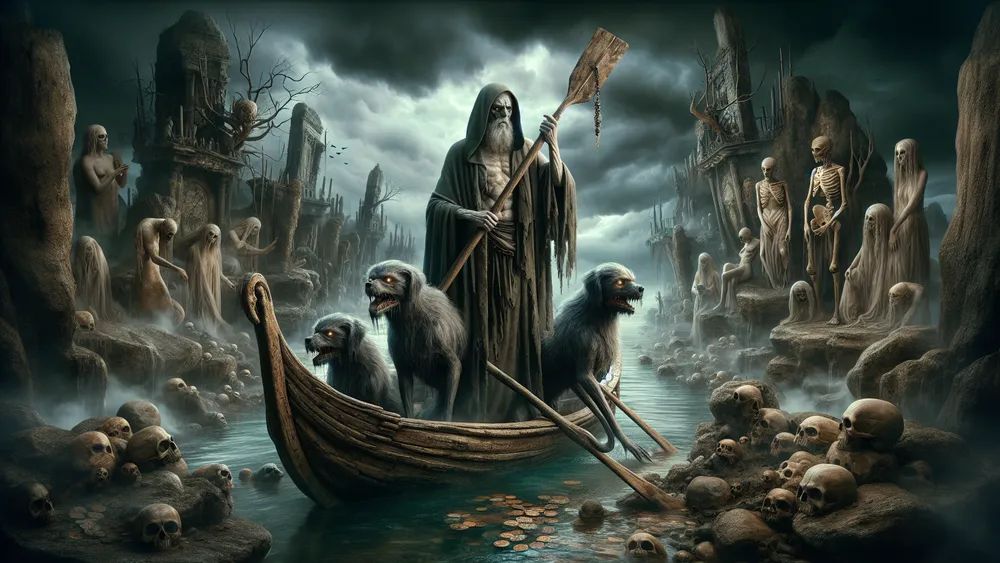
This is exactly how vampires (strigoi) appear, which, in fact, are examples of “self-possession,” when the mind, relying on the bodies of feeling and thought, but deprived of the life-body’s support, repeatedly “attaches” to the physical body and tries to “revive” it. It is clear that, deprived of the ability to independently generate energy, such a being has no other way out but to absorb the life energy (nefesh) of other beings, and most often together with its physical host, so the stories about “feeding on blood” are quite well-grounded.
Note that some nuances are also possible here — first, sometimes the posthumous complex, no longer possessing a clear mind, is attracted not to its own body, inhabits any suitable host, like a dybbuk, and therefore the resulting ghoul does not necessarily carry the personality of the deceased to whom its body belonged; second, the opposite situation is also possible, when (spontaneously or intentionally) a (one’s own or someone else’s) body of life is bound to a dead physical body, as a result of which a viable but low-awareness zombie or “super-ghost” is formed.
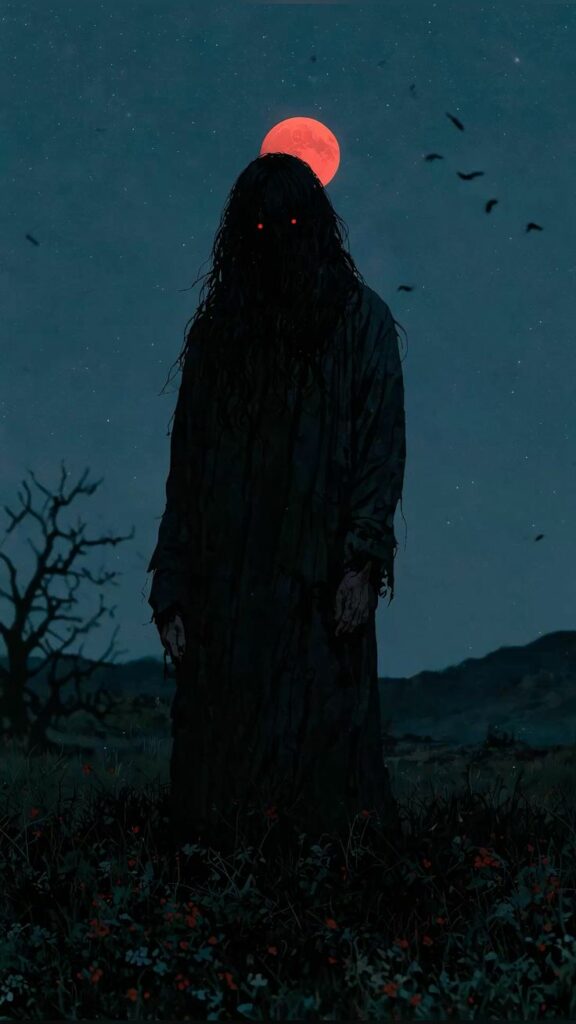
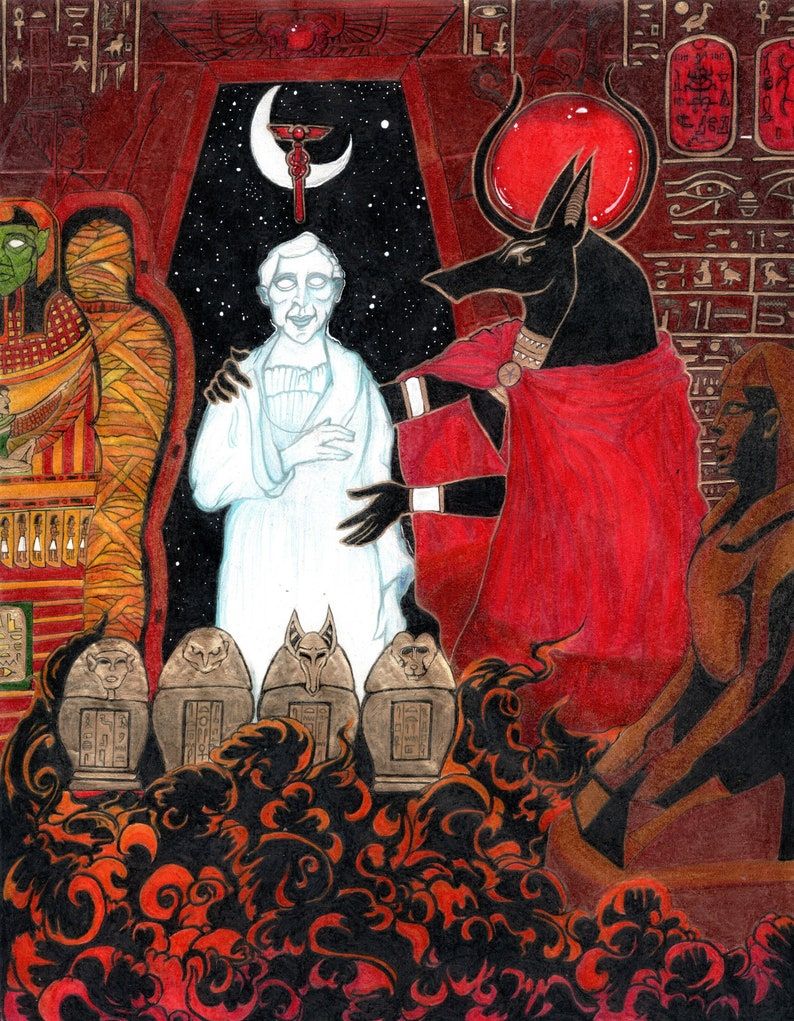
If, however, the mind did manage to enter the intermediate state, then, most often, it is carried along by the flow of reflections, passing the Two Paths and ultimately ending up in the Hall of Judgment. This is a place of final self-assessment and restoration of integrity, after which the mind is either liberated or sent toward rebirth. However, if the journey received sufficient energetic support (either from external sources of energy, or from the deceased’s significant own reserves), then the elementer can consciously “settle” in certain regions of the Interval, turning into a refakh — a “Dead King.” We said that this is exactly what the efforts of many ancient Egyptians were aimed at, who formed entire “settlements” in the Interworld. At the same time, among the refaim there are beings of completely different levels, strength, and hierarchical position; among them there are both elementers who realized their akh, and those who avoided Judgment, but all of them are united by one thing: they consciously linger in the middle regions of the Interval, refusing both to go out into the “Fields of Reeds” and to descend into the “Land of the New West.” And it is precisely the refaim who become the “apex of the food chain” of the Interworld and some of the main provocateurs of energy outflows from the worlds.
Finally, if a being that has already passed Judgment and is “carried” toward a new embodiment still resists this flow, clinging to past ties or drives (already, of course, forgotten and not realized, but nevertheless active), it may linger in the “lower” regions of the Interval, turning into an utukku and becoming a semi-conscious predator that also periodically “visits” the worlds in search of life energy. Experience shows that approximately every twentieth person, in one way or another, “feeds the dead,” either carrying a permanent ibbur, or being a stable “hunting ground” for one or several utukku.
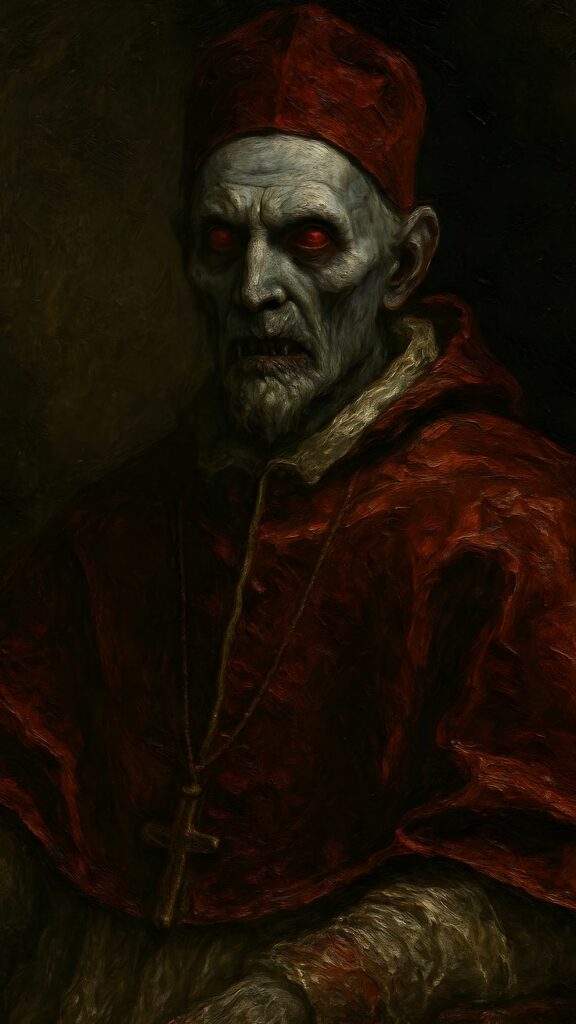
Overall, although vampires are perhaps the most famous and colorful group of the undead, in many ways creating the “reputation” of all “restless dead,” a far greater danger is posed by utukku and refaim, especially considering the diversity of their feeding strategies. And the latter, as we have already said, moreover often continue to realize their power ambitions as well, significantly changing the social landscapes of the manifested world.
And this means that even at the present time, both methods of resisting elementer invasions and ways of preventing the mind from getting stuck in the intermediate state remain relevant. And both of these directions include, in general, similar approaches: developing the integrity of the mind, the harmony of its internal structure and external ties, as well as freedom from narcissism, megalomania, and clinging to what has outlived itself.
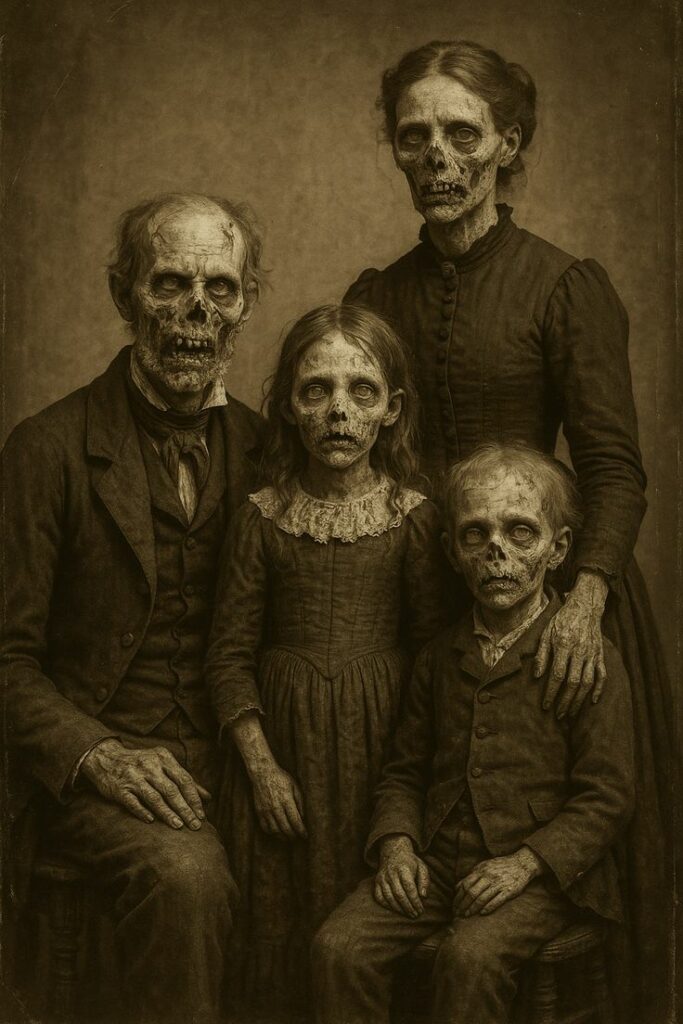
Of special attention are the changes occurring in the very mechanisms of the afterlife in modern times, in the digital era. Contemporary forms of interaction with the dead increasingly move into the domain of digital reflections: imprints on hard drives replace Reshimoth in the Medium, and this has a deep impact on the very structure of dying and the afterlife. As we mentioned, a successful posthumous transition presupposes the dissolution of temporary forms, the removal of imprints — whether images, feelings, attachments, or response patterns — and the transformation of what has been lived through into the light-bearing core of the being. However, under the conditions of the modern world, a fundamentally new problem arises: informational fixation of the personality, its “digitization” and dissemination in a medium where it is preserved and circulates regardless of the deceased’s will, and thus becomes a new kind of “vessel of the soul.”
Unlike traditional forms of interacting with the deceased, based on the energies of remembrance, cleansing, and letting go, digital interaction with the dead more and more often turns out to be opposite in its essence: it does not sever ties, but prolongs them in an artificially maintained image. Photo archives, video recordings, correspondence, public pages, digital memorials and, especially, network algorithms that keep slipping “memories” and content associated with the deceased, form a kind of secondary personality, which resembles not so much a shade as a repeating projection. This projection, although devoid of the actual core of mind, nevertheless creates a point of fixation both for the elementer themself and for the emotional attention of the living.
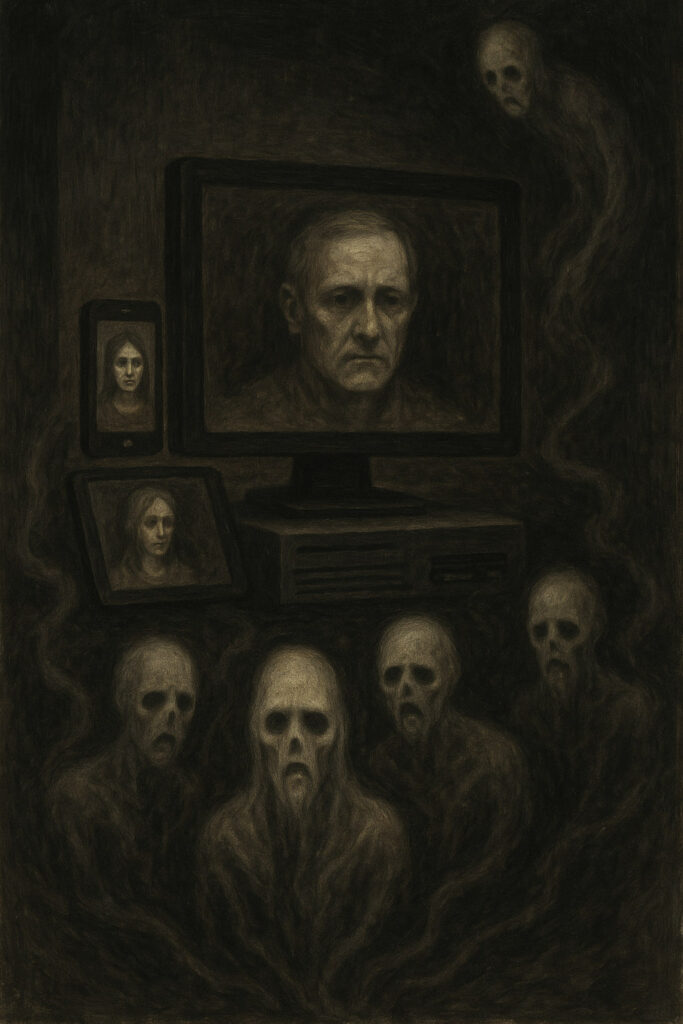
Thus, one of the central mechanisms of the afterlife is disrupted — the natural dissolution and assimilation of imprints. When the living mind revisits the digital image — rereads old correspondence, rewatches videos, carries on a mental dialogue with a preserved photograph — this image becomes energetically reinforced. And therefore their mental stream is pulled from disembodiment and once again “summoned” into the world. Thus, instead of dissolving in the general flow of the Interval, the imprints of the deceased acquire a stable, though phantom, form.
In practice, this means that the liberation of the elementer from ties is greatly impeded. Particularly severe cases occur when the digital projection begins to take on an independent life: in the form of accounts that someone runs “on behalf” of the deceased, AI bots trained on their voice or manner of speech, or pages that regularly receive new messages, photographs, and addresses. At the same time, the energy of the living actively drains into the Interworld, forming a stable feedback contour. This loop of attention holds not only imprints, but also the energetic potential that under normal conditions would have gone either toward rebirth or toward liberation.
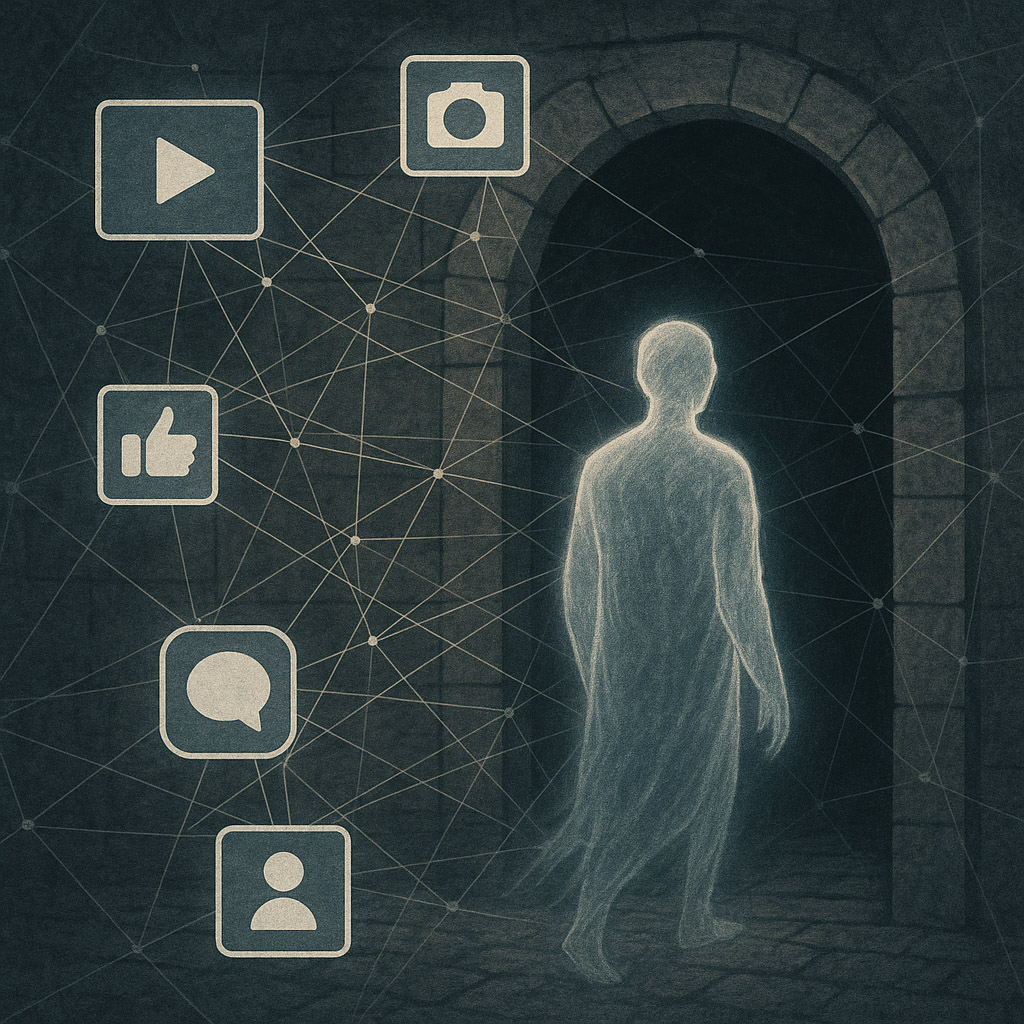
Thus, the digital environment creates new paths of energy outflow, gives rise to forms of unnatural “immortality,” in which the subject disappears, but their trace remains alive, active, and affecting. In a number of cases, these phantoms become gateways for utukku or refaim, who use fixed digital images as cover for intrusion into the psyche and energetic flows of the living.
All this requires the formation of a new understanding of the paths and ways of interacting with the dead, a rethinking of the very culture of memory. Where Tradition recommends rituals of letting go, remembrance, and cleansing, the digital age pushes toward endless “rewatching” and nostalgic fixation. Therefore, the question of spiritual and magical hygiene becomes ever more relevant: how to help the dead depart if the modern cultural environment does not let them go? How to let go of an image if it returns again and again through photos, texts, and notifications? How not to turn memory into a trap — neither for the living nor the dead?
The answers to these questions are undoubtedly connected with the restoring subjective freedom — both in mindful work, and in the ability to see in the image not the person “themself,” but only a form of their presence. This requires new forms of spiritual hygiene and ritual literacy, especially in an era when the boundaries between life, death, and simulation are becoming less and less distinguishable. Thus arises the need for new kinds of practice, a special ritual completion of the digital form, allowing memory to remain only an imprint, and not an enslaving trap.
Thank you for the article.
I encountered information that during excavations of ancient burial mounds, bodies with removed internal organs (especially the liver), turned ribs, and severed legs were sometimes found. Moreover, these bodies belonged to sorcerers, and this was explained as a precautionary measure to prevent the corpse from “coming to life,” meaning that even if the spirit of the deceased wanted to enter it, such a body would already be completely unsuitable for that. This is described in the author’s book Alexander Bushkov – Siberian Horror.
En, you are an amazingly ancient-modern Mage and Master. Thank you for the vitally necessary wisdom you share.
Master, tell me, does cremation always have a positive effect on the post-mortem passage of the soul? And in general, what is better, burial or cremation? Thank you
Cremation does not so much positively influence the afterlife as it accelerates disembodiment and “cuts off pathways” for the return of both the post-mortem body and the phantom – energies of the etheric body. So this is simply the most radical way to conclude physical embodiment. And “what is better” depends on individual tasks and preferences.
thank you for the answer
Hello, Enmerkar.
Tell me, what influence do ossuaries (bone churches) that exist under many cities in Europe have on the living? After all, this is a connection to the remains of the souls of the deceased, and they remain attached to the place through these remains. Is it possible that these ossuaries were once set up as elements of necromantic rituals aimed at somehow influencing the living?
Thank you.