
Liberation in the Afterlife
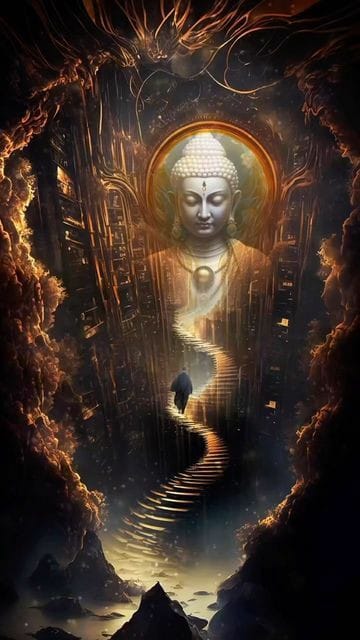
As we have already noted more than once, studying the geography and the principles of construction of the Intermediate is important for two reasons:
firstly, because it is precisely there that the main predators are located, consuming the energy of beings, and
secondly, because posthumous wandering through the Interworld awaits every being, and its success largely depends on the degree of preparedness.

The success of posthumous wandering can have two outcomes:
- at a minimum — minimal energy loss ensures minimal suffering as well, reduces the danger of getting stuck and becoming an utukku, and also contributes to an optimal exit into rebirth;
- at a maximum — the afterlife provides unique opportunities for the mind’s exit from Gilgul (true, only if the corresponding resource was developed during life).
It is clear that for a Magus the greatest interest is precisely the latter possibility. In it, in turn, two levels are distinguished: “temporary” and “absolute.”
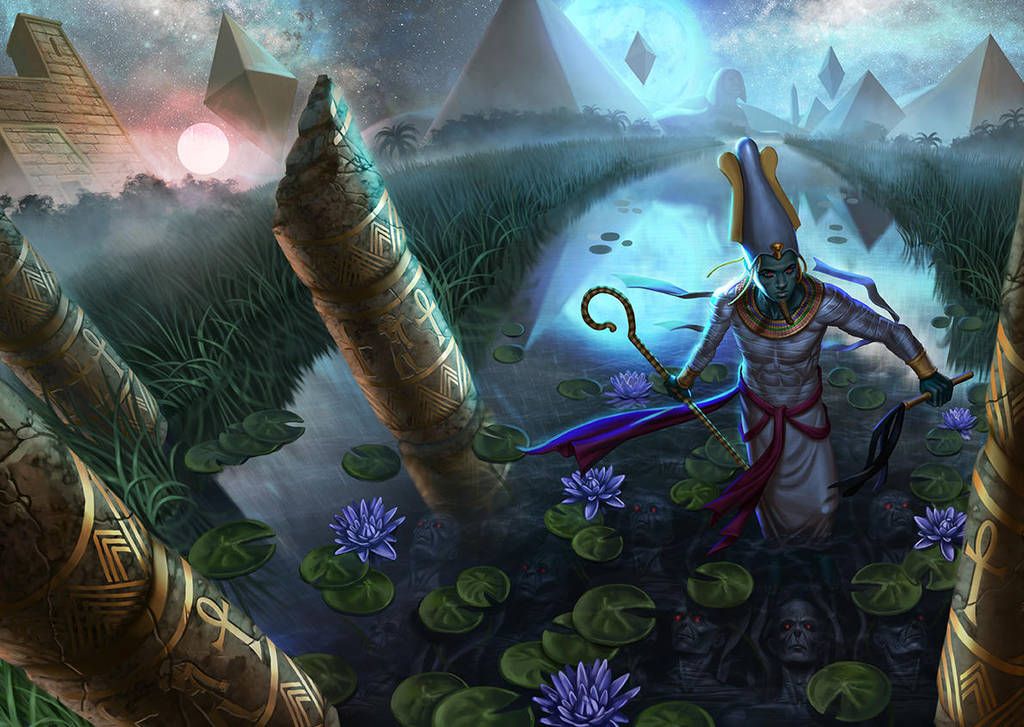
By a “temporary” exit from Gilgul, this Myth interprets the mind’s transition to integrated existence in the “higher” spheres of being, which are known to Buddhists under the name “Pure Lands” (Buddhakṣetra), and, for example, to Egyptians — as the “Fields of Reeds.” Such a transfer of the mind offers strong potential for complete liberation — the attainment of the pleromic state (or, in Buddhist terminology — Tib. tarpa, Skt. abhimukti).

At the same time, although the Intermediate state provides favorable opportunities for liberation (due to a significant weakening within it of the “streams of habits” — destructive drives developed in the stream of the mind), it lacks resources to use them. Accordingly, it is possible to use the opportunities of the weakened bonds of Yetzer hara in the Intermediate only if the skills necessary for this were developed during life.
Two fundamentally different approaches to such development are known — the “Western,” or “initiatory,” consisting in instilling into the mind-stream a steady cognitive impulse and reflected in the “Book of Going Forth by Day” (“The Egyptian Book of the Dead”), and the “Eastern,” or “contemplative,” consisting in training the mind-stream to see the world as reflection (it is described in the “Bardo Thodol”). Both approaches include the skills of recognizing forces and phenomena that appear to the deceased in order to “break through” their constraining influences toward the “pure mind” shining through the gaps in the Intermediate’s coarse fabric (Egyp. akh, Tib. rigpa).

At the same time, on the Western path these forces are precisely “overcome,” whereas on the Eastern one they “dissolve,” but in the end cease to be obstacles, “veils” on the path to liberation.
When they say that the ancient Egyptians “lived in order to die,” they do not mean that they were gloomy nihilists; on the contrary, they imply that they valued the time of life and tried to make the most of it in order, in the Last journey, to attain the Pure Lands or the Radiant Akh.
Reenacting the posthumous state in mystery dramas, a detailed study of the Names of the Gatekeepers and the geography of Duat, Contest rituals and other approaches and techniques of the Western tradition familiarize the mind with such recognition. As a result, the mind is firmly centered in itself, stops heeding alien voices quickly, and such a habit (although, of course, also greatly weakened in the Intermediate) increases chances of passing dangers and traps of the posthumous experience, and to achieve “minimal” or even “maximal” success in it.
In exactly the same way, the ability developed in meditative sessions to see the “pure mind of clear light” makes it possible to recognize it at death and either enter it to attain full liberation, or, at the very least, to obtain a blessed rebirth.
In any case, work on harmonizing one’s being, integrity and self-identity is not only the “development of Merit,” ensuring the evolution of the mind; it is also creating a chance for liberation during posthumous states and spaces.

Good day, esteemed great traveler!
Do you think that daily repetition of mantras (for example, among the Krishnaites) will lead to liberation from gilgul?
Hello.
Repetition of mantras by itself only teaches the consciousness to be one-pointed. But this one-pointedness, when properly used, can indeed lead to liberation.