Draugars and Einherjar
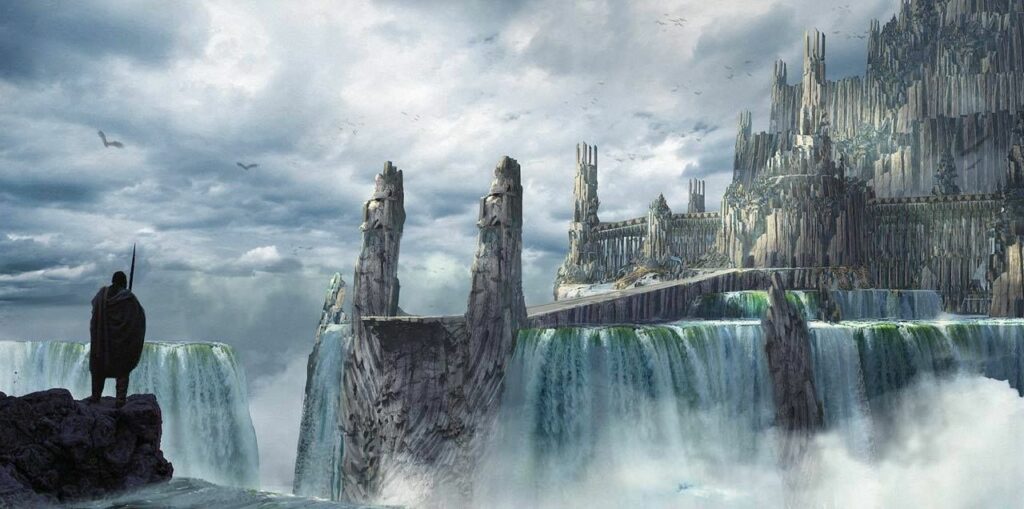
Another unique feature of the Nordic myth is that it not only outlines various “borderline” states and levels of consciousness, but also offers an entire body of methodological guidance for working with them.
One such “borderline” form is the “restless dead” — beings poised on the edge of life and death, yet not crossing completely to either side. If virtually all cultures and traditions describe one group of such beings — vampires, then Scandinavian legends speak of two more important forms — “undead” (draugars) and “warriors” (einherjar).
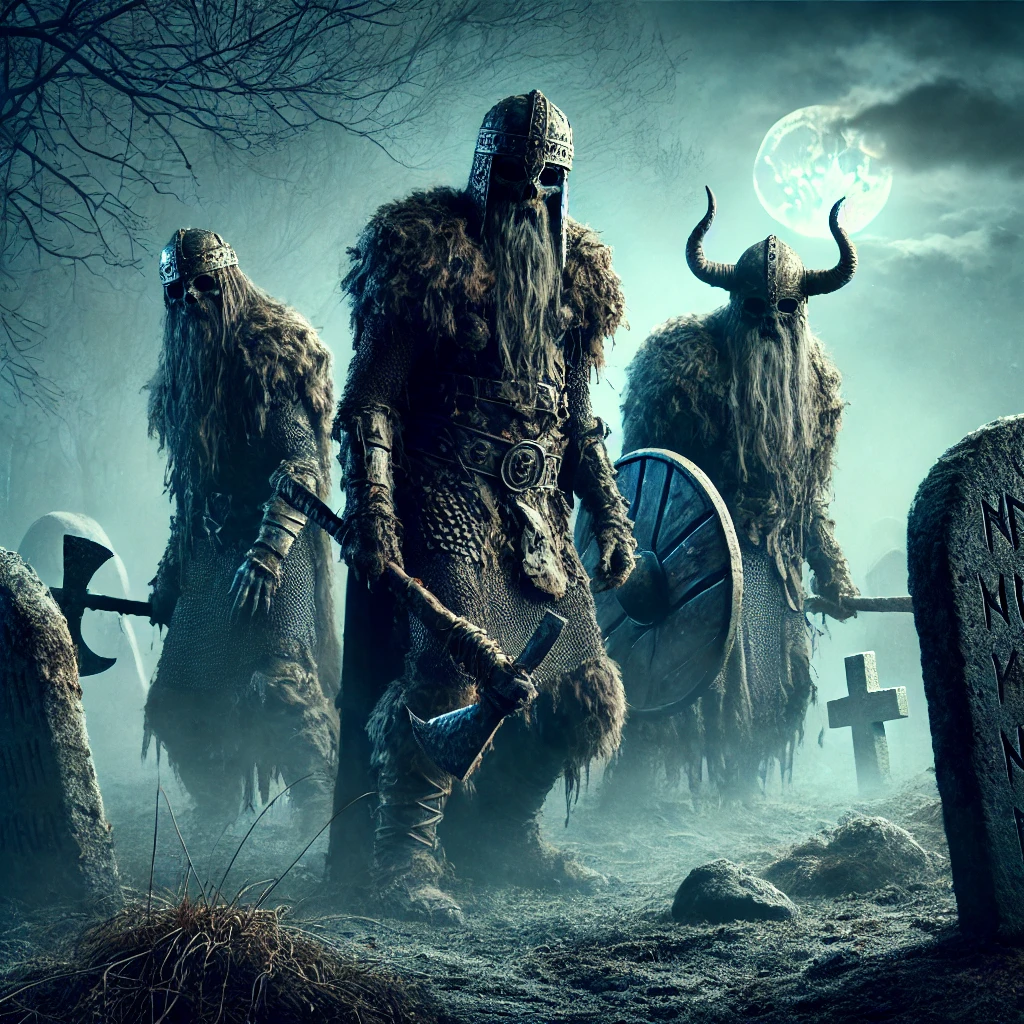
We have already discussed the tradition of creating draugars, widespread in ancient times.
However, of no lesser significance is the army of the einherjar, the “guard of Asgard,” defending the worlds from invasions of “evil” dead.
Contrary to widespread interpretations, neither the einherjar nor the valkyries who “choose” them are “incorporeal” beings. Both have a physical body which acquires a semi-divine quality. The einherjar are not fully dead warriors, but rather mortally wounded, dying heroes whom the valkyries must find and bring to Valhalla before they die. If the valkyries do not find them in time, their souls will go to Hel — the abode of the dead.
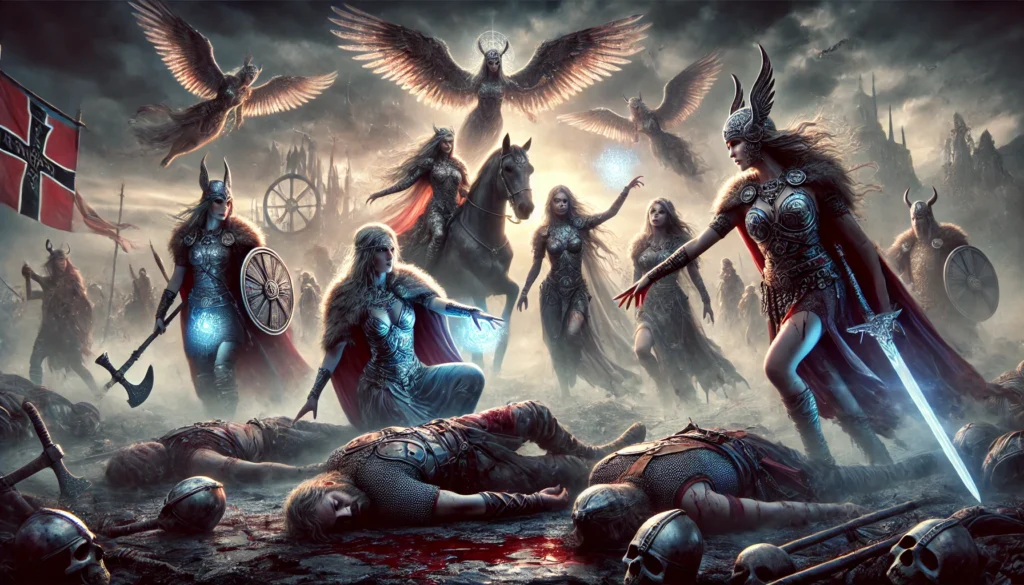
Einherjar who make it to Valhalla continue to exist in a state of “eternal dying”: they take part in battles, receive wounds, and each evening they come back to life again. This gives them a dual nature — they are simultaneously both alive and dead, expressing a tense readiness for the great battle of Ragnarök.
In the same way, the Valkyries are special beings: on the one hand, their connection with Odin and their ties to the afterlife endow them with supernatural qualities, but in myths one often encounters mentions that they can be wounded or even killed. In a number of legends, valkyries form relationships with humans, which emphasizes their bodily, and therefore mortal, nature, albeit with considerable magical protection and power.
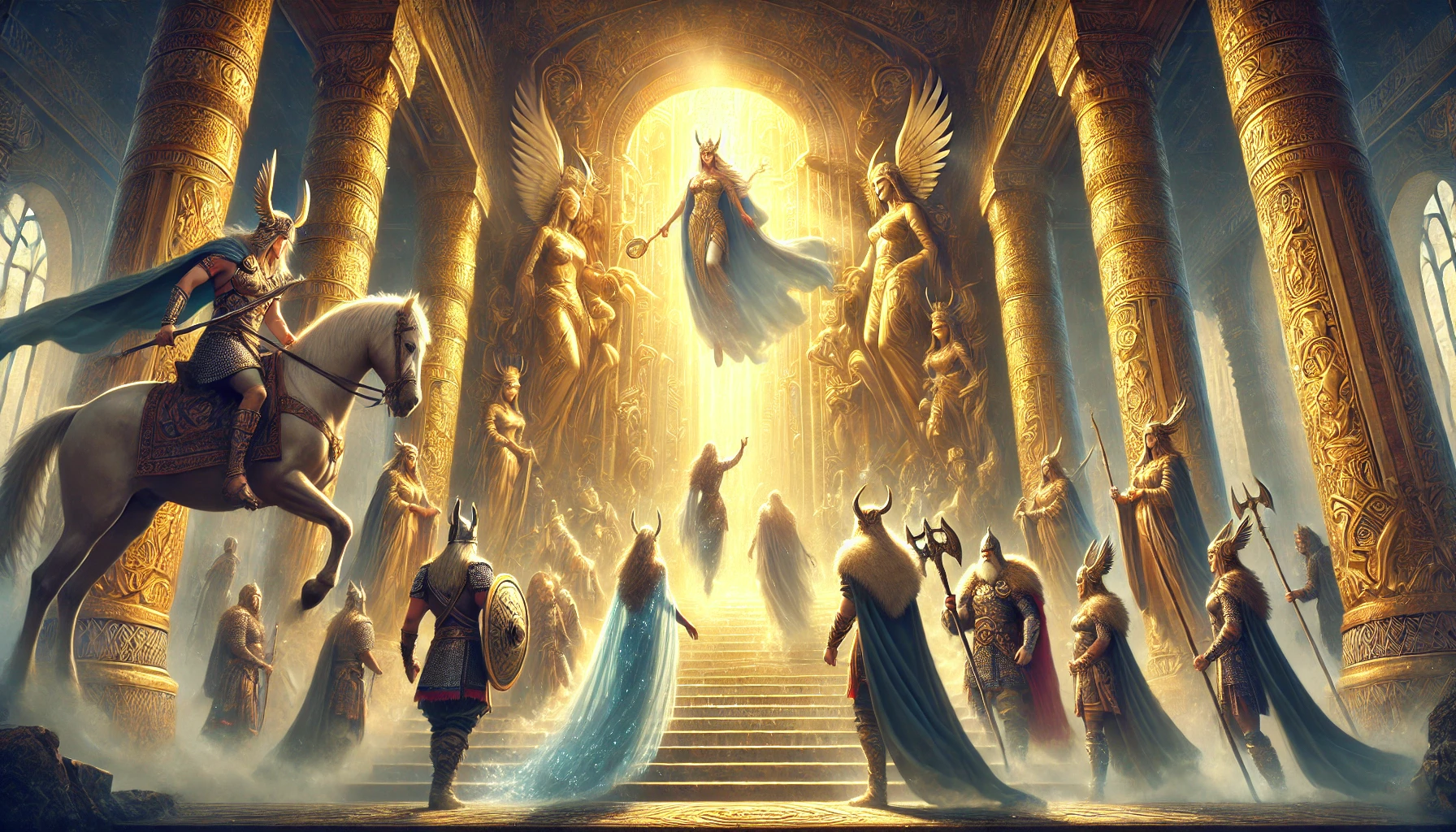
Accordingly, Valhalla and Fólkvangr are special intermediate spaces, “waiting halls,” where warriors between life and death continue to exist, training for the coming Ragnarök. This space is intended for heroes who are neither fully alive nor fully dead: they fight, are wounded, die, and come back to life again. In this sense, Valhalla and Fólkvangr are unique spheres where beings remain in a special cyclical state.
Sources that sustain the einherjar’s vitality in their special state of “undeadness” are two magical creatures associated with Valhalla: the boar Sæhrímnir (“Boiled-and-smoked”), killed and resurrected daily, whose meat serves as food, and the goat Heiðrún (“Light-heavenly”), from whose udder flows life-giving mead. These animals are the sources of the life force that nourishes the host. In this sense, Sæhrímnir embodies the same principle of rebirth as Thor’s goats — Tanngnjóstr and Tanngrisnir, also resurrecting after being eaten or sacrificed. They express the world cycle of repetition, the yearly circle, and in general — self-sustaining natural cycles. Heiðrún can be compared with the cow Auðumbla — a source of life force, from whose udder flowed the four Rivers of Life that nourished the Proto-Giant Ymir. At the same time, the image of Auðumbla connects two hostile, opposing groups of beings in Old Norse mythology — thurses and Aesir, since she fed the frost giant Ymir with her milk and brought forth the god Búri — the forefather of all the Aesir and ancestor of Odin. Thus, she personifies a source of life force undifferentiated and undirected, and therefore universal.
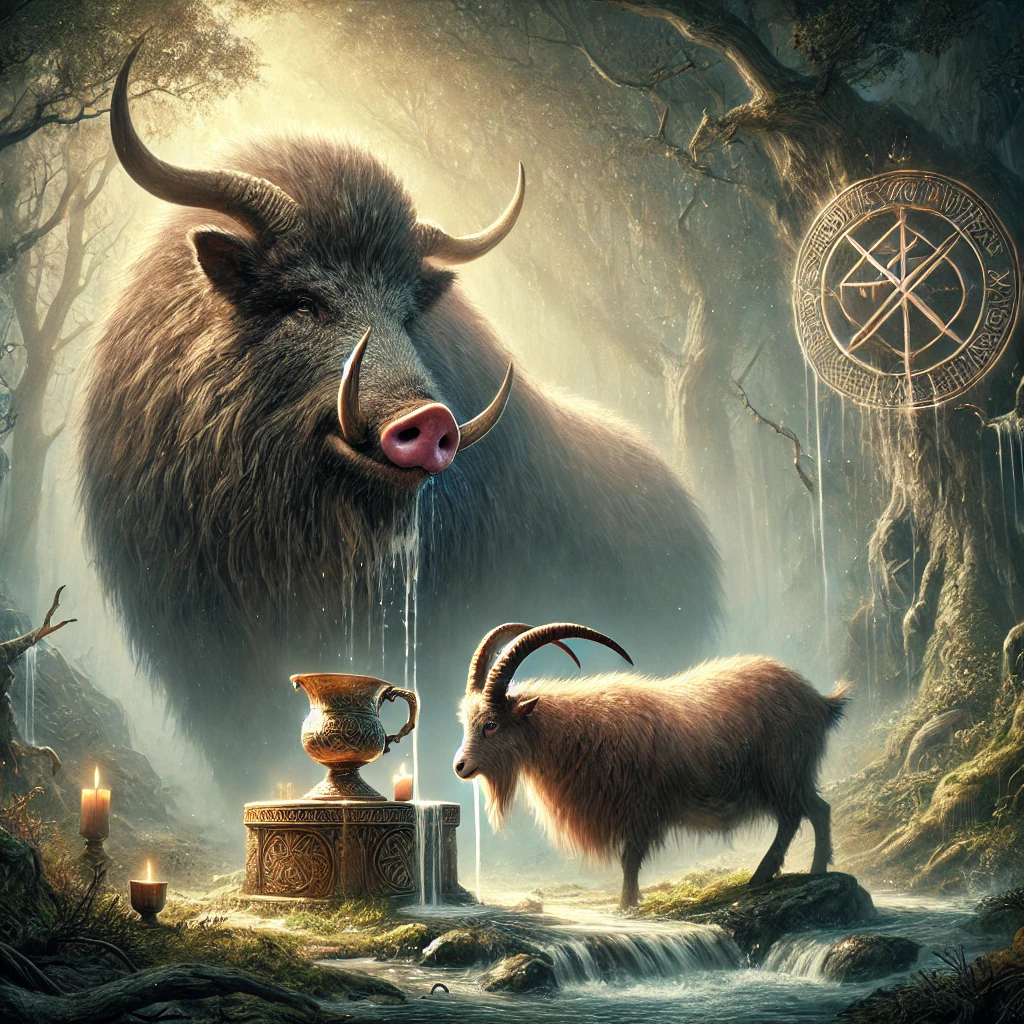
Thus, Valhalla is a “universe in miniature,” with its life cycles and sources of energy. In a similar way, Fólkvangr is the same kind of “self-contained” world, in which the role of the energy source is performed by the Great Goddess of Life — Freyja, and the cycle is maintained by the warriors’ sexuality, driving energy flows.
The notion of such subspaces is important for a holistic approach to describing worlds and the Interworld because it shows that the boundary between them is often unclear, and with corresponding energy sources present, it becomes blurred altogether. It is important to understand that the great confrontation of Ragnarök is a conflict of life and death, order and chaos, and therefore only living warriors can fight for the gods in it — and these turn out to be the einherjar.
Hello, Enmerkar.
What can a person feel when encountering someone from the restless dead (vampires, ghouls, undead draugrs, etc.)? Decline of strength, confusion of consciousness, overwhelming weakness? I once experienced that when I spent the night in an abandoned village house in a very desolate area, I fell very ill, to the point where I thought I would die – barely survived the night, experiencing a severe headache with a fever. Another person who accompanied me got bitten by a mosquito on the eye, causing it to become very red and swollen. At that time, this incident seemed very strange to me, and later I began to understand that this is how an attack by some aggressive otherworldly spirit might manifest.
Also, when describing contact between people and elves somewhere in the woods or mountains, it is mentioned that a person may suddenly be overwhelmed by irresistible sleep, which is almost impossible to resist, and having fallen into such sleep, they may find themselves in their world.
Can you comment on this based on your experience?
Thank you for the article.
Hello.
Regarding contact with the undead – of course, the first sign will be a loss of energy.
As for elves or other fairies – it depends on which ‘Court’ they belong to.
If it’s fairies from a good court, they will most likely try to avoid the meeting or erase the memory of it.
If you encounter the ussi-das, then, of course, loss of energy or even abduction is a quite probable outcome.
Please tell me, are these states when it feels like the end has come, and you can’t do anything, perhaps a repayment of some very old and very large debt to those “non-living” beings? For maybe, at some point, we were companions, even close beings?
In honor of the upcoming Samhain, an analogy arises between the riders of the Wild Hunt, who, it is believed, can kill any traveler they meet and take them with them, and the Ussida. Are these different beings or different descriptions of the same phenomenon in essence? Thank you.
The Wild Hunt (https://en.enmerkar.com/myth/dikaya-oxota) is precisely the reverse process; it is the “hunting” of spirits and the dead that have escaped from the otherworld, which are attempted to be returned. However, considering the scale and spontaneity of this phenomenon, it is certainly dangerous for living travelers who encounter it.
Dear Enmerkar, thank you for the article. How can a person remain invulnerable? There, the Archons drain energy, there are predators of various kinds. Is it better to be constantly in the Flow of some tradition, or conversely live the life of simple citizens: home-work-series-food?
To be completely ‘invulnerable’ and avoid energy losses is unlikely possible in principle (at least until we achieve full realization/full enlightenment). However, one can (and should) strive to minimize these losses, and to do this, work on the integrity of one’s consciousness is required. It is impossible to take energy from us without our consent, but our problem is that our consciousness is fragmented, and some of its parts do not know what is happening with others. Thus, when we attain integrity, when our attention becomes the rightful master of our psycho-cosmos, we begin to ‘miss blows’ much less often and disperse energy.
❤
Thank you for the interesting and explanatory article. I have read somewhere that there is also mention in myths of a “non-Helheim” place for holding the souls of drowned people, somewhere under the authority of Njord, as I understand it, but the context of the article is different, not about quantities, but about qualities and their comparison.
Thank you for your wisdom!
Mila, yes, it is certainly better to be in a state of home – work – food (degradation – emptiness) :)))