
‘Breath of Bones’: What Do Ghosts Want?
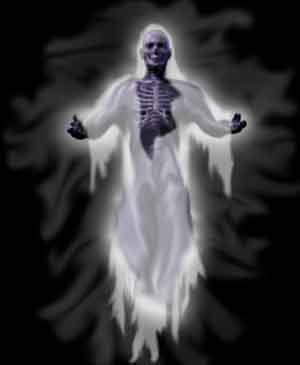
Perhaps almost everyone, at some point in life, has in one way or another encountered ghosts, phantoms, poltergeists or other similar “paranormal” phenomena. Mass culture, which exploits the sense of the Stranger evoked by ghosts and delights in unsettling people, has reproduced these images, creating a rather romantic — but, unfortunately, far from accurate — picture.
According to common belief, all ghosts without exception are, in fact, Elementers, “stuck” between incarnations, kept here by strong attachments and seeking release or the “settling of debts.”
At the same time, careful analysis shows that this is true for only a tiny fraction of “ghosts”; the overwhelming majority have almost nothing to do with the personality of the deceased and are merely “imprints” of their power, of their life. Such “imprints” are traditionally called “Breath of Bones” or Guf / Khuš ha-Guf.
In fact, the Breath of Bones is a decomposing etheric body, perceived due to a combination of certain psychological and physical circumstances.
Namely, most ghosts are not wandering souls, but remnants of the living body, scattered by “etheric” winds. Just as a scrap of clothing snagged on a tree and whipped by the wind can create the illusion of a living creature, so the remains of the living body produce a similar impression.
Nevertheless, it would hardly occur to anyone to “rescue” clothes hanging from branches, yet cases of “magical rescue” of “ghosts” (and other interactions with them) have become increasingly common recently.
For this reason this post was written — I would like to spare honest but naive seekers a waste of effort and pseudo-magical practices. If you truly want to rescue someone, you should look for those who genuinely need it, rather than fuss over decomposing remnants — a sad, but natural, sight. Moreover, the romantic image ascribed to Elementers is also very far from reality, since most of them are not “unfortunate victims” but “unfortunate predators.” To determine whether a given ghost is an Elementer bearing the core of a personality, or a Guf / Khuš ha-Guf bearing only its imprint, you only need to check at what power level your interaction occurs. Regardless of what keeps an Elementer from further embodiment, it is always vampiric. Deprived of a physical body, such an entity is also incapable of generating energy and therefore desperately needs inflows of life force, which can only be provided by living beings. That is, any interaction with an Elementer drains life force, possibly causing the living to lose life force, depending on the power balance between the living person and the disembodied entity. At the same time, Guf / Khuš ha-Guf, although they may look frightening, exhibit vampiric properties only if a living person pours life into them. In other words, any loss of life force in this case is purely psychological and starts with the person who is losing power. It is precisely this danger I wish to warn against — do not pour life force everywhere where it’s missing. It follows that an encounter with an Elementer is always a struggle; an encounter with the Breath of Bones, however, is like an encounter with any corpse — unpleasant, ritually unclean, but not inherently dangerous — provided you avoid mistakes.
Can we refer to elementals as vampires that come in dreams from the deceased, warning about danger (and often truthfully)? And why do the deceased always call to join them?
The space of dreams is an area of elements, but, nevertheless, the images of the dream are mostly projections of the psychocosmos.
What are the features of elementals and Kush-Ha-Guf in relation to the Wild Hunt?
The Wild Hunt as a phenomenon is precisely aimed at eliminating elementals from the manifested world. The breath of bones is an element of this world; the Hunter does not gather corpses, he only drives away the revived dead. The Wild Hunt as a ritual can also lead to confrontations with elementals, although it is primarily aimed at overcoming oneself.
If the body and, possibly, its parts can be a point of support holding back the process of disembodiment, how dangerous can organ transplantation (transplantation) be? This question is by no means trivial.
Well, not that it’s “dangerous,” but of course it cannot be indifferent – a deceased person, part of whom continues to live in another person, certainly cannot completely disembody and remains in the Elements (as, however, do those whose bodies are used in anatomy for training and in museums and institutes for study). How dangerous this is depends on the person themselves – some of them tolerate this “stagnation” relatively calmly, while others turn into a demonic creature.
How does it stand with Blood on this matter? Regarding its transfusion, I mean.
To what extent is the opinion true that spirits are tied to a place and cannot leave it? And if they can, then only by joining a body?
Thank you.