Separation of Conductors and the “Etheric Body”
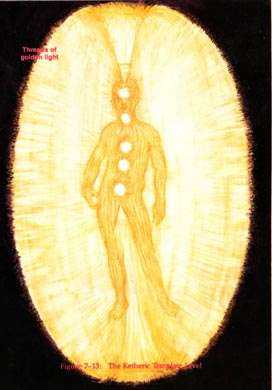
In one of our previous discussions we mentioned that on the physical plane a person has two conductors. The first is traditionally called the “physical” one, and the second the “etheric,” or “life” body. Let us try to clarify this.
Since ancient times people noticed that, alongside the “dense” body, there exists another conductor of consciousness, as if “superimposed” upon it. The ancient Egyptians called this conductor the Ka of a person. The Ka was the bearer of the creature’s “life-force,” the “breath of life” (yet the life-force itself — Hu — was not identified with its conductor, the Ka). They found that Ka existed not only in humans but also in animals, plants, and even gods manifesting in the physical world. Often one god could be the Ka of another — for example, the Nile (Hapi) was regarded as the Ka of the god Ptah. In tombs the Egyptians placed empty sarcophagi specifically so the Ka could find refuge there. According to Egyptian belief, the Ka dwelt in the tomb together with the body, but often left it. It was thought that the Ka needed food, so they ensured there was always food in the tomb so that the Ka would not have to wander in search of sustenance.
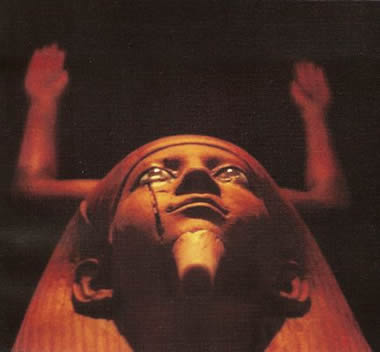
The concept of Ka was developed by the Kabbalists into the concept of the “lower soul” — Nefesh, which supplies the vitality of the dense body — the “Guf.”
The Egyptians observed that when a person drowns, falls from a great height, or freezes, the life-body departs the dense body and may then return to it. The life-body has the shape of the dense body and is quite ordered: one can distinguish organs, currents, and so on within it.
It is on the basis of the Ka that the Dream Body is built on the Ka; it is the Ka that underlies the formation of the “aura.”
In fact, the Ka is the next evolutionary form that the conductor of the physical plane is meant to assume. The Ka is not separable from the Guf it animates; it simply indicates the particular manner in which a given life manifests in a person, especially in that which moves within a person even when the consciousness is asleep.
In the current state of development, the Ka and the dense body are closely linked — together they form the conductor of the physical plane, and neither of these parts can exist entirely independently of the other. On the one hand the Ka receives energy from the dense body, yet on the other it gives the dense body the capacity to receive energy, imparting vitality.
This means that the dense and “life” body are in a dual relationship; accordingly, men generally have an attractive Ka, while women have an expansive Ka.
But what, then, does it mean to have two conductors on the physical plane?
It turns out that the separation of conductors is an evolutionary process: on the mineral level the mind does not have a Ka, and therefore lacks manifestations of vitality. It is the Ka that gives the mind the capacity for active influence on the physical plane, whereas the Guf is entirely passive. Incidentally, this is why blood is considered a manifestation of the Nefesh, not the Guf (“Nefesh and guf are exchanged in the blood” — Zohar).
It follows that a person is active on the physical plane only thanks to the presence of an additional conductor. It is precisely the binary pairing of conductors that creates the potential difference — the condition for any activity. On the planes of feeling and thought the capacity to act is much weaker; there the mind currently has only «mineral» form of manifestation (it merely perceives those planes, and all its influence upon them still ultimately takes root in events of the physical plane), and it will acquire the ability to act only after a similar separation of conductors. It is precisely this separation that will, in Rosicrucian thought, constitute the next step in the evolution of humanity.
But for now all human activity is concentrated on the physical plane, and the source of this activity is precisely the Ka, the Nefesh — the “life-body.”
Thank you 🙂
Enmerkar, as I understood from the latest articles, the astral, mental, and other bodies of a person are only abstractions and have no actual existence? Is that what you meant? But what then carries the mental, sensory, and other properties of a person? The brain, as materialists believe? And what other connection can there be between the monad and the body, except through a series of conductors? Or did I misunderstand something? 🙂
Of course, they are quite relevant, just their relevance is not ‘separate’, as often said. In reality, describing them as ‘a complex of bodies’ or as manifestations of one body can be effective if it is clearly defined what you mean. In my opinion, there is a danger in the concept of ‘different’ bodies – to recognize ‘higher’, ‘subtle’ bodies as more important than ‘dense’, and to engage in their development while neglecting the physical. On the other hand, describing them as forms of manifestation of one body encourages holistic development. However, all this does not mean they do not exist. Consciousness undoubtedly has a conductor(s) on different planes.
Tell me, can the ‘life body’ be seen with physical sight? If yes, what significance does its color have?
Of course, both the etheric body and its product – the aura – can be seen. In fact, I wrote about this. Its color – and not only color, but also density, brightness and other characteristics – indicate both health status and emotional state.
Thank you for the answer.
Thank you for the detailed response! I basically thought so! 🙂 And regarding the neglect of the physical body, I think this aspect is more characteristic of the Western Path than the Eastern one. And Christianity, alas, played a significant role in this. Non-dual perception of the world (Advaita-Vedanta, for example) tends to support balanced development…
I don’t think that this danger is greater in the West. The Western world is not just monks torturing the flesh; it also includes Vikings, berserkers, Templar knights, and finally, Cossacks who developed the body in all its aspects – both physical and mental, and ‘astral’. On the other hand, there are plenty of examples of flesh mortification in India and China. And such Paths can be quite productive for someone; however, they have nothing to do with Magic.
When the physical and ‘etheric’ body are separated, what is formed is called ‘double’ by the Mages of Mexico (teaching of Don Juan, K. Castaneda)?
I’m not very familiar with the Mages of Mexico, but as far as I understand, they call the vedogony a ‘double’, in which the fullness of consciousness is transferred. And if this is the case, then the ‘double’ is not just the ‘etheric’ body, but a counterpart built on its basis, which has manifestations on all three planes.
Can the Double exhibit some activity and perform actions in the interests of its owner? Moreover, let’s say sometimes exceeding the limit. For example, person A doesn’t want person B to come to him on a certain day – and person B becomes ill. But person A did not wish illness for person B in this case.
Yes, the ‘double’ can sometimes gain independence, and this is more bad than good because in such cases, it is poorly controllable. At the same time, in a number of magical schools, attention is paid to the development of the double, thus accelerating the evolution process.
“the very life force – Hu” respected Enmerkar! I ask you to elaborate on the concept of “Hu” as it is unclear what category of “life force” you have defined as “Hu.”
What paths of development for the etheric body exist?
All systems aimed at controlling and organizing life energy, all methods of psychophysical training – both Eastern and Western schools have many such systems.
Thank you for your response, but what systems of psychophysical training exist in Western schools?
Of course, there are, and there have always been.
For example?