Kingdoms of Sin
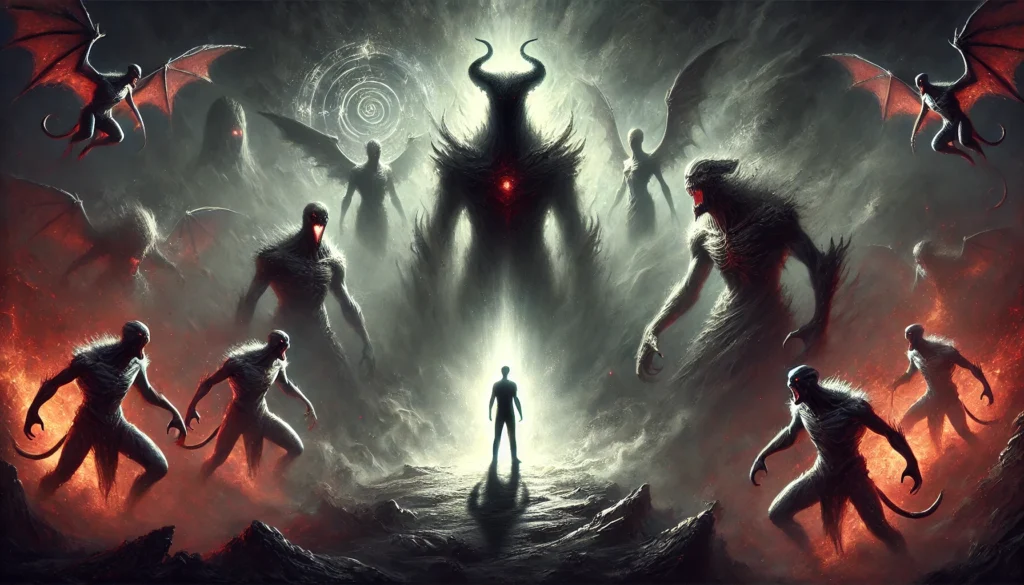
In our book “The New Lemegeton”, vol. 2, we argued that, from the perspective of an “occult topology” of the mind, its architecture can be considered not only from a dynamic perspective of processes – the Gates – but also as a collection of “regions,” fields, or “Kingdoms” corresponding to different matrices of the mind.
In other words, just as we speak of an act of the mind “leaping,” of its tapping into potential resources, we are speaking about the intersection of Gates and use the terms “Thresholds,” “Gatekeepers” and “guides,” so too, when we speak of the mind attaining a particular stable state, of activating a given matrix, we borrow concepts and images from theurgy and goetia.
Overall, this picture corresponds to two “hypostases” of the Tree as a universal matrix: within it one can also distinguish a “stationary” aspect – spheres or sefirot – and a dynamic aspect – channels or tzinoroth.
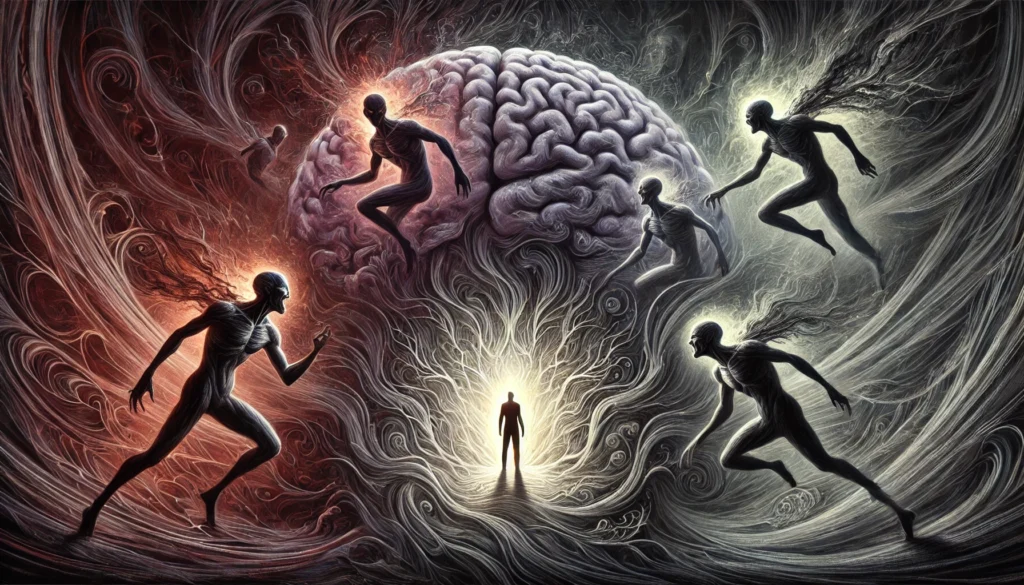
In that sense, such a topology of the psyche resembles “brain maps” that establish correspondences between particular anatomical structures and the processes associated with activity in them.
Accordingly, each sphere or Gate of the mind can be seen as the source of particular processes in the psychocosm, and the matrices identified within them as its various constructive or destructive states and tendencies.
At the same time, the Solomonic system derives from its descriptive discourse two supreme bases or destructors of the mind corresponding to the establishment of individuality (distorted into a sense of separateness – Lucifer) and to its immanence, the psychic space corrupted into the all-consuming Lilith’s abyss. Considering these primal principles too basic for mapping, Solomonics builds its map of the psychocosm on the “remaining” nine “Kingdoms,” where all activity concentrates — and all the possibilities of both constructive and destructive functioning of the mind — concentrate.
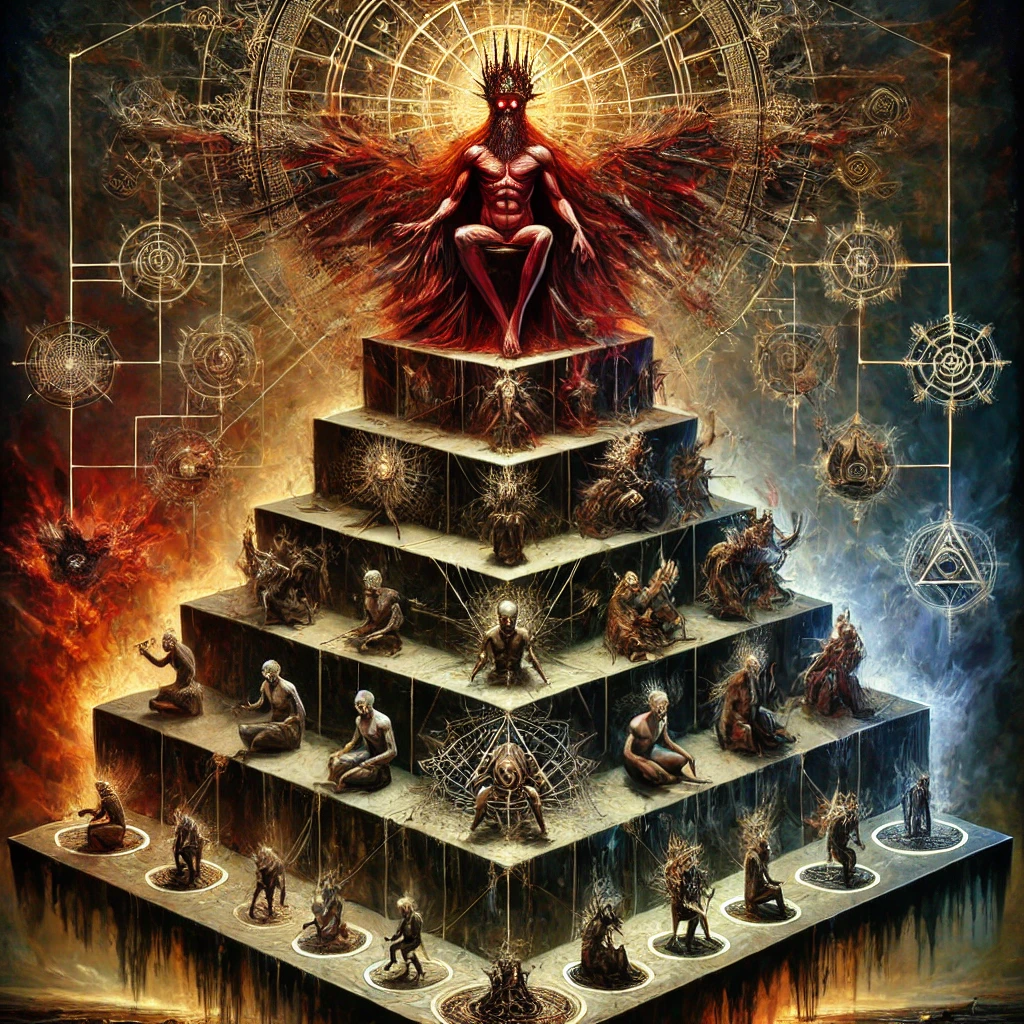
In accordance with the inner, heptarchic logic, each “kingdom” manifests as an octad: a King surrounded by seven Magnates, so that each of the mind’s activities (and, correspondingly, each of the distortions – the destructors) appears in its “own” form and in seven “secondary” aspects. Note that neither the Lemegeton nor other sources give a precise classification of the demonic “magnates” according to their place in the retinue of each king, indicating only those aspects of their “status” that are important from a practical point of view, but not always encompassing all the features of a given matrix’s activity.
We should also recall that all the Gatekeepers are “distributed” across the four cardinal directions, which, as we have repeatedly noted, corresponds to their predominant activity within one of the psychocosmic spheres, and are divided into “diurnal” (realizing) and “nocturnal” (receptive) cohorts.
Given such an abundance of attributions, it is important to understand that each applies mainly to a particular perspective, and depending on whether we consider a demon as a Gatekeeper or as a Matrix, different correspondences — compass, planetary, zodiacal, or psychological — are more appropriate.
We will quote an excerpt from our book “The New Lemegeton” that is important for understanding the principles described:
Each of the “subordinate” demons discloses some quality of the overall destructor, fully expressed by the figure of the King. Nevertheless, the appearance in the mind of activity from a “junior” demon does not automatically imply the presence of the “senior” one, although with an unfavorable development the entire retinue of a given “sin” gradually manifests in full. More often, however, several Gates of different destructors are active in the mind, through which the available energy drains away, so that the person, in effect, simply becomes a “cow to be milked,” supplying energy to the infernal layers.
We emphasize that the term “sin” (peccatum, טמאה) in this context is devoid of moral judgment; it is not understood as a “transgression” deserving “punishment,” but simply as a destructive quality, an energy that opens a gate to outflow and the disharmonization of the mind.
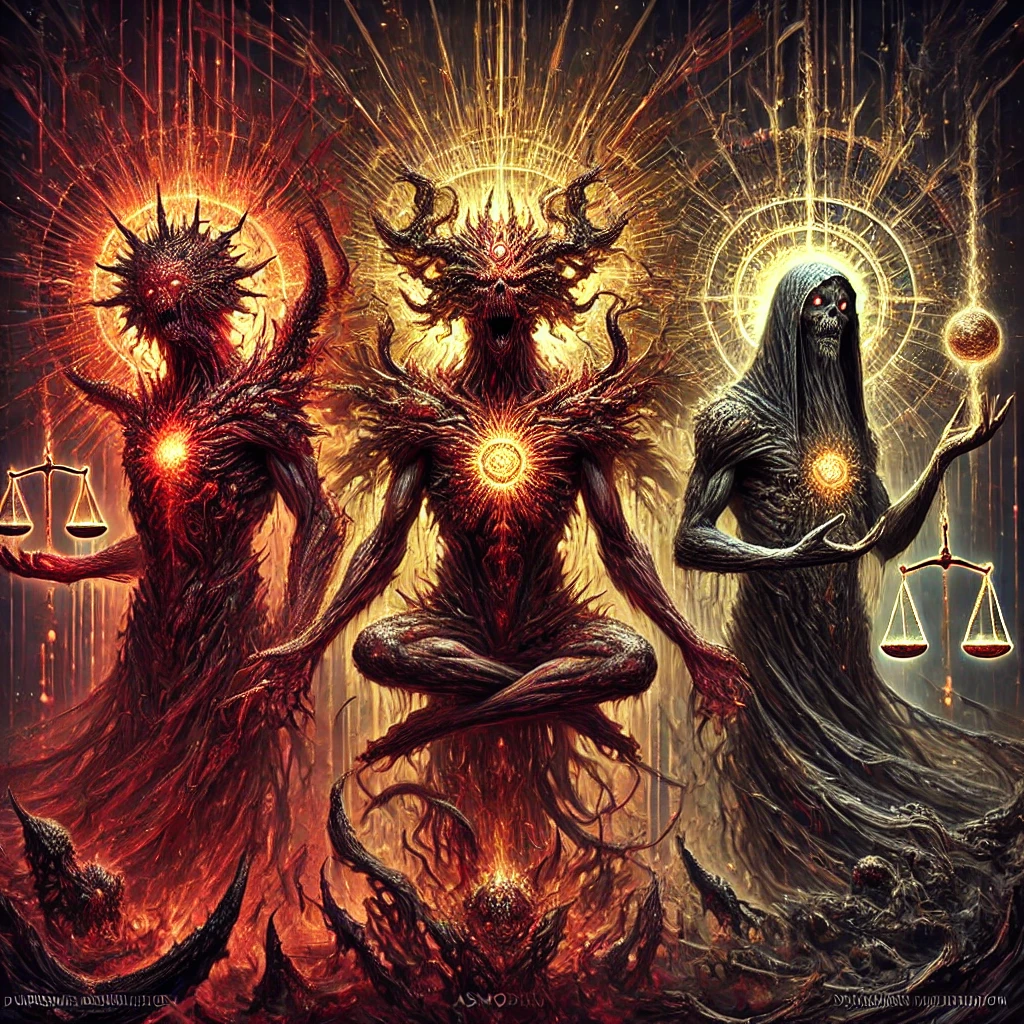
Moreover, three destructors are conventionally considered “primary” because it is through them that “initiation into darkness” most often occurs — that is, disharmonious matrices arise and develop. These “initial Gates” are typically regarded as the distorted force of repulsion – anger, the distorted force of attraction – avarice, and the distorted search for equilibrium – ignorance. Accordingly, the three demonic kings – Belial, Asmodeus and Bael – most often push the mind onto the path of destruction.
These three obstacles block our way to perfection; three poisons contaminate our mind, preventing it from knowing itself and the world: the denial of what is proper to it; the clinging to what is not proper to it; and the inability to distinguish the self from the non-self. The first gives rise to anger, the second to the root of avarice, and apathy takes root in the third. Thus, if we have ceased to feel anger and do not experience strong longings, this does not necessarily mean we are closer to freedom: perhaps we are simply poisoned by indifference.
Belial is closely associated with Paimon – the demon of “brilliant image” – and Balam – the demon of cunning; with Bael are Vine – the matrix of “narrow-mindedness” – and Zagan – the demon of reliance on the external; with Asmodeus – Belet – the king of abuse – and Purson – the matrix of “logical coercion”:
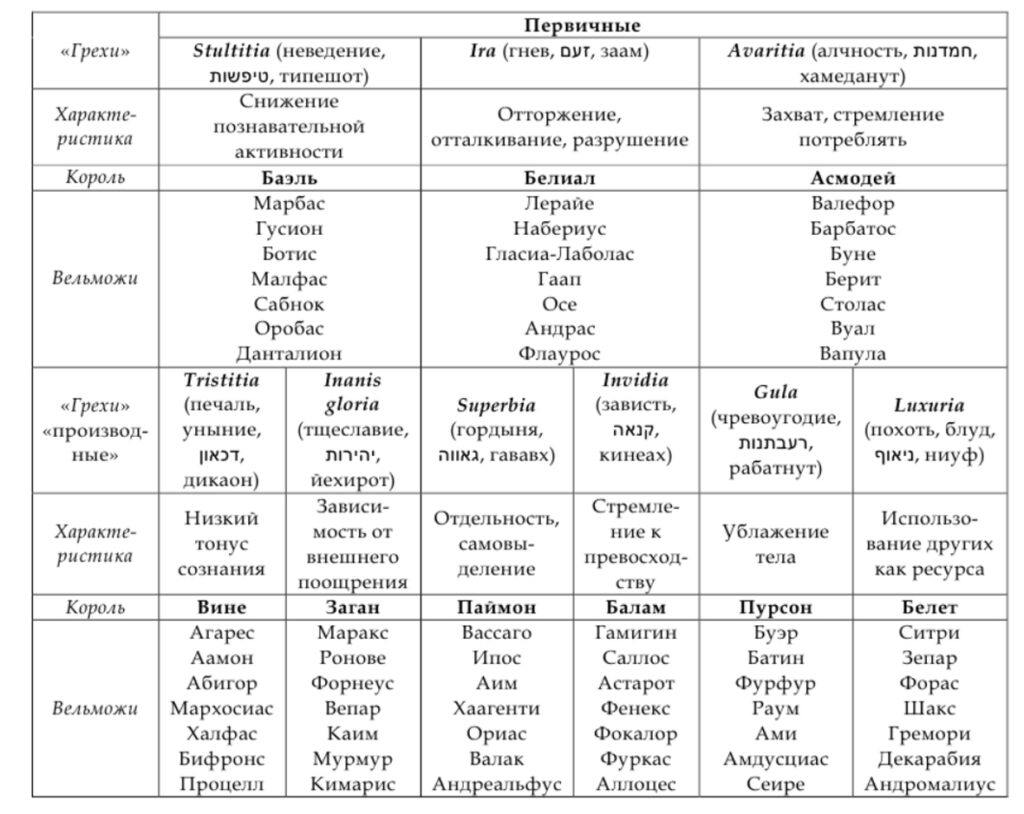
Thus, the three triads of “sins” — Gates of energy outflow — lie at the root of the mind’s infection by destructive matrices.

Examine the full classification of such pathologies in detail.
The Triad of Stoppage
1. Stultitia (ignorance, טיפשות, tipeshot). The first cause of ineffective functioning of the mind most often proves to be low cognitive activity, a “reluctance to know.” This sluggishness of the mind, the loss of tone and the drive for active knowledge of oneself and the world, is one of the most common bases of destruction. These Gates are opened by Bael – the demon of false experience, counterfeit understanding that replaces the mind’s true ardor.
In the retinue of the King of Ignorance are found:
Governor Marbas – the matrix of simplified, flattened thinking,
Duke Gusion – the demon of dependence on experience,
Count/Governor Botis – the matrix of emotional lethargy, indecision,
Governor Malphas – the demon of “denying evil,” conservatism, attachment to “customs,”
Marquis Sabnock – the demon of patterned thinking,
Prince Orobas – the model of “wise” idleness,
Duke Dantalion – the demon of “enlightened” idleness.
The refusal to know induced by Bael can develop either into a general asthenia of the mind (“melancholy”) or into a search for external supports arising from one’s own “softness” – “vanity.”

2. Tristitia (sorrow, melancholy, דכאון, dikaon). In modern terms this destructor is most accurately described as depressive or melancholic behavior: an absence of vivid desires and drives. The “King” who opens these Gates is the demon of jealousy – Vine, who forces one to feel “inferior” in comparison with others and to sink into despondency from that feeling. His retinue includes:
Duke Agares – the matrix of emotional or intellectual flight,
Marquis Aamon – the demon of ignoring, indifference,
Duke Abigor – the model of the “victim state,” submission to authorities,
Marquis Marchosias – the matrix of indecisiveness,
Count Halphas – the demon of lack of initiative,
Count Bifrons – the demon of inability to let go of what has outlived its use,
Duke Procell – the matrix of paralyzing fear of the unknown.

3. Inanis gloria (vanity, יהירות, yehirot). The inability to find support in oneself gives rise to a desire to find that support externally; inner “softness,” the absence of backbone, of one’s own “skeleton,” drives a search for external props, “crutches.” The King of such striving is Zagan – the demon of “acting.”
In his “retinue,” or rather “troupe,” are:
Count/Governor Marax – the matrix of “trust” in “sources,” seeking confirmation in them,
Marquis/Count Ronove – the demon of creating important images,
Marquis Forneus – the demon of a painful desire to be liked,
Duke Vepar – the matrix of manic mendacity,
Governor Kaim – the demon of idle talk, disputes, sweet speech,
Count/Duke Murmur – the demon of “applause,” a dopamine addiction,
Marquis Kimaris – the demon of ostentatious heroism.
The Triad of Repulsion
1. Ira (anger, זעם, zaam). We live in a world dominated by the force of repulsion. Even when we strive to obtain something, it often seems natural to do so by taking it, directly or indirectly, from another. The demon that distorts self-definition into anger is the King of exploitation – Belial. Belial is, above all, the repulsion of love, the repulsion of attraction, replaced by domination and exploitation founded on contempt for the subjugated, arrogance, and the suppression of their individuality. In the retinue of the King of oppressors are:
Marquis Leraje – the matrix of belligerent traditionalists, inquisitors, and aggressive revolutionaries,
Marquis Naberius – the demon of scholasticism, asserting oneself at another’s expense,
Count/Governor Glasya-Labolas – the model of sadistic pleasures,
Prince/Governor Gaap – the demon of domination and suppression,
Governor Ose – the demon of active opposition of the self to others,
Marquis Andras – the matrix of separatism, feudalism and self-alienation,
Duke Flauros – the demon of aggression.
The feeling of superiority and rejection of others induced by Belial can manifest either actively as pride and self-exaltation, or passively as envy.
2. Superbia (pride, גאווה, gavah). Catholic theology considers pride the “mother of all sins,” and its absolute expression — the force of infinite differentiation, of self-separation — is the universal force of repulsion, the father of all demons – Lucifer. However, in the “subcelestial” circle of the Grey Gatekeepers this force is not considered in such an absolute sense but more specifically as self-exaltation, the striving for (even apparent) superiority and (even imagined) advantages. In this form this energy is expressed by the demonic matrix of the King of Kings – Paimon. Paimon is superiority for its own sake, uninterested in whether it is justified, but publicly exhibited and relentlessly displayed. The retinue of the King of Glamour consists of:
Prince Vassago – the demon of hopes and “positive thinking,”
Prince/Count Ipos – the matrix of truculence, ostentatious masculinity,
Duke Aim – the model of demonstrating superiority, of better “preparation,”
Governor Haagenti – the demon of invented “kingdoms,”
Marquis Orias – the matrix of posing,
Governor Valac – the model of demonstrating purity and incorruptibility,
Marquis Andrealphus – the demon of ostentatious elitism.
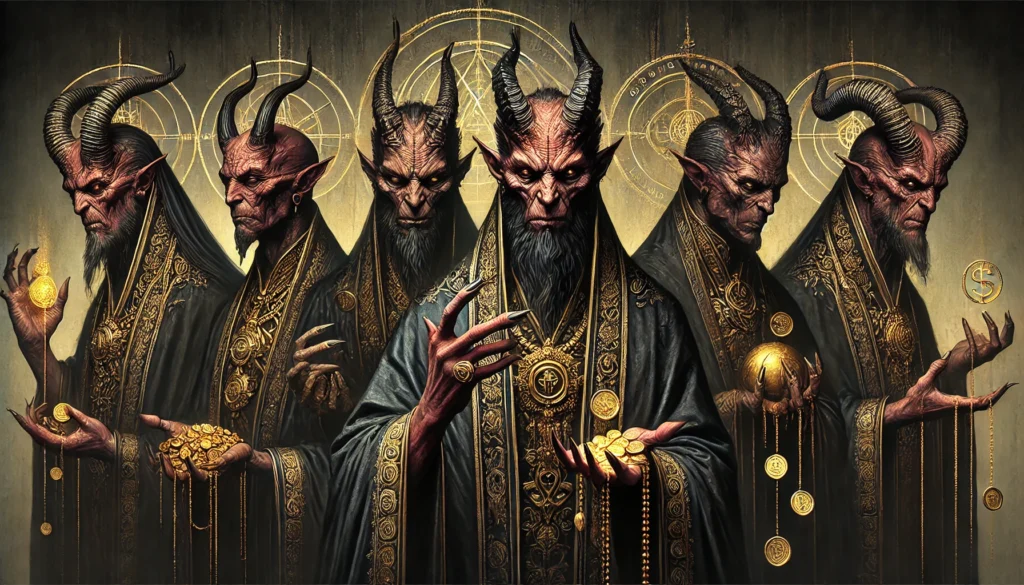
3. Invidia (envy, קנאה, kineah). Dissatisfaction with what one has and envy of what others possess give rise to a cunning drive toward intrigue, deceitful appropriation of others’ resources, or manipulation of them. This use of others as a field for implementing one’s own ambitions is expressed in the matrix of the King of Manipulation – Balam. The retinue of the matrices of intrigue and manipulation includes:
Marquis Gamigin – the demon of false messianism, false teaching and false prophecy,
Duke Sallos – the matrix of sycophancy, fawning,
Duke Astaroth – the demon of mental violence, intellectual manipulation,
Marquis Phenex – the model of dependence on material conditions,
Duke Focalor – the demon of suppressing others’ worldviews,
Knight Furcas – the matrix of using another’s experience,
Duke Alloces – the matrix of exploiting another’s authority.
The Triad of Attraction
1. Avaritia (avarice, חמדנות, hamedanut). The distorted force of attraction turns into clinging, avarice, the desire to acquire and retain. As a perversion of the sense of unity and love, this destructor compels one not merely to hold on to unnecessary, unsuitable things and phenomena, but to drive one into ever new chases for them — into accumulation: people, material goods, experiences, information — building up a thick husk on every level of the mind’s functioning. For that reason the demonic king who embodies the matrix of grasping in its maximal, emotionally all-consuming form is Asmodeus, traditionally regarded as one of humanity’s chief enemies, depriving the mind of its main chance — the chance for love.
The retinue of the King of Cold Hearts is formed by:
Duke Valefor – the demon of theft of things and states,
Duke Barbatos – the matrix of exploitation of nature,
Duke Bune – the model of clinging to the past,
Duke Berith – the matrix of clinging to other people’s opinions,
Prince Stolas – the demon of hoarding information,
Duke Vual – the matrix of clinging to relationships,
Duke Vapula – the model of clinging to activity, to skills.
In its more particular manifestations, avarice expresses itself as the drive to indulge “somatic” and sexual excesses – an exaggeration of bodily needs (“gluttony”) and a distorted sexual energy (“fornication”).
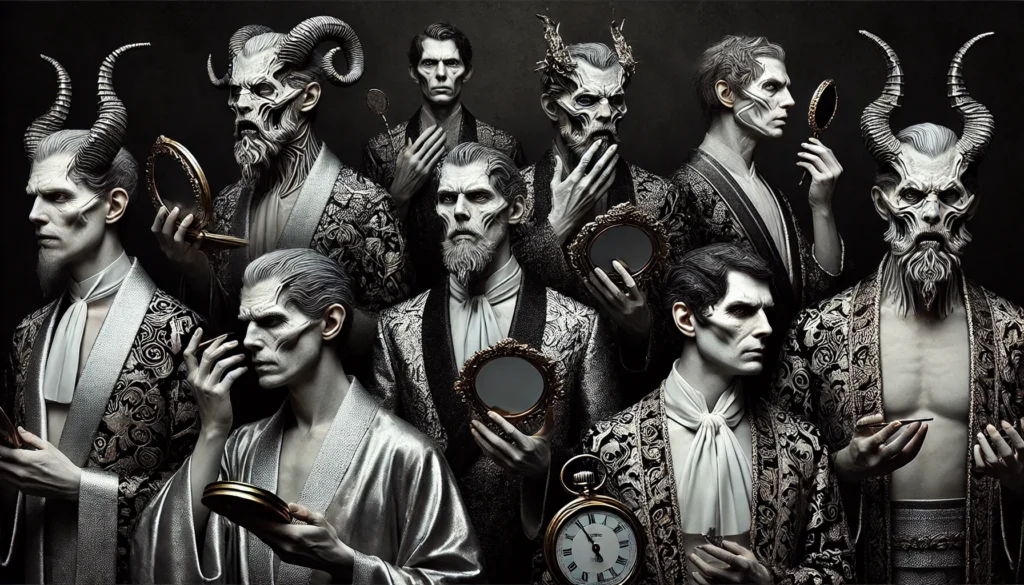
2. Gula (gluttony, רעבתנות, rabatnut). The pattern of obsession with bodily welfare, health, satiety, comfort and ease, directing all energy to the material plane and forcing the mind to “starve,” is embodied by the figure of the King of “design” – Purson. This matrix creates a priority in the mind of external shells and the body over the spirit, form over meaning, appearance over content.
The retinue of the King of Shells is formed by:
Governor Buer – the matrix of obsession with a “healthy lifestyle,”
Duke Bathin – the demon of “enjoyment” of knowledge,
Count Furfur – the demon of calculation, mercantilism,
Count Raum – the model of using others as a resource, marginal behavior,
Governor Ami – the matrix of attachment to the external “usefulness” of knowledge,
Duke Amdusias – the matrix of attachment to the external neatness of knowledge,
Prince Seere – the demon of striving for bodily “satiation.”
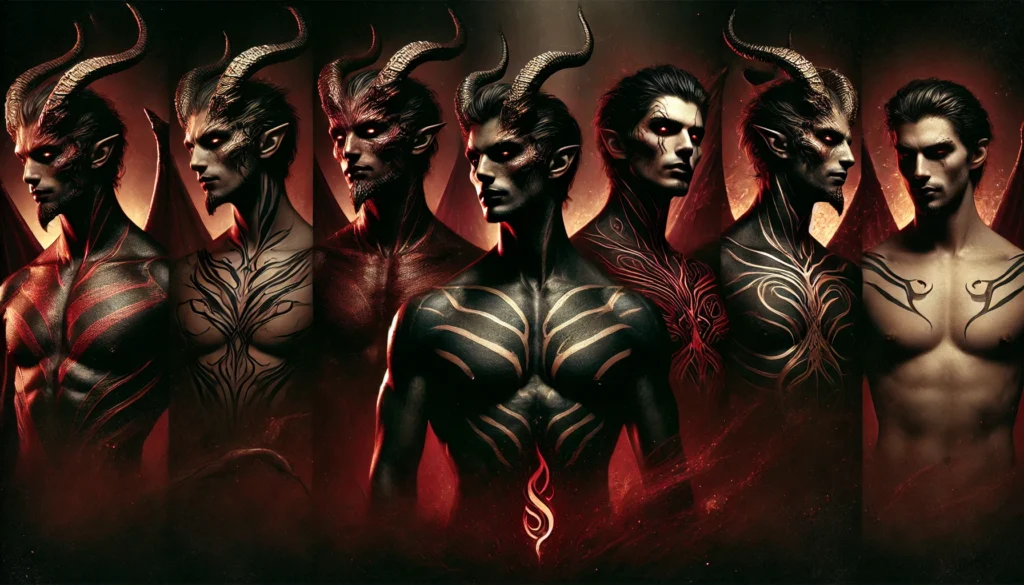
3. Luxuria (lust, fornication, ניאוף, niuf). The clinging to sexuality that turns other bodies into a resource and one’s own into a commodity is expressed by the King of Passion – Belet.
In the retinue of the King of Fans are found:
Prince Sitri – the matrix of “philander,”
Duke Zepar – the demon of empty systems,
Governor Foras – the matrix of “rationality” in interactions,
Marquis Shax – the demon of broken promises,
Duke Gremory – the model of the “fatal” man, the lover, the gigolo,
Marquis Decarabia – the demon of virtuality, fantasies and phantasmagoria,
Count Andromalius – the matrix of self-attractiveness.
An accurate definition of the “diagnosis” and the identification of destructive matrices active in a given mind makes it possible to chart several ways to free oneself from them.
Firstly, knowing the characteristics of a matrix (its elemental, planetary and other correspondences), it is possible to oppose constructive manifestations of those same categories to it.
For “diurnal” demons the antidote will be creative activity, and for nocturnal ones – inspiring experience.
- If the principle of intelligence is afflicted, one can look for remedies in places rich in air – mountain summits and windy spaces;
- If the destructive matrix nests in the principle of desires – contact with fire and its manifestations will be useful;
- If the pathology presents in the emotional spheres, contact with water will be beneficial;
- If demonic influences affect primarily the sphere of activity, healing will be found in journeys into deep forest, immersion in caves, and other contacts with the principle of earth.
Similarly, for a mind afflicted by demonic kings it can be useful to wear gold ornaments; the energies of princes are resisted by tin, dukes by copper, marquises by silver, counts by iron, governors by amalgams, and a knight by lead (the last two with precautions due to physical toxicity).
Secondly, there arise opportunities for genuine hermetic transformation: the restoration of the matrices’ original state using kabbalistic and alchemical approaches.
Thus, the task of goetic diagnosis is to single out the destructors most active in the mind, in order then to transform them back into the “original” matrices of the Gates – the corresponding Genii.
This is precisely the goetic therapeutic strategy for freeing the mind from the destructors that bind it.
Once again thank you for such a detailed analysis!!!
Hello, dear Enmerkar. Can I know the origin of these titles? Why “marquis”, “prince”, “count”? Why not “leader”, “chief” or “boss”? It always “cuts” the ear. )
Hello. These titles indicate planetary affiliation:
“The Lemegaton System also includes the correlation of spirits with planetary spheres: 9 spirits are associated with the sphere of the Sun and are called Kings, 7 – with the sphere of Jupiter (Princes), 23 – Venus (Dukes), 15 – with the sphere of the Moon and are called Marquises, 12 – Mars (Counts), 15 – with the sphere of Mercury (Governors), and 1 – with the sphere of Saturn (Knight). The ‘titles’ used to denote the position of each spirit are related, firstly, to the order of the planetary Sphere (that is, the sphere of Secondary Causations), and secondly – to the relative size of its vortex (that is, how many smaller vortices can be distinguished in its composition). It is worth noting that, in addition to the spirit’s affiliation with the planetary sphere, its ability to influence the flows of consciousness is also highlighted, which also experiences certain ‘planetary’ influences, and the final effect is composed of both components – the ‘title’ of the spirit and the ‘field’ of its action.”
https://enmerkar.com/en/magic/spirits-of-the-copper-vessel
Thank you! I added the page to my favorites. As always, it’s systematic and very clear.