
Jealousy: Vine
The knowing mind strives to translate its potentials into actuality, i.e., to realization. It is in the very process of realization that the mind comes to know itself and the world, and therefore this striving is one of the basic drives in the structure of the mind.
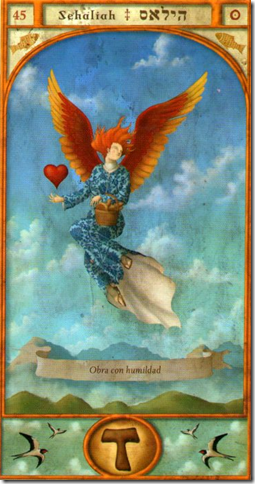
In the language of Kabbalah this striving is expressed by the Genius Sealiah, whose name means “the mover of all things”. In its completely pure, unclouded state this all-fulfilling capacity of the mind manifests in its integrating activity, its all-sustaining solar activity, and the “vegetative” (“levushim“) level of consciousness.
“When I said, ‘My foot slips,’ your mercy, O Lord, upheld me” (Ps. 93:18)
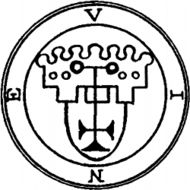
A distortion of this principle, the root of which is the principle of substitution — the power of Beelzebul — can manifest as an active striving to possess what seems valuable and as destructive activity aimed at those who possess it. In other words, instead of integrating new elements into itself, realizing and enacting them, the mind begins to envy those who have already realized them and be jealous of those realizations. Thus to the solar, governing activity is added Mars’s destructive expansiveness, and as a result a destructive agent appears in the mind, whom the Lemegeton names “the king and earl Vine.”
The demon’s name, meaning “vine”, is taken from the name of an ancient wooden battering ram, and points to the demon’s drive to demolish the “walls” that separate the realm of realizations of one being from the “possessions” of another.
“Vine is the forty-fifth spirit, a great king and earl. He appears in the form of a lion, riding a black horse, with a viper in his hand. He can discover hidden things, witches and wizards, and give knowledge of the past, present, and future. By the command of the conjurer, he will build towers; demolish huge stone walls and raise storms on the waters. He rules over 36 legions of spirits.”
The lion’s head indicates his authority, the black horse distorted realizations, and the snake the poisonous influence that affects the mind. Overall the demon’s image reflects a drive to dominate by suppressing the realizations of others.
The Demon “breaks down walls”, erasing boundaries between “property”, which is — actualized reality — of different beings.

A mind that discovers the possibility of new possibilities for realization ought, in principle, to strive to reorganize itself so that these realizations become naturally available. Nevertheless, when a person sees that someone else possesses what he or she would like to possess (whether we are speaking of abilities, opportunities, objects, or anything else), he or she often first experiences envy, a stream of negative thoughts under the slogan “why is that person better than me?, why do they have it and I don’t?”. If the desired object can be seized, the next stage is often jealousy — the desire that no one else should have it, which, of course, is a distortion of the drive to integrate realizations into one’s individuality. Instead of thinking about how to improve oneself, the person thinks about how to prevent others from becoming better, how to stop others from surpassing them, and thus becomes destructive toward others.
Such a distortion leads to the mind losing its all-encompassing capacity, and beginning to try to realize only what seems to it “prestigious”, “status-bearing”, or “necessary” for external, formal reasons. The mind ceases to analyze which of its inclinations are genuine desires and which are whims, which are ready for realization and which lead to destruction, and pursues only apparent values.
Clearly, opposing the demon involves not only maintaining one’s individuality and analyzing desires and inclinations (which is necessary for any opposition to destructive forces), but also cultivating in oneself the drive to act not on immediate advantage, but on what has “ripened”. By and large, for the Magus, it makes no difference, but not in the sense of apathy or indifference; rather in the sense of lacking prejudices of the kind “I will do this, and I will not do that”. The Magus does what must be done, what his Way, his Orlög, requires, regardless of how “advantageous” or “expedient” it may seem.
The Magus understands that what he has realized is the fruit of his own efforts, his own discipline, his own actions. What others have realized must in no way affect his striving; “I want that too” must not be the motive. I want what my Way, my individuality, requires, not what others have. If someone possesses what I do not possess, it may be his success (or his failing), and if I truly need it, such an opportunity will mature and present itself. If I share what I have, I will not become any less unique; my uniqueness is in my perspective, in the very nature of my awareness, not in what I possess.

>>In other words, instead of integrating new elements into oneself, realizing and executing them, consciousness begins to envy those who have already achieved such realization and to envy the realizations themselves.
But when person A sees that another B is moving or only wants to move in a direction that person A himself would like to go, but in this situation he has an inner voice telling him that this other B will not succeed, that B is not good enough, and in general circumstances are objectively against B. And this voice is so strong that person A actively expresses it in interpersonal communication, crushing all attempts by B and lowering his motivation.
In this case, does the same demon act through A, or is it something else?
While person A consciously does not envy B and wants all the best for him (it seems to him that he is doing this precisely for good).
It is beautifully written, and regarding the tendency of consciousness toward others’ realizations, envy, I see here a cornerstone like beauty – the beauty of realizations, the beauty of forms, actions, and generally as a principle. After all, although we subjectively perceive the external and internal in relation to consciousness, in reality the division is quite conditional; we perceive the world associatively like, say, perfectly ordinary yellow daisies can evoke joy, while yellow leaves in the yard evoke sadness. And here, I think, beauty as an expression of the highest of the triumphs of Spirit accessible to us stands out, which can be associated with anything external, being intuitively attractive yet not understood by us – for it is easy to describe something ugly, yet how many creative people have burned in attempts to express beauty. It seems to me that beauty is a beacon pointing to the boundary between flesh and spirit that often becomes destructive for moth-like people who thoughtlessly fly toward anything bright, and envy here is merely a search for warmth, an attempt to fill one’s cold and harsh shell with someone else’s light, another’s feeling. But whatever the case, I believe that beauty should be the only truth for a free consciousness that is not accustomed to following the lead and bowing to either others’ truths or others’ Power.
How can consciousness discover opportunities for new realizations for itself?
I think this: many people do not clearly see where to go, in which direction to develop. But there are emotions, that is, what comes not from the mind, from consciousness, but deeper. This is such an inner compass that quickly and sensitively reacts to what is good for you, what is bad, what is desired, and what is not. So – interest in what another has is a sign – this is important for you too. The main thing is not to let this emotion grow into envy. I think envy and jealousy can be easily overcome when you understand and accept the uniqueness of yourself and others’ individuality.
It is clear that what I will say is written in almost every book, and that any cause for distortions of consciousness can be called a lack of love, and one would not be mistaken. I think that in regard to jealousy, it arises from the experience of fighting for attention, the need to deserve, and the lack of experience of one’s own unconditional value. And besides opposition, I see the possibility of freedom in simply giving this. It is clear that it speaks about oneself, which means giving to oneself. Although, as far as I know reality, this can only be done in one cunning way, to give to others. Perhaps I am a proponent of psychological theories about imprints and root episodes, and absolutely a very pragmatic person. While writing, I also thought about the method of reversal or re-experiencing, there is such a thing too. Although I am not sure about it. It is not a fact that this is not a way to “give birth to oneself back,” rather than to grow.
Quote: “and if I really need it – such an opportunity for me will ripen and open.” – But what if I already need it, and the opportunity ripens too slowly? And the desire is there, and it arises precisely from looking at others who have already achieved? How to deal with expectation and impatience, and with that jealous gaze – “But he (she) has already achieved!”? 🙂
In fact, very often what others have serves as a stimulus for development; we just go to the same goal by a different route, in a different way, and even if we copy something, we are learning too. And if we wait for ‘the opportunity to ripen and open,’ we can wait our whole lives and end up with nothing. All people are at different stages of evolution ‘from simple to complex,’ and you can go around in circles in endless searches for your potential realization for a very long time, constantly bumping your head against obstacles, and there are many examples of this from life. And such an experience is not necessarily suitable for an individual. In this case, the so-called ‘bright path’ of development may lead a person to complete loss of orientation and the acquisition of burdensome karmic programs. But one can make someone else’s goal a guideline for themselves, and for some time that becomes a good motivator for development. That is, we kind of latch on to someone else’s experience and accelerate our evolution. Then there are also methods in magic to copy various qualities, where one can copy the qualities and virtues of many great people, thus significantly increasing one’s personal power and potential for subsequent development. Speaking of demons, in addition to their lower predatory vibrations, they also have higher ones, which are accessible not to everyone. Thus, in WINNE, there are potentials associated with spiritual search and exploratory potential, which can help in comprehending human nature. Sometimes, it is useful to utilize such an opportunity in one’s development.
From the text, one can conclude that Sealiah belongs to the plant level of consciousness, left branch.
Are there geniuses who belong to the mineral and animal waves of life?
It is not entirely correct to relate Geniuses to different waves of life; however, in the general system of Shemhamforash, one can still trace the Tetragrammatical pattern. For example, geniuses 1-18 are often associated with Yod (and hence, Fire-Shamaim), 19-36 with the first He (and Water), 37-54 with Vav (and Air-Ruach), and 55-72 with the second He (and Earth-Aretz).