
Veelzevul — “Feelings Inside-Out”
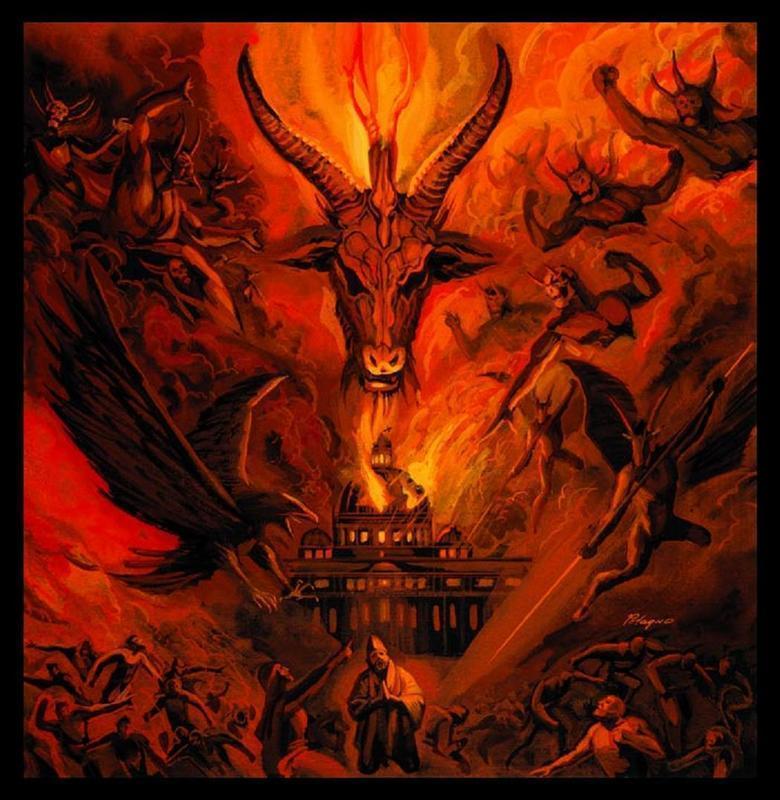
Among the mighty destructive forces the human mind encounters, there are distortions of transitional gates, the gates through which the mind knows itself and the world, and distortions of its own internal currents and processes. The first group consists of the forces described by the Lemegeton as “demons of the gates,” or “goetic demons”; the second group of destructive tendencies is mentioned by the “True Grimoire.”
The three faculties the mind relies on in itself, in which it lives and functions — will, intelligence, and feelings — can be globally “spoiled” by internal contradictions, and these distorted Primal Principles are embodied as Archdemons — Lucifer, Astaroth, and (in the system of the True Grimoire) Veelzevul.
Mentions of Veelzevul (Belzebuth, Beelzebub, etc.) appear frequently in literature dating back to the Old Testament. The corresponding deity — Baal-Zebub (“Lord of the Palace”) — was highly venerated by the Canaanites and Philistines and had many temples and oracles.
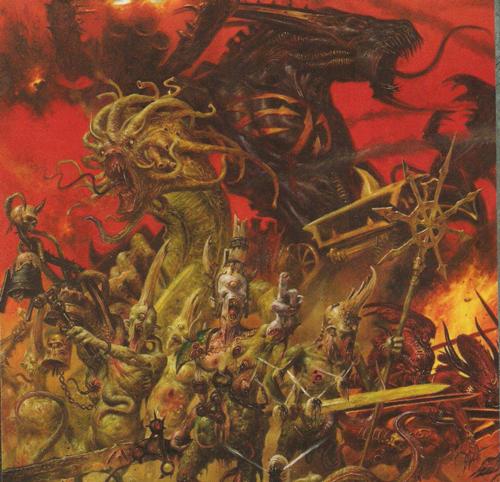
The “Testament of Solomon” says that Veelzevul is not merely the “ruler of demons” but “makes the visage of any demon manifest.” The latter statement is extremely important because it emphasizes the impossibility of any destructive force manifesting without its embedding in the emotional faculty. Moreover, this can be related to Veelzevul’s role as the “second” among demons, who supports and connects the demonic hierarchies.
Like all the Baalim (“Lords,” “Rulers”), Baal-Zebub personified authority — in this case, authority over the “palace,” that is, the principle of manifestation.
In the Classification of the “True Grimoire” Veelzevul governs water elements, and the “Great Grimoire” calls him “Prince of the North.” His chief servants and assistants are Tarchimach and Flevreti, who dwell in Africa (“True Grimoire”). In any case, this is precisely the principle of manifestation, of expressiveness we have mentioned. At the same time, associating Veelzevul with the planet Hesper (the evening Venus) indicates that this manifestness pertains to the “sunset of feelings,” that is — to the distortion of their primal basis.
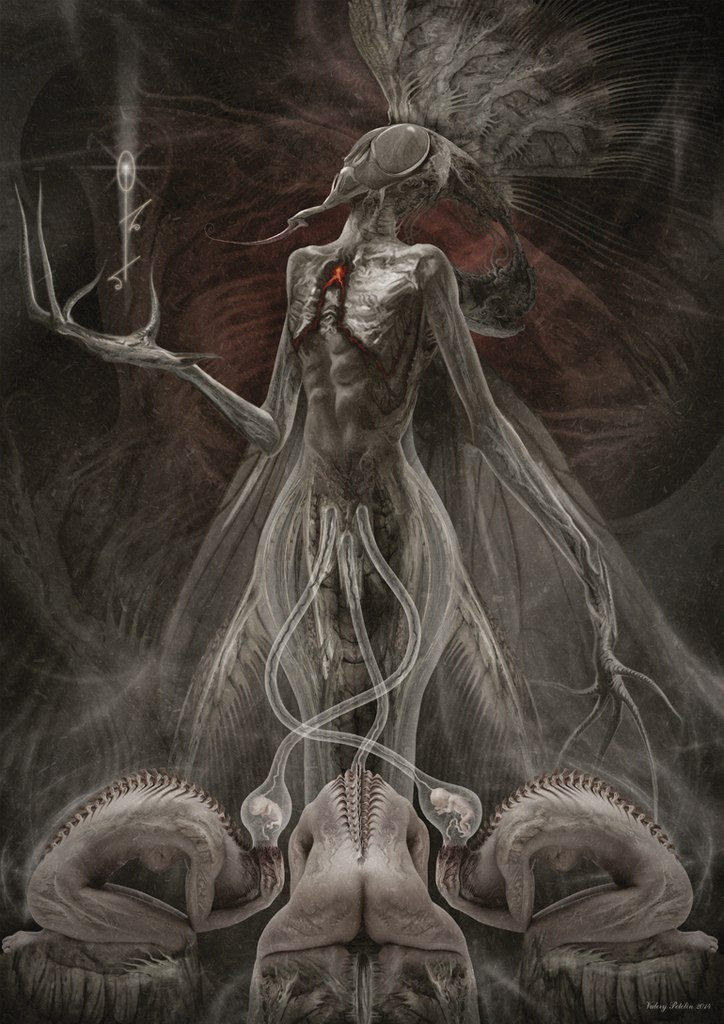
Other traditions call Veelzevul an archdemon of the qlippah Gagiel — the “shadow” of the sephira Chokhmah — which accounts for his title “Lord of the Heavenly Abodes.” In this sense Veelzevul is a force that introduces primary division both at the macrocosmic and the psychocosmic levels. This may seem somewhat dissonant with his role as “lord of feelings” (which are born at the level of Binah), yet in fact Veelzevul is the force that inserts division into the primal homogeneous cosmos, creating the possibility for galaxies and planets, and on the level of the psyche turning a single, unified experience into a stream of separate emotions. In this regard, Veelzevul is akin to Azazel, and both are opposed to the archangels Raphael and Raziel. This duality — with the dividing principle of intelligence (sephira Chokhmah, qlippah Gagiel) and the unifying power of feelings (sephira Netzach, qlippah Orab Zerek) — makes Veelzevul the sovereign master of the psychocosmos, as emphasized by the “Grimoire Verum.”
The capacities attributed to Veelzevul — to “beget pride,” to “destroy kings,” to “corrupt priests,” to “inflame envy and the thirst for murder,” etc. — are common to all demons; however, in this case, special emphasis is placed on the drive to possess (numerous cases of possession by Veelzevul are described) and on controlling people’s emotions. H. C. Agrippa furthermore notes Veelzevul’s desire to be worshipped and places him among the rank of “false gods.”
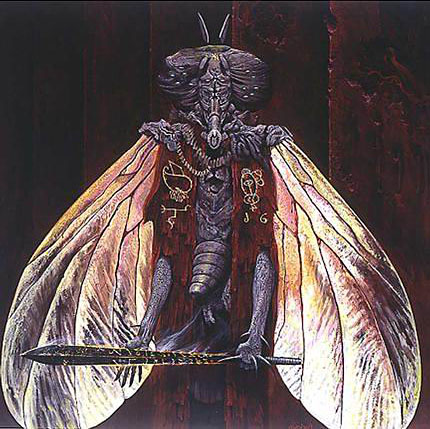
In this respect, Veelzevul may be compared with another “demon of ignorance” — Bael, who personifies the renunciation of cognitive activity. Most likely these demons can be identified with one another, though they describe the destructor from different angles: Bael is the “spider” that keeps the mind bound in the fetters of ignorance, while Veelzevul is the “fly” that flies to filth and false notions instead of to true wisdom.
The third demon of ignorance — Belial — also manifests a refusal of knowledge, but from another side: actively repelling the very possibility of cognitive activity, restructuring the mind-complex as a “structure around” a common axis or center, yet as an “army against” certain “foreign ideas” deemed unacceptable knowledge or condemned habits.
Thus, all three demons are, in fact, different manifestations of the same basic destructive principle: “ignorance as such” (Bael), “ignorance of intelligence” (Belial), and “ignorance of feelings” (Veelzevul).
At the same time, Veelzevul “builds a bridge” between anger and greed, between Belial and Asmodeus, since he replaces the mind’s meaning-making and analytical activity with emotional impulses, turning the desire to follow the Way of knowing into an instantaneous impulse to “possess what is superior.”
As “Lord of the Flies,” Veelzevul, on the one hand, rules over diseases and filth, and on the other, over souls that have fallen from divine grace. Yet Veelzevul is not the filth itself; he is the turning toward it — the substitution of cognitive activity by emotionally charged and justified ignorance.
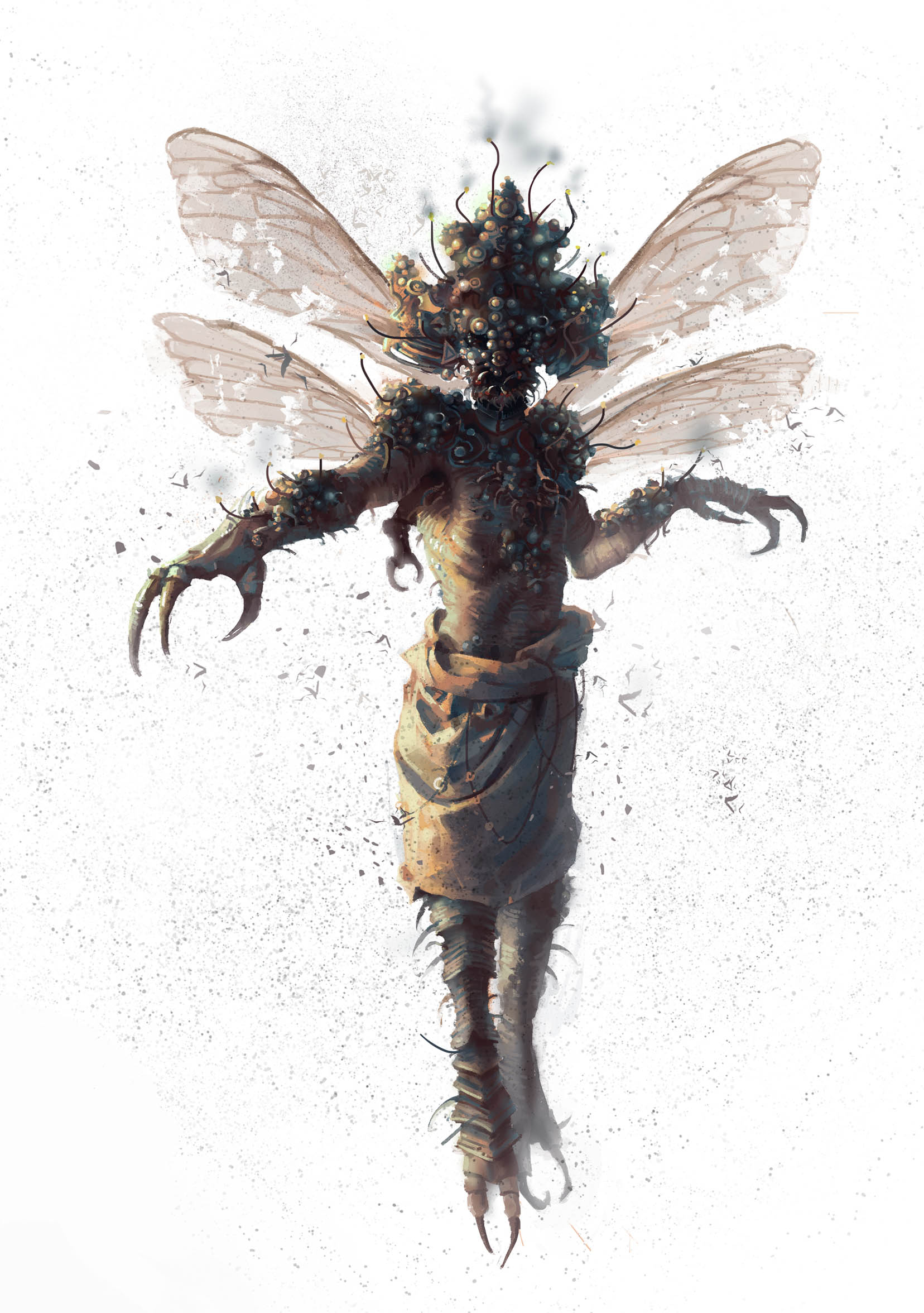
The form in which the Demon most often appears — a fire-breathing bull (alternatively a goat, a leopard, a fly, or a bee in other guises) — testifies to the unbending power of spirit and its regal nature (all the Baalim of ancient Canaan appeared in the form of bulls).
Another important correspondence for understanding Veelzevul’s image is his aforementioned association with the qlippah Gagiel (Obstacles), the shadow of the sephira Chokhmah, which expresses the “madness” created by this demon — the replacement of logical thought with chaotic indulgence of whims and passions. From this standpoint, it is unsurprising that Veelzevul directs energy toward Lucifer; the mixing of feelings leads to the fragmentation of will.
In short, Veelzevul’s influence on the mind consists in the dissolution of hierarchy, the mingling of ideas and emotions, and their entanglement with whims, caprices, and passions. In other words, this destructuring force manifests whenever the mind proclaims a whim or caprice to be its “true desire” and starts vigorously striving to fulfill it.
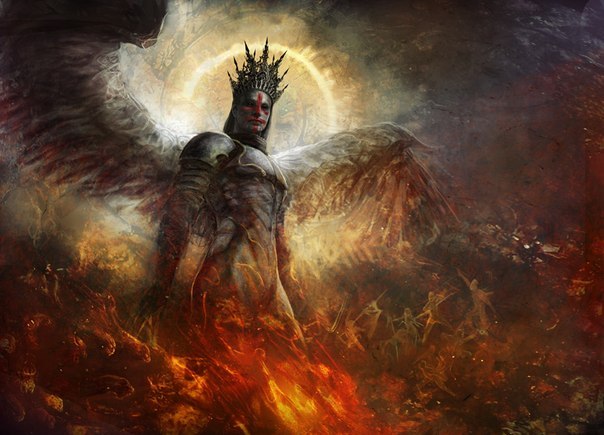
In this sense, he indeed forms the “higher triad” of demons alongside Lucifer, who shatters the single stream of will, and Astaroth, who enslaves the intellect. In other words, if Lucifer is the refusal of the sense of unity and the opposition of oneself to the common principle of the cosmos, Astaroth is the refusal of knowing and the subordination of dry logic to the living flow of the mind, then Veelzevul is the refusal of the “wisdom of the heart,” of that immediacy rooted in feelings — the guidance born from the first awakening of the aware pole of the mind.
Indeed, the mind is very prone to latch onto the faintest impulses of its realm of realization (we have already said that the seeds of realizations are the potential field of the mind, its emotional faculty) and to declare them its goal, irrespective of how much these seeds relate to the mind’s current Way of development, how deeply they are rooted in it, or whether they are desires at all. By acting thus, the mind violates the principle of its harmonious flow, turning from a majestic river, flowing from heaven to heaven, into a collection of little streams, marshes, and puddles, disconnected from one another and from their sources. It is precisely in this sense that one can speak of Veelzevul’s destructive power over the mind, turning the Psychocosmos — from a lofty palace — into a swarm of flies.
For the principle of feelings to be a fertile field rather than mere rotten filth (Hebrew “zabal”), it must be controlled, ordered, and directed by the mind.
Accordingly, resistance to Veelzevul lies in self-knowledge, self-analysis, and in preventing the mind from switching from genuine desires to mere whims.
When the mind flows from Chokhmah to Binah, and not from Gagiel to Satariel, when the seeds and shoots in its field are its own, it can preserve its integrity, harmoniously absorbing the currents of knowledge and realization.

Once again, thank you, because once again I am facing the manifestation of Beelzebub (or Beelzebul? I can’t figure out which is correct) and I have lost to him before…
Regarding the experience. Here’s how it was. I provide a record based on my diary from 18 years ago. The curtains were drawn, the light in the room was only from the fire under the tripod with incense. The acrid smell irritated my throat, and I constantly wanted to cough. The smoke made the space tangible and viscous. Fear pierced my body with a fine tremor. I held in my hand sheets of paper scribbled with spells created by mixing translations I had done myself from the English editions of ‘The True’ and ‘The Great’ grimoires – Russian translations were not yet available. In the Triangle lay a piece of rice paper (this was the best option for a pure medium that could be found), with a drawn Seal. The cloak rubbed unpleasantly against my skin, and the general state was quite nervous and tense. After the usual cleansing procedures, oaths, and invocations, I stared into the triangle until it hurt my eyes. Nothing. Again and again I repeated the text of the Ritual. Somewhere around the twentieth repetition, the smell of smoke began to gradually mix with the stench of decay, of rotten meat, so nauseating that there were fears of vomiting all over the Circle. I swallowed hard and continued reading. Here it is. A huge fly appeared out of nowhere and started making circles in the room. I thought – with such stench, it wouldn’t be long before I would die too – there would be something for the fly to feast on. My sense of humor hadn’t disappeared – well, that means I’m still sane. Meanwhile, the smell intensified, and my mouth was already filled with a bitter taste. At some point, when I was already looking for a place to vomit so as not to make too much mess, suddenly a quiet, mocking whisper sounded: ‘Well, there you are, baby, is this what you wanted to see?’ By that time, I already had some experience with such interactions, and this haughty tone seemed offensively unoriginal. ‘Yes, I.’ I had also gotten used to answering cheekily. Above the triangle, a blurred and unclear silhouette was visible. Only two huge horns protruding from the smoke could be distinguished. ‘And what do you need?’ – the question followed – either in my head or in the air; and with it stirred new waves of unbearable stench. ‘I just wanted to look you in the eyes.’ ‘You could have just looked in the mirror. My eyes are in yours.’ Again the laughter intonation. ‘Really? I’m not stinking that badly.’ (I’m trying to act tough.) ‘Oh really? I think you smell much worse.’ ‘And what do I smell of?’ (Trying to understand what he means.) ‘You stink of rotting desires. You give birth to them like stillborn babies, and they decay, filling your soul with stink.’ ‘Not at all, I know my desires, and I try to fulfill them.’ (Liquid is already gathering in my mouth, my head begins to spin.) ‘You not only don’t know your desires, you don’t even know what a desire is.’ ‘Fine. Then tell me, what is it?’ ‘Why should I tell you?’ ‘You know the order. Otherwise, I won’t let you go.’ ‘Funny. It’s still a question of who holds whom and who can let whom go or not.’ ‘Try to leave, and then you’ll find out the answer.’ ‘But can you leave me? You’re in my power.’ ‘Nothing of the sort. I’m not in your power; only God (I name the Names) has power over me.’ (laughs again) ‘Yes-yes, another disobedient one. Do you even believe that?’ (I read the Torture Incantation.) He laughs. Then he condescendingly replies: ‘Desire is what creates the world. What you are trying to accomplish – can it create a world?’ ‘Well, not always.’ ‘There you go. Every time you try to accomplish something that does not come from God within you and does not lead to this God – you worship me.’ ‘I do not worship you.’ ‘Of course, you do. The whole world is filled with worshiping me. All civilization is built on worshiping me. People do what their eggs, stomachs, and cocks want, but not what God inside them wants. Their entire life is pleasing me.’ ‘I see. I can expel you by allowing God within me to manifest.’ ‘Try it’ (there is no longer the former bravado in his voice). ‘You are weak. Just because you have learned the Names and spells does not mean you are strong. You were my slave, and you will remain one.’ ‘We’ll see.’ I read the spells of release and expulsion. The fly drops to the floor, buzzing and rolling over, gradually quieting down. The stench does not disappear. I repeat the Expulsion three times. With my last strength. I finally vomited – barely had time to close the Circle. I curl up in the circle. I’ll clean it up later. Here’s yet another one. How many of them are in me?
It becomes much clearer when the author describes their own experience. From the provided conversation, one can understand the nature of the demonic power described in the article much better than from the abstract reflections of the article itself. It would be good if the author provided such comments for other articles about demons, already existing on the blog, as well as for those he still intends (and I hope he intends) to write.
And how to understand where I am, and where they are? We have been together so long that the boundaries have blurred. How to understand where my whim or reluctance ends, and where their will begins. Sometimes it’s just unbearably… like in a high-security prison. And how to understand, with the mind or with the heart. How to hear the soul……………….
One of the basic human virtues that can help is honesty, first of all with oneself. Here are a few records to assist: https://en.enmerkar.com/magus-way/vnedrenie-i-izgnanie, https://en.enmerkar.com/drugoe/sistema-lemegetona-vrata-soznaniya.
I didn’t quite understand the moral. So should we fulfill desires? Or rather, not go along with our stomachs?
Thank you, a very good quote from the Diary.
What does it mean ‘God within oneself’? Does it refer to the Personal Genius, a specific Name of Power with which you associate your true consciousness, or is it something more abstract… let’s say, Microcosm?
What does God want within us? – Some answers are found in the realm of the unspeakable. One who has realized the Truth might share, but there are no words to express it, hence – silence… Sometimes, when touching the atmosphere characteristic of the spirit of the knower, the “tuning fork effect” is triggered – something in us resonates, and we take on (copy) the State of the Knower… then words are unnecessary.
Still, I would like to know what is truer. I am not a magician, just curious. After all, there are quite different opinions on this matter about what a person essentially represents and the divine within them. In some teachings, a person is considered a reflection of the whole Universe (World Spirit, Atman), while in some occult practices, instead of, roughly speaking, absorbing the whole world, they search for a connection of their consciousness with specific emanations of this world or, more precisely, the World Spirit (Personal Genius, Daimon). It’s probably no coincidence that you called yourself Enmerkar.
Your question intrigued me in that I saw in this question a similarity to the topic of runes and vectors. And in general, an interesting topic to ponder. From my limited experience (though without such experience, it’s quite difficult to understand, and it’s not a fact that it’s the only possible one), there is not much of a difference in the object of awareness. In its scales. For example, passing through some rune, studying this energy in myself and externally, it is very well felt that by understanding one, one can understand everything. At the same time, each time I distinctly feel what is called a ‘vessel’ here. In each of these experiences, one can reach a state where they know – just one more step and the roof may go. It means they are not ready to realize yet. But what to choose as the ‘object’ and direction of awareness, Daimon or Universe, or a tree – it’s probably everyone’s personal matter and to some extent is the Path.
This same principle, in my opinion, can also be applied to personal relationships. I’m just thinking out loud now. To be honest, I would usually back away from people similar to me. Such a tattered sparrow and I look at them – ‘who even are you?’) I saw a statement on this blog (this has nothing to do with anyone personally; I remember everything. And everyone remembers everything, every movement, just not always aware). I saw a statement on how to determine what is yours and what draws you to it. In fact, it draws quite strongly to the opposite. Sometimes it pulls dramatically) This is probably some property of the world) and in fact, simply the desire to know it. But, including when misapplied, it can lead to annihilation. I remember Beelzebub and desires.
I do not quite understand the difference between Beelzebub and Lucifer?
“The image in which the Demon often appears is that of a fire-breathing bull (also, a goat, a leopard, a fly, or a bee, in other forms), speaks of the unyielding strength of spirit and its royal nature.” Why?
While reading an excerpt from the diary, I forgot about the article and to think. The excerpt reveals the essence much better. Articles should be supplemented with such excerpts. It’s very useful – informative, cautionary. When will people begin to realize that this is not fictional narrative but a diary; perhaps someone will save their reason and life.
Yes, yes, a passage from a personal diary is very good and helpful for understanding much better than abstract reasoning, although they are necessary. It’s just worth complementing them with personal experience and specific examples from life.
You can calmly communicate with archangels and archdemons through semi-astral. Demons are usually activated in those worlds where there is no balance. They are like predators activated for cleaning. It is possible to negotiate with everyone, everything can be solved.
To exert violence and summon someone forcibly… I don’t think that is the right solution. Don’t compare yourself with King Solomon; his connections played a very natural role.
I am very grateful for the article; it has become a guide and a strong hint in the work of casting out Beelzebub. I am very grateful for this extensive work of yours.