
Dionysus: Feelings As They Are
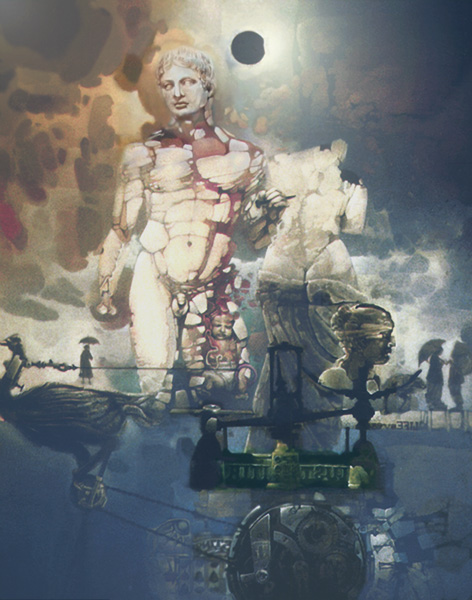
Contrary to the commonplace view of ancient Greek religion, the chief god there was not, in fact, Zeus. Of course, Zeus was the head of the pantheon, the father of the gods, and so forth. Yet devotion to Zeus was not religious in the modern sense; it was more political and resembled paying taxes to the ruler.
The power that truly made the soul of the ancient Greek tremble and filled it with mystical feeling was Dionysus — a god almost forgotten today, who has been reduced to the patron of winemaking.
Dionysus was an ancient Thracian god. The Thracians were far less “civilized” than the Greeks, who regarded them as barbarians. As with all agricultural peoples, the Thracians had their fertility cults and a god of fertility — Dionysus.
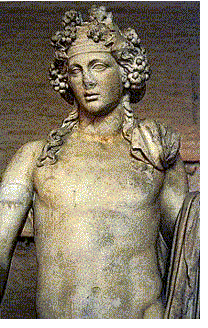
The religion of Dionysus enjoyed colossal popularity primarily because it restored the feeling intensity suppressed by reason. The world appears to it full of pleasure and beauty; the imagination is suddenly freed from the prison of daily cares. The civilized city-dweller of Greece, weary of reason, was incapable of intense experiences (as, indeed, is the modern person). The spirit of the urban dweller, orderly and prudent, found expression in the cult of Apollo, which we have already discussed.
The cult of Dionysus, which came from Thrace and is only briefly mentioned by Homer, contained the seed of a different way of exploring a person’s relation to the world. The Greeks saw in the phenomenon of ecstasy confirmation that the soul is something more than a mere paltry double of the “Me,” and that only “outside the body” can the soul reveal its true nature.
“Dionysianism preached a merging with nature in which a person surrenders to it completely. When the dance in the forests and valleys to the sound of music brought the bacchant to a state of frenzy, he bathed in waves of cosmic rapture; his heart beat in time with the whole world. Then the entire world seemed intoxicating, with its good and evil, beauty and ugliness. Everything a person sees, hears, touches, and smells — manifestations of Dionysus. He is present everywhere. The smell of the slaughterhouse and the stagnant pond, icy winds and enervating heat, tender flowers and a loathsome spider — the divine is contained in all. Reason cannot accept this; it condemns and approves, sorts and selects. But what are its judgments worth when “the sacred madness of Bacchus,” evoked by an intoxicating dance beneath the blue sky or at night by the light of stars and fires, reconciles one with everything! The distinction between life and death disappears. A person no longer feels torn from the Universe; he has identified with it, and therefore — with Dionysus.” (Alexander Men. “A History of Religion”.)
The myth of Dionysus is twofold. As in many other cases, this god had two incarnations: an “older” and a “younger.” The elder Dionysus, Dionysus Zagreus or Dionysus Sabazios (“Sabazios” probably meaning “savior”, also of common root with Greek σέβειν, to revere) — was an ancient Phrygian deity.
At first he was called “Lord of the Universe.” Nonetheless, as with other peoples, this god of the Power of Life was not supreme in the pantheon, though he was deeply revered by the people.
Later myths tell that passionately in love with his mother, Zeus satisfied it by taking the form of a bull; then, in the guise of one repentant and allegedly castrated himself, he placed a ram’s seed in the womb of his mother, and Demeter gave birth to a daughter, Persephone, for whom Zeus again burned with desire and, in the form of a serpent, united with his own daughter; the fruit of that union was the boy Zagreus with the head of a bull.
Dionysus as a god of nature was subject to the primal forces of Fate and Necessity.
No sooner had he come into being than Dionysus sat on his father Zeus’s throne and, having received a scepter from Zeus, began to shake the world and hurl thunderbolts. This provoked Hera’s fury, and she incited the Titans to kill Dionysus. The Titans attacked the divine child while he was looking into a mirror. Hera bribed the guards and, using rattles and a mirror, lured the infant from the throne. For a time Dionysus managed to escape his pursuers by changing his shape — now into Zeus, now into Kronos, now into a youth, a lion, a horse, a serpent. But when Dionysus took the shape of a bull, the Titans overtook him and tore him apart, smearing his face with white honey. They placed seven pieces of his body into a tripod vessel, boiled, roasted, and ate them.
The tearing apart of a wild animal and the eating of its raw flesh by the bacchantes was later regarded as a re-enactment of what the Titans did to Dionysus himself, and the animal, in a sense, acted as the god’s incarnation. The Titans were of deep, earthly birth, but after they ate the god they acquired a divine spark.
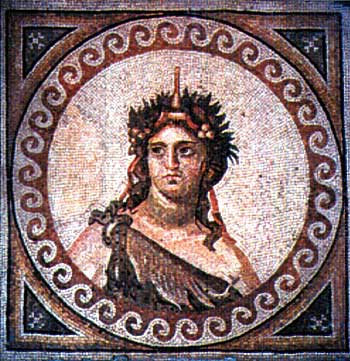
Athena saved only the still-throbbing heart and brought it to Zeus, who gave it to the mortal woman Semele, from whom another, younger Zagreus was born — the constant epithet of Dionysus as the “first” son of Zeus and the Queen of the Underworld, torn apart by the Titans immediately after his birth. Zeus incinerated the Titans, and from the ashes composed of the bodies of the Titans and of Zagreus, humans were created.
Having swallowed his son’s heart, Zeus once more fathered Dionysus by Semele (daughter of Cadmus, king of Thebes). At Hera’s prompting, Semele asked Zeus to reveal himself to her in all his glory, and when he appeared in the blaze of lightning he incinerated the mortal Semele and her palace. Zeus snatched the premature Dionysus from the flames and hid him in his thigh. At the proper time Zeus “gave birth” to Dionysus, later opened the stitches not at his thigh but later, and then entrusted Dionysus, via Hermes, to the care of the Nysian nymphs or Semele’s sister Ino. The name “Dionysus” may mean “Zeus’s limp,” for the god apparently limped from carrying the child in his thigh. Hermes played the role of midwife in these unusual births.
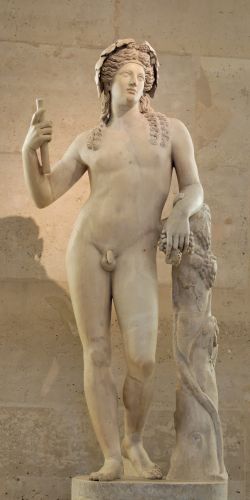
The nymphs raised Dionysus in the cave of Nysa (hence another possible origin of the name Dionysus — “Divine Nysa”.)
There Dionysus’s tutor Silenus taught him nature’s secrets and how to make wine. Silenus is usually depicted as a kindly, slightly tipsy old man with a horse’s tail and hooves.
This “new” god traveled from Hellas through Syria to India and back through Thrace into Hellas. According to myth, Dionysus not only traversed the earth but also descended into the Underworld.
When the young Dionysus wished to bring his mother out of the Underworld, someone named Prosymnus showed him the entrance to the realm of the dead, demanding as his fee the enjoyment of Dionysus’s body. This entrance lay by the Alcyonian marsh. Dionysus agreed, but by the time he returned Prosymnus was dead. Dionysus then cut a branch of a fig tree, fashioned it into the shape of a phallus, and mounted it. According to Clement of Alexandria, phallic images of Dionysus were erected in commemoration of this; every year, at night on the shores of the Alcyonian marsh, festivals for Dionysus were held. From the Underworld he brought out his mother Semele, who became the goddess Phiona. There was also a tradition that the Ancient Zagreus existed as a spirit in the Underworld until Dionysus reunited with him during his descent, so that the purpose of this descent was to attain the fullness of Dionysus’s nature.
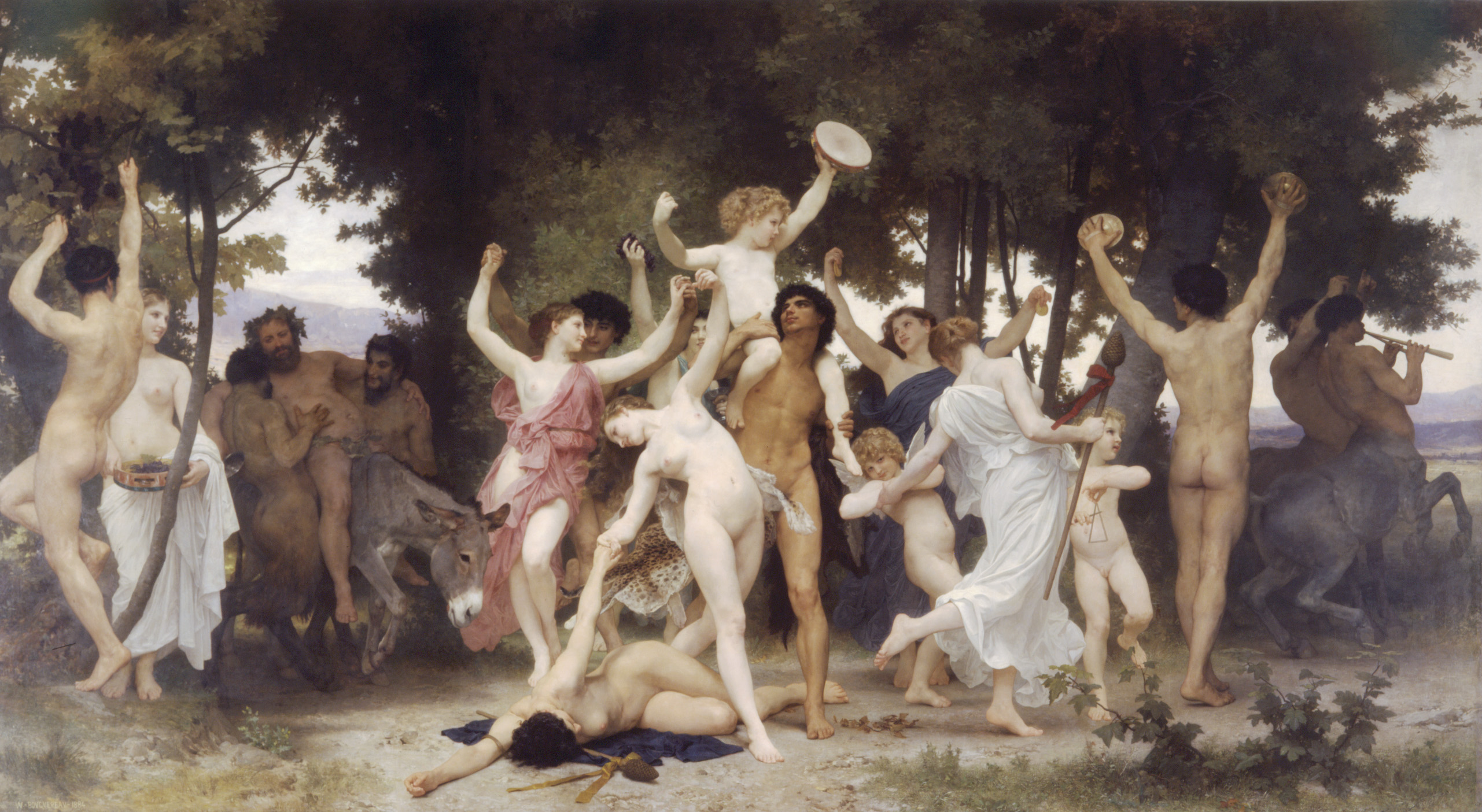
Madness was a constant companion of Dionysus. Thus, in one version of the myth, King Lycurgus, having rejected Dionysus, killed his son with an axe in a fit of madness, convinced he was felling Dionysus’s vine. The daughters of Minyas, king of Penthus, also lost their minds and were torn apart by frenzied bacchantes. The mother of that unfortunate king was among these women; she mounted her son’s bloodied head upon a thyrsus, convinced it was the head of a lion cub. In Argos Dionysus likewise drove women mad. They fled to the mountains with infants at their breasts and began to devour their children.
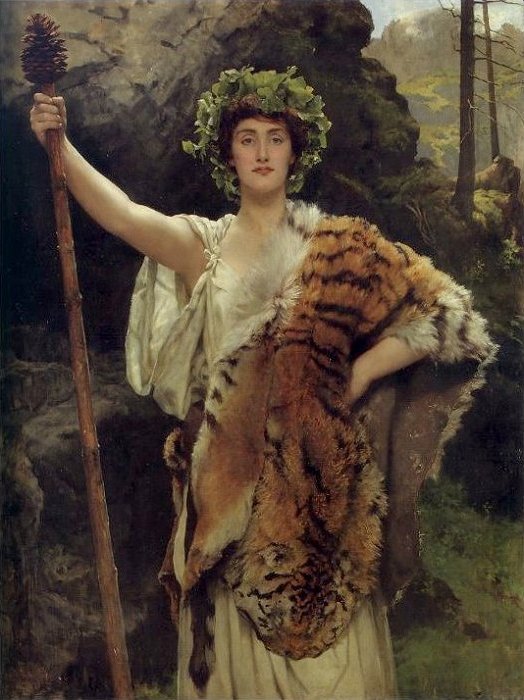
Similar tragedies befell other women who rejected Dionysus: the daughters of Kings Proetus and Minyas, having gone mad, tore their own sons to pieces.
When Dionysus returned from India, the goddess Cybele (or Rhea; both are pre-Olympian great mother-goddesses) purified him of the murders committed during his fits of madness and, crucially, taught him her mysteries and initiation rites. Thus Dionysus was not only a god himself but served as priest of the Great Goddess.
The god received epithets such as “born of a cow,” “bull,” “bull-like,” “bull-faced,” “bull-headed,” “horn-bearing,” “horned,” “two-horned.” In Athens and in the Argolid city of Hermigone there was a cult of Dionysus “wearing the hide of a black goat.” And in the myth of Dionysus’s upbringing with Ino, Zeus transformed the young god into a kid (sometimes a lamb) to save him from Hera’s wrath. The association with the goat, as well as with procreative power and nature, is indicated by Dionysus’s constant companions — the satyrs.
Besides the bull as the principal animal symbolically connected with Dionysus, the myths also associate predatory cats such as cheetahs and lions, bears, and snakes with him.
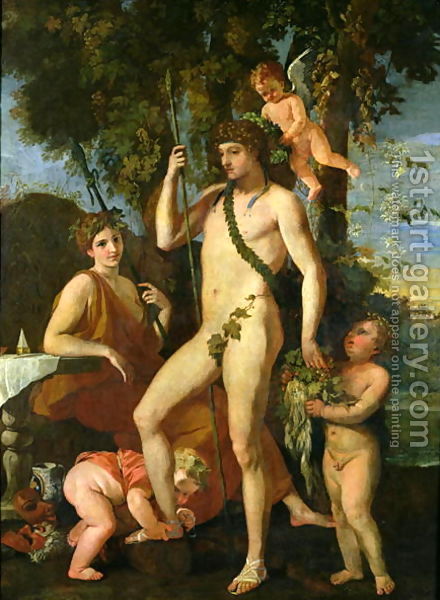
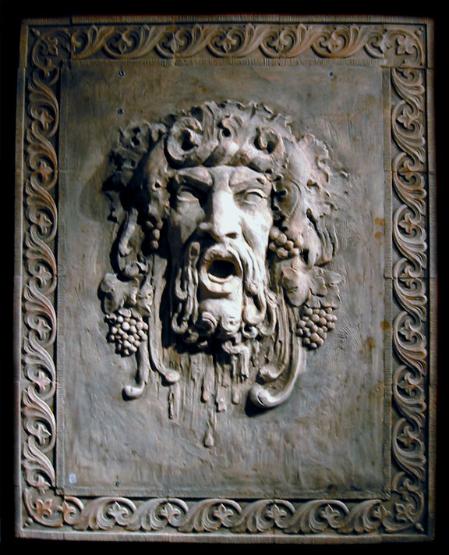
Dionysus was identified with plants as well, especially the grapevine, the raw material for wine, and trees. Nearly all Greeks offered sacrifices to the Tree-Dionysus. One of the epithets the Boeotians gave the god was Dionysus-in-the-Tree. He was often depicted as a column in a cloak, his face a bearded mask with leafy shoots.
According to myth, once during a hunt Dionysus saw a very handsome satyr skillfully playing a shepherd’s flute. The satyr’s name was Ampelos. He pleased Dionysus greatly and became his devoted companion. But one day Ampelos fell from a cliff and died. The god wept for a long time at his grave and implored his father Zeus to restore his friend to life. Zeus took pity and transformed the slain satyr into a grapevine that bore fruit whose taste resembled nectar. In the fruits was enclosed the sap of the earth, born of sunlight, moisture, and fire. In memory of this, Dionysus wandered the world teaching people to cultivate the vine, from whose fruit the divine drink — wine, which frees the feelings — could be made. From the name of the satyr Ampelos came the Greek word for grape — ampelos.
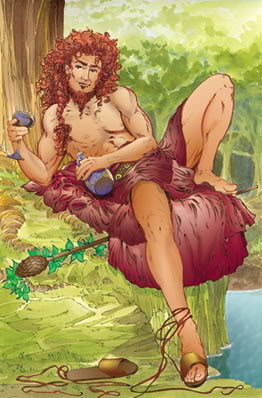
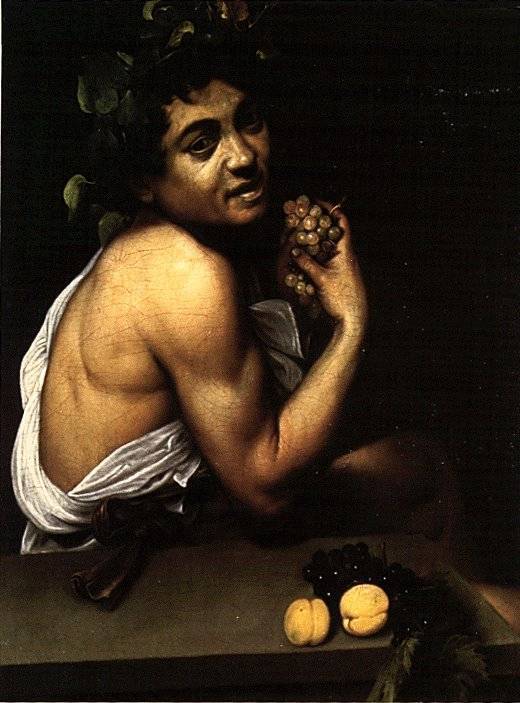
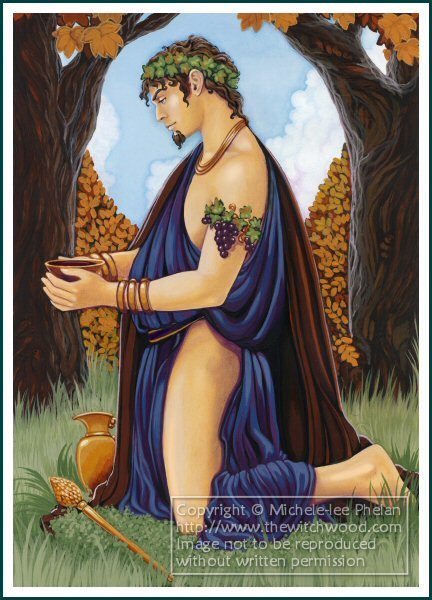
Wine is an attribute of Dionysus, as are the thyrsus, incense, ivy, grapes, the serpent, a retinue of animals, satyrs and maenads — the general idea being freedom, irresponsibility, abundance, happiness and equality, or a sense of narcotic intoxication varying from light tipsiness to ecstasy and raging frenzy.
Ivy traditionally distinguished Dionysus and his retinue from all other deities and people, since in Greece ivy does not shed its leaves in winter (during the festivals of Dionysus).
The Roman name of Dionysus — Bacchus — cannot be explained from the Greek language. The place of Dionysus’s upbringing, Nysa, was placed at one time in Egypt, at another in India; towns with that root appeared all over Europe (for example, Nice). The name of Dionysus’s garment — bassara — is not of Greek origin. The name Dionysus has been read on a tablet from Pylos dating to the second millennium BCE.
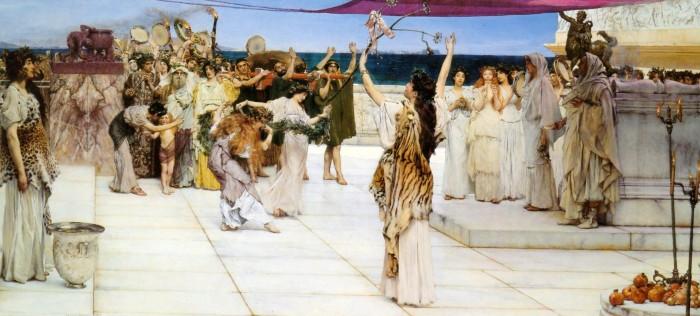
In Dionysus’ ecstatic procession took part bacchantes, satyrs, maenads or bassarides (one of Dionysus’s epithets is Bassareus) carrying thyrsi (staffs) wreathed with ivy. Girding themselves with serpents, they laid waste to everything in their path, overcome by sacred madness. With cries of “Bacchus, Euoi” they praised Dionysus — Bromius (“violent,” “noisy”) — beat the tympana, gorged themselves on the blood of torn wild beasts, struck the earth with their thyrsi to draw forth honey and milk, uprooted trees and swept along crowds of women and men.
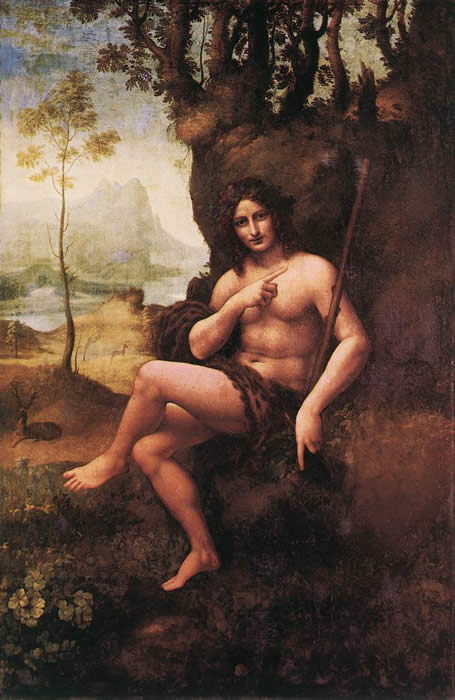
When the god Dionysus suddenly appeared before his followers, a monstrous noise would rise — only to turn into a deathly silence filled with the deepest sorrow when he suddenly vanished. At Dionysus’s appearance his maenads would enter a state of rapture and ecstasy, begin to dance wildly, and fall into uncontrollable fury.
On Parnassus every two years orgies were held in honor of Dionysus in which the phiai — the bacchantes of Attica — took part. In Athens solemn processions were held in honor of Dionysus and a sacred marriage of the god with the wife of the archon basileus was performed.
In Rome Dionysus was venerated under the name Bacchus (whence bacchantes, bacchanalia) sometimes spelled ‘Bacchus’. Later he was identified with Osiris, Serapis, Mithras, Adonis, Amun, and Liber.
“Later he identified with Osiris, Serapis, Mithras, Adonis, Amon, Liber.”… and also Jesus Christ. This includes the celebration of the Day in winter – Christmas, as well as the torn apart Dionysus and His subsequent Resurrection, the descent into Hades – Hell, and the journey to India and back, and the phallic Easter loaf with eggs and Holy Communion Wine and Flesh… – Truly, He has Risen!…
“And why did the Titans cover Zagreus’s face with white chalk? Are there any theories or opinions?”
A feeling balanced by reason is already Not That feeling. A feeling is mad. It’s when you run through half the city at night, through dangerous areas. You arrive and bang your fists on the iron door of the entrance. You bang with all your might to get someone to open it, for all the neighbors to wake up and know that you LOVE. No, a true feeling cannot be balanced by reason. It is fire, it is an avalanche, it is the ninth wave. It’s when you draw pentagrams on the bathroom floor with shaving cream with trembling hands from excitement and resentment, so that the most powerful hurricane reaches your offender and destroys their life into smithereens. And it works. But it doesn’t make you happy because pain, whoever it belongs to, remains pain— a feeling that you will have to endure to the end, to drink to the last drop, which you cannot put in a distant drawer and lock with a key. Life is so small and miserable, and love is just one bonfire that, burning, leaves behind only ash, a photograph that you will hang in a frame to look at and resurrect in memory that moment when you were young and in love. When, soaring above the world in blissful ecstasy, you were a bird of happiness, born for a moment, only to then sink into the abyss and crash against the rocks of reality… A feeling drives itself to the very edges and hurls itself to the bottom of the abyss… so that later, opening your eyes and realizing that you accidentally survived, you begin to balance it with reason, to light a small candle on that ash where green leaves will never grow again…
“…I am falling, burning with fire in the night, I am shattering into thousands of shards, but only one force, which is inside, remained cold, and that’s all. Piercing with a gaze, looking at me, it offered me to be free, from pain, from suffering, from fire, and to cool my feelings to be cold. It insisted, only in them lies your trouble, they are the evil that causes all the pain. Kill them! And the prison will end, I am reason, I know what I’m proposing…” The problem is that one ‘kills’ the other. Passion kills reason, reason kills passion (any feeling raised to the absolute is passion). And somewhere in a mythical land between them exists a compromise, mutual agreement, tender care, and trembling closeness without violating each other’s boundaries. At least, I believe in that))
Beautiful text)