
Belial’s “Corporate Unity”
The Great Archdemons that preside over the disharmonious manifestations of the Psychocosmos disrupt both individual and collective minds, provoking colossal drains on energy that exhaust the sephirotic worlds and sustain the Qliphoth.
The scale of these destructive powers is truly macrocosmic, although their roots lie in the mind’s vices, and therefore overcoming them is a necessary condition for the expansion and development of the awareness of any being or collective. At the same time, victory over such mighty foes is impossible without a clear understanding of the character of their activity, which is why the Magi devote considerable time to the study of demonology, allowing one to detect the manifestations of the primary destructive forces within one’s own mind.
Moreover, any klipha, a shell, is only an encrustation formed on the mental impulse that generates power, turning that power in a destructive direction.
We have already discussed two such potent destructive forces — Asmodeus and Astaroth, which demonize the principles of love and intelligence.
Another of the grand demonic forces that rule the human mind is the Great King Belial.

The sense of oneness that provides the foundation for feeding this demon is an extremely important and fertile feeling, embedded in the foundations of any mind. Every individual manifestation of mind, in its depths, is aware of its unity with the universal mind as such, and this awareness, in its purity, helps to maintain harmony and the unity of the flow of power. At the same time, unity manifests in multiplicity, and the Great Father of the Worlds reveals himself in the infinite diversity of his perspectives — individual minds.
It is not surprising that this feeling, when distorted, gives birth to one of the best-known destructive forces — Belial.
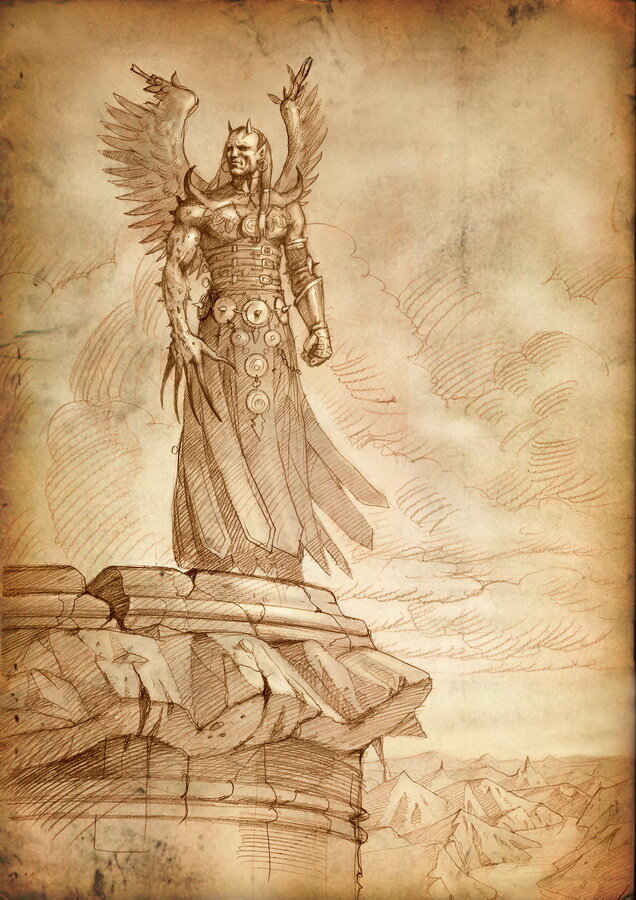
Lord of the South, Belial (from Heb. beli ya’al — “without worth,” “useless,” sometimes Veliar — the Dishonorable), another name — Matanbuchus (Matanbuchus, from “מתעב” — “to despise“), rules the emotional sphere, directing the social instincts of the mind in their active expression. Magical tradition assigns him to the klipha Ghaigidiel, the antipode of the sefirah Chokhmah (the Light of Intelligence). But in place of the bright differentiating activity of Intelligence, Belial fills the mind with a gloomy herd mentality, though sometimes dressed in fairly respectable colors.
Belial precisely generates the well-known destructive pattern — unification through opposition. Communities created and sustained by Matanbuchus rest on the opposition of ‘us’ versus ‘them,’ on xenophobia and hatred of everything that does not fit into the value system of the “in-group.” In other words, Belial’s “socialization” is not built on attraction but on repulsion, alienation; therefore, such communities resemble gatherings of bitter, enraged people.
According to the Lemegeton, Belial was created immediately after Lucifer and, by his own claim, was the first to fall among the worthiest and wisest angels.
In the Qumran text “The War of the Sons of Light against the Sons of Darkness” (c. 1st century BCE) Belial appears as the leader of the dark forces
«You created Belial, the angel of enmity, for the purpose of corruption. All his dominions are in darkness, and his purpose is to sow evil and sin around. All the spirits subject to him are nothing other than angels of destruction»;
Despite the epithet “Useless,” Belial reappeared time and again in human history.
In the Old Testament, Belial appears not merely as a seducer of man, enticing him to crime and enlisting him among the “sons of Belial,” but as one who turns a man into a Belial.
Medieval history is full of struggles with this “most lying of demons.” Saint Juliana is told that he “rejoices in human evil, delights in a man’s dying hour, loves lust, sows discord, [he is] the one who caused Adam and Eve to sin in Paradise.” According to the exorcist S. Michaelis’s “Histoire Admirable” (1612), Belial is a prince of the Powers who inclines people to pride. It is clear that medieval thought, with its hatred of the body, was ready to attribute to “lust” and “the works of Belial” almost any manifestation of sexuality, which, of course, is incorrect. Belial does not simply produce lust; he promotes fornication as an attempt to fill a soul’s emptiness with someone else’s body. Sex as the natural continuation of love lies outside the sphere of demonic influence, but it is very easily turned into mutual consumption. Unlike the Mother of Darkness, Belial holds no power over the very nature of sexuality; he rules only its social aspect — sex for money, for power, for career, and so on.
Belial is one of the 72 (Lemegeton, No. 68) or 69 (J. Weyer, “Pseudomonarhia Daemonum”, No. 23) spirits subject to King Solomon; he is named among the four principal ones and is also described as one who remained in the human world and received offerings after the destruction of the Bronze Pitcher.
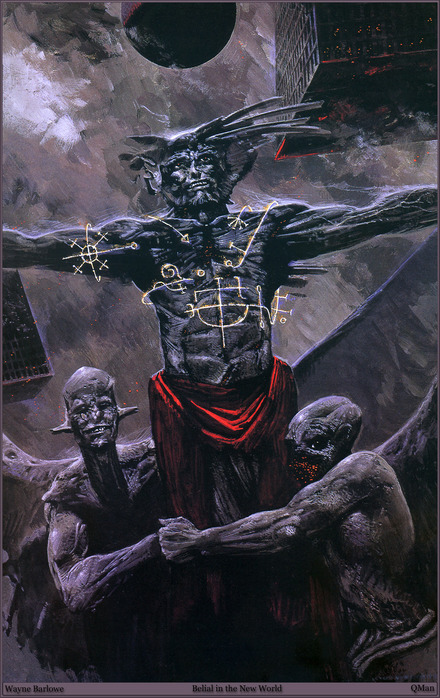
Belial is the first aesthete of Hell and dislikes appearing in the guise of terrifying monsters. He “appears in the form of two beautiful angels, sitting in a fiery chariot, speaking with a pleasant [and courteous] voice” (Lemegeton). Note that the very duality of Belial’s image already precisely indicates the character of his activity — the opposition of the individual nature of man to his social nature.
To Doctor Faustus (1587), however, he appeared “in the form of a shaggy, coal-black bear…,” bringing with him the chief infernal spirits, his most illustrious advisers and servants. Mephistopheles, describing the order of Hell, names Belial as one of the four rulers invested with princely authority. He governs 50 (according to the Lemegeton) or 80 (according to Weyer) legions of spirits (“partly of the order of the Powers and partly of the order of Angels” — J. Weyer).
The Lemegeton recommends bringing sacrifices and gifts to Belial, “otherwise he will not give true answers to questions.” Since Belial is the demon of alienation, he demands sacrifices and returns; he takes and dries up, and thereby produces a feeling of superiority.
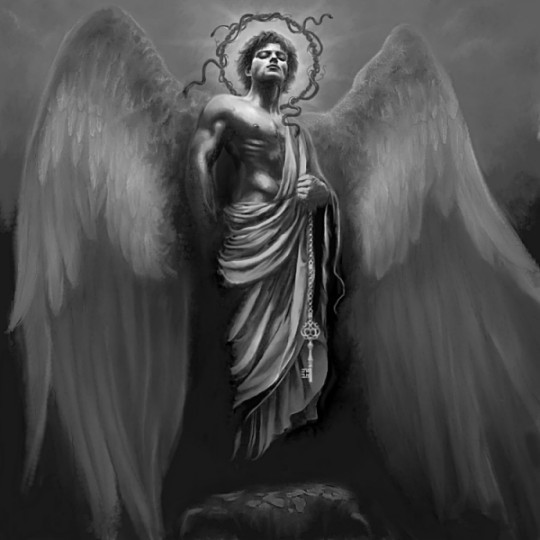
In some sources, Belial appears as the legal representative, the advocate of Hell in a suit against the Divine forces for the right to rule over humans, a suit often judged by King Solomon (in “Das Buch Belial” by J. Teramski, 1473, Belial, having exhausted legal stratagems, even dances before Solomon to win him over).
It is often noted that Belial incites people to unusual forms of sexual expression, to adultery and generally to lust (as mentioned, the energy drain in this case arises not from lust itself, but from its social role); he moved David to take a census of the Israelites, from which 60,000 people died. Yet, satisfied with the mere statement of this fact, few attempted to look at its causes — which, as mentioned, lie precisely in the destruction of the social feeling effected by Belial. In medieval Christianity, Belial was sometimes perceived as a possible equivalent of Satan, but whereas the latter is marked by hostility to man, the former is marked by inner emptiness, which man attempts to fill with every kind of herd manifestation — orgies, gambling, and in modern times — the “spirit of corporate unity” cultivated in various companies and organizations.
Belial governs social allocations: he apportions “senatorial privileges, procures the favor of friends and opponents, and gives excellent ministering spirits.” And all of this is also realized through oppositions and the construction of internal schemes of hatred.
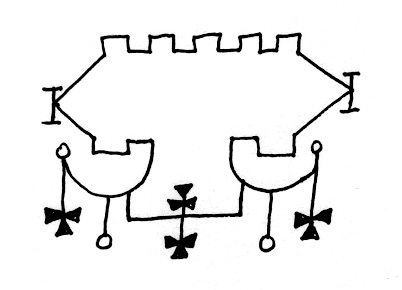
In any case, Belial is the chief lord of human society in the form in which it exists today, with its cult of consumption, the neglect of individuality and its manifestations, the replacement of inner life with a thirst for adrenaline, and the central importance of social status for inner comfort.
Many of the key laws by which human civilization has developed from its very beginning belong to him, and therefore Belial is one of the principal selective forces who helped create the species Homo sapiens.
However mighty his power, one feels from him “a great cold, despite summer weather,” that is, deep in the soul a person senses that the chase for social status and for adrenaline cannot give inner equilibrium.
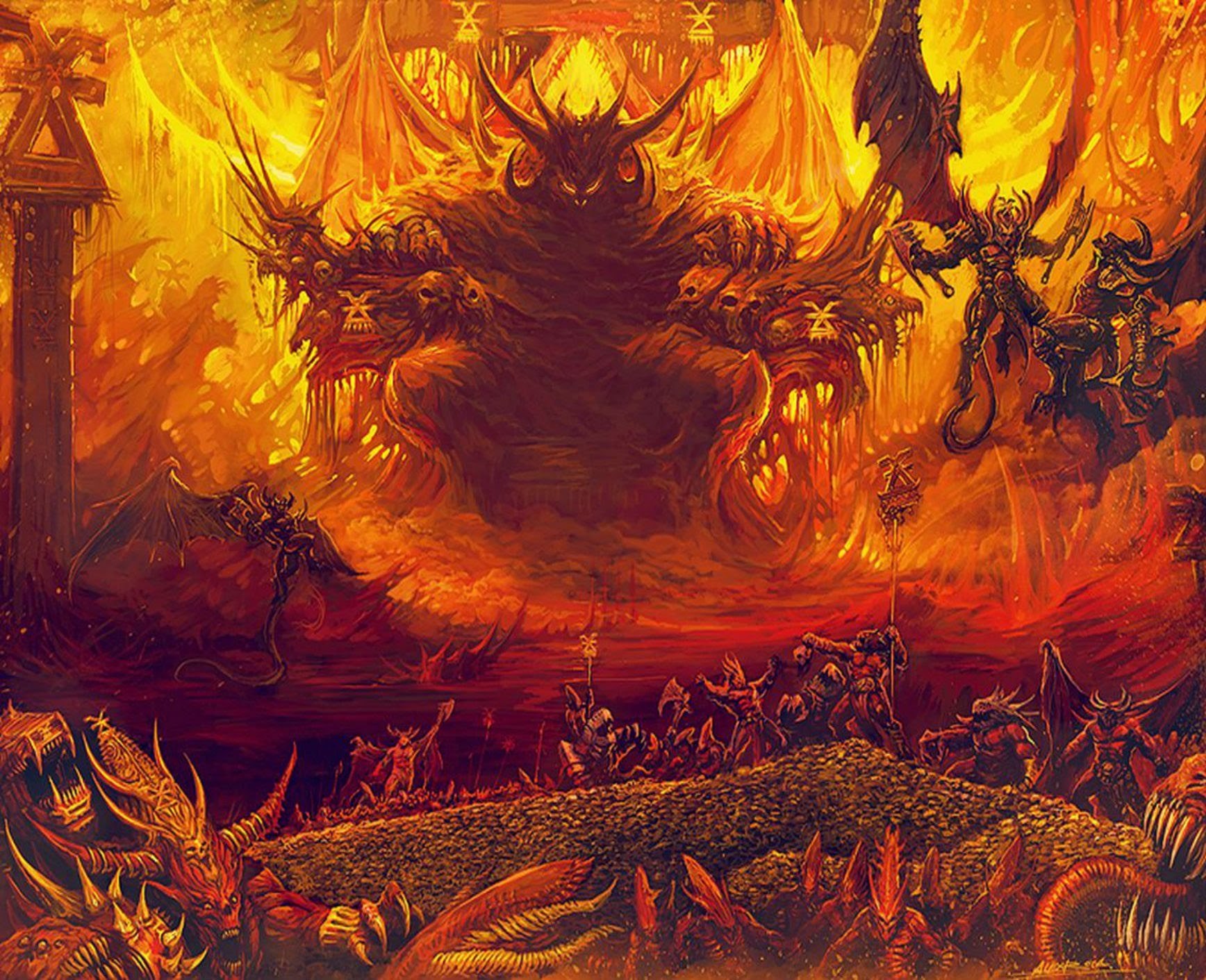
In his crudest manifestation, Belial governs the chaotic movements of human masses — the roar of the crowd and the madness of fanatics are subject to him; he directs social movements toward the absorption and destruction of individuality, and toward destructive manifestations, wars and pogroms. Thus Belial often provokes conflicts and wars to stoke that sense of separateness, exceptionality, or “being chosen,” which frequently unites immature and imperfect societies built not on inner kinship but on opposition.
Overcoming Belial’s rule consists in the shift of mind from seeing oneself as “a cog in the system” to the idea of the Pleroma, a “union without mixture,” to focusing on individuality and the search for internal sources of life in place of external surrogates.
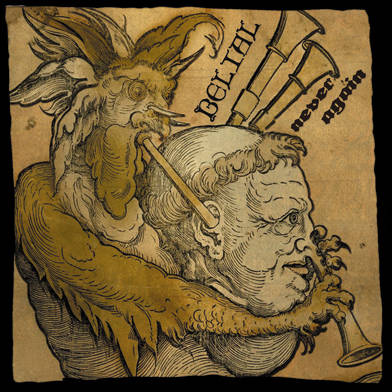
Queueing and proper adherence to it in social and public organizations. A good practice of contemplating the manifestation of ‘corporate unity.’
“Social Networks = Networks of Belial?”
All networks are the networks of Belial. In the broadest understanding of this idea of interconnectedness of the One, if it comes to that.