
Yetzer hara and the Buildup of Husk
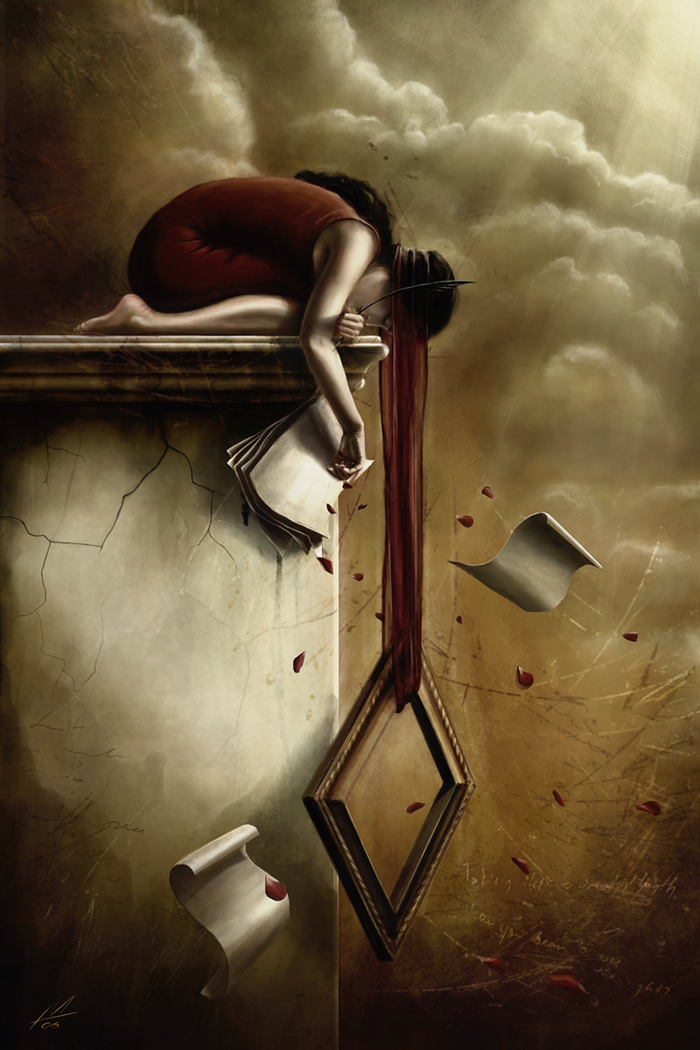
The stream of mind, manifesting as separate selves, personalities, and psychic manifestations, is by nature highly heterogeneous. Being merely a process, a mode of self-reflection of the singular, all-encompassing reality of the Great Spirit, mind actually manifests in the form of a great number of constantly arising and dissolving flows, each of which from time to time strives to set itself against the others, to assert itself as something independent and self-existent.
Traditionally, this impulse to struggle, to change the very mode in which the stream of awareness functions, is called Lamassu – the Parasite of mind. As we have already said, the Parasite’s strategy is aimed first and foremost at distorting the perception of energies flowing through the mind, since incorrect perception is the foundation on which distorted systems of interaction are subsequently built.

Such distorted perception of the macrocosm and psychocosmos, imposed by the destructive elements of the mind, leads to the formation of inefficient models of action and behavior as a whole, turning them from modes of awareness into forms of self-assertion and opposition to the integral reality. In other words, the Magi long ago noticed that the very foundations of describing oneself and the world on which human life is built are “corrupted,” and it is this deep pathology of the mind that leads to the construction of ineffective behavioral schemes and loss of power. The individual mind, seeing itself as ‘personal’ mind, organizes its functioning not as a flow reflecting reality but as a unit clinging to itself and its properties. Kak we have already discussed, this “original corruption” of mind, sometimes called “original sin” or the Yetzer hara (Heb. yetsēr hā‑rāʿ, lit. “inclination to evil”), is the “seed” from which dead ends and gaps proliferate in the mind. At the same time, those models of action grounded in an originally distorted perception, precisely because of their destructiveness, cannot lead to the accumulation of Power, and therefore constitute empty experience — a husk that accumulates on the mind and which, in turn, becomes an obstacle to the penetration of light. In fact, the development of mind built upon the Yetzer hara microcosmically repeats the cosmic process of the worlds becoming encrusted with the “husk” of the Qliphoth. Moreover, the more “neglected” this process is, the firmer the barriers to development, and accordingly the darker the mind. In other words, both macrocosm and microcosm turn from a harmonious and ordered symphony of co-awareness into a world of struggle and mutual devouring. However, despite the fact that the implantation of the Yetzer hara into the ocean of the mind begins with the very birth of that ocean, and the destructive ground itself cannot be completely eradicated without the total disintegration of the self and a “reboot” of incarnation, the very sprouting of this seed — and all the more so its producing fruit — is by no means an inevitable process. Put differently, although every manifested mind is infected with the Yetzer hara, it does not follow that in every mind this Yetzer hara dictates the rules of the game. It follows that the “tending of the garden” spoken of in religious texts acquires a distinctly psychocosmic meaning: the necessity of constant “weeding” of the field of perception and removing from it the sprouts of destructive patterns. Control, the primary hallmark of a disciplined Magus’s mind, is largely aimed precisely at preventing his mind from being clogged by destructive elements. Monitoring one’s energetic status, the character of one’s interactions and perceptions for signs of accumulation or loss of Power is the key that helps preserve the Way despite barriers and obstacles. And even in the case that an exhausting battle leads to a temporary decline of Power, if it was carried out impeccably, what remains afterward is Authority, which also attests to the correctness of the chosen course. But if the movement of Power that initially seems like an influx proves on inspection to be a loss not accompanied by an increase of Authority, then not only the action itself but the ideological foundations on which that action was based require reconsideration.
They say you can restructure consciousness by removing a corrupted element and replacing it with a correct one. Just like a colonnade of a building changes – first a new column is brought in and then the old one is removed. Is this possible?
In my opinion, replacing one element in the system leads to a restructuring of the entire system.
It remains only to prove to a person that their authority has not grown and their actions are mistaken. Not everyone can deal with this on their own. However, if we recall Darwin’s theory, the strongest survive, so help may not be required? Is it worth trying to explain to a person that they are accumulating chaff, or should we leave everything as it is, without intervening?
The well-known philosophical principle “Ockham’s razor” – “do not multiply entities beyond necessity” means that one should not seek more complex explanations where simpler ones exist. I want to ask—if one adheres to this principle in answering the question: “Do obstacles on a person’s path to growth live within their psyche, or outside of it?”—what answer would come out?
I believe that the husk hinders the passage of Light from within, lowering the height of energy vibrations, thus reducing the ability to interact with Entities of High Vibrations, which ultimately gives a distorted picture of Reality.
About 10-15 years ago, I remember I intended to experiment with implanting false memories. I wanted to check if it was possible to achieve significant personality changes in a short time (artificially, rather than through accumulating experiences). At that time, I was not familiar with esoteric literature and somehow subconsciously avoided this area (up until 2017-18).
But then I somehow forgot about it, and I don’t remember how the experiment ended (if it was successful, I probably won’t know whether I succeeded or not, since false memories will be perceived as true, and it won’t be possible to find out where the substitution occurred).
====
So, my question is: Is such a practice dangerous, and what is the risk? Has anyone tried it; please share your personal experience.