The Quaternary and Manifestations of Mind
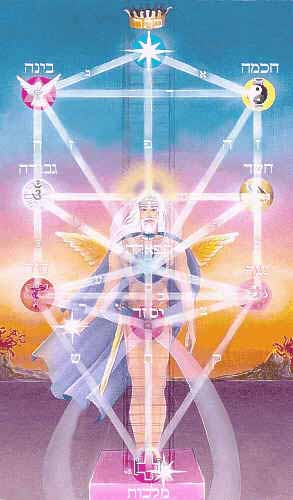
Understanding the importance of the manifestation of the quaternary cyclical process (the so‑called “Tetragrammatic Cycle”) in the formation of the Cosmos, note that the quaternary constitutes the unit of evolution of mind.
This means that, on the one hand, beings whose level of consciousness allows free interaction with one another may be at four stages of mental development, and, on the other hand, each such level (traditionally called “wave of life“) inevitably includes four sublevels. These sublevels are conventionally called Inert (a level of mind entirely devoid of initiative), Growing (capable of incorporating the simplest elements into its composition, possessing both activity and passivity), Ministering (capable of active operation, but only under the guidance of external forces), and Transforming (capable of autonomous active operation).
As mentioned, individual waves of life cannot interact directly with one another, being separated by perceptual barriers. The aggregate consciousness of each such wave is traditionally called the Adam Kadmon of that wave, and correspondingly, the Universe’s manifested consciousness is the Adam Kadmon of the Universe.
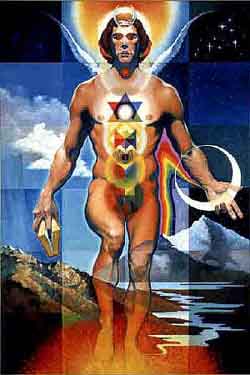
Thus each particular Adam Kadmon contains four levels of consciousness corresponding to the four stages of the Tetragrammatic Cycle. This is evident in our world (our wave, our Adam), which includes mineral, plant, animal, and human levels of mind. The same situation occurs in the hierarchy of ministering spirits: the “angelic” hierarchies also have four levels of consciousness: “mineral” — “eikhalot“, meaning ‘halls’; “plant” — “levushim“, meaning ‘garments’; “animal” — “malakhim“, meaning ‘angels’; and “human” — “ashim“, meaning ‘fires’. The same applies to the Governing spirits (the gods): among them are beings of all four levels. Moreover, within the ‘human’ level, as within any other aggregate consciousness at a single level (such an aggregate is called an “Adam Protoplast“), these four levels can likewise be distinguished.
Several important practical conclusions follow. First, the development of a Magus’s mind passes through all four tetragrammatic stages: from inert to transforming. Depending on the stage the mind is currently at, different approaches to development are required. Second, a Magus’s interaction with beings from other waves of life must take into account which form of mind it belongs to and which interaction methods with it will be most effective.
What are the methods of interaction with beings for each of the four levels?
Methods corresponding to their state of consciousness.
Good day again 🙂 As far as I understand, to distinguish the sub-levels of the subconscious, one must possess some amount of Power. But can we look at it more simply? For example, the behavior of a specific person in everyday life can be conditionally divided into the behavior of a leader and a follower. Does his behavior have any connection with his sub-level of consciousness? Can everyday behavior serve as a starting point for understanding what exactly needs to be done for his transformation? 🙂
Not quite that, leadership does not imply a higher state of consciousness. It only reflects the disposition of the source of activity: for a leader, that source is their internal impulse, and for a follower, it is an external impulse.
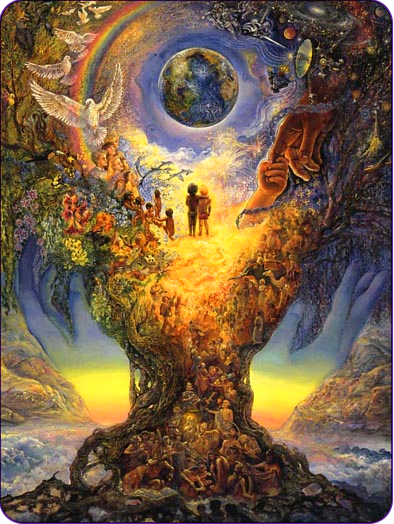
Yesterday I read this text about the realms of consciousness: on the one hand, the feeling that the mind is crossing the reason and I understand nothing, and on the other – such an exciting feeling as if I’m on an imagination simulator. And today I came across such pictures, among which I found many illustrations, as it seems to me, to the text: http://vk.com/photo-48310330_303998322
The four varnas and four ashramas of Vedanta imply exactly this principle, defining destiny, and each of the varnas has four sub-levels…