
Paimon’s Glamour

Creation as the formation of a field to actualize potentials occupies an exceptionally important place in the magical worldview. It is by using supports an assemblage of actualized energies that the mind can develop, expand, and realize.
An attitude toward the manifested world as a favorable opportunity for the mind’s development is expressed by the genius Haziel. The Genius is related to the spheres of Taurus and the Moon, which points to its close connection with rooting and grounding energies that allow the mind to make full use of the possibilities of the physical plane. These energies are said to give people steady footing and confidence in tomorrow, and the name of the Genius, which can be rendered as “Merciful God” or “God of Mercy,” underlines his influence on a “positive” attitude toward the world.
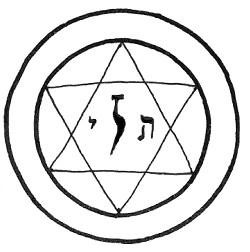
Nevertheless, an infatuation with the manifested plane, absolutizing it, and transferring it from being a means into an end leads to a distortion of the grounding energies and to the creation of a “cult of materialism.” Moreover, the involvement of both “earthly” and “lunar” energies gives this “cult” not only an all-consuming character but also a hint of aestheticism, and the materialism and hedonism of this cult spill over into a fascination with the outward appearance of objects, an obsession with glitter and tinsel — in short, what is now called “glamour.”
This destructive force is embodied in one of the demonic Kings since the distortion of the attitude toward the material is one of the basic destructors, one of the key delusions that leads to a whole slew of problems and inefficiencies.
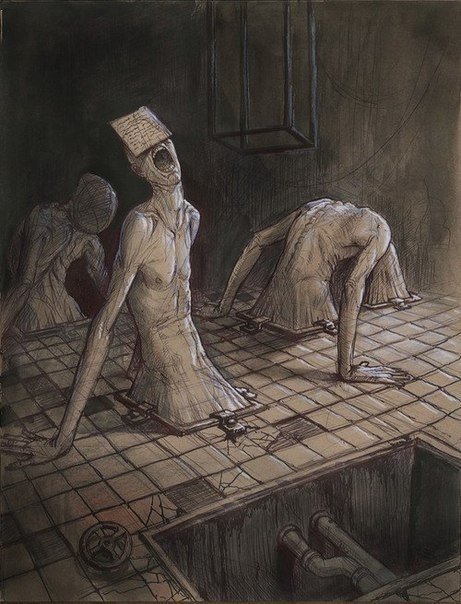
«Lemegeton» reports:
“Paimon (Paimon) — the ninth spirit, a great king, wholly subject to Lucifer. He appears in the form of a man with the most magnificent crown on his head, seated upon a dromedary. Before him march a throng of spirits like men, with pipes, cymbals and other musical instruments. He has a loud voice, and he roars at his first appearing, and his speech is such that the magus may not understand him until forced to express himself more plainly. This spirit can teach all arts, sciences and various secret things. He compels and forces any person to serve the magus, if the magus so wishes. He grants good friends, such as can teach all arts. He belongs to the order of Dominions. He rules 200 legions of spirits, some of which belong to the order of angels, and some to the order of Powers.”
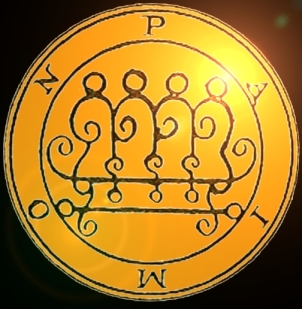
Let us unpack what this description says. First, it points to Paimon’s “greatness.” It speaks of the demon’s global reach: his manifestations touch very different areas of mind, especially those subject to Lucifer. The latter means that the path for Paimon’s influences is opened by intelligence, and although this demon comes from the west — therefore ruling over emotions — his power rests on an ideology, on reasoning of the sort “the whole world is shit, all people are scoundrels,” and paradoxically the consequent “take from life everything while you can.” Lucifer’s rule primarily implies a renunciation of love; its internal devaluation leads to the resulting coldness and emptiness, which are compensated by outward glitter and bright colors. The “earthly,” material component of Paimon’s influence amounts to skating over the surface, a refusal to look deeply — deep into oneself, into the depths of the cosmos, into others.
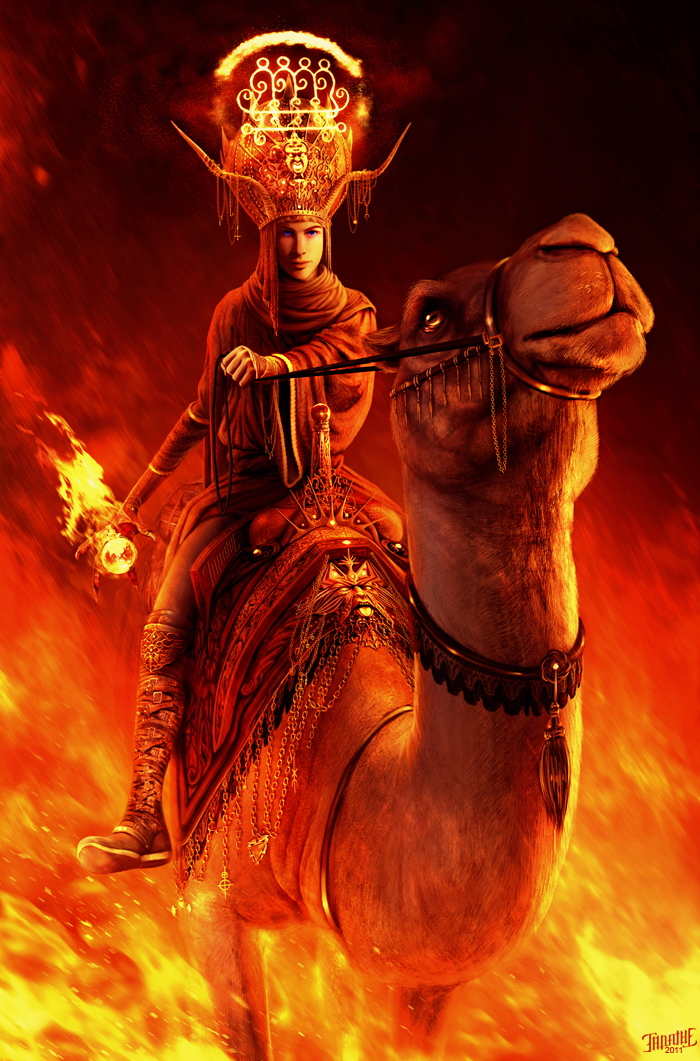
According to J. Weyer (Johann Weyer), the words of the prophet Ezekiel — «your garments were adorned with every precious stone» — apply to Paimon; a host of musicians appears before him on the head of the demon — “the most magnificent crown” — all of which underscores the depth of the demon’s authority over mind. Paimon’s “refinement,” his corrupted aestheticism, is emphasized by another characteristic — his androgyny, his intersexed nature: he appears as a “man with a woman’s face,” and this androgyny signifies not a harmonious synthesis of masculine and feminine principles, not their cooperation and fusion, but an imitation, a counterfeit that contains internal dissonance, once again concealed by outward tinsel and glitter. Paimon is not simply a “feminine man”; he is a man who poses as a woman, imitates a woman — that is, crudeness posing as sensuality. The latter is expressed in the demon’s voice: “His voice is powerful, and at his first appearing he roars.”
Paimon rules realizations through intelligence; a person under his influence is convinced that he knows and understands everything, and often plays the part of the experienced, world-weary type. This is precisely what the Lemegeton refers to when it states that “he may reveal what the earth is and how it rests on the waters, what the abyss is and whence the wind comes….” This Luciferian trait, however, does not extend beyond posturing and does not lead to genuine reflection or understanding.
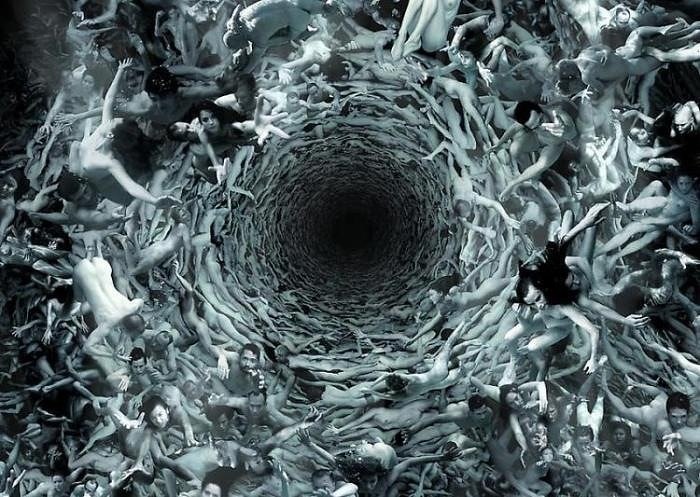
A person who falls under Paimon’s influence does not merely strive for material acquisitions; they become the focus of their life. He truly believes himself to be happy when he buys an exclusive outfit or a brand-new phone; he truly suffers when he “looks bad” or when people “treat him poorly”; he is dependent on public opinion and social stereotypes, while at the same time considering himself some kind of original, authentic figure. The incredible intellectual primitiveness implanted by the demon is masked by an excessive layer of make-up, glitter, boas and feathers, and the cold heart, incapable of love, hides behind ostentatious “sensitiveness” and “impressionability.”
It is clear that one can oppose Paimon by cultivating the right attitude toward the physical world and its resources as the environment in which the mind develops — an environment important but nonetheless secondary to spirit — an environment that must not be neglected, but to which one should not become infatuated.

Thank you. Very timely and helpful.
Question: What is the fundamental difference between the manifestations of Gaap and Paimon?
Gaap – south, fire; Paimon – west, water. Gaap – a tyrant and despot, Paimon – a cruel pretty boy. Gaap will hit on the head, Paimon – will smile while driving needles under the nails.
It sounds a lot like the expression “Life is a bridge; walk across it, but do not build a house on it.”
By the way, En, is there an opposite to Paimon? Some are all intelligent and apparently wise, but there are also those who consider themselves foolish, etc. And this doesn’t always align with reality; it’s not always a result of being honest with oneself. Often it’s just as much of a fiction imposed from outside.
So, fierce collectors (of anything) are under the influence of Paimon, am I right?
What to do if the awareness of the secondary/illusory nature of materiality existed and exists, but some of the ‘characteristic features’ you described above still hold?
With Respect.
I suspect the answer, but I join the question posed by Corwin.
I read your article and asked myself, what were you actually trying to reveal in it? And for whom? Everyone who truly engages in goetic practices long ago understood that the descriptions given by the Lemegeton are strictly conditional (one could even assume symbolic), and the true essence of the described demons reveals itself only at the individual level of a specific neophyte. You assert that Paymon does not offer a genuine understanding of the nature of things (how could you know this?). Why do you attempt to understand and reveal the essence of what should be understood and accepted in its original form, which is determined through (and possibly from this more accurately) unrecognized facets of a specific personality in accordance with the degree of its enlightenment.
Any descriptions are conditionally subjective and symbolic in nature, but some are incredibly useful. I believe that articles are useful for those who want to eliminate any destructive influences from their consciousness.
It should also be added that the Lesser Key in Crowley’s interpretation is offered in a significantly simplified version compared to the original source, which suggests that the author deliberately wished to mystify and distance the reader from conducting goetic evocations. Therefore, this and similar works are more suitable for theoretical acquaintance of the neophyte rather than for actual practice, the foundation of which, fortunately, is known to few.
Dear Enmerkar, first of all, I want to express my sincere gratitude for such a significant understanding of the topic and its concise disclosure. Unfortunately, I cannot leave my question for public view. It is too personal in nature. To my even greater regret, I do not have the opportunity to write to you via the aforementioned, technological ‘write to me’ button, as pressing it does not trigger the necessary or known processes for me. May I ask you to leave me your email address? There is a topic I find necessary to discuss with you specifically. I also cannot rule out that you might find this context quite curious and even intriguing. Yours sincerely.
feedback@enmerkar.com
The funniest thing is that I used to have a wild allergy to wormwood. Tell me how it is possible that it can send both angels and other service spirits? Or is it the ability of all higher ranks?
Just as “Enochian” angels arrive: many “gray”, “heavenly” spirits are completely under the control of demonic Kings.
Thank you! How does coordination and interaction between different hierarchies occur? Is it also at the level of laws? Although if such information can be harmful, it probably shouldn’t be disclosed. As I understand it, it currently looks like a council. With facts and discussion.
Interaction occurs very simply – according to the food chain (just as we can observe in earthly biocenoses). Higher order predators control those below, regardless of which hierarchy they belong to.
Hello! I see a great similarity between the 5th arcana the Hierophant and this demon. Is the Hierophant consciousness freed from it?
Hello.
Yes, there is a certain intersection of ideas.
And it can be said that the Hierophant is that self-centered state of consciousness that is distorted by the King of Glamour.