
Barbatos — Insulted Nature
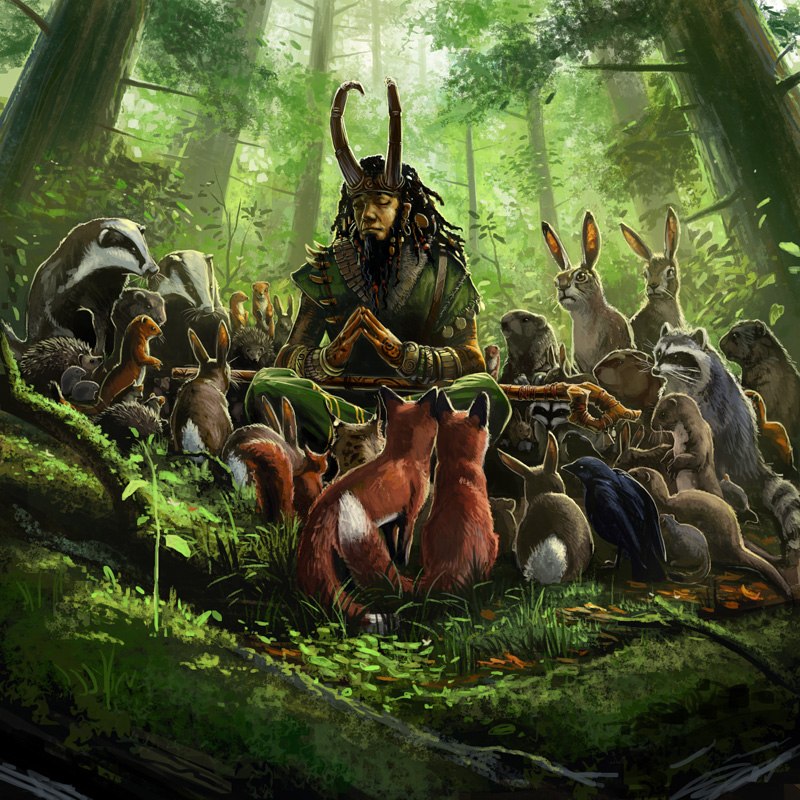
One of the most important and profound feelings available to the human mind is the sense of unity with the entire cosmos — with forests and clouds, with streams and mountain crags, with plants and animals.
This sensation, arising from the deep unity of all things in the Great Spirit, is not only mystical but genuinely magical — it propels one to active deeds aimed at reducing suffering, at reunion and reintegration into the Pleroma.
How much inspiration, how much poetry has been drawn from Dionysian ecstasies, and how much Power the mind can find by interacting with the Waves of Life!
And, of course, no less destruction stems from the disintegration of this feeling.
The Power that drives one to struggle against nature, to harm it while masquerading as “unity” with it, is manifested as one of the Grey demons — Barbatos.
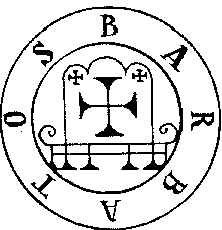
“The Lemegeton” says the following about this Demon:
“The eighth Spirit is called Barbatos. He is a Great Duke and appears when the Sun is in Sagittarius, with four noble kings, accompanied by great hosts. He teaches the understanding of the song of birds and the voices of different creatures, such as the barking of dogs. He uncovers hidden treasures, breaking the magical charms that were laid upon them. He belonged to the Order of Powers, some part of which he still rules. He knows all about the past and what is to come, reconciles friends and furthers the alliances of rulers…”
In the Grimoire’s terms, the “teaching” a Demon imparts is precisely a false awareness.
In this case, the Demon implants a false sense of belonging to nature.
A typical example of Barbatos’s influence is the modern “recreation in nature.”
People pile into cars, drive somewhere “away from the urban bustle,” eat shashlik, drink vodka, and leave behind broken and sawed-off branches, heaps of trash, and trampled grass. Then they happily drive home, having “enjoyed the scenery and fresh air.”
And, of course, this activity has a whole range of negative consequences.
Besides the obvious harm and, as its consequence, the burden on the soul, there also arises the retaliation by nature spirits disturbed by such “visitors,” and, of course, the very illusion of unity — a disrupted energy current, which amounts to setting oneself against the Great Flow and, accordingly, to losses of energy and Power in general.
And in this lies the main danger. Barbatos places a person, effectively, outside the common flow of the cosmos, pushes him beyond the field in which any development of awareness is possible, and thereby deprives them of any chance of improvement, turning them into a creature driven to consume capable only of consumption and of exploiting others’ resources.
The “four noble kings” mentioned by the grimoire are, of course, the four kings of the elements — it is interaction with them that Barbatos disrupts.
In fact, Barbatos is a distorted, parodied god of nature — Kernunnos — perverted into a demonic guise in which the impulse toward creative transformation has been replaced by an impulse to consumption and rape.
For the Magus it is very important to notice this Demon’s influence. Every piece of paper thrown into a forest or meadow, every needlessly broken branch puts a person into opposition to the Great Flow, and thus not only pollutes the mind, not only burdens his “karma,” but also disrupts the harmonious flow of consciousness. Attentiveness, discipline, and, of course, the Magus’s keen sensitivity ensure one does not miss opportunities for development that union with nature — the elements, the Elementals, and, in general — the realms of mind — offers.
In nature, it’s clear with the shashlik. I saw in the city boys and girls paint their bodies and make additional holes in them or pump all sorts of color and shape transformers into their bodies. I think this is also the influence of this demon. In the city of Moscow, almost no one litters the streets. I began intentionally throwing small amounts of trash on the street, and this demon appeared. It turns out that this demon maintains cleanliness in the city. I started throwing mental trash, and this demon appeared too. It seems like it establishes itself as a spirit, a regulator in the four elements. Both in the microcosm and the macrocosm. I’m sure this demon turns Earth into a desert, which can live and bear fruit both externally and internally.
Is a zoo not a distortion of love for nature? What about keeping exotic animals at home, where they only suffer in such conditions? And natural history museums, where stuffed animals are displayed and schoolchildren are shown, with explanations like: “This is a bunny, and this is a fox”? And movies about unfortunate animals, where they are always tortured and end up killed? The series Flipper about dolphins, which led to the development of a disgraceful business, resulting in thousands of dolphins being killed and tortured in aquariums every year? And those aquariums themselves. This list can go on indefinitely. The issue of littering with bottles in the forest is far from exhausted.