Spirits of the Copper Vessel
We have already said that ceremonial magic operates primarily through ministering spirits.
Now it is time to clarify why these spirits are called Demons or Fallen Angels.
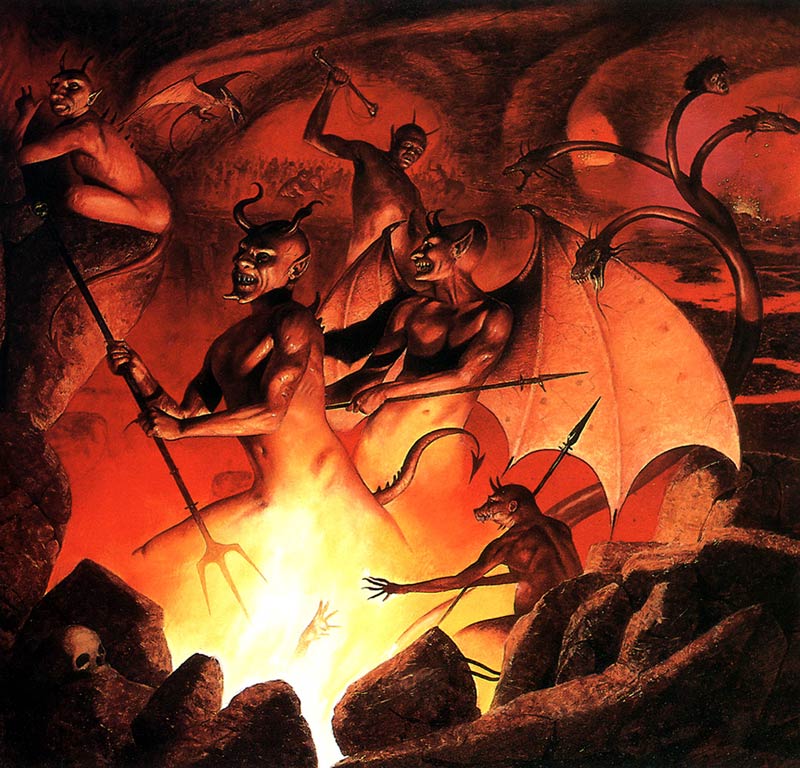
It is perfectly clear that by “fall” an impartial person does not mean a crude rebellion against God, but a constructive rebellion against the divine.
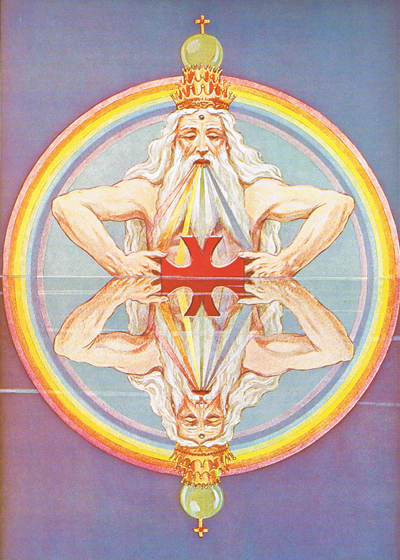
By this we mean efforts to fragment the One nature into distinct aspects — in other words, involutive actions. It is known, however, that such actions are as necessary for the existence of the Universe as evolutionary (unifying) ones.
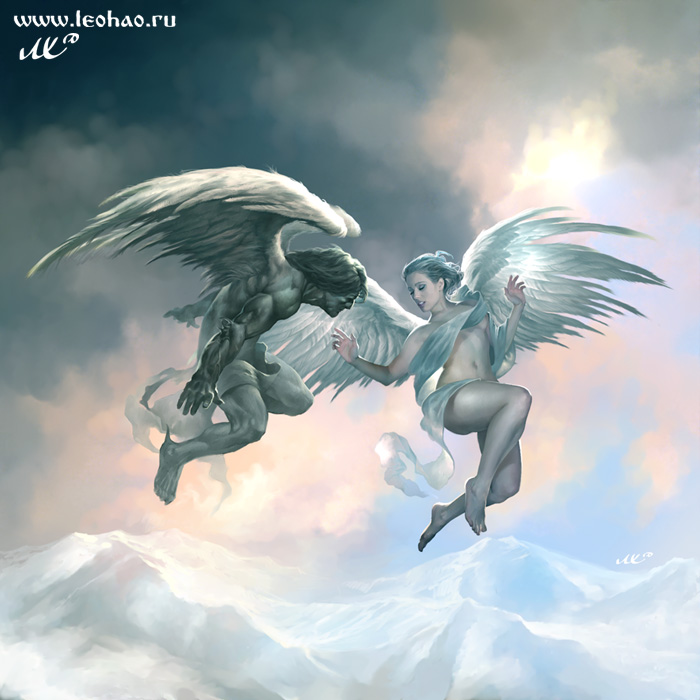
Usually these two kinds of forces are described as Direct (right-handed) and Reverse (left-handed) vortices. Moreover, each vortex may be either ascending (evolutionary) or descending (involutive).
Each of these kinds of vortices, as mentioned, may equally be considered a mechanical system or a volitional entity; in the latter case, within the Judeo-Christian tradition, the descending (usually direct) ministering vortices were called Angels, while the reverse ones were called Demons.
Thus, Goetic practice aims to master the forces of the Reverse ministering vortices.
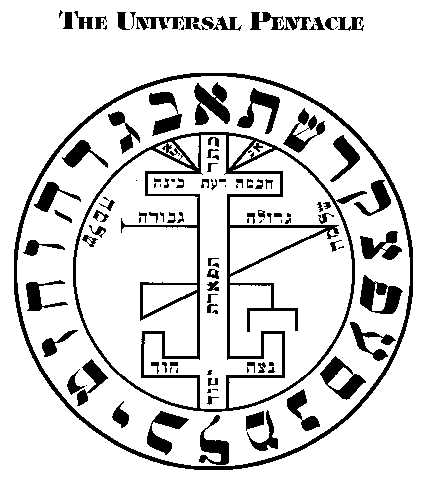
Although the number of such individual vortices defies enumeration (since vortices are capable of individualizing collectives — that is, a vortex composed of several simpler ones acquires its own entity without absorbing the entities of its constituents), it became clear as far back as Ancient Babylon that they can be reduced to 72 principal vortices.
We will not go into the subtleties of the sexagesimal system of reckoning adopted in Mesopotamia here; we only note that it is the most convenient for describing vortical motion.
According to that system, any circle, including a celestial (zodiacal) one, is conveniently divided into 72 kiner (groups of five, since it is the number five — the pentagram — that describes the structure of the elemental vortex), and each kiner corresponds to both an evolutionary (the so-called Genius) and an involutive (“Demon”) vortex.
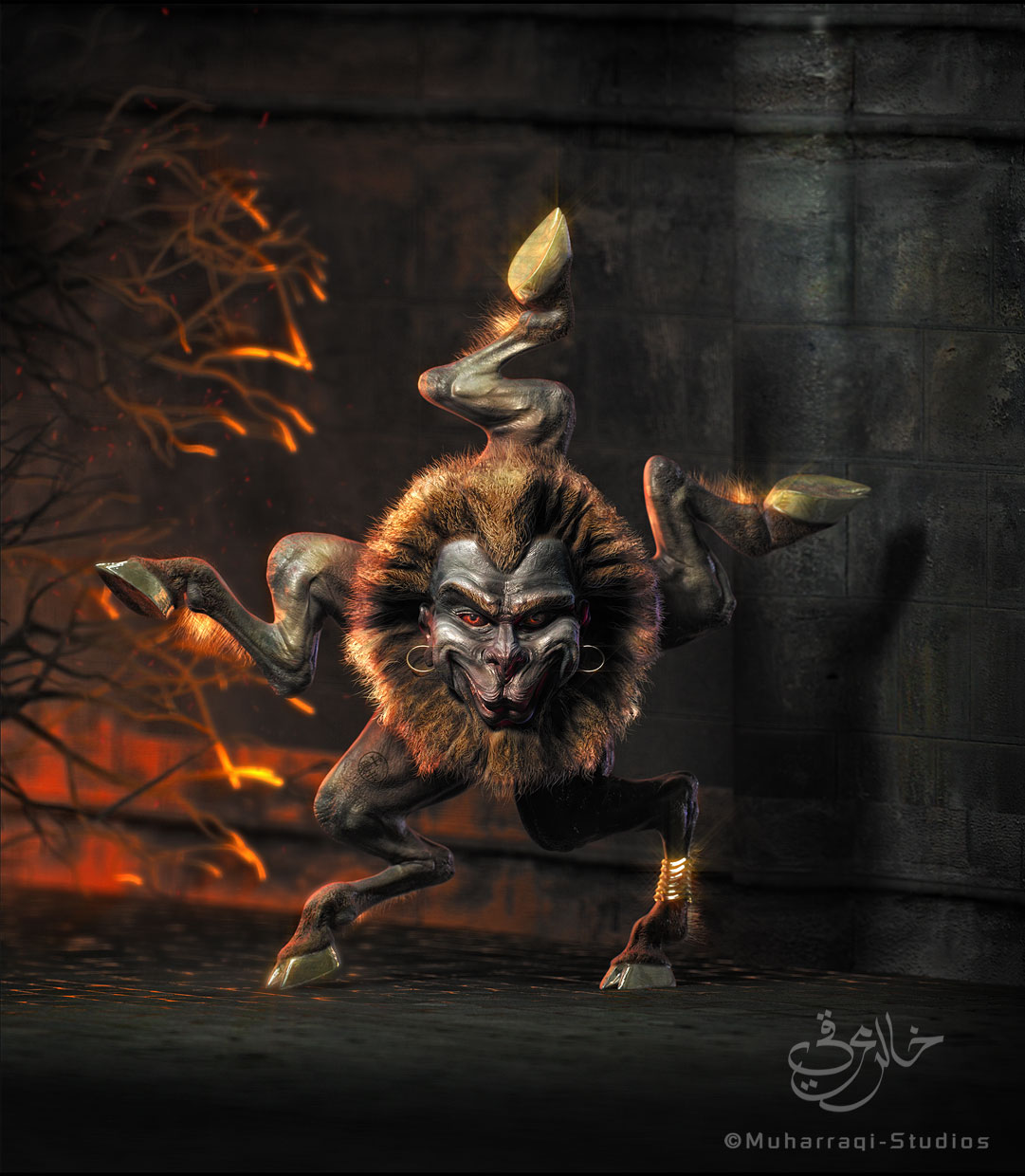
Two more or less coherent treatises dealing with the structure of these vortical communities have come down to us: 1) Lemegeton (“the Clavicula,” a tract that arose around the 10th century, although mentions of it are known from the 1st century), which consists of four parts: “Goetia,” “Theurgia Goetia,” “Ars Paulina,” and “Ars Almadel”; and 2) “The True Grimoire” (dated to the 15th century). All of these systems describe “demonic” hierarchies, though they differ in the names of demons, their sigils and their proportions. From a classificatory standpoint, Theurgia is the most complete, yet numerous accounts show that in terms of effectiveness (practical applicability) the system of the Goetia proves the most potent.
The Lemegeton system is based on correlating spirits with planetary spheres: 9 spirits belong to the sphere of the Sun and are called Kings, 7 — to the sphere of Jupiter (Princes), 23 — to Venus (Dukes), 15 — to the sphere of the Moon and are called Marquises, 12 — to Mars (Counts), 15 — to the sphere of Mercury (Governors), and 1 — to the sphere of Saturn (Knight). The “ranks” used to designate each spirit’s position refer, firstly, to the order of the planetary Sphere (that is, the sphere of Secondary Causations), and, secondly, to the relative size of its vortex (that is, to how many smaller vortices can be distinguished within it).
According to legend, it was the 72 Demons of the Goetia that King Solomon confined in the Copper Vessel, sealed it with a secret seal, and cast it into a deep lake. However, Babylonian priests retrieved the vessel and unsealed it (the legend says in search of treasure), releasing the “Demons” back into the world — it is clear that these Babylonians proved wiser than Solomon, for they understood that the world cannot exist without both its light and dark sides. They nevertheless made sure to create 72 Great Seals, each of which had power over the corresponding “Demon.” They were obliged to do so because the Great Seal of Solomon had been lost, and there was no possibility of joint governance of the Spirits of the Vessel. It is believed that the 72 Great Seals were entrusted to the corresponding Keepers (of the Seals), upon whose shoulders fell the duty of guarding the stability of the world. But that leads us deep into legend.
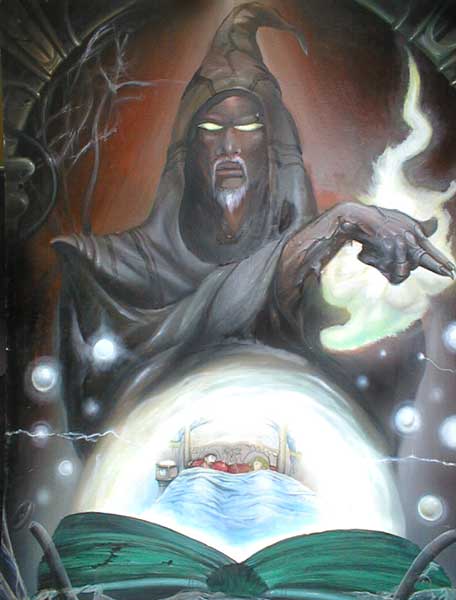
Thus, the information available to us indicates that the art of Goetia, directed at commanding the spirits of the kiner of the heavens, has deep roots leading back to the most ancient experience of interacting with the Dual vortices, considered in personified form.
Who else does ceremonial magic deal with besides the service spirits?
In its classical form, almost only with them.
What can the runes not do, is clear from the previous post. What can ceremonial magic not do?
Cannot provide strength, for example.
A bit unclear regarding “directions” … Angels, as I understand, represent involutive entities; the very word “Angel” is of Greek origin and means “messenger”. A similar term from Jewish/Arabic mythology (Malakh, meaning sent one). This refers not to transmission but rather to commissioning, thus indicating a service nature. Their involution lies in the nature of servicing, it moves from the whole to the fragmented. Demons represent a binary opposite to Angels on the good-evil axis, however, by their nature, they are also involutive.
Now let’s return to our … vortices. Kiner represents a vortex pair, where the initial vortex is involutive (as its source is the One, as an integral), while the reverse vortex is evolutive, as (its source is the Whole, as a sum). Why then do they write that the direct vortex is evolutive??
The terms “involutive” and “evolutive”, as well as “descending” and “ascending” are not quite synonymous. It is believed that Angels perform involution in the sense that they condense matter; however, their efforts are aimed at increasing the influx of Light, that is – towards evolution. Demons cause a withdrawal of strength, Light, similar to the evaporation of water through plant leaves, creating reverse pressure, thus indirectly contributing to evolution. However, the binarity does not lie in what they contribute to, but in HOW they do it.
Regarding “cannot provide strength” … service spirits in ceremonial magic are used according to the vector of their main activity, i.e., the caster gains access not to the source of power but to its use. They do not acquire strength at this time but can use it … the difference in many cases is not great (since they still have to use strength), but it is crucial as it creates limitations and dependence on “tools.”
And why is there a desire to control demons? Why is direct (evolutionarily-involutionary vortex) unsuitable in this sense? Or is “demon” a collective term for both types of vortices?
No, it’s not collective. The direct vortex is not exactly unsuitable; it’s much harder to manage since it has a support in higher realms of reality in relation to humans.
“72 Great Seals were entrusted to the respective Guardians, who were tasked with maintaining the stability of the world. However, this leads us deep into legend.” –
Are there plans to tell this legend on the blog pages? 🙂
I’m curious to know how possible it is to get the full story: from the origins and legend to modern times.
Thank you.
Could you please tell me, maybe I have gone off track and it is completely out of place… but where can we classify Arab djinns – among demons, that is, as ’embodiments of energy drainage’? And is the interaction with djinns for Arabs not the same as with demons for Christians? They also dissolve without a trace, burning in Dinur?
Djinns in Arab culture are elemental beings, spirits of the deserts, hence they are not very friendly to humans, but by formal characteristics, they rather belong to free spirits than to service ones. However, probably, this name was also used for some demons.