
Baalberit: Authorities and Sources
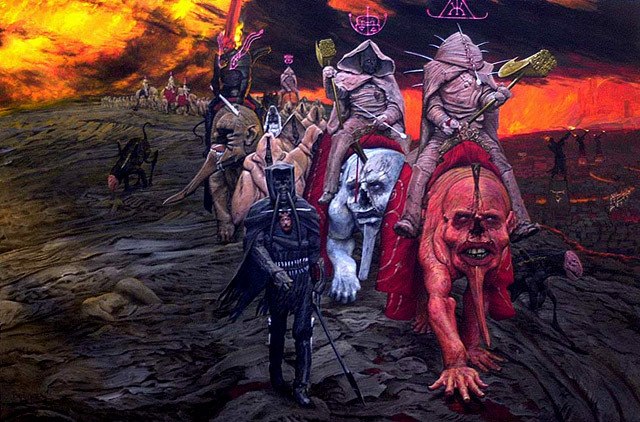
The necessity of continuity in the flow of Power, its succession and socialization as a form of passing on experience and exchanging energy means that any development, regardless of its direction or intensity, includes learning — learning from experience, using established action patterns, the accumulation of methods for solving problems.
We have often said ‘learning’ in the human and magical worlds means different things: people equate learning with reproducing others’ approaches, while the Magi call it entering the stream of the Wyrd.
Nevertheless, both variants include an important notion — the concept of authority — the skill of finding a successful way out of various situations.
Of course, this important notion has not escaped distortion and corruption, and three Gray Dukes replace concepts: Baalberit, Abigor and Alloces.
Since this distortion originates with Baalberit, today we’ll discuss him.
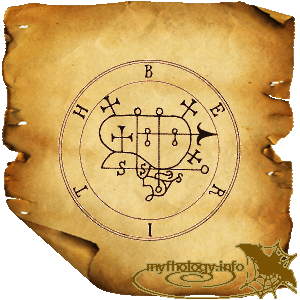
The name of the Demon — of Semitic origin — is a corruption of the name of the Shechem (a town in Palestine) deity Ba’al-verif — “Lord of the Covenant.” This indicates that the Demon seeks power through destructive unions and spurious hierarchies.
“The Lemegeton” describes the Demon thus:
“Berith — the twenty-eighth spirit, powerful, great and terrible duke. He has two other names given him by men in later times: Beale or Beal and Bofry or Bolfry. He appears in the form of a soldier in red clothes, mounted on a scarlet horse, with a golden crown on his head. He gives true answers concerning the past, present and future. He can turn all metals into gold. He can give ranks to men and confirm them. He speaks with a very clear and gentle voice…”
J. Weyer (Johann Weyer) clarifies slightly: “…he gives a man honors….”
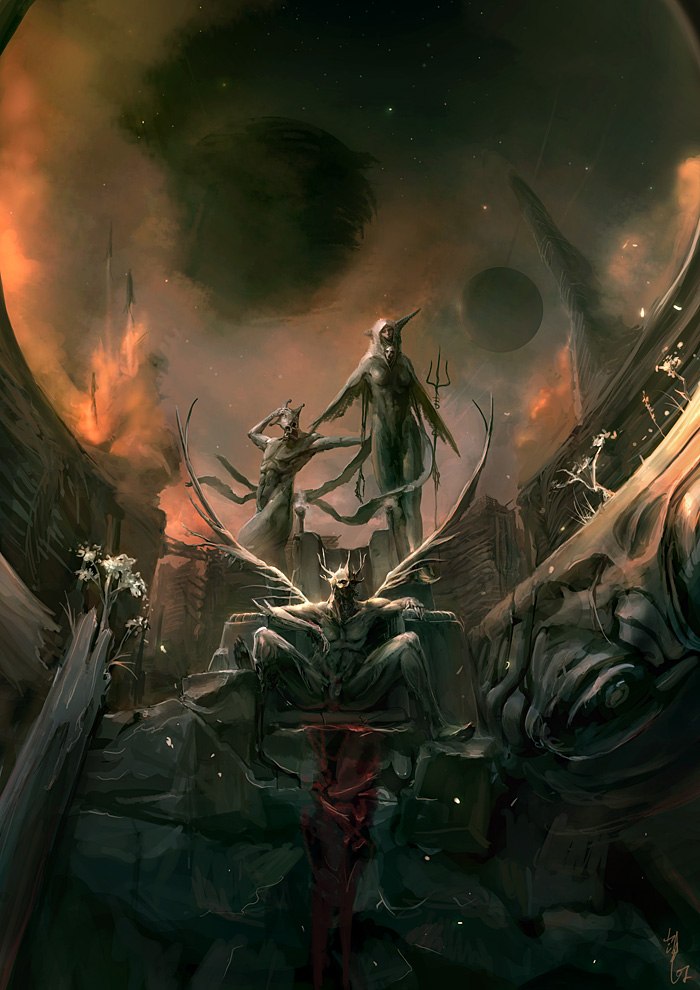
Let us pay attention to a key point: Baalberit himself decides whom to bestow “honors” and “titles” upon; he forges “covenants” between those who may have no inner affinity, and the resulting disharmonious conglomerates become major sources of energy leakage — which is, in fact, the Demon’s aim.
This is precisely the Demon’s principal danger: he compels people to follow someone who seems “important” or “right,” creating systems of authority often unsupported by any internal correspondences.
The destructor arises because adopting a particular action pattern draws one into a specific stream of practice.
In other words, who a person pays attention to directly determines in which Wyrd their development will take place; therefore adopting another’s Wyrd that does not match an individual’s inner nature can cause energetic conflicts and Power dissipation.
The sad reality is that many people try to follow other people’s Ways instead of seeking their own, simply because someone’s opinions seem “authoritative” to them. And, of course, such an existence cannot be effective and leads only to exhaustion and disappointment. The Demon whispers: “Well, he (she) cannot be talking nonsense — after all, he (she) is so respected, so authoritative, so popular.” It is not that all authorities are false. The point is that each has his own Way, and therefore his own authorities; listening to someone only because others listen to them is ineffectual.

Again we emphasize: the striving for continuity, receiving Power and learning are natural, right and necessary. The destructor arises when the chosen source of Power does not match the individual’s characteristics and does not form a harmonious chain with it. A Magus should not follow those whom others follow; he must not fall into the trap of widely publicized authorities. He should listen only to those with whom he feels an inner affinity, whose Wyrd (and even better, whose Orlög) aligns with his own Way. In taking someone’s advice, when listening to or reading someone’s thoughts (including this post), a Magus must thoroughly test how well the spirit, Way, and Power of the advisor accords with his own nature. It is not about how strong or successful the advisor is, nor about his achievements or his progress. A Way that may be extraordinarily effective for one person may be utterly barren or even destructive for another. Avoiding Berith’s influence means “make a covenant” only with those people or currents where an inner affinity already exists — to choose companions and paths according to the voice of your heart, not by their prominence or popularity.
I apologize for some off-topic – but since we are talking about demonology, I will ask a question in this context, not specifically related to the theme of this article.
You, Enmerkar, write about the 72 demons of the Lemegaton. If we take the Tree of Life (more precisely, its shadow side), then 72 demons relate to the Sefirot (more precisely, to the ‘Anti-Sefirot’). Each pair of demons relates to a specific decan of the Zodiac (the day spirit and the corresponding night spirit). Each decan of the Zodiac corresponds to a Minor Arcana of Tarot (numerical cards). Each number card, from Ace to Ten, corresponds to a Sefirah.
Thus, Berith, which is mentioned, relates to 1-10 degrees of Capricorn, to the Two of Pentacles, respectively, to the Sefirah Hokhma, as well as to Malkuth (like all Pentacles).
However, besides Sefirot, there are also Paths. The first book, I believe, that relates the direct demonic correspondences to the Paths of the Tree of Life – is Liber Arcanorum, obtained by Aleister Crowley, and containing the seals of the Geniuses of the Paths of the Tree and the corresponding klippotic demons.
In this case, the question arises – if there is a certain issue that can be connected with demonic influence, how to identify this influence? How to distinguish the anti-sefirah influence from the influence of the Paths? After all, how correctly the opponent is identified determines the effectiveness of opposition to them.
As an option – to conduct a Divination using Tarot. If (of course, provided that the Divination is conducted correctly), the Trump card appears, then the problem is related to the Shadow Paths and their geniuses. If a numerical card appears, then one should work with the classical 72 demons.
Then another question arises – what if a face card appears?
Although, in fact, face cards also correspond to Sefirot and Zodiac (they cover either a whole triad of signs or a whole zodiacal quadrant).
I think there are two practical approaches to interacting with the shadow side. One approach is direct (as described in the Lesser Key and other grimoires) – namely, directly evoking the spirit and placing demands upon it.
The second approach is indirect. Essentially, binding the corresponding force. You do not summon the demon into the Triangle and do not give it instructions. You conduct a ritual designed in such a way that the main focus is on the Genius. You call for the assistance of the Genius and bind the Demon in the process. For example, in this operation, the final Hey could be the consecration of a Talisman, on the face side of which is depicted the seal of the Genius, and on the reverse – the Demon. At the same time, as for the 72 Demons, the task of the correct choice of correspondence in the pair Genius/Demon arises.
By the way, it is not entirely clear that, say, the First Genius, Vehuiyah, corresponds to the 1st Kiner of Aries. But at the same time, the time of its influence is from 12:00 on March 20 to March 24; 31 of April; 11 of August; 22 of October; 2 of January – that is, for some reason, most days of its influence, do not relate to Aries.
In what case, then, is direct evocation more acceptable, and in what case is invoking the Genius while binding the demon?
It seems to me that in the early stages, the second approach is more acceptable.
Frater, the correctness of divination depends on the intuition of the interpreter, not on interpretative Talmuds; the hand always reaches for ‘that’ element from the set, yet establishing the correspondence is the task of the interpreter.
Indeed, establishing correlations between spirits and the ‘Skeleton’ of the Universe – the Tree of Life – can help clarify some of the characteristics of these spirits’ influence, and thus facilitate both the search and overcoming their influences. For instance, the fact that Baalberit corresponds to the Two of Pentacles – that is, to Hokhma in Malkhut – indicates its active influence on the receptive field – which confirms the substitution of authority I mentioned in the article. Nevertheless, this same information is provided by direct evocation as well, and no reasoning and calculations can replace encountering the spirit ‘face to face.’ Yes, one can draw a direct question and pull out the Two of Pentacles from the deck, concluding that there is false authority at play, as well as finding a way out of the situation by equating it with the Genius Sehiakh – the genius ‘returning exiles,’ meaning – returning the consciousness to its own flow. Sehiakh is the genius who endows with prudence and caution. The Two of Pentacles is simultaneously the Meaning of the Path (Wisdom of Malkhut) – Sehiakh, and – the Distortion of this meaning – accepting someone else’s flow – Baalberit. Summoning the Genius will allow a return, but without identifying Berith, it will not provide that differentiating ability that will later enable distinguishing ‘one’s own’ authorities from foreign ones. Therefore, it is possible to use both approaches for identifying and overcoming the problem, but it is better – nonetheless – not to fear and carry out the operation of Goetia. Any correspondences and relations can be beneficial in principle: both information that Baalberit controls the first daylight decan of Capricorn, and that its influence is of southern nature, that is, pertaining to the sphere of feelings (it is precisely feelings that are deceived, leading one to accept false authority as something worthy of trust), and many other correspondences. However, the main question is how much knowledge of these correspondences can really help find the demon’s influence IN oneself. For some, they can be really valuable, but for others, on the contrary, they risk turning into exercises of the mind, leading away from real self-analysis. Therefore, for finding distractors within oneself, it is important primarily to LOOK closely and honestly inside one’s psychosocio, and for this, beginners may be advised not to employ the ‘Great,’ or ‘outer’ Goetia, wherein the demon is summoned into the Triangle of art, but rather the ‘lesser,’ or ‘inner’ Goetia, when the corresponding foreign element is crystallized in consciousness, objectified, and then overcome, subordinating it to the individuality of the mage. This approach, although it will not provide complete overcoming of destructive influence, will pave the way for this overcoming that will follow when the corresponding level of development is reached.
“Therefore, in order to search for detractors within oneself, it is essential first and foremost to look carefully and honestly into the depths of one’s psychocosmos. For beginners, it can be recommended not to pursue the ‘Great’ or ‘external’ Goetia, where a demon is summoned into the Triangle of Art, but rather the ‘Lesser’ or ‘internal’ Goetia, where an appropriate alien element crystallizes in consciousness, becomes objectified, and is then overcome by submitting to the individuality of the mage.”
And if the identified ‘element’ is not alien to me? Would you still recommend Goetic evocation in that case? Or is it better to postpone it for a case of genuine necessity, since, as is well-known, curiosity killed the cat? Looking as deeply as I can, carefully and honestly into the depths of my psychocosmos, I find that my ‘devil’ teaches me the Dharma quite effectively (the ‘angel,’ somewhat less effectively, as it tends to constrain, whereas the former allows for ‘burning’ from excess but not to the point of self-destruction). I ‘contrast’ this with humanity, ubuntu…
http://ru.wikipedia.org/wiki/%D0%A3%D0%B1%D1%83%D0%BD%D1%82%D1%83_(%D0%B8%D0%B4%D0%B5%D0%BE%D0%BB%D0%BE%D0%B3%D0%B8%D1%8F)
I was in the flow and fell out of it. As I rise, or rather cleanse, I again began to feel the kinship, the forces of currents close to me. I was almost merging with the flow. Fearing a repeated fall, I drew conclusions for myself. Orleg is like a thread. I came to the conclusion that Orleg is the following of tradition and being in the flow in which the Authority of this tradition resides, this is monotheism. Other traditions, authorities, and Orlegs are needed for the interaction of Vird. Vird (polytheism) is the ropes, cords, knots tied to the Orleg thread to confuse the traveler or for the traveler to unravel them.