The Matrix Nature of the Tree

The concept of the Tree of the Sefirot, which has become firmly established in the Magical Myth of Kabbalah, is not merely “gymnastics for the mind,” an exercise intended to teach how to find and compare analogies (though that function is not insignificant), but a thoroughly practical system that increases the effectiveness of magical ritual activity and contributes to the development of consciousness.
As we have said repeatedly, from the standpoint of the Myth we are considering, the foundation of the cosmos is the Primordial duality Mind and Environment, in which each pole by itself is a homogeneous manifestation without qualities, and only their mutual penetration generates an object world accessible to cognition. This duality is symbolized by various images: Father and Mother, Light and Vessel, God and the World, Mind and Being, and so forth.
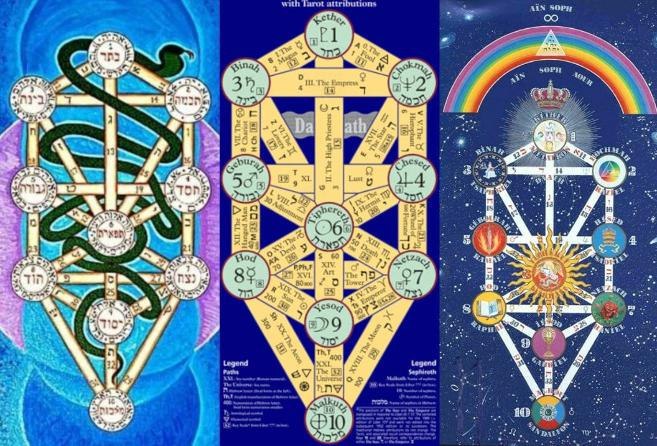
The Tree of the Sefirot is one of the most convenient descriptions of the process of primary interaction between mind and environment, allowing us to see the main regularities of that process. On contact with the environment, the mind manifests its matrix nature, while the environment, perceiving the activity of the mind, gives rise to motion – vortices. Accordingly, for Magic it is equally important to understand both the structuring of the mind and the shaping of the environment.
The matrix nature of the mind implies that this manifestation, unlimited in itself (Ain Sof, the Ineffable), upon contact with the environment, singles out within itself distinct states, modes that possess relative stability, internal wholeness and structure. For example, by touching Being itself, by “becoming aware” of the existence of the Environment, the mind manifests as Keter, the principle of the possibility of manifested being. It makes no difference whether we speak of the cosmos as a whole or of any particular object: the awareness of the very possibility of its existence is Keter, the “Crown” of that object. Such awareness has a matrix nature because subsequently the Light, in which (in itself) no change, division or limitation has occurred, nevertheless manifests no longer as the undifferentiated Ain Sof but as an “imprint” of Keter. In other words, the awareness of the possibility of Being, like a mold, makes an impression in the Light of mind — the Keter matrix.
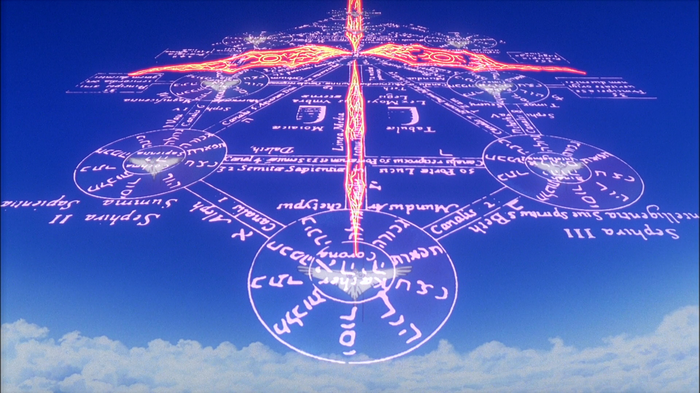
Further, by becoming aware of an object as possessing properties, the mind acquires the “face” of Chokhmah, and by recalling its wholeness — enters the matrix of Binah; by discerning in the environment the possibilities of its “induced” activity, the mind finds itself in the matrix of Chesed, and by discovering that this activity can suppress weaker impulses — manifests as Geburah; continuing the discrimination of properties and moving to their “particular” description, the mind manifests in the matrix of Netzach (focusing on interrelations) and Hod (accentuating the properties); finally, by moving to the principle of form, the mind reveals itself in the matrix of Yesod, and by perceiving the object as actually existing — in Malkuth.
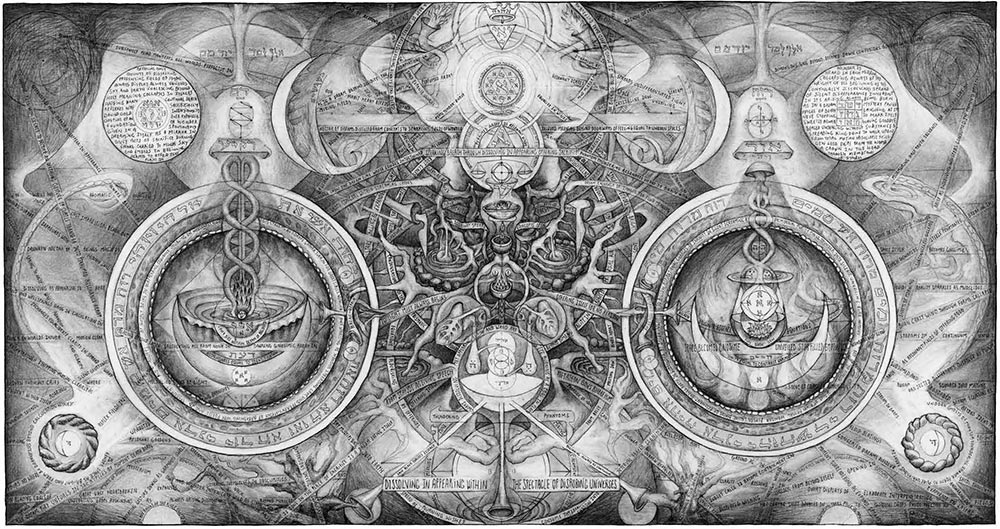
Because such “matrix nature” has a “self-contained” character, each separate state, each “imprint” of the mind, can also be considered a whole Tree, and conversely, any Tree can be described as a particular sephirah of a higher-order Tree.
Accordingly, when considering any object or process and finding pronounced features, we can both correlate it with a particular sephirah (with all its attributive series) and single out its particular sephirotic components. For example, in describing an object as having a “Jovian” nature, one can see that, when perceiving the object as a whole, the mind emphasizes the Chesed matrix, while isolating individual properties, one should remember that the Keter of this object is a “Keter in Chesed,” that is, the general idea of the object already includes the notion of its “sovereign” nature, and so on.
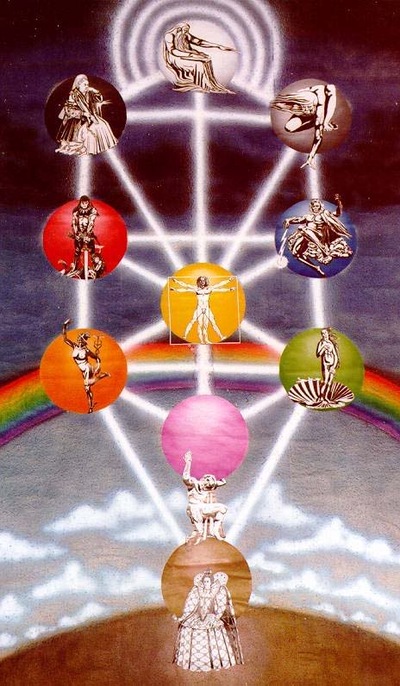
Note that the “matrix” concept of the sefirot is precisely a description of the interaction of the mind with the environment, since matrices of the mind can also be considered “by themselves,” as, for example, Vajrayana does in its “deity tantra.”
For the Magus, the ability to describe the structuring of the mind in its contact with Being is an extraordinarily important tool for increasing one’s effectiveness. Although, to repeat once more, this does not change the nature of the mind, understanding the mechanism of the choice of reality, as well as the properties and qualities of both the resulting environment and the mind, makes it possible to develop proper awareness strategies through interaction.
Leave a Reply