Matrices of the Mind
Mind, as an active field of actualizing potentials of a single supra-real reality, can be regarded as a collection of active tendencies, strivings and correspondences, hierarchically arranged according to the principle of mutual influence and mutual inclusion. In other words, just as the macrocosm as a whole and in its parts is a complex system with a multilevel hierarchy of actual and potential forces, the psychocosmos may likewise be viewed as a field of varying intensity and orientation.
For the magical worldview, conceiving the psychocosmos as a complex, multilayered reality is extraordinarily fruitful not so much philosophically descriptive as practical, since isolating and objectifying individual currents of consciousness and describing them in mythologically meaningful terms greatly facilitates control, management and ordering of those currents, and therefore the overall harmonization of the mind.
In this sense, different approaches may be used depending on individual preference, and in different situations or states. Among such approaches is the consideration of currents of consciousness as vortices, vectors or matrices.
The vortex “model” is most convenient when consciousness operates in the realm of desire; the vector model when the matter concerns streams guided by will; and the matrix model when it concerns the formation or transformation within the mind of stable operating structures.
Any mental agent, as indeed any “macrocosmic” phenomenon, can be regarded as a vortex — when one speaks of its internal motion and the sources of that motion — as a vector — when one speaks of its outward influence — or as a matrix — when one speaks of its “pivot points“, the skeleton of its existence.
Viewing the mind as a matrix structure, it can be imagined as an assemblage of an infinite number of points — individual modes of consciousness, elementary logos (and their “concrete” manifestations, states — “models” — Me), some of which are actualized, others potential.
Moreover, each such manifestation of logos, each Me, can be manifested constructively, as a constructive element of mind, or — distorted — as a destructive element.
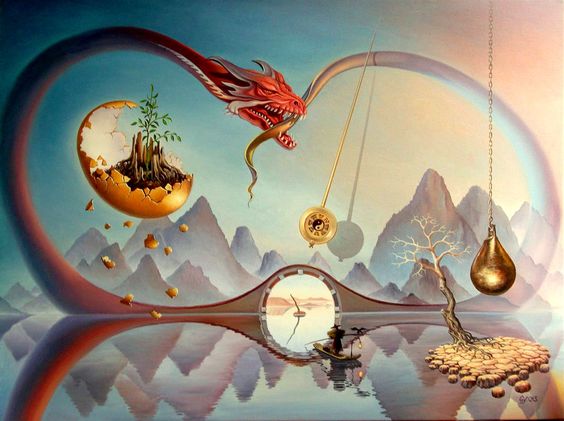
A set of interconnected and interdependent Me, united by a common hierarchical principle, can be regarded as a matrix. At the same time, of course, the matrix itself also turns out to be a “model” — a “Me“, and each of its individual elements can be regarded as a collection of lower-order Mes. Strictly speaking, from this standpoint the entire psychocosmos as a whole is a matrix of the highest order, encompassing an infinite number of elements and matrices of lower orders.
All inhabitants of the psychocosmos – Keepers, Demons, Predators, Parasites, idams – may likewise be regarded as matrices, comprising assemblages of individual Me of lower order. And each such matrix may be more or less manifest, more or less active, depending on the degree of activation and the hierarchical position in the overall structure of mind of its individual elements. The ordinary human personality is usually composed of elements from several such matrices, which accounts for its internal disharmony and contradiction.
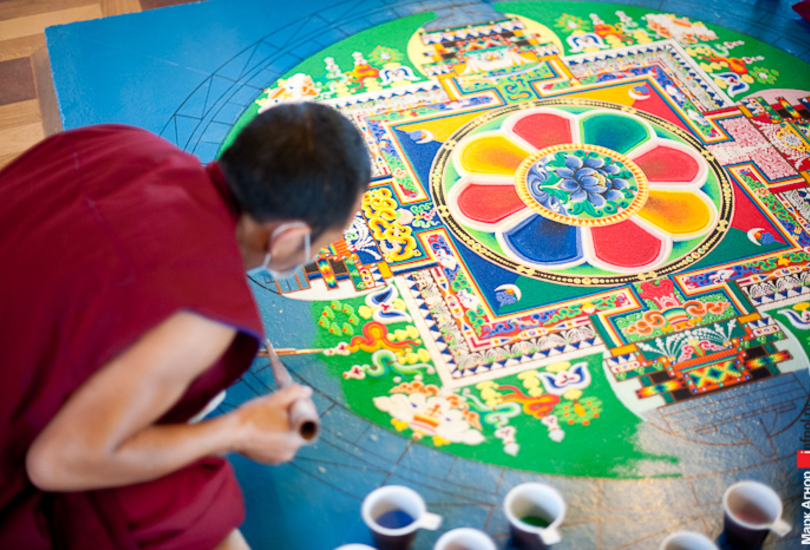
The practical importance of this mode of description lies in the fact that by identifying individual mental matrices and locating their key elements one can activate or, conversely, diminish the activity of a given matrix, increase its harmony and alter its intensity of influence on the psychocosmos as a whole. In fact, the search for, identification of, and eradication of destructors — a task that occupies such an important place in the inner work of the Magus — can be regarded precisely as a process of transforming matrices, since by inactivating a destructor that serves as an “anchor” for a matrix, a trigger for a given agent, one can quickly and effectively harmonize the mind and increase its development and actualization. Likewise, by finding and activating the matrix of a “constructive” agent, for example an idam or a Keeper, the HGA, etc., we also create a short path to inner harmony. Understanding that each agent, each current of mind “rests upon” certain key points that “launch” that current or “activate” that matrix greatly eases development.
“Assumption of divine forms”, like theurgical operations, can also be regarded as a temporary activation of certain matrices, and the more precisely the crystallization points of those matrices are chosen, the more successful both the ritual and its outcomes.
By viewing one’s mind from all three perspectives, by varying and combining development methods, the Magus attains his goal — the freedom and independence of the mind as a unique way of self-knowledge of the Great Spirit.
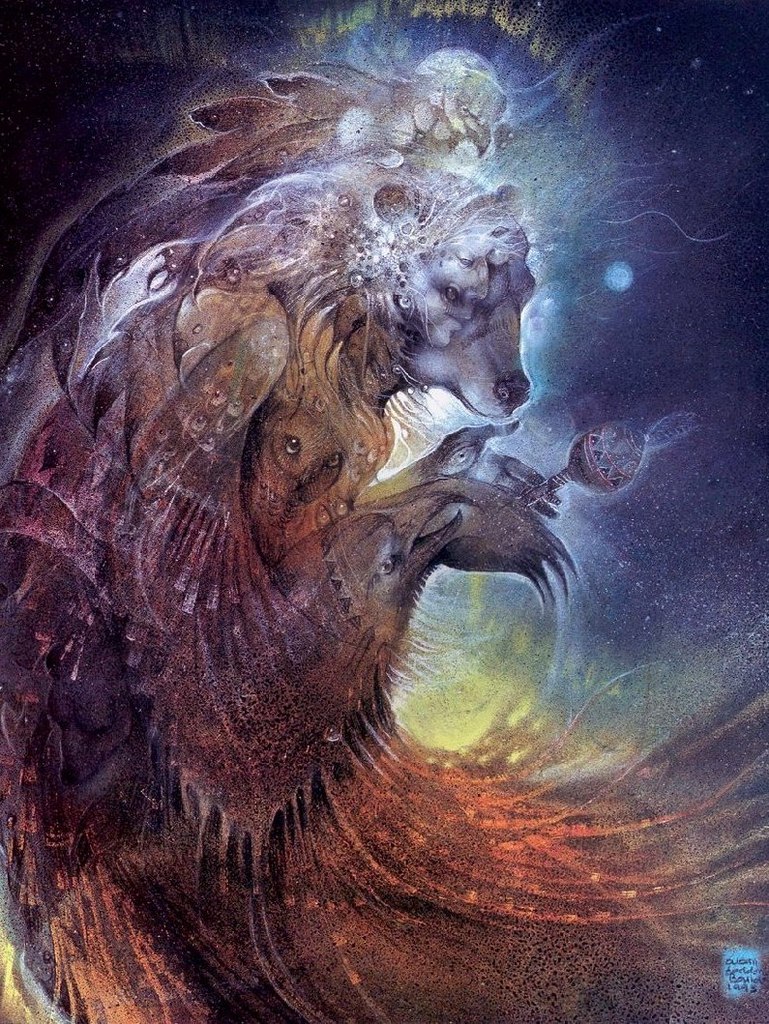
There is no need for abstract without imagery in any models. Concrete imagery requires specifics.
Thoughts based on my vision:
Vortex structure: serves certain manifestations, action in the present, serving to change reality, a form of energetic structure serving certain goals.
Vector: forces directed at changing this or that reality, including the matrix of consciousness, encompassing goals, tasks of the manifested and the potential.
Matrix of consciousness: a specific type of energetic perception formed according to upbringing, attitude towards the world, and dependent on the level of PSI consciousness.
The higher the psi, the higher the realization and thus the more complex the matrix.
Hello! And is memory of the states of the matrix Authority? The amount of Power in such a matrix context is probably the ability to quickly find and activate the necessary and suppress the unnecessary for the realization of M?
Authority from this perspective is memory of the activity of matrices that have been successfully activated and then returned to a potential state, the ability to find trigger points for the quick actualization of these matrices. The amount of power in this model corresponds to the degree of hierarchy of the most general matrix of consciousness, its harmony and inclusion of lower-level matrices.
A rarely good article, Enmerkar. This method of considering objects (vortex, vector, and matrix) is the application of a mathematical approach to esotericism and practical questions of consciousness research.
Greetings.
Anyway, the idamas are not the inhabitants of the psychocosmos: it is more likely about projections (i.e., some aspects of idamas) that are perceived by the psyche of a particular being.
There is hardly any sense in mixing tantric tradition and theurgy. There are principled discrepancies concerning the postulate of God-creator.
The difference you are talking about is a methodological difference considered as ideological. For the Western theurgist, the most important thing is the active activity of differentiated consciousness, and therefore for him, God-creator is the initial “external” force from which the very possibility of actions arises. For the Eastern contemplator, the most important is the cognitive activity of unified consciousness, and thus for him, reality is found “inside” consciousness, and consequently, there is no need for a concept of another “creator” other than consciousness itself. Accordingly, what for the active consciousness of the theurgist appears as an external acting force, for the contemplative consciousness of the vajrayana is one of the manifestations of the very consciousness. The difference is in the methodological approach: for some, it is easier to be aware while acting, for others, while contemplating. But the nature of consciousness does not change because of this.