
Who Sees This Dream?
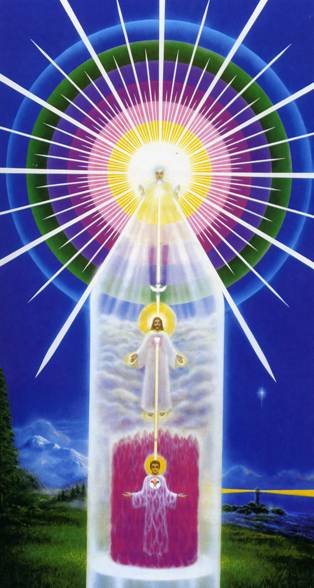
The problem of the “Higher Soul” standing behind the ordinary personality has always been one of the principal issues not only in religion but also in Magic.
We have already said that the Magic of Abramelin gained enormous popularity precisely because it paves a path to interaction with this “Self,” presenting it in the image of the “Sacred Angel-Guardian.”
We also discussed that such a “suprapersonality,” a “supramind,” is often perceived as external to the ordinary personality, as a Daemon, a guardian spirit.
Spiritual Masters, from prehistoric times and across cultures accompanying magi, prophets and priests in their visions, testify that the knowledge of this Keeper and conversation with him represents a fundamental and universal spiritual experience. In all the sacred scriptures and spiritual practices of the world’s religions we repeatedly encounter this paramount theme — the theme of a person’s connection with a spiritual entity that serves as a representative of the supreme (and possibly impersonal) deity and as a conduit that helps one approach it. Of course, this experience is especially clear in Eastern traditions, which proclaim the identity of the individual (Atman) and the universal (Brahman) spirit.
But the Western world did not remain aloof. In the Book of Sacred Magic one is advised to withdraw for six months (in another variant — for two years) and to perform the ritual of calling the Sacred Angel-Guardian once a day during the first month, twice during the second, three times in the third month, four times throughout the fourth, and then for two months. Crowley asserts that the complete ritual takes eleven months, and during the eleventh moon
“dedicate yourself wholly to this Work; may you remain in unremitting zeal, setting aside all needs except the natural necessities of eating and sleeping.”
So much effort is expended on what, in the Thelemic tradition, is regarded as the beginning and end of all Magic. It is held that until Knowledge and Conversation are achieved, no vision, ritual, invocation, evocation, charm, divination or magical practice will be truly effective or worthy of trust.
To clarify the role of this experience we must address two questions: first, why the Suprapersonality is perceived as external to the personality, and second, what the relationship is between the personality and the “Angel.” First of all, note that, to avoid confusion, we will not use the term “Angel-Guardian,” despite the entrenched use of those words in modern occultism, since we use the term “Angel” with the meaning “Involutive Ministering Spirit.”
To clarify the nature of the interaction, let us again recall that Tradition distinguishes two different states of mind: directed (“wakeful”) and undirected (“sleeping”). However, taken to its logical conclusion, this idea turns into the claim that, in essence, “all is dream and only it exists.” It turns out that the everyday world, perceived in daily life, is not as linear as it tries to appear. The ancient Greeks were the first to notice this, of course.
Thus Plotinus argued that:
«Firstly, 1) it is impossible for time to be motion, since every kind of motion already presupposes time.
Secondly, 2) time is not a measure of motion or its quantity either, because to measure these quantities we must use a part (a measure) of time: that measure again presupposes either motion (for example, the speed of light in a vacuum, used by modern physics as a constant), or some “other time” with which the first can be compared.
And thirdly, 3) time is not number, even a “continuous” number, because a measure or part must again be applied to time. But is a “part of time” the same time or not time? A part is a number, yet time does not depend on number, while the counting used in measurement already presupposes time,
says Plotinus. Time, therefore, is indivisible, although it contains “earlier” and “later.”
That “Eternity” of Plotinus and the Platonists (Greek aión — Aeon) is the one (τό έν) ground and indivisible substance of both “mind” and “matter.” Specifically, from a certain point of view, everything is present in everything and always. And that is the characteristic feature of the “non-vectorial” state of dreaming. In order to differentiate, to divide this “all-in-all,” our “ordinary” mind, our personality, comes into being. Leibniz in the Monadology illustrates the position as follows: each monad “reflects” the Cosmos (since it has a “subject or ground of itself in God”), but it is “without windows” allowing it to look beyond itself. It is precisely for that reason that one may confidently assert that the world is a product of the activity of mind, its creation. At the same time this creation is not “arbitrary,” because it lies within a common flow and is limited by other creative impulses. The “possibilities,” the “ideal perspectives” of an individual’s creativity are summed up in its “ideal image” — the logos.
However, the paradox is that, to “separate” the world into elements it is necessary to transfer the center of mind into those elements; that is there must be a “descent” of mind. This means that the familiar “personality” is as much a “dream,” a product of the exclusion of a number of categories from the primordial unity, as everything around it. Thus the Platonists discovered that the “ordinary” mind cannot be considered “wakeful”; it is, in essence, also a dream — only a dream within the Flow of Power, as opposed to dreams outside it (virtual, Interworld dreams).
So the most important conclusion reached by both Western and Eastern ways of knowing is the paradoxical assertion of the illusory, spectral, dreamlike nature of the everyday. It turns out that the motion of emotions and thoughts is governed by capricious forces, and the psychic process usually perceived as whole is merely a theatre in a well-staged production.
The next conclusion is obvious: if there is a dream, there must be a Dreamer. A characteristic feature of dreaming is that the dreamt and dreaming personalities are identical during the dream, but somewhat different after waking. It was precisely this idea that gave rise to the thought of a “Higher Soul” which “sleeps” and “sees itself in dreams” as the human personality. And it seems that upon awakening, a person merges with the Absolute, identifying Atman and Brahman. The Golden Dawn equated different levels of mind with the Kabbalistic “layers of the soul,” matching the “Angel” to the level Yechida.
At the same time, conception is somewhat simplified. It presumes the “simultaneous” (given the conventionality of time itself) existence of the “higher” and the “lower” self. Yet traditional teachings say that this “higher” exists only potentially, and is accessible to perception only because of the conventionality of time. Namely, the Higher Soul is the total awareness of the Monad that it will attain by passing through all cycles of incarnation, fulfilling its potentials. That is, It is “a guest from the future”; it is what the individual mind will become at the end of its evolution. In limited existence, however, it is, in fact, the logos of the being, its ideal principle serving as the “matrix” for its individual development. At the same time, since the number of a monad’s potentials is infinite, and the process of their realization is likewise infinite, thus over time the “lower” self will never reach the state of the “higher,” forever approaching it asymptotically.
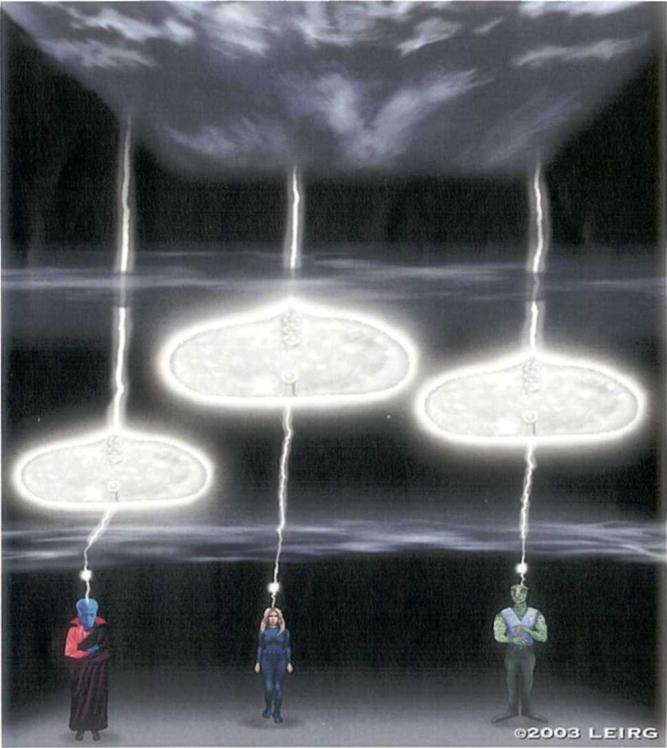
This in turn leads to the following conclusion: the “Higher Soul” perceived in spiritual experience is only a “model” of the ideal state created by the mind; it is not identical with mind itself, and therefore is external to it.
Thus the reason the personality and the Suprapersonality are separate lies in their fundamentally different natures: the personality belongs to the world of time, while the Suprapersonality belongs to Eternity, to the Aeon.
Moreover, it becomes clear that the interaction of the self and the Suprapersonality is two-way: on the one hand the self expresses only one aspect of the Suprapersonality, and on the other — it is precisely in that expression that the transition of the Suprapersonality from potential being to actual being is realized. In other words, not only is the personality a creation of the Suprapersonality, but conversely the Suprapersonality is the result of the self’s activity.
Thus, for the Magus the “Higher Soul” is not an object of worship, not a coveted goal; it is one of the participants in the great game, no more privileged than the “lower” personality, which is both its creator and its creation.
Could it be that “I” and “I”, are nothing more than a kind of abstraction, something that in a dream sees the Dreamer solving some task or (in time) overcoming something that we can compare with an internal conflict? That His consciousness is divided into Upper and Lower and He, trying to overcome this division, evolves… and when His goal is achieved and He realizes Himself, then there will not be a single “I” or any “I”, but this something unknowable to us?
It seems that the nature of the interactions between the “superego” and the “ego” deserves special attention.
Mmm.. Enmerkar, do you know how many such ‘incarnations’ a monad can have at the same time? That is, a person (or someone else) can be walking around, while somewhere else one exists, and both essentially being.. well, being this construct)? Or does one disincarnate first and then the other goes?
Yes. The stars of different people can synthesize and generate a single Star. Moreover, all parent stars remain free individuals and at the same time – sparks of a unified whole. This shared star for many is called the Feathered Serpent by Indian magicians. Its power is such that it can even manifest as a standalone individual among people in one form or another. They also talk about a universal process when all people’s star synthesis happens at once. It lasts more than five thousand years. As a result of this long Night, a Superbeing is born, called the New Sun – the only son of Earth and Sky. According to prophecies, the Fifth Sun should be born in this century…
Randy: the law of multidimensionality (multiplicity, reflection, and binary) explains such a scheme of existence, parallel incarnations-paths, of the same original essence. Divine beings (higher races in the hierarchy chain) are capable of dividing themselves (the single individual monad), or more accurately, of distinguishing from themselves, separate particles (sub-monads, sparks), which can simultaneously incarnate in 2-4-6 or more worlds of the system (or systems) as so-called avatars. Which subsequently, in their incarnation, implement according to the weird the corresponding part of the potential that was distinguished in the sub-monad. Other beings, lower races, are unable to split themselves in this manner, but possess a binary nature from the original creation, and therefore can evolve parallel to each other in different worlds, as well as in different variants of the same world (in different dimensionality). Subsequently, upon reaching a certain stage in their fiery transformation, they are capable of merging into one, as well as splitting themselves later. From this simple law arise phenomena such as: “phantom doubles (otherworldly)”, “double destinies”, “parallel worlds”, “twin flames”, “kindred “souls” (monads), “binary universes”, “11 string theory”, “fractal theory”, and so on.
On one hand, this is indeed another player, equal to all the others. On the other hand, it is precisely that Star which always shines in the night sky and never lets one down.
Hello Enmerkar! I am trying to understand the concepts. In this article, you write: ‘The Higher Self is the total awareness of the Monad that it will acquire after going through all cycles of incarnations, realizing its potentials.’ So, as I understand it, the Higher Self/Logos is kind of a projection of the Monad into the infinity of time, meaning that the Monad itself is indeed.
But here
https://enmerkar.com/en/way/fragmentation-of-mind
You write:
‘As long as a being identifies itself with temporary “piles” of affects, or even with the “over-Self” of its existence—it is doomed to destruction. Only when consciousness achieves identification with the Great Spirit in one of its infinite individual aspects does it identify with its Monad, transcending both forms and their absence, being and non-being’—thus here the Monad is opposed to the Higher Self.
Thus I see a contradiction between these two articles. If, following the first article, to gain freedom one must strive to find contact with the Higher Self and thanks to this come to the awareness of their identity with the Monad. However, if following the second article, on the contrary, one must disidentify with the Higher Self. Could you please tell me, is there indeed a contradiction, or am I just confused with the concepts?
Hello! I am very glad for a thoughtful reader. The Monad does not have its own ‘I’; it is not a personality; it is a special, fundamental characteristic of each flow of consciousness; it does not exist in reality, and in the process of development can never be fully actualized. In this sense, its ‘Higher Self’ mentioned in the first quote is the same abstraction that one can asymptotically approach, but never reach. The Monad is merely a direction, a system-forming factor. And this is what the second quote speaks about—any ‘I’ that can be realized is a relative property, and therefore it belongs to the conditioned world; thus it is doomed to destruction. A fully actualized Monad is identical to the Absolute Spirit, non-localized consciousness; hence, in a certain sense, it is super-personal, more accurately—it exceeds both personal and impersonal consciousness.