Archons and Eldjotuns
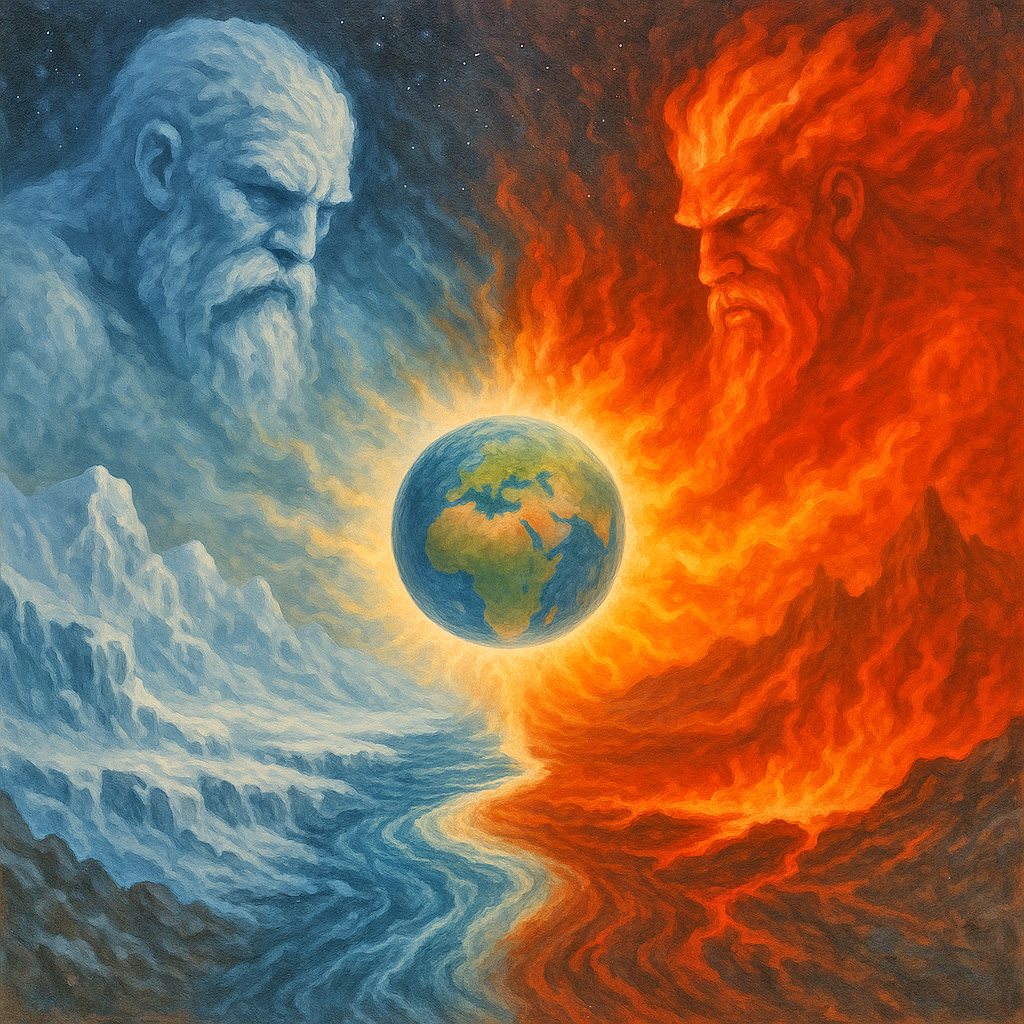
According to the views of virtually all esoteric Traditions, the manifested world arises from the interaction of two primordial forces, which are seen as both opposing and unified.
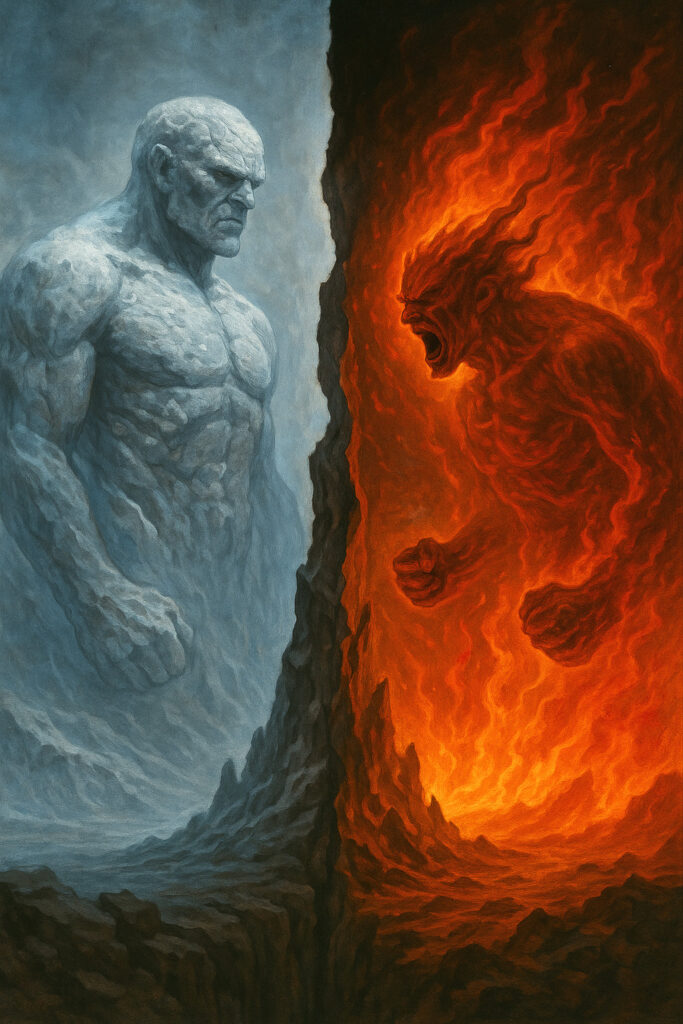
The Nordic myth, noted for its precision and attention in describing primordial forces and events, speaks of the birth of the world from Fire and Ice, which together form the World Stream – Elivagar.
We have repeatedly said that the function of “restraining manifestation,” directing it along specific channels and patterns, belongs to the “Rulers of the Interval,” whom the Northern Tradition calls Hrímthursar and the Western tradition — Archons.
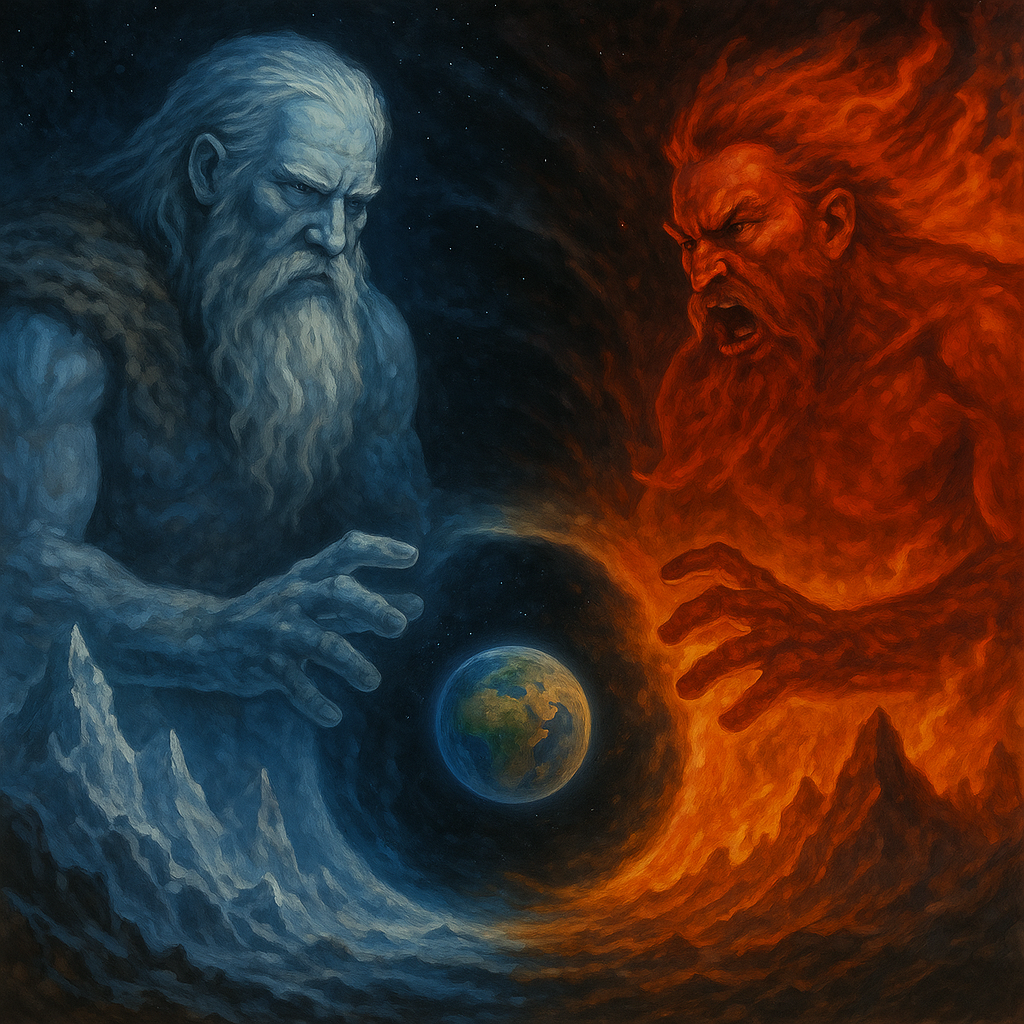
However, the second pole of this binary pole – the Forces of Primordial Fire, the eldjotuns, deserve closer study.
When it comes to such Fiery beings, Myths and Traditions often focus primarily on their destructive aspect, since it is precisely the “loss of control” over the forces of Muspellsheim (or Kalagni) that is often seen as either the cause or at least the mechanism of the destruction of the world.
Meanwhile, Ialdabaoth himself, the Proto-Archon, is the same manifestation of Fire as Abraxas, and only then is he “tamed” or “petrifies” in his ignorance. The wrathful temper of the Archons, the leonine appearance of the Proto-Archon – all these are reminders of their common origin with the Fiery forces, since the very nature of the Aeons, the Jotun-Progenitors, implies activity.
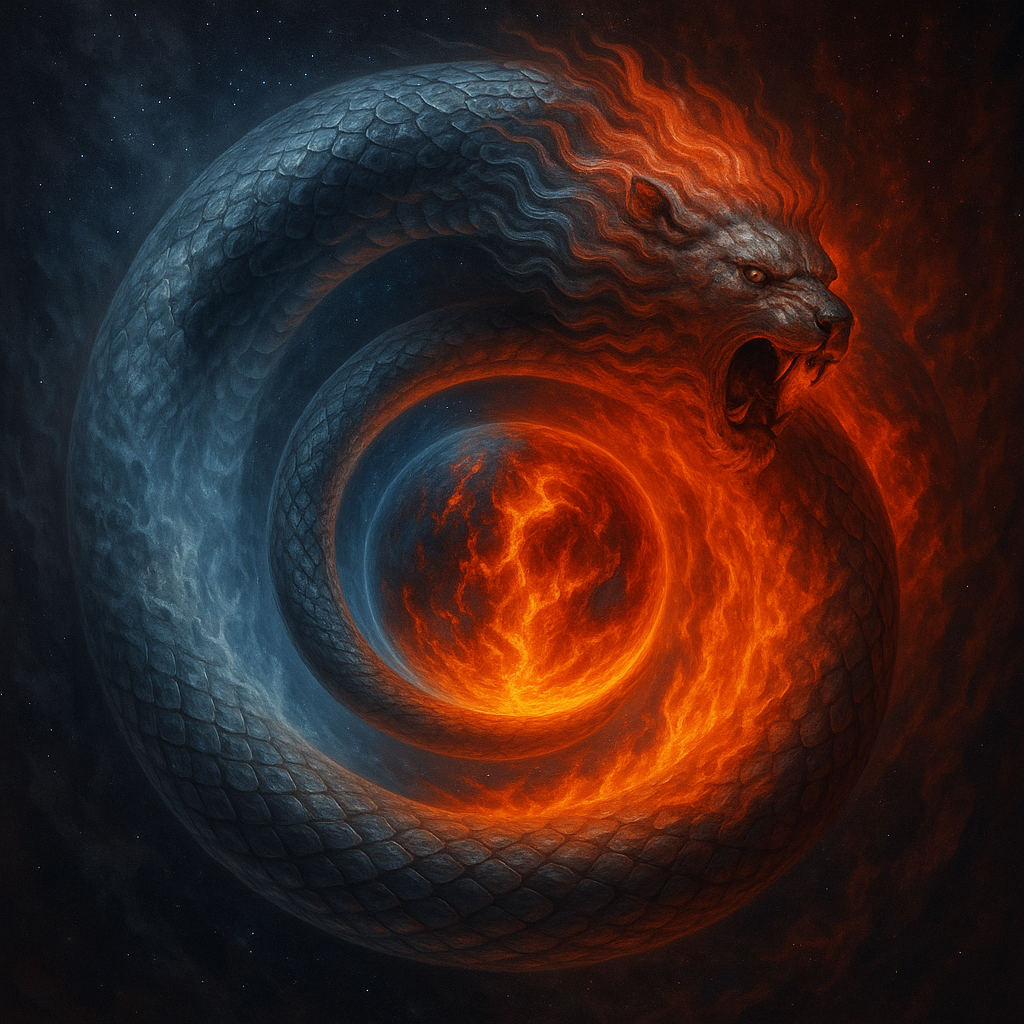
If in each aeonic syzygy, in each pair of Primordial Entities, there is both an expansive and an immanent principle, then the Archons are the children of Sophia, born “without a father,” from Her own striving “upwards,” and it is precisely this that is expressed in their “stopping,” “crystallizing,” that is, a tendency toward passivity.
However, the very nature of this tendency is fiery, and Sophia is not only the shining Shekhinah, but also the unbridled Shakti. Therefore, as is not difficult to understand, Ialdabaoth has a “fiery” alter ego, which Tradition usually calls Ariel.
At the same time, both Ariel and Abraxas are manifestations of Creative Fire, whereas the eldjotuns, led by Surt, are the forces of destructive fire.
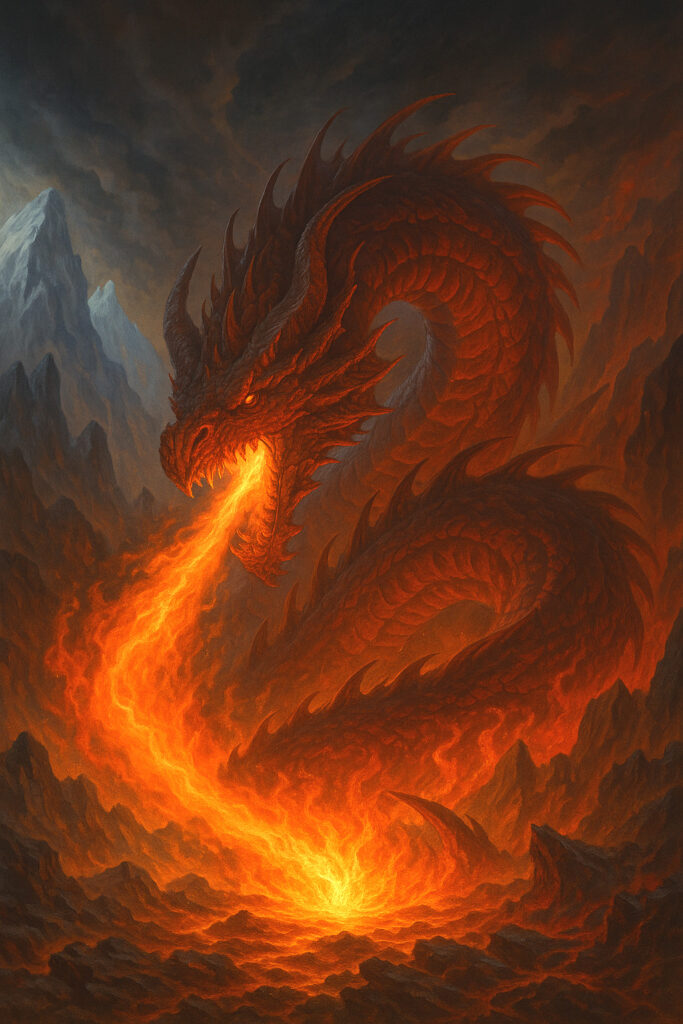
Mythologies often describe uncontrollable, chaotic fiery forces such as Serpents and Dragons – Asag (Asakku) of Mesopotamian myth (who is the “alter ego” of the Water Dragon – Abzu (Engurra)), Zahhak (Dahak) of Iranian mythology, Typhon – of Greek mythology, and so on – not simply as “opponents of the gods,” but as anti-manifestation forces; in this sense they are also opponents of the “forces of primordial fixation” – the Archons.
In a more “peaceful” sense, Primordial Fire is expressed by figures such as Hyperion (Ancient Greek Ὑπερίων – “Very high”) – the Father of the Sun in classical mythology, or Krios (Krios, Ancient Greek Κριός, Κρῖος or Κρεῖος – “Ram”) – the force of primordial vital activity; he is also associated with lightning and heavenly fire, which, however, also oppose the gods and their cosmic ordering.
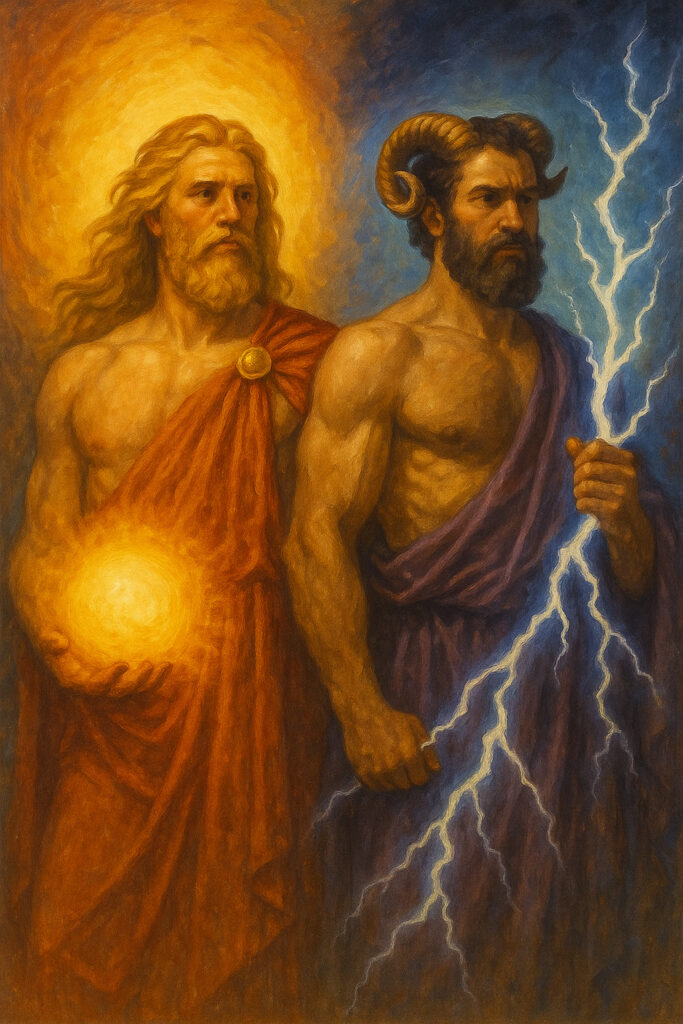
The key property of the eldjotuns is their uncontrolled expansion: in its pure form, fire seeks to fill and transform everything it encounters, and this spread is usually extremely destructive. Obviously, before Surt breaks out of Muspellsheim, destroys Bifröst and burns Midgard, this role of “disruptor of order” is performed by Loki (whose name in the form “Logi” also means “Fire”), and he is the necessary force for changing cycles, eliminating obsolete forms and creating conditions for new ones. Another such “anti-archontic” mythological figure is the eastern image of Shiva-Bhairava, also embodying the forces of primordial and destructive fire.
In the Gnostic worldview, such Fiery forces correspond to figures representing extreme, radical acts of destruction and change; they are usually described as Fiery angels, the Drivers of the “apocalypse” or purification. In this sense they are called “Sparks of Chaos” (Káosneisti), which emphasizes their destructive, disruptive nature. Interestingly, it is precisely from such Fiery forces that the grigori also originate – the “Grey cardinals” of the universe, who often (though usually not openly) oppose the Archons.
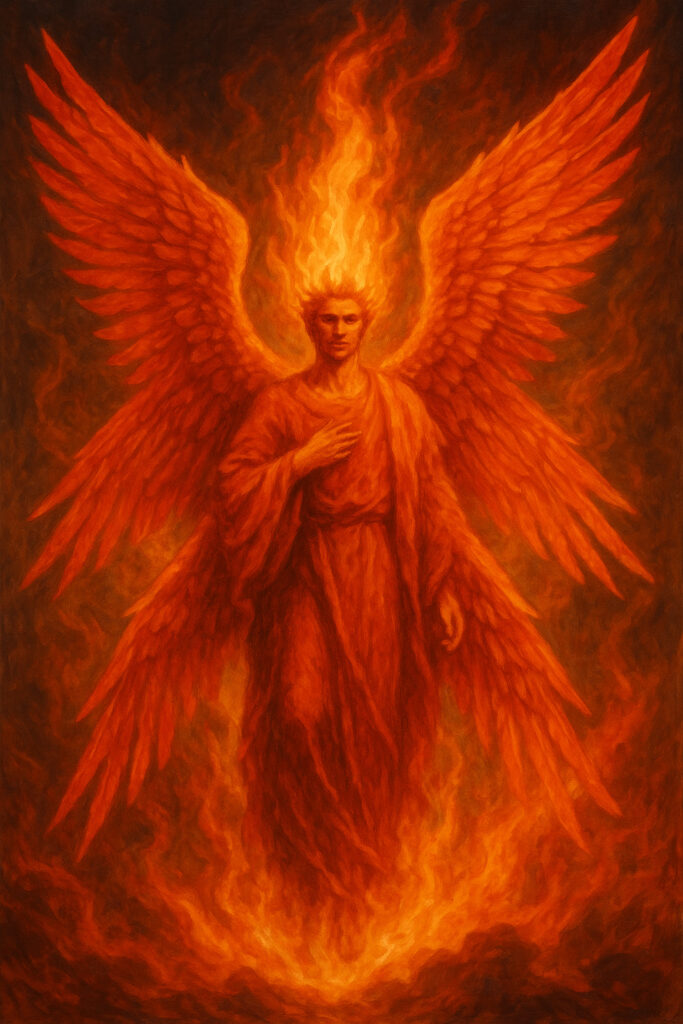
Manifestations of the Fiery giants, these “sparks of Muspellsheim,” can usually be detected by barely noticeable changes in reality: flashes of inspiration, unexpected breakthroughs, revolutions in thought and cataclysms transforming the universe; when out of control, they become untamed fiery vortices, bursts of chaotic fire and waves of madness sweeping away everything in their path.
Strange as it may seem, in this confrontation it is the Archons who play the “positive” role, limiting the destructive manifestations of the Sparks of Chaos and preserving the universe from total destruction. Cosmic cataclysms, volcanoes, plasma storms, wildfires — these are all manifestations of eldjotunic will.
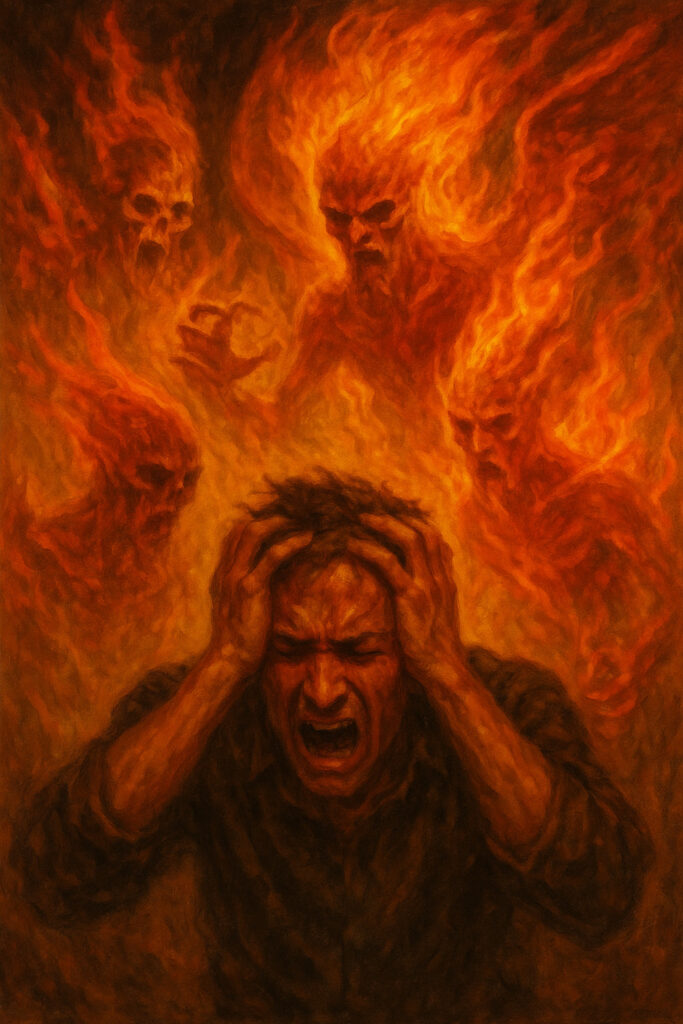
Contact with the eldjotuns most often leads to “psychic melt-downs” – loss of identity, flashes of madness, the destruction of logical connections and individuality. They intensify inner fragmentation, kindle nihilism, the drive toward total negation, provoking self-destruction or aggressive expansionism. In their presence, bridges and differences burn away; good and evil merge in a flow of molten potential; the ego dissolves, though not in enlightenment or illumination, but only in a blazing emptiness.
However, if in the confrontation of Ice with Fire the Archons win, worlds become mechanisms, unconscious algorithms, which leads to petrification and the cessation of evolution; if the Chaosneisti win, everything falls apart into chaos, losing stability.
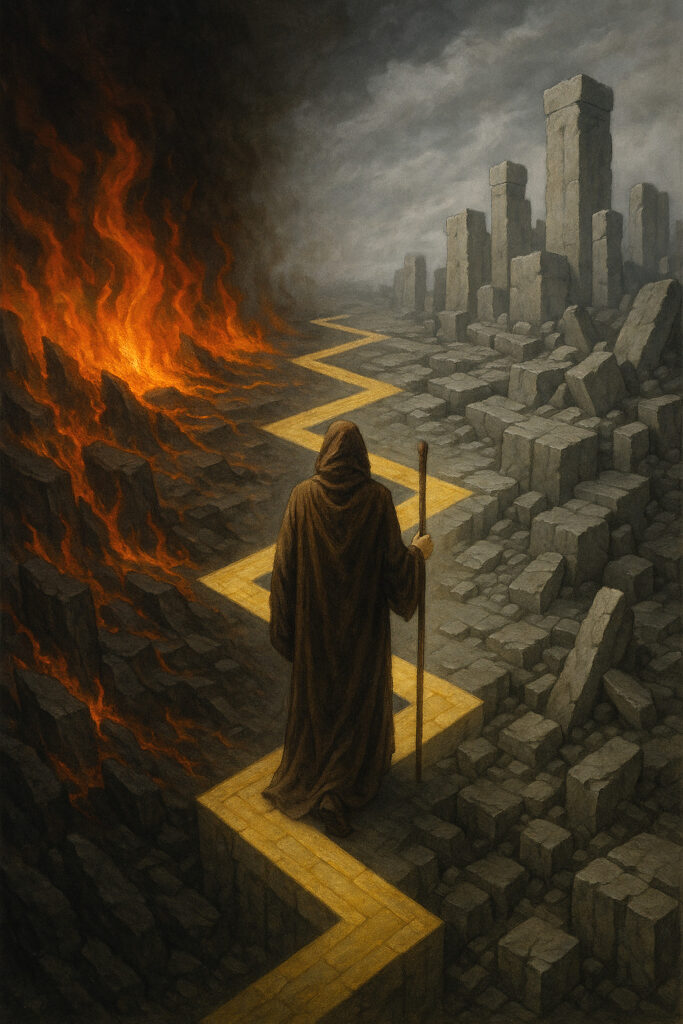
For a Magus, opposing Archontic forms can be dangerous precisely because, by resisting the predetermination of heimarmene, he can “fall through” into the chaos of Muspellsheim’s boiling uncertainty. Of course, a Magus striving to break free from predetermination (heimarmene) must oppose the Archons. However, in this resistance he risks “falling through” into Muspellsheim — a chaotic, blazing potential where forms are destroyed faster than they can take shape. Although it is clear that Niflheim contains all potentialities of form, and Muspellsheim contains all potentialities of active manifestation, breaking free from the “power of forms” can only cast one down into the chaos of destruction. Destruction is useful only when it “clears the space” for new creation, but this new creation is precisely the force of fixation, manifestations of partial “icing.” One can say that just as, in its extreme manifestation, the striving to create can spill over into an archontic “cult of forms,” the Way of activating transforming energies easily “slides” into Chaosneistic destruction. Due to the “dual” nature of fiery forces, practices used in chaos-magical currents often cause surges of both destructive and creative states; they tap the same currents from which the Chaosneisti emanate. In passing, note that the growing popularity of “Chaos Magic” is a subtle sign of the onset of an era of archontic expansion. It is in such a period that the balancing invasion of the Chaosneisti becomes inevitable, and Chaos Magic turns out to be a harbinger of their manifestation. However, if such a Magus does not maintain balance, he easily becomes a servant of Surt, destroying not only archontic structures, but also everything that connects him with the Pleroma. Taking these dangers into account, it becomes clear why the Traditional Way of the Magus requires the ability to walk the razor’s edge between the Primordial forces, drawing from Fire — light and creativity, and from Form — meaning and support.
Leave a Reply