Aeons and Archons
The idea that manifested worlds are a distorted expression of some pure or divine Primary Source is found, in one form or another, in most traditional systems that describe the world. The concepts of “original sin,” “Kali Yuga,” Mazdean and Gnostic views converge on the idea that the world we observe, although it proceeds from an ideal Primary Source, undergoes “pollution” or “darkening” in the course of its manifestation under the influence of certain destructive forces.
The Gnostic Myth says that this “distortion” occurred even before the manifestation of the universes themselves: it affected the primordial reality, which this Myth calls the “Kingdom of Eternities” — the “Aeons.”
According to this view, the cause of the “fall” was a special property — an inevitable “imperfection” — of the aeonic system itself, in which the position of the semantic aspect — “Wisdom” or “Sophia” — turned out to be “too far removed” from the Primary Source — the Depth, Bythos. In other words, self-knowledge of divine reality proceeds from its “periphery,” the level of the most “external” potencies and the simplest properties, toward the “center,” toward ever more essential and integral qualities. For such a movement of Wisdom to be possible, she must, first, be located on this very “periphery” of aeonic reality, forming its outermost layer, and second, possess a powerful centripetal force leading it along an inductive path. At the same time, since the very nature of Cognition is the creation of representations of its objects, Wisdom, Sophia, at her “external” level “dreams” of the Father, the Depth, Bythos, whom she must ultimately reach in her cognition of aeonic reality; however, not yet possessing the purity and strength necessary to comprehend Him, she “imagines” an incomplete, distorted image of Him, which becomes real as the Protoarchon Ialdabaoth. The Gnostic myth calls the “engine” of this cognition, the force of Sophia’s creative striving, Abraxas, and thus, one can say that Ialdabaoth manifests in response to the potency of Abraxas.
In order to better understand the essence of this process, one can approach it from another angle, and for this, turn to the Nordic description of the world. According to this Myth, the basis of the universe also lies in the interaction of two Primordial Principles — the Passive, ice, Niflheim, and the Active — fire, Muspelheim. One can say that ice in this context is a state of ignorance, the absence of movement of consciousness — that is, the primary state of Sophia — and fire is Sophia’s centripetal activity, the desire for self-knowledge and self-manifestation — that is, the energy of Abraxas. When fire comes into contact with ice, the primary movement arises, the Great Stream Elivagar. Then from this stream, in various ways, the First Being is born — the giant Ymir, from whom the Universe is subsequently created. In other words, Ymir of Norse myth performs the same role as Ialdabaoth of the Gnostic: it is a force that arose as a result of the primary creative impulse, but in itself does not possess the wisdom necessary to create a perfect world. And in exactly the same way, one can say that the essential basis of the world-process is the Stream Elivagar itself, whose active, moving aspect are the Progenitor-Jotuns, completely analogous to the way the Aeons in the Gnostic myth are regarded as individual properties or manifestations of the divine Stream of Perfection — the Pleroma.
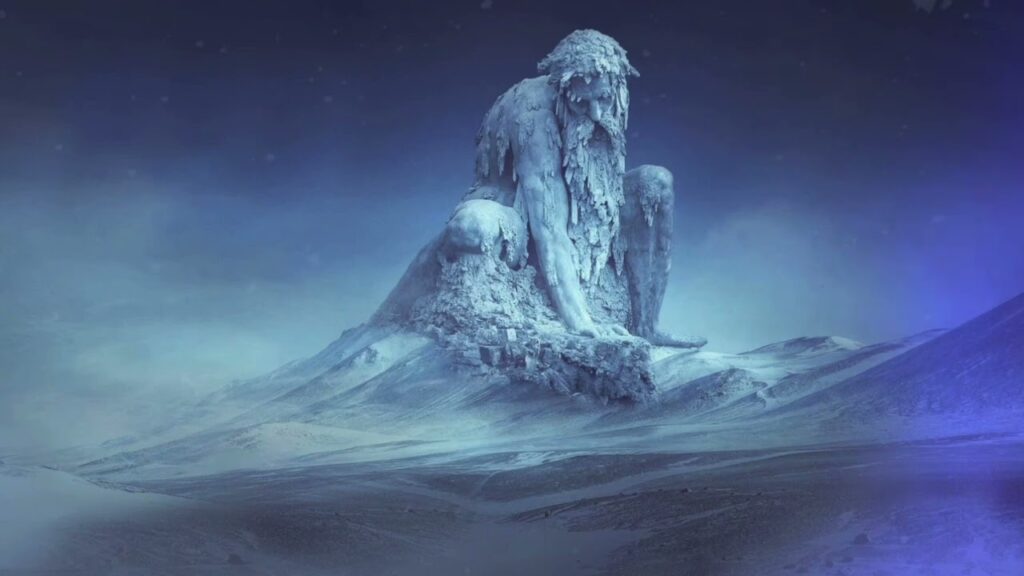
At the next stage, as discussed above, from this Stream a number of forces arise, among which there are both inertial forces, the “clutching” of the stream itself in its potential depth — Hrímtursar, or Archons, as well as forces of differentiation and creativity — gods and other manifestations of Prav, enter into diverse, complex relations with each other.
And in parallel, the process of “correction,” harmonization, ordering, and actualization of reality, considered as the “ascent of Sophia,” unfolds as well.
Thus, two global and mutually contradictory tendencies of the universe arise:
· the general striving for actualization, manifestation, and cognition, and
· resistance to development, a pull toward unmanifestedness and virtuality.
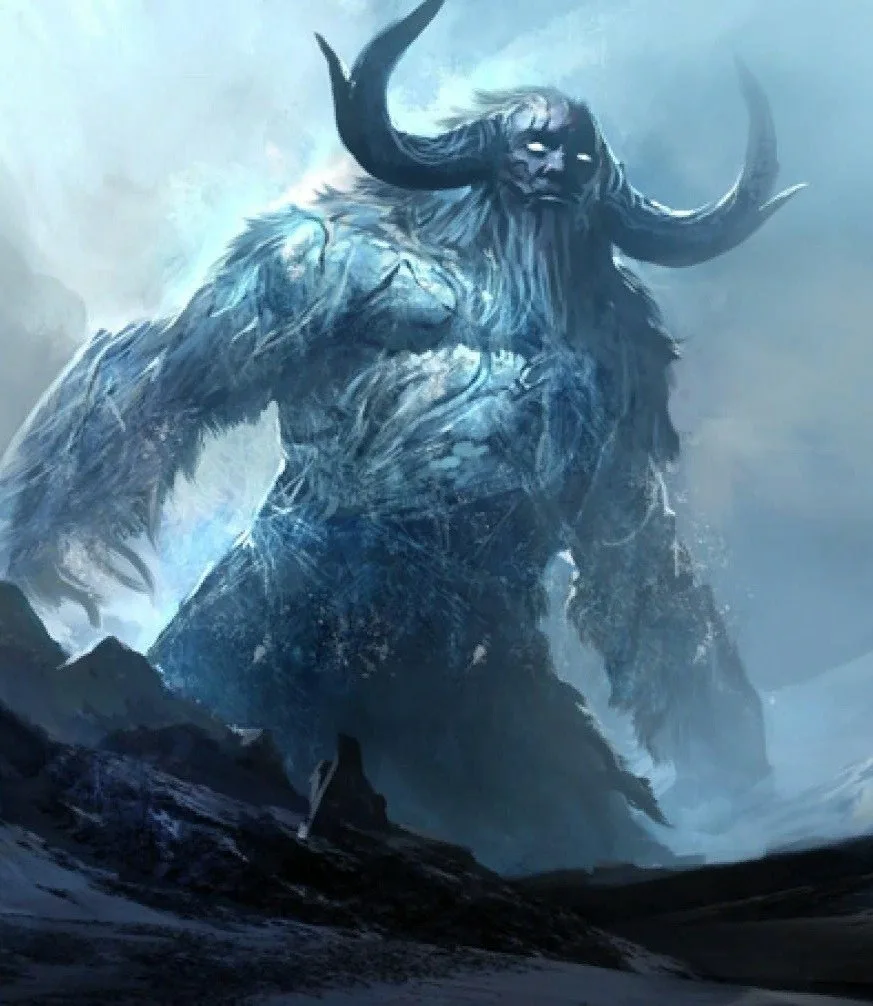
We also remember that the first striving, in turn, also manifests both in its constructive, evolutionary form of the generation of wisdom — and the manifestations of this striving are all aware and developing, “free” forms of mind — as well as in the destructive form of energy consumption, finding its expression in predatory and demonic forces. In turn, the second tendency can manifest in the form of “enslaving conditions” — the so-called “Heimarmene,” designed to restrain the mind from overly rapid manifestations and awareness, as well as direct outflows of life energy under the influence of the hierarchy of Predators in the Interspace, at the head of which are the Thurs-Fomorians, whom the Gnostic myth also calls the “Secondary Archons.”
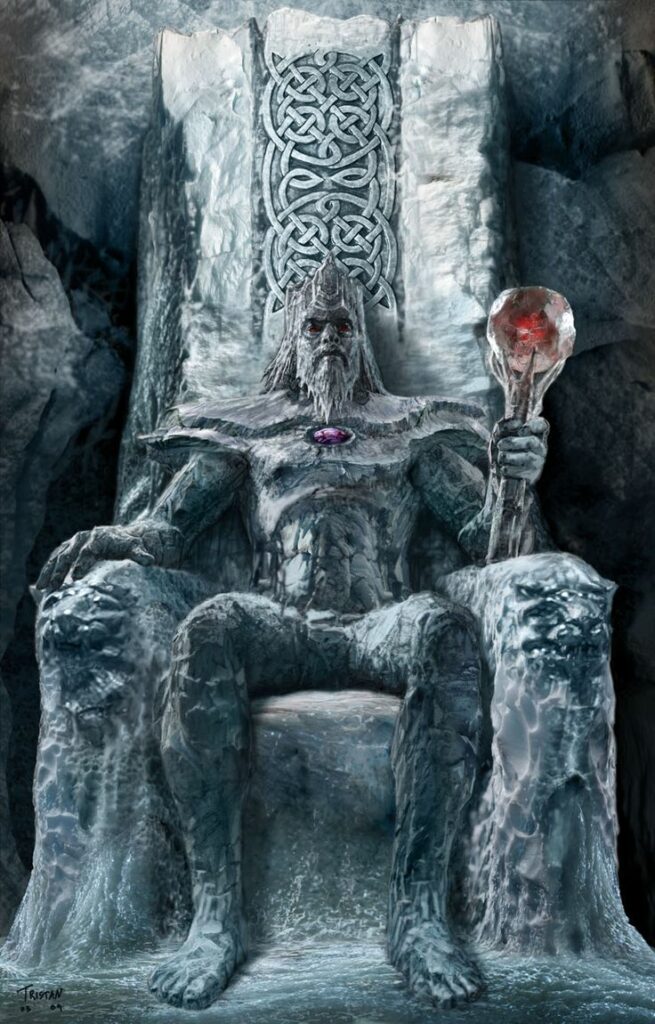
Thus, aeonic reality, the world of unmanifested divine potencies, or the Stream Elivagar, expressing itself “in itself” as a set of potential spaces and qualities — Utgard or the Interspace — is “realized” in the form of a complex arena of forces that are in various types of interaction with one another — births, absorptions, and confrontations.
Notice that the flow of the “ascent of Wisdom,” the process of self-knowledge and self-actualization of divine reality, occurs surrounded by a large number of obstructing forces, identifying and opposing which becomes the main part. Thus, the “excessive,” in the opinion of many, emphasis by magi on hostile beings and entities does not reflect a one-sided perception of reality, but rather reflects an accurate assessment of world-forces.
Hello, Enmerkar.
Thank you for the article!
How accurate is the analogy from psychology regarding mortido, as a desire for death – ‘resistance to development, yearning for unmanifested and virtuality’;
libido, as a desire for life – ‘a general aspiration towards actualization, manifestation and knowledge’?
The source of any desire is the impulse of self-knowledge, arising from the Monad as a particle of the Absolute, whose projection in humans is their Divine Spark. If for the realization of this act of self-knowledge the vector of desire deviates from one world in favor of another where it can be realized, and this world is reflected in the given reality only in the form of an imaginary world, will such an escape from reality express ‘resistance to development and a yearning for unmanifested’? After all, any depression and apathy, just like a strong surge of mortido, arise precisely due to a person’s inability to realize their deep impulse of self-knowledge in current conditions and within given resources. It is often in such cases that someone retreats into imaginary worlds – either an ultimate retreat in the form of the death of the body as a conduit of consciousness in the current reality, or a temporary one – as a turning away of consciousness from the surrounding reality in favor of imaginary worlds – an internal escape.
Moreover, it is precisely the attempt at maximum devaluation of any unauthorized manifestation of fantasy and imagination – the effort to repress it and impose its veto on this organ of the human soul – that is the main tool of the Demiurge (its evil and irrational Gnostic version) in controlling any reality it has created, from which the minds inhabiting this reality are not supposed to escape. Any concept of ‘the world as a prison’ always includes attempts to minimize the significance of the imaginary and strictly control the remaining pathways there. It is precisely such an attempt to fully control the world of the imaginary (imaginare) that television and its more advanced version in the form of the internet and virtual environments represent.
Therefore, I believe it is worth distinguishing between these two concepts: imagination, as the ability of human consciousness to travel through other worlds, and virtuality, as a method of absolute technological control over imagination realized through modern scientific and technical means.
After all, most people who spend a significant part of their time in the virtual environment possess almost no ability for genuine imagination. This, in the modern world, without exaggeration, is a genuine hidden alchemical knowledge.
How do you actualize reality in a world of lies? One that only you trust.
Schauta’s wait can also be an active activity, and vice versa – an absolutely passive activity of death.
Hello.
Yes, the analogy with psychoanalytic concepts is appropriate, and one can say that, in a certain sense, the desire for manifestation is libido, while the refusal of it is mortido.
As for the difference between ‘imagination’ and ‘virtuality’ – it all comes down to the possibility of productive use: reality is such a flow of realizations in which their energy relies on previous stages, and hence the next action becomes not just ‘another realization,’ but – a new, albeit slightly higher and more synthetic, level of it.
As such, if imagination, creativity, etc., leads to development, that is – to an increase in understanding and the ability to act – it is productive and evolutionary.
If it is merely ‘shooting and chasing,’ i.e., effectively a kaleidoscope of one-level energies and images – then it just cycles the consciousness at one level, leading to losses and empty dispersion of energy.
https://enmerkar.com/en/magic/the-virtual-and-the-alternative-realms
I reread the Eighth in neural network translations, back and forth. 888, the surges of Mortido you described as ‘from the inability to fulfill a desire,’ is this not a banal alienation of you from the views imposed on you?
Hello, thank you for such clarity. One thing I didn’t understand: ‘Thus, the aeonic reality, the world of unmanifested divine potentials or the Flow of Elivagar, expressing itself ‘in itself’ as a set of potential spaces and qualities – Utgard or the Interval, ‘realizes’ itself in the form of a complex arena of forces, which are in various types of interrelations, births, absorptions, and confrontations.’
Does it mean that the Interval is the only possible manifested reality? In other words, roughly speaking, does an realized enlightened mage end up at the end of the path in some ‘nowhere’? Or does ‘to exit the wheel of Samsara’ not equate to ‘leaving the Interval’ and the mage continues to dwell within its spaces?
Hello.
The Interval is the aggregate of all possible realities, existing in a potential state.
Consequently, for a ‘realized and enlightened’ mage, the boundary between potential and actual reality disappears, as does that between separate branches of manifestation.
Thank you so much! for your wisdom and effort!!
In my coordinates, Aeon Bitos is the center, the idea of the center; as it is the center, it is the original prime potential of all being (the possibilities of being and not being). The second point is that the center is self-identity. If it is not fulfilled, then there is no center at all. The question is, is it possible to ‘imagine’ a center while being at a distance from it on the periphery? After all, the idea of the center consists in the fact that it can be only one; there cannot be two centers. That’s how Yaldabaoth was cast beyond the limits of the periphery (eonic reality) into the outer darkness. Am I correct that the eonic reality (the system of eons) is contained within the ‘golden egg’ that floats in the causal ocean? And what constitutes the ignorance of Yaldabaoth? Does he have the qualities of a subject?
Indeed, many diagrams of the Eons (presumably developed under the influence of sephirotic systems) depict the Pleroma as a ‘multilayered’ reality, where each Eon represents a level, layer, or sphere. However, in the gnostic system, Eons are merely different forms of manifestation of the One; they do not ‘overlap’ one another, though they do give rise to one another logically. In this sense, Bitos – Depth – is the ‘essential’ aspect of the Pleroma, Sige – its ‘self’ aspect, and so forth. As for Yaldabaoth, as we discussed in one of the notes, his blindness is a systematic property of singular reality in the ocean of totipotency to ‘close its eyes’ to all other possibilities:
https://enmerkar.com/en/myth/the-false-light-of-yaldabaoth
I have another observation I would like to share. Yaldabaoth, as depicted by the Gnostics, resembles a ‘GUT’ with a head attached. Well, here it is clear, the program of the gut is to understand that the creations of Yaldabaoth work according to the principles of food chains. The entire physical reality and the reality of the interval are structured according to the principle of the food chain, ‘one eats another’. The question is, as I understand it, can it be otherwise? The very interval and physical reality, by their nature, cannot be different; can they do without hierarchy, without food chains?
It follows that Yaldabaoth holds within himself the principle of actualization, i.e., he highlights (by the force of his gaze?) from this shimmering haze of possibilities (the shimmering Rorschach blot), some specific ‘pattern’ and grants it the right to exist, but at the same time denies all other possibilities the right to exist? If a specific possibility of existence is realized, then the entire surrounding bundle of possibilities that could have been manifested instead is canceled? The already manifested possibility is literally surrounded by a ‘boiling bundle’ of alternative possibilities. Well, in general, a possibility is always an alternative; one can replace another. In the pleromic reality, they are all realized simultaneously, right? In the Kenoma only ‘one of’ them? Or in the Pleroma, possibilities are just possibilities and do not receive any actualization, i.e., they are somewhat ‘virtual’? If that is the case, then the sense of this Kenoma reality for the development of possibilities is unclear? What is so characteristic of Kenoma that is absent in Pleroma in terms of experience for consciousness? The second kenoma, or better said the abyss of techoma, is also the virtual space of the interval; it too is boiling with those very possibilities – here we can draw an analogy with quantum entanglement in physics. Thus, we have this logical element known as possibilities; Being is fundamentally possibilities, including both negative and positive. Then, by its nature, what would the possibilities residing in Pleroma differ from the ‘roaming’ possibilities in the interval of Techoma? Well, only one answer seems to be implied: in the Pleroma, they are ‘PURER’, but that is only half of the answer)). P.S.: By the way, if Pleroma is excessive fullness, and it seems to pour outwards from its excess, surpassing its edges. But it seems to me that without the differentiating force of Nahash (or the force of Yaldabaoth?), there can be no outpouring, no shedding of emanation. Pleroma does not imply the shedding of the particular but does not oblige it, nor serves as its condition. Overall, one can compare Pleroma to a unifying and dissolving pulsing sound within itself, from which, due to ‘desynchronization’, separate sounds (emanations) are shed. In general, a good model would be that of a polydrome, in which simultaneous movement back and forth occurs. That is, emanations are shed, but they do not leave Pleroma; hence they simultaneously pour out (prodos) and return (epistrophe), and since all this takes place in the unique ‘space’ of Pleroma, they also abide. These three processes coexist simultaneously; there is no ‘before’ or ‘after’. Therefore, this is a polydrome. ‘Movement in place’. A perfect combination of static and dynamic.
You’re saying here, “Sofia, at her ‘external’ level, ‘dreams’ of the Father, the Depth, the Bitos, to which she ultimately must arrive in her understanding of aeonic reality. However, not possessing the purity and strength necessary for understanding Him, she ‘imagines’ an incomplete and distorted image of Him, which takes form as the Protoarchon Ialdabaoth.” But there’s no sense in this, because Bitos is fundamentally indefinable and unknowable; it’s like trying to imagine a metaphysical point, which is essentially zero.))
Sofia’s descriptions of her “dream” are a very vivid representation of her attraction – the attraction of the “most distant,” and therefore the most “tense” sphere – to its Source, as a state where there is neither distance nor tension.