
Abraxas – the Fire of Creative Desire
In the complex Gnostic system of world-creation, composed of countless heavens and aeons, the driving force that unites and differentiates the Pleroma is called Abraxas (Greek. Ἀβρασάξ) .
Some scholars claim that the name of this god derives from the Hebrew “abberaka” (בְּרָכוֹת), meaning “Blessed“; others that it is a corrupted name of one of the Egyptian gods. There is also the view that the name goes back to an ancient Coptic or Egyptian magical formula, symbolically meaning “Do not harm me” (“Do not touch”) and addressed to the deity as “Father”. That formula was commonly inscribed on an amulet or talisman and worn on the chest beneath the clothing. Other etymologies trace the name to abh — “father”, bara — “to create” and negation — “Uncreated Father“, or from Greek habros and saō, “Beautiful, glorious Savior“.
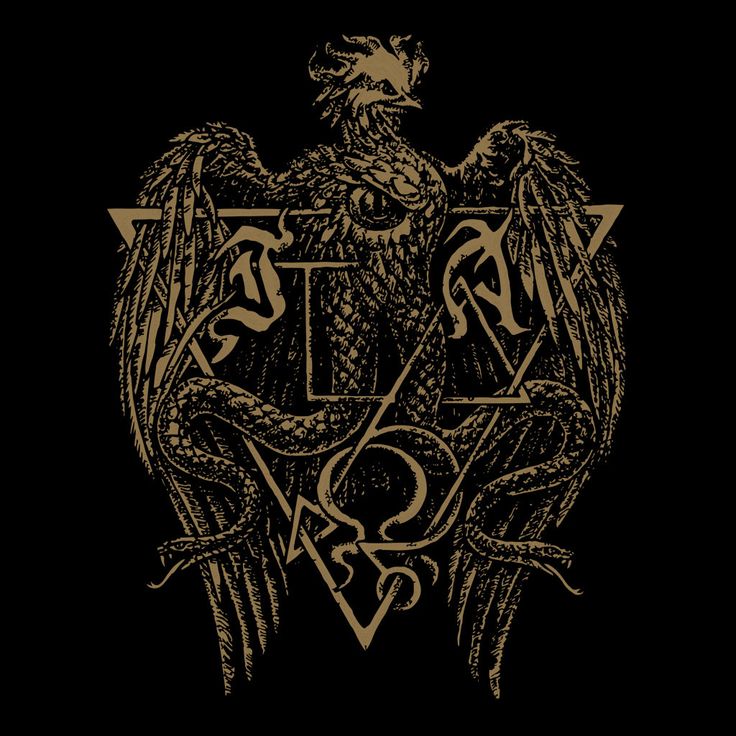
From the second century onward, among Syrian and Alexandrian Gnostics Abraxas was the supreme head of the heavens and aeons, as if uniting their fullness in his person. In this sense Abraxas expresses the creative will of the Absolute, which permeates the cosmos, the world’s intense striving to exist.
According to the teaching of the followers of Basilides (d. 140), God, the uncreated, eternal Father, first begot Nus, or Mind, Logos — the Word, and Phronesis — Intelligence; from Phronesis came Sophia — Wisdom and Dynamis — Power. It is this assemblage of primary emanations that is embodied in Abraxas. They form the highest Kingdom of Light, which radiates creative activity from which all things are born, and from which proceed 365 orders of spirits that sustain the cosmos. At the head of these spirits stands Abraxas — the highest of seven gods, embodying them. Basilides asserted that Abraxas acts as a mediator between humanity and the Divine Essence.
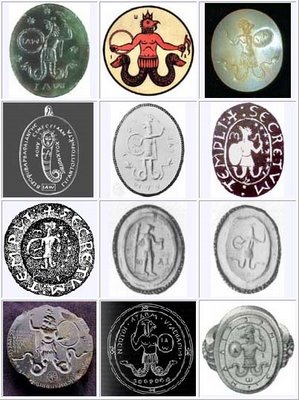
His name and image often appeared on gems and amulets — the Supreme Being with Five Emanations, marked by appropriate symbols. Abraxas was depicted as a man with the head of a rooster or a lion; in one hand he held a round or oval shield (the sun), in the other a scourge, chain, or club. From the human body, the deity’s usual form, grow two supports — Nus (Mind) and Logos (Word) — symbolized by serpents, denoting inner sense and quick comprehension. His rooster head, a symbol of foresight and vigilance, represents Phronesis. His two hands hold the symbols of Sophia and Dynamis — the armor of Wisdom and the ruler’s scepter. Beside the image of Abraxas there was a series of letters bearing specific meanings, some of which formed the word “Abraxas”.
According to tradition, Abraxas is a warrior, who conquers evil in all its forms, a fierce fighter for justice, understood as creative order, conformity to the cosmic plan. He, like the rooster, which is the symbol of the rising sun, is the first to greet each new morning of each new day.
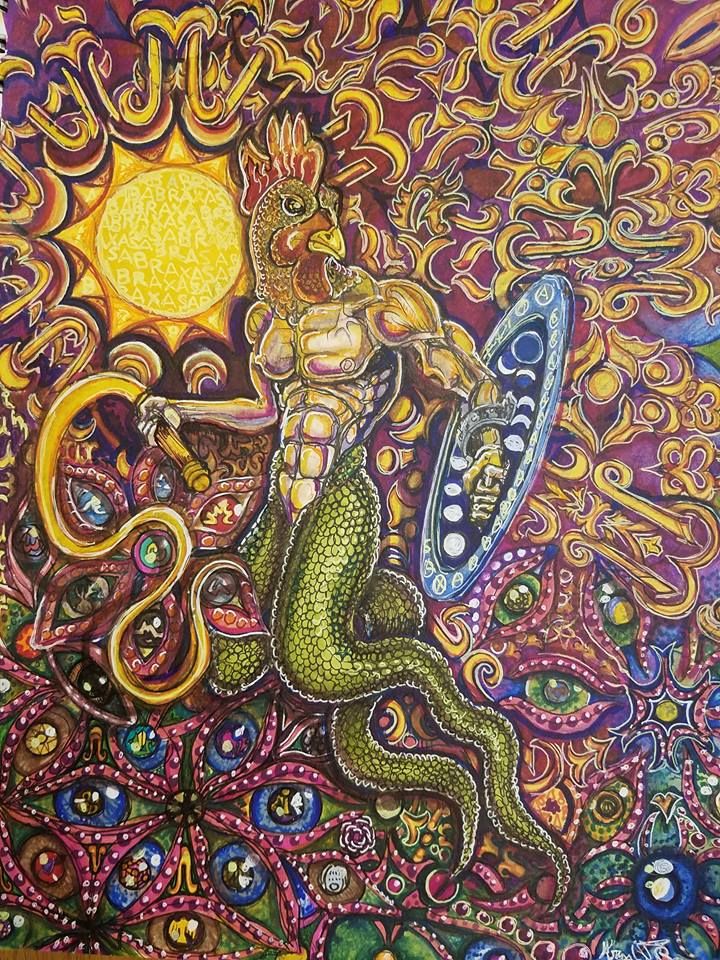
At the same time, Abraxas is a force of well-being and wisdom that can be attained only through a fearless struggle against opposing forces, necessarily overcoming them, because in Abraxas’s hands is the scourge (whip). The scourge is a symbol of authority and dominance over adversaries; it is his instrument against evil.
Formally, the name is composed of seven Greek letters (and the magical number 7 symbolizes the general idea of the Universe). The sum of the numerical values of the letters making up the word “Abraxas” (A – 1, b – 2, r – 100, a – 1, x – 60, a – 1, s – 200) amounts to 365 — the number of days in the year (“the wholeness of worldly time”), and also the number of Gnostic heavens (“the wholeness of worldly space”) and the aeons corresponding to those heavens (“the wholeness of spiritual reality”), the cycle of divine action.
The cosmic character of the number 7 as the total number of letters emphasizes the meaning attributed to the name Abraxas of the culmination of the moments of being, of ultimate totality. According to Greek gematria, Abraxas is equivalent to “Mezon”, the second of the five tetrachords of the Greek musical scale: the sum of the numerical equivalents of the letters of both words is 365.
Being the source of creation, Abraxas is the lord of the heavens and of time.
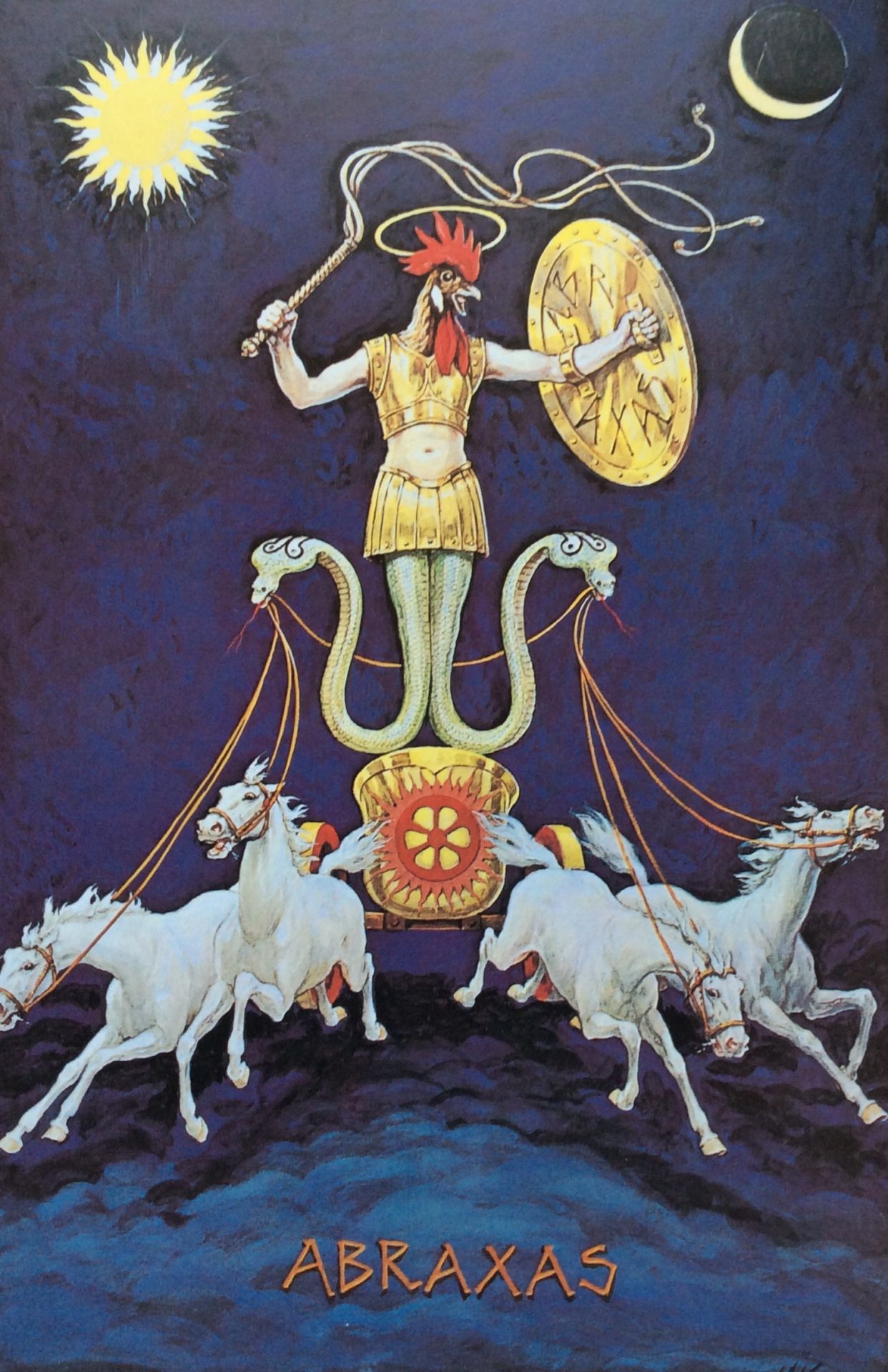
As Jung wrote of Abraxas, this “new god”, “shining like a lion, instantly tearing his victim apart, beautiful as a spring day”, Abraxas is Pan, Priapus, a subterranean monster, a coil of winged serpents, the true Hermaphrodite, the “holy creator”, love and the killer of love, the saint and his betrayer, “the most dazzling light of day and the darkest night of madness.” “To see him is to be blinded, to know him is to go mad, to worship him is to find death, to fear him is wisdom, and salvation is possible if one does not resist him.” At the end of the “Seven Sermons to the Dead”, after the ode to Abraxas, the author concludes: “In that world man belongs to Abraxas, who either begets or swallows him and the world.”
Both the name Abraxas and his iconographic image were widespread outside Christian Gnosticism, in the cult-magical practice of late-antique syncretic paganism.
In the Middle Ages Abraxas became rather well known again: his image as a talisman was adopted by alchemists, who wore medallions on their chests depicting the human-rooster-serpent.
In the 13th century the symbol of Abraxas was used on the seals of the Order of the Templars, who considered Abraxas one of the manifestations of Baphomet and regarded him as a special cosmic being, the World Vortex in the aspect of Desire. In the Middle Ages his name was deemed demonic and listed among the practices of black magic.
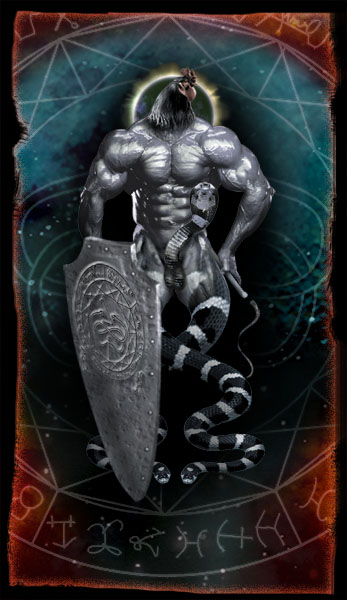
Thus, the image of the Gnostic god expressing the primary energies of creation has undergone a long development. It should be noted that, unlike “true” pagans, the Gnostics regarded their “gods”, “archons” and “aeons” primarily as symbols of an inexpressible spiritual reality, a poetic approximation to describe their nature. Yet such symbols were very much alive, carrying power and wisdom.
Once again, thank you very much, it’s good that there are people like you who give truly useful advice 🙂
Thank you to the author for the publication, a lot of interesting things. I only read the description from the perspective of Christians about heresy and paganism related to it.
And in paganism, is there an analogue of Abraxas?
Yes, any Fire god in its ‘higher’ understanding is Semargl, Agni.