The Great God Pan: Overcoming Separateness
I call Pan the All-World, the Shepherd, the whole of the universe,
The sky, the sea, and the solid earth — an all-embracing realm,
And the unquenchable fire; for all of these are Pan’s domain.
Rise, blessed one, come forth, swift-footed, goat-herder, co-throned with Oramus, Bacchant, lover of frenzy, starry one who strikes
The strings of the Cosmos, giving rise to melody and harmony.
You ward off phantoms, yet you are terrifying to mortals,
You love the watering places and pastures, goat and ox folds.
Keen-eyed hunter, beloved of Echo, progenitor of bright
greenery, dancing with nymphs, many-named all-father,
Life-giving and fruitful Paean, the world-maker,
cave-loving and fierce; truly you are the Horned Zeus.
yields to your power the boundless breadth of Gaia,
The depth of ocean that embraces the earth with its flow,
The realm of air that generates shared sustenance for the living,
And the restless, fierce fire, movement and joy.
All this is in your hands, all are obedient to your commands,
All change their nature at your command,
wise provider of humankind and the whole cosmos.
Now, blessed one, frenzied Bacchant, join our libations,
Grant us a beautiful fulfillment in life,
Drive away panic, chase it beyond the bounds of the earth.
(Orphic Hymn to Pan)
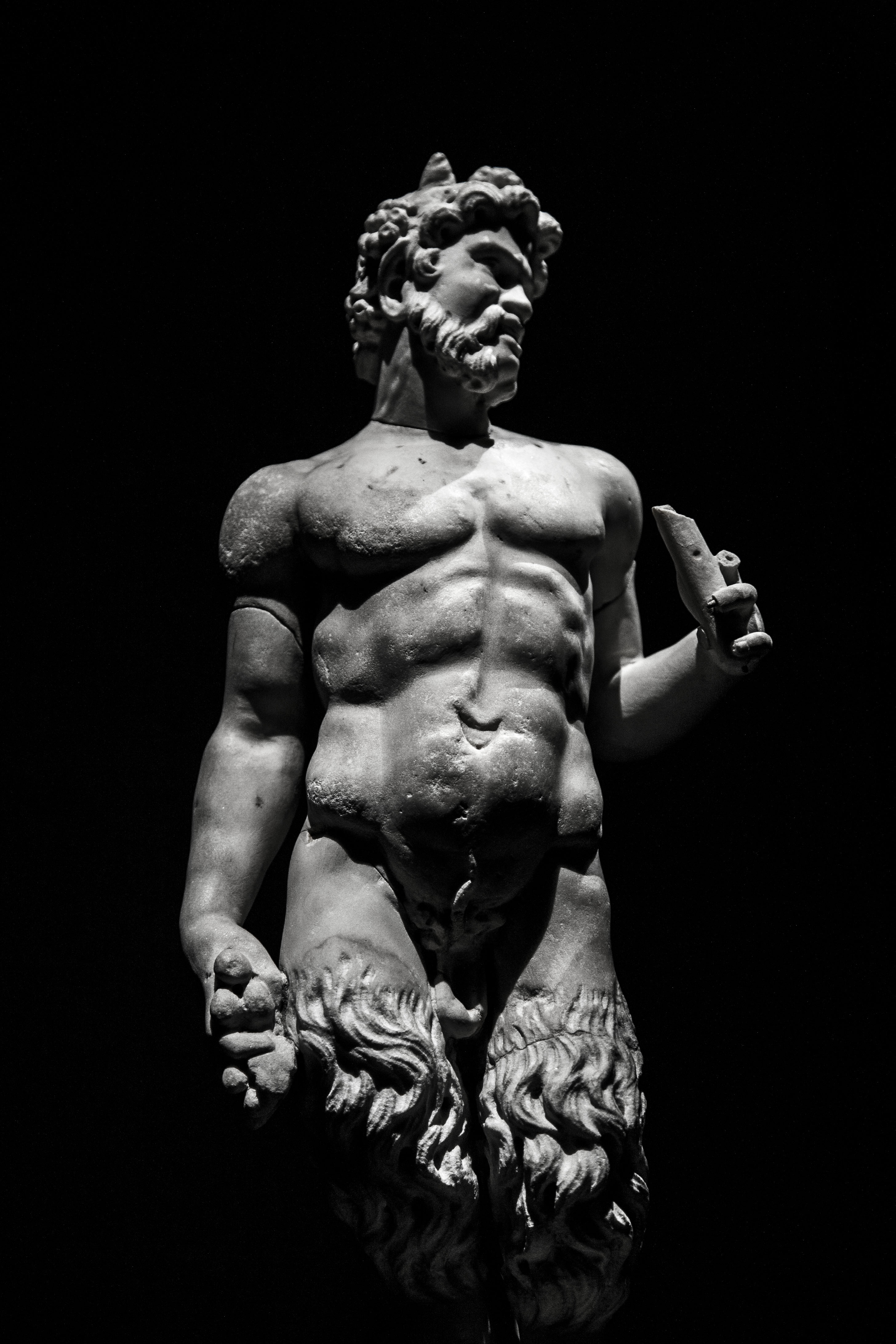
Among ambiguous images that possess both Macro- and Psychocosmic significance, occupies a prominent place the Great Goat-footed god — Pan, who is often reduced in much literature to a “shepherd god,” although the Greeks revered him on a par with Zeus and Apollo, and Magi — from the Orphics to the Thelemites — sang hymns to him.
Pan’s mythology is highly heterogeneous — he is sometimes described as one of the “younger” gods, a son of Hermes, sometimes as a son (or even a suckling brother or alter ego) of Zeus, and in the most esoteric conceptions he is regarded as an ancient, self‑born principle of all‑unity, manifesting as a chthonic, pre‑rational (and therefore appearing as animal) ground of the very stream of life.
For Crowley (at whose funeral, as is well known, his own “Hymn to Pan” was read), the goat-footed god is the embodiment of desire itself, the driving force of life and the entire world process.
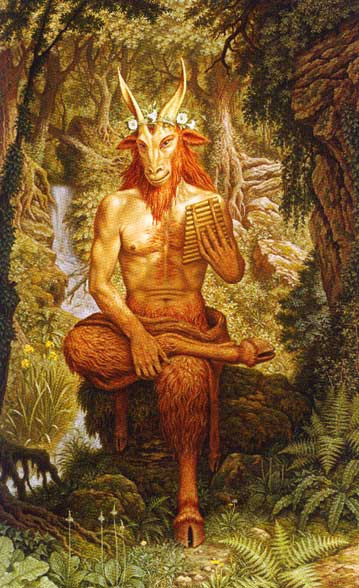
Among Pan’s mythological traits we should note several important ones:
- All the myths agree that the gods do not consider themselves superior to Pan, despite his “ugly” appearance;
- Pan can do what even Zeus cannot — he can cause ‘panic’ — a collective, uncontrollable fear — even upon the Titans;
- Pan opposes (and sometimes complements) Eros;
- Pan is always in motion; he never stops, sleeping only briefly at noon — the clearest time of day.
Thus, by his very nature Pan expresses the unifying principle of nature: even when regarded as a “shepherd” in his most “lowly” aspect, he nonetheless performs the function of holding discrete elements (goats, sheep) together as an aggregate, a whole (“the herd”). In this sense Pan is, of course, akin to the Celtic Cernunnos and the Slavic Veles. This trait is even more pronounced in the collective panic that this god can unleash — creatures forget everything and, seized by terror, rush as a single stream away from the source of their fear. In this respect one can draw a parallel with the so‑called “water truce,” when during a dry season predators and their prey peacefully drink from the last remaining pools. According to the Roman mythographer Gaius Hyginus (“When the gods were in Egypt, fearing the great Typhon, Pan ordered them to transform into wild beasts, so as the more easily to deceive him“), it is from Pan that the zoömorphic (that is, non‑human) images of the gods originate.
Since it is separateness — the opposition of one part of the cosmos, one being, to another — that lies at the root of disharmony and is the cause of many destructive forces, the image of Pan can be a powerful transformational tool for the Magus, helping to overcome destructive manifestations of self‑separation and to return to a state of process, a flow, seen in a particular cross-section.
If the mind succeeds in finding and identifying that force which is embodied in the image of Pan, it can invoke it within itself, thereby moving from existence in fragmentation to movement in the flow.
In this sense Pan (as an alternative to Eros) expresses a non‑merging, “quantum” movement of a stream of discrete elements that do not oppose one another but are integrated into a common field. If Eros (as the full antithesis of Naxash) still evokes a striving for fusion, for the total unification of elements, Pan leaves them room for self-expression and self‑determination; in this resides the manifestation of his “hermetic” nature (that is, akin to the differentiating principle). It is no accident that Pan taught Apollo divination — for intelligence to manifest intuitive capacities it needs a certain integrative ability.
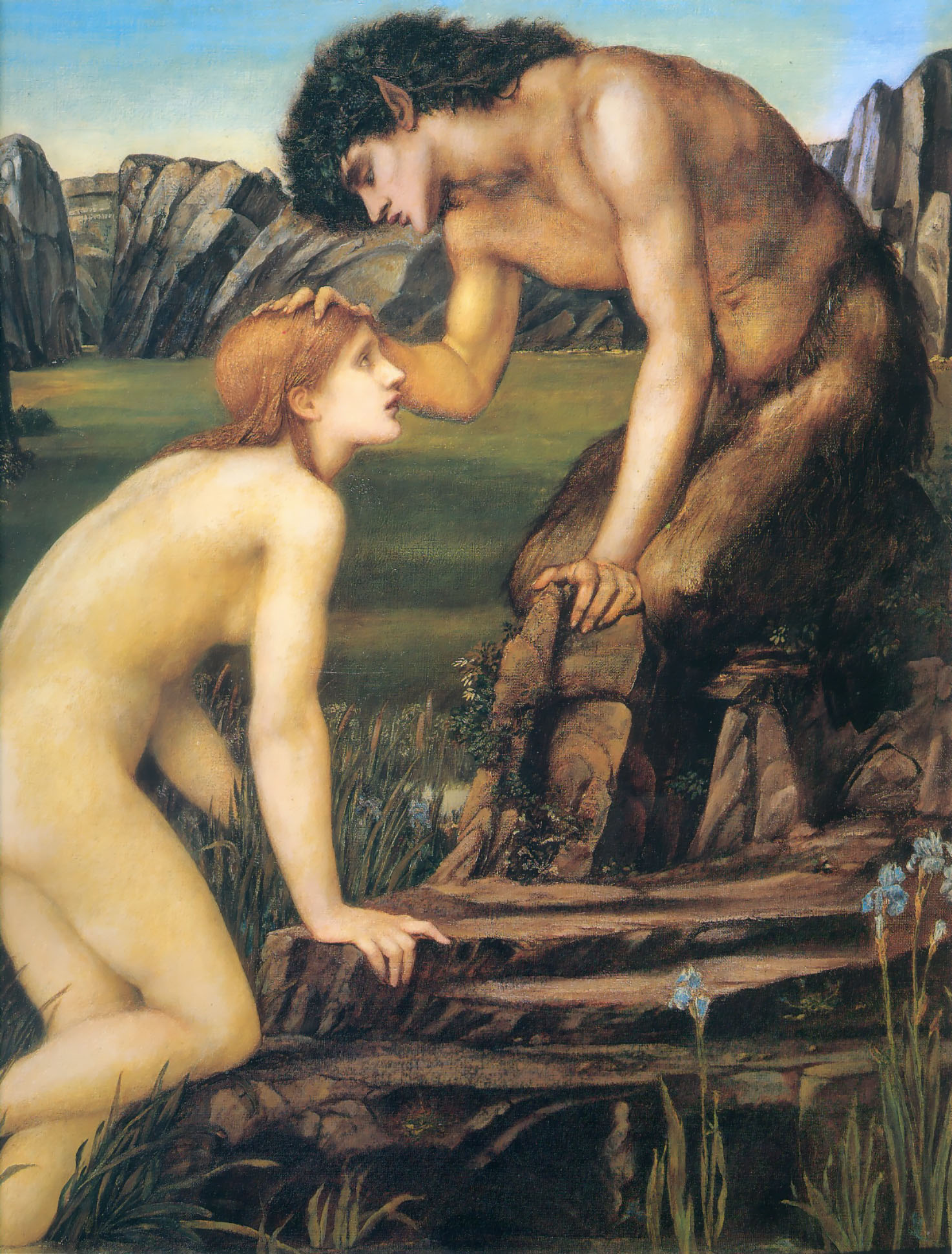
The image of Pan is a “masculine unification” in the sense that it combines with identification, with definition, and does not imply dissolution or absorption. It is precisely in this sense that Pan was at once regarded as a god of darkness, a nocturnal deity who sleeps at midday, and as a daytime force that rivals Apollo. Many depictions of the Goat‑footed one stress his phallic nature, and the numerous myths of Pan’s loves for various nymphs complement the idea of the expansive character of his power.
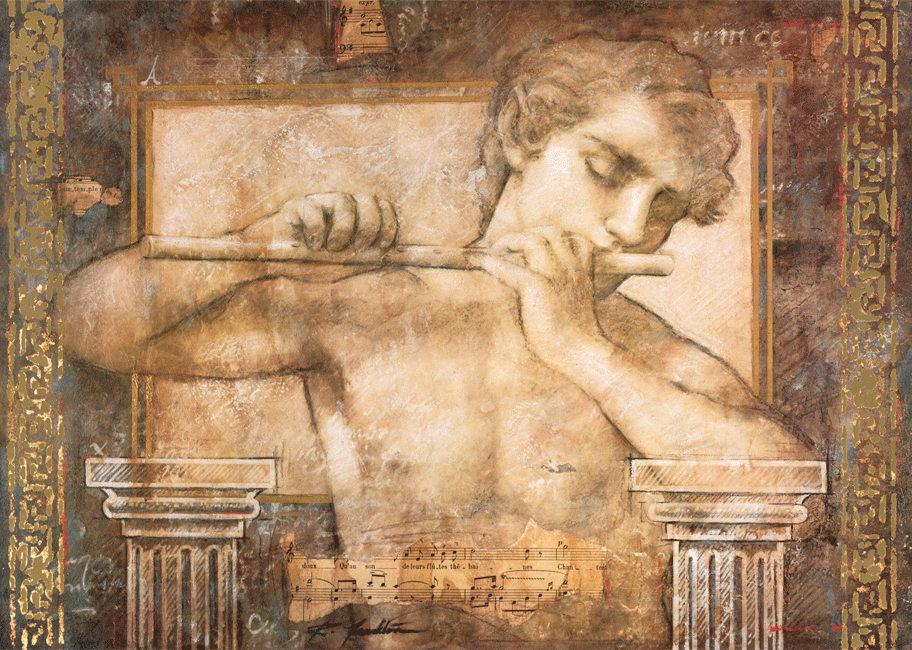
In order to overcome the force of self‑opposition without thereby falling into dissolution, it is necessary to discover and actualize in the mind that striving for symphony, for synarchy, so vividly expressed in the image of Pan (it is no coincidence that Pan invented the seven‑note shepherd’s pipe). For balance and harmony in this flow, of course, a sense of cosmic order, of hierarchy (reflected in the image of Zeus), and a clear understanding of what is taking place (which Apollo provides) are also required.
Thus, for the Magus centering his mind on the perception of unity in diversity, valuing variety yet not denying unity, the image of Pan and the principles that follow from it prove to be the most valuable instrument for actualizing in oneself the power of the Pleroma, the striving for “union without mixing.”
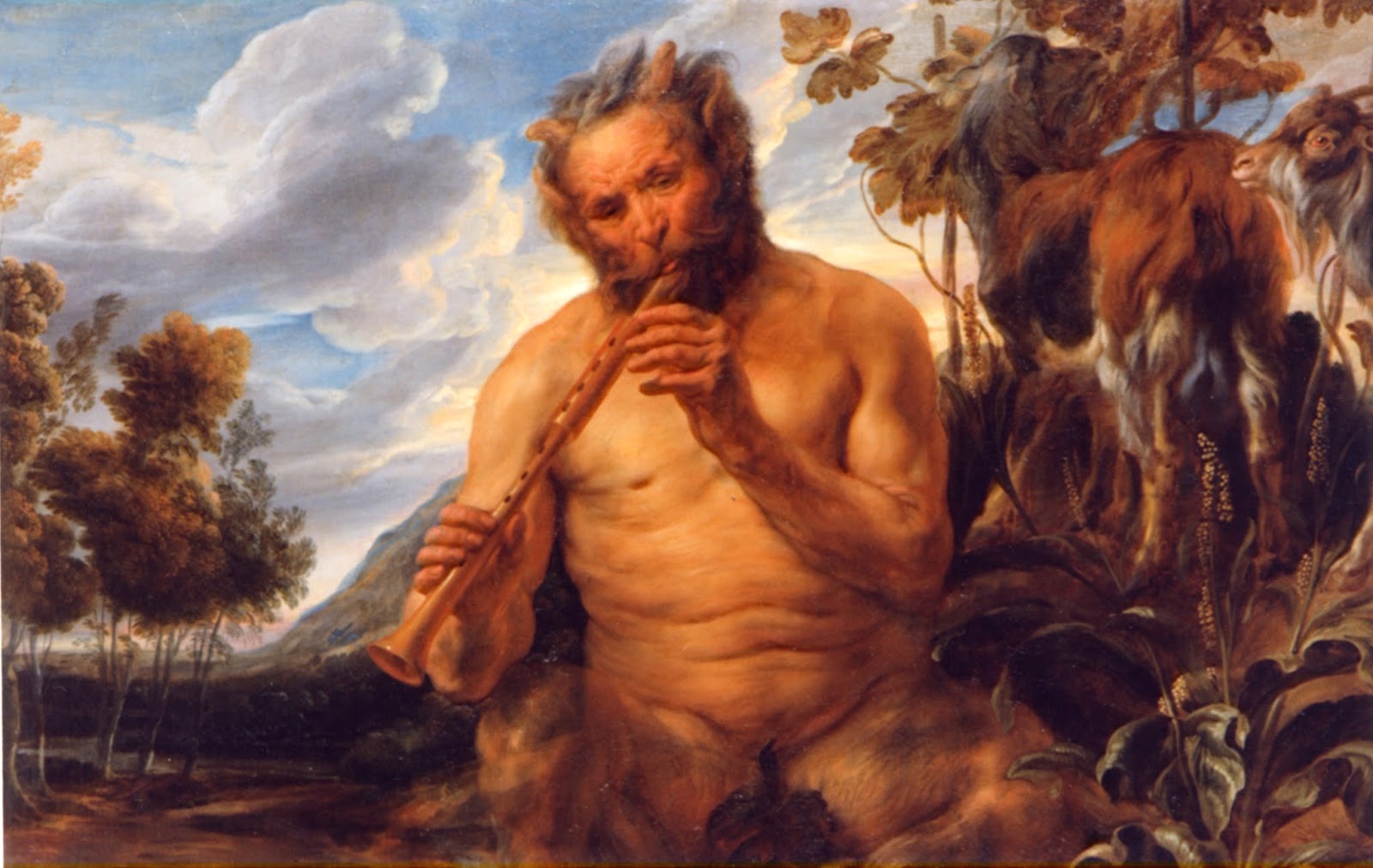
The touch of Pan can occur when, for a moment, the basic division between object and subject is lost in consciousness and the world of nature begins to be experienced not as separate from the person as a field of objects, but as a unified, living, and therefore dangerous substance, with which the human soul becomes tightly bound at that moment. And the chill of fear along the spine at night in the forest—these are the signs of Pan’s approach when the human world begins to ‘stop’, the protective walls of the ego begin to crumble, and suddenly it is discovered that you are merely one of the many offshoots of the world, tightly bound to it by the drive belts of instincts and not some separate self-contained unit, as the consciousness assumes. In such a state, a state of merging with nature, a person can also see various forest spirits, mermaids, kikimoras, and other manifestations of natural spirits. And those, in turn, can see the person, as they become more defenseless from them through the separation of worlds. And far from always such an experience is one of being in harmony with nature. After all, as in the poem by Zabolotsky, nature knows nothing of good and evil, of life and death—it is all one whirlpool for her. These categories are introduced by consciousness, which is lost in that moment:
Lodeynikov leaned over the leaves,
And at that moment he envisioned a
Huge worm, with iron teeth
Grabbing a leaf and darting into the darkness.
So this is harmony with nature,
So these are the night voices!
So this is what the dark waters murmur about,
What, sighing, the forests whisper about!
Lodeynikov listened. Above the garden
There was the confused rustle of a thousand deaths.
Nature, turned into hell,
Was carrying out its deeds without artifice.
A beetle ate grass, a bird pecked a beetle,
A ferret drank the brain from a bird’s head,
And the fear-warped faces
Of night creatures looked out from the grass.
Nature’s eternal press
Joined death and being
Into one knot, but thought was powerless
To connect two of its mysteries.
And, as far as I understood, this veil separating man from the world is the very veil that thins, for example, at Samhain. And the meaning of the hunt for power is then how a person will manage to integrate and non-contradictorily include within the structure of their consciousness those formerly foreign elements they encountered while experiencing such an experience, not letting them destroy themselves and weaken their self-identification, which would cause a loss of power, and simultaneously manage to include them into their world?
So does Pan represent a personified image of all that exists? Or is it more akin to Baphomet? Can Pan be compared to DAO?
DAO, Dharma – is the faceless ‘Order of Things’, it is the sum of all forces and interactions, in their fullest manifestation. Pan – is the embodiment of the unity of the immanent component of life, that is – of all bodies and their manifestations.
It’s quite complicated to understand)). I remember in one of the articles you used the term ‘boiling singularity’ regarding the Abyss (I don’t quite remember which, it seems it was about the power of Shakti). Is this applicable to Pan? As I understand this phrase, boiling means immanent. Singularity is convergence at a point, but this point is special – it is dynamic and not located in one place (more precisely, there isn’t a place – it is ‘virtual’). And the very approach to this point is infinite, like moving along an asymptotic curve. A rough physical example is a whirlpool in a sink or a hurricane. On the other hand, if we consider life, then the measured pulsation, in order for something to pulsate, there must be an exterior and an interior. Can the two models described above be attributed to Pan?
The great flow of power. The ‘pull’ between the Father and the Mother is still not DAO? Or is that precisely DAO?
In these terms, one can say that ‘DAO’ is the internal foundation, a structuring factor or logos of the Great Flow of Power.
The father is indeed the foundation of everything. By communicating with Him, you will feel that He is called “Father” precisely because of the sense of our essential beginning.