The Horned Lord of the Forests
We have already, many times, noted the exceptional importance the gods hold in magic-oriented mythologies, binding the threads of life, serving as stewards of plants and animals and channeling the great flow of power into the realms of embodied beings.
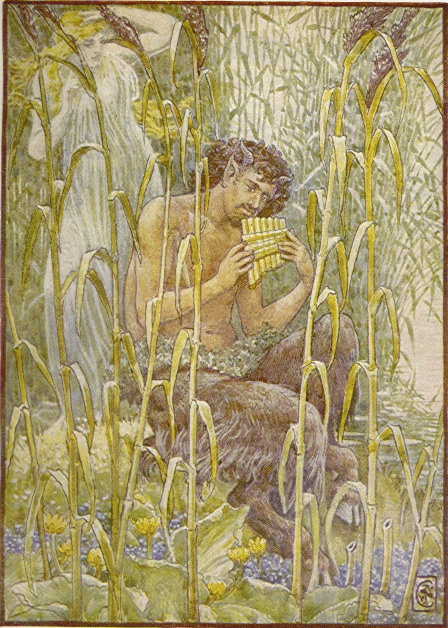
The Slavs, the Scandinavians and even the Greeks regarded these deities in binary pairs — Veles-Dazhbog, Ullr-Freyr and Pan-Dionysus respectively. In these pairs the first god brought life into being (and at the same time reclaimed it at the end of life), while the second god represented life as a stream, a process.
The Celts, however, found a god who combined traits of both the Great Earth God (venerated by them as Dagda, Esus) and the God of Beginning (Myrddin) — Cernunnos.
Not only the Druids, but also modern Wiccan practitioners appreciate this god’s qualities, which allow one, through interaction with his power, to enter the stream of life with a fullness unattainable for binary pairs of other mythologies.
Thus, Cernunnos is the Lord of life and, at the same time, its giver. This manifestation, uniting the great principles, is unique in its integrated completeness.
The name of this god means “Horned“, underscoring his close connection with pre-human forms of life. In Latin it is recorded as Cornuno: cornu means ‘horn’, and uno ‘one’.
It is sometimes thought that the precursor to the cult of Cernunnos was precisely the cult of Dionysus, known as Dianus (from Latin divinus, meaning ‘divine’) or Dionysius (the deity of Nys). It is believed that his cult first appeared in Thrace, which historians also include within the bounds of Old Europe. Dionysus is supposed to have symbolized a process of renewal and to have been a pre-Indo-European god, very ancient and possessing masculine virtues. The bull’s horns and snakes that adorned him are associated with the strengthening of Dionysus’s role in the lunar cults of Old Europe and with his status as a divine son involved in an incestuous union with his mother, the Great Goddess. Archaeological finds from Old Europe indicate that bull’s horns symbolized the moon, and in this sense could also be connected with the idea of balanced opposites, the masculine and feminine principles.
When the Greek cult of Dionysus became known in Italy, it evolved into the cult of Bacchus, merging with native beliefs. The Romans identified him with the Etruscan god Fufluns, who had earlier entered their religious myths under the name Dianus. Although his cult was mainly associated with winemaking, the memory of the horned one remained in the Romans’ depiction of Bacchus’s followers, the satyrs, as goat-legged and horned. Such horned minor deities only emphasize once again that Bacchus’s original nature is that of a god of the woods. The Roman Senate in 186 BCE declared the cult of Bacchus illegal, but it survived within secret societies, and in the 1st century CE it reappeared as a mystical belief.
When the Romans advanced north and west, conquering Celtic lands, they encountered the antlered deity whose appearance was not very different from the Italian horned god they already knew. The Romans gave him the Latinized name Cernunnos — the horned one.
The importance of the Horned God was shown by his authority over the entire forest. In the religious and magical practice of that time, he, the “master of the beasts“, held a prominent role. His symbols included the flute, the shepherd’s staff and the pine branch. Cernunnos was the god who established the covenant between human hunters and prey. The Horned God gave people food, and to the animals — renewal and the continuation of life. In turn, people performed certain magical rituals that returned life-energy to the forest. This constituted the magical secret of the hunting cult: a killed animal was ritually restored through a magical ceremony dedicated to the Horned God.
It was considered important to preserve the animal’s essential part — namely, to help the life-energy of the slain creature survive after its body had been killed.
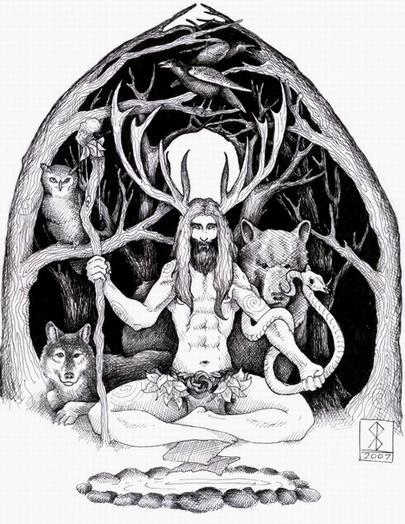
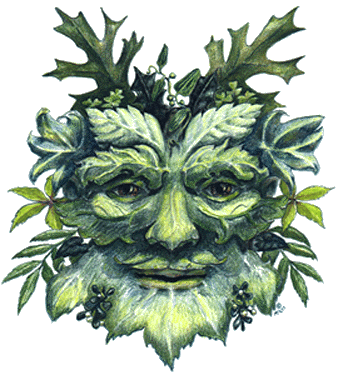
As Lord of life-force, Cernunnos is also the god of the world tree. The Druids revered the Oak as the Primal Tree, and Cernunnos sits beneath the World Oak in majesty.
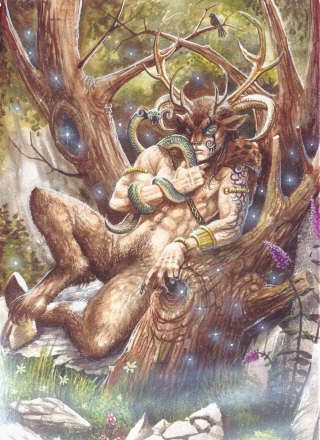
Besides the familiar Antlered God, Cernunnos was sometimes depicted, following the model of Dionysus, as a bearded man wearing a wreath of ivy, and sometimes as an effeminate youth wearing a young stag’s skin and an ivy and laurel wreath. He was also shown in a black mantle or clad in a panther’s hide. In later times Dionysus was portrayed with long curly hair crowned with vine leaves and berries. In one hand he held a thyrsus, and in the other a cup (chalice); often Cernunnos’s attributes included the Horn of Plenty and a pouch of money, symbolizing his relation to the productive forces of nature. In his left hand was his Horned Serpent — a symbol of sacred sexual power associated with the Great Mother.
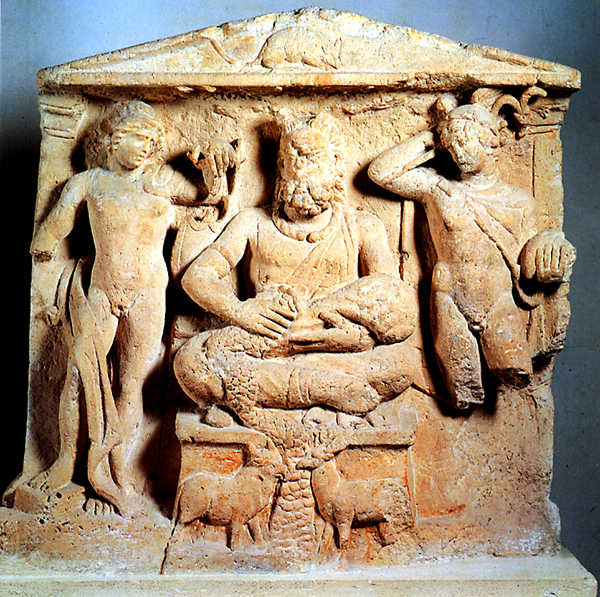
Thus, Cernunnos is the Great Giver of life, the unifying god of worlds, the lord of the forest, animals and plants precisely in their pre-human, non-human nature.
It is this aspect of the god — the god of living beings but not the god of humans — that expresses the antagonism between nature and man (culture). Cernunnos is the god of those forces of nature that will never submit to humanity, may cooperate with humans but never serve them; he is the god of the mighty ancient wood, for whom all people are a mere ripple on the water, a faint trembling of leaves.
This same aspect gives rise to the image of Cernunnos as the God of the Night Forest, since the night forest, like the thickets of the forest, is unknown, mysterious and elemental.
Therefore Cernunnos’s hunting is the “Wild” hunt, unbridled and uncontrollable, like a volcanic eruption or a hurricane.
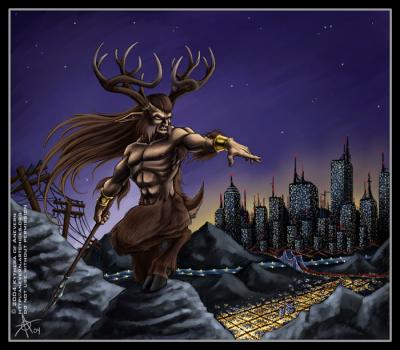
However, this god is undoubtedly benevolent. Though he feels no special affection for humans, he nevertheless will not kill or oppress them without need, although his wrath may be felt by anyone who passes through a recently clearcut area: the Lord of the Forests will not ask who is guilty; to him all people are the same — they are, after all, only people, and thus even someone uninvolved in the devastation of the forest at such a place may suffer.
Even more terrible is Cernunnos’s wrath against hunters who do not return the life-force of the animals they have killed to the forest, who treat killing as mere consumption or, worse, sport. For such people, by the will of the Horned God, the path to life and power is closed to them.
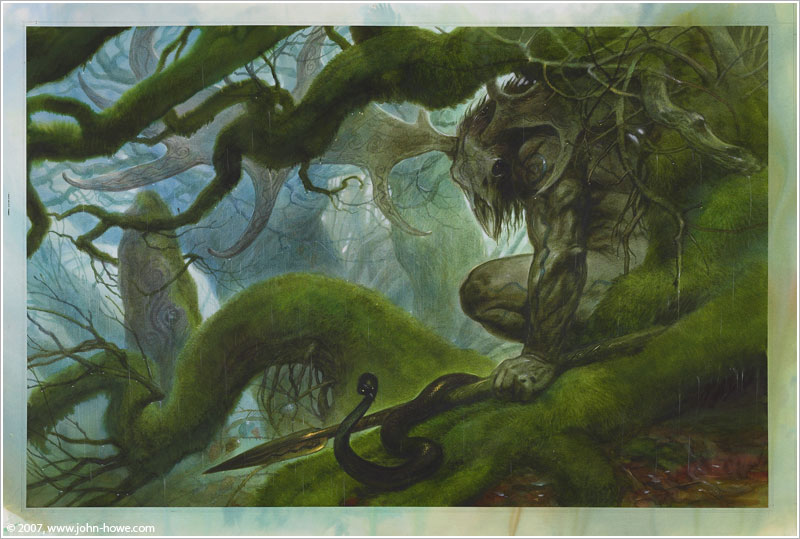
Yet if a person does manage to reach Cernunnos’s power, and the God turns his gracious face toward them, such a torrent of wondrous force descends upon that person that even a single drop of it completely transforms both soul and body.
It was precisely through interaction with the Power of Cernunnos that the Druids developed the cult’s most potent elements. It was He who gave them the strength to understand the primordial wisdom of nature; it was He who helped them break free from human conditioning; it was He who made them truly free and happy.
If for Cernunnos the sin of humans is not personalized, can any person return the life energy of a killed animal, or can this only be done by the hunter who killed it?
For Cernunnos, it doesn’t matter who returns the power, but for the hunter, it does matter. If he does not want to bear responsibility, he must do it himself. However, if the goal is to appease Cernunnos, then it can be done by another.
“In turn, people performed certain magical rituals that return the life energy back to the forest.” –
Have these rituals survived? Or is the form not important, but the internal attitude?
Why is a ritual necessary? Will there not be a reincarnation without it? Or is it for a different reason?
A ritual is any symbolic action that does not have a specific necessity.
So it turns out… If the hunter takes the life of an animal, he interferes in the natural cyclical process of life/death governed by Cernunnos… and if so, then having intervened, he must show that his actions are forced (food acquisition) and symbolically return the process back to who it is due (Cernunnos). By not doing this, the hunter confirms the fact of intentional interference in the action of Forces, for which he is punished.
The Hunter is one of the first gods of humanity. He is the one who governs the cycles of Life and Death. He is both the hunter and the prey in one person. As long as this world exists, he will be the keeper of its laws.
“changes the soul (and the body)” It’s interesting, how recognizable is the body after such changes?
Self-identity is preserved, but at the same time, something changes so fundamentally that, despite the overall similarity, there can be so many differences that, indeed, a person may cease to be recognized.
Thank you very much for the detailed post. I have read a lot about Kerni), but also haven’t read a lot. Interesting article. Copy-paste into your notes)))
Is the risk great even for a ‘righteous’ seeker to reach the angry face of Cernunnos instead of the benevolent one? Is this fraught with death?
I would like to know your opinion, on the images of Cernunnos, a pentagram appears between the horns; there is a sample in the middle of the article. http://zodiaque-nancy.blogspot.com/2007/04/mythologie-de-cernunnos.html What relation might it have to him? Thank you.
esperance What is a pentagram? Different cults, rituals, and witchcraft have various interpretations, but the meaning is one. All natural elements are encompassed in a five-point star, and it doesn’t matter if it’s inverted or not. In the world of subtle matters, there is no concept of inversion; the subtle world is inherently inverted))) it is a mirrored shadow. And Kernun is originally unrelated to this. Nowadays, giving power to talismans and protective charms, contemporary witches often use the symbol of power (the pentagram). To surely charge a given item. In general, to find a protective and guiding egregore, as well as a friend and mentor, Kernun might be suitable ‘to rise’. But do not forget about the primordial wildness and harsher justice (in some understandings, this is akin to cruelty, as ‘homo’ in the animal world and the natural realm is ENEMY No. 1). Be blessed.
The image of Cernunnos sitting with crossed legs closely resembles the image of the god Shiva. Many similar traits: posture, staff (with Shiva it is a trident), snake, moon (with Shiva it’s a crescent). I am not saying that the gods are identical, only that certain traits are similar.
http://www.youtube.com/watch?v=mFvpMObnzB8&feature=related
Surely, to someone who angers Cernunnos in the forest, he can easily slip in a death cap mushroom, or a bordered garerina, or a beautiful webcap into their basket so that the person doesn’t even notice.
What does it mean if you encounter Cernunnos in OS? Can someone advise?
This ‘Someone advises’ is within you. Ask and listen. I hope my suggestions don’t confuse: Maybe you are being invited to hunt? Maybe someone is hunting you? Perhaps you are being warned against wrong steps? Or maybe you are being guided along your path?