Fohat and Finias
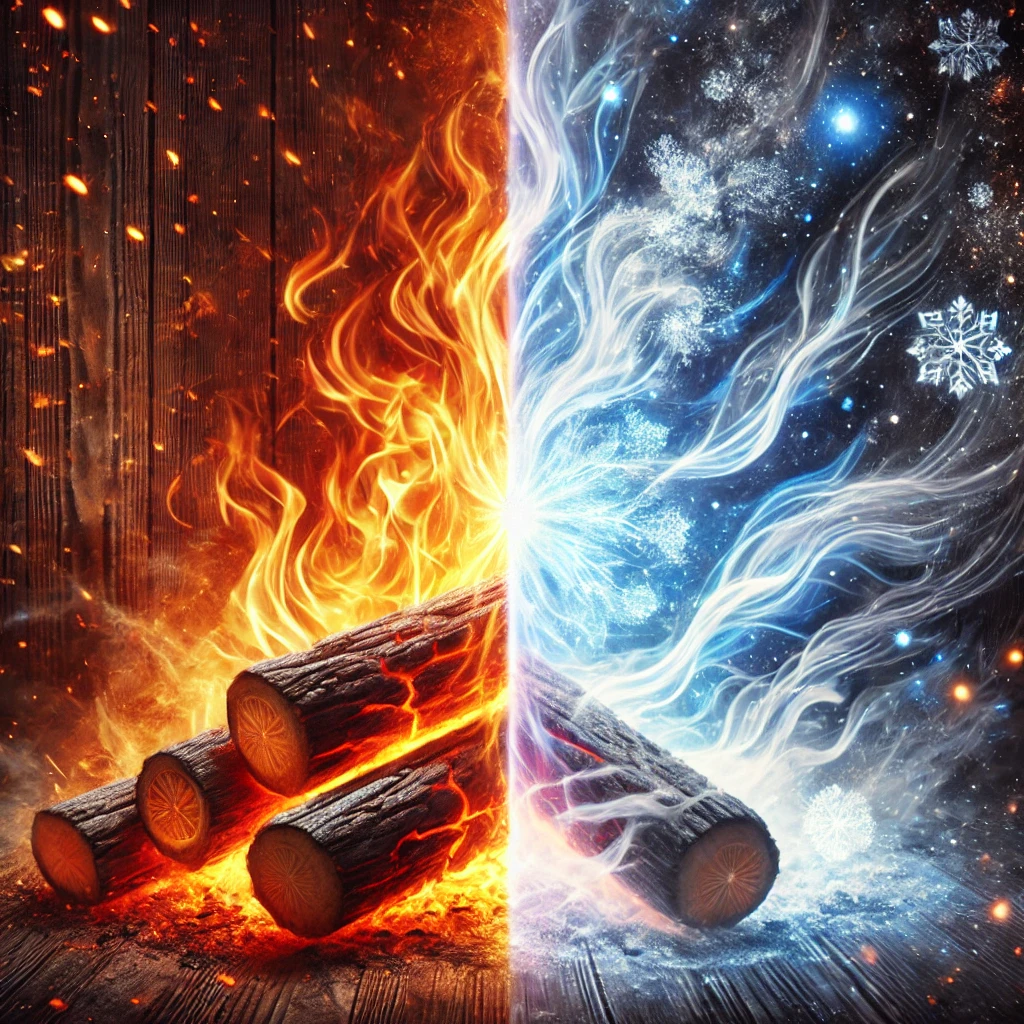
Fire has always been perceived as a phenomenon with a dual nature, combining within itself the material manifestation of the element and the expression of the primordial creative force.
Earthly fire acts as a reflection of that divine creative energy that initiates the birth of reality, awakens life, and inspires transformation. Therefore, it is both an element whose flames can be seen and measured and an expression of a fundamental energy capable of initiating cycles of destruction and renewal, uniting the material and the spiritual.
At the same time, fire, in its dual nature, unites creation and destruction, the manifested element and the primordial creative force. It can be the gentle light of a candle, the warmth without which there is no life, and the all-devouring fire that ends epochs and gives birth to new worlds. Thus, the principle of fire in its general sense encompasses both matter and spirit, manifesting itself as photons, plasma, the energy of light, and self-awareness.

One could say that elemental fire is a grounded, “condensed,” and “tamed” manifestation of the primordial. Material fire burns, while spiritual fire transforms. At the same time, elemental fire can also serve as a gateway to the primordial when used consciously, for example through rituals, alchemy, contemplation, and so on.
However, the Primordial Fire is, on the one hand, a source of life, but on the other, a force that ends the existence of forms, burning worlds at the end of times, when it manifests as Kalagni (the Fire of Time), the Fiery Gehenna, the Incinerating Light. There is no “limited” burning unlike elemental flame; instead, there is an endless pulsation: in one “phase” it creates (light, life, worlds), and in another it destroys (dissolves forms, collapses the universe).
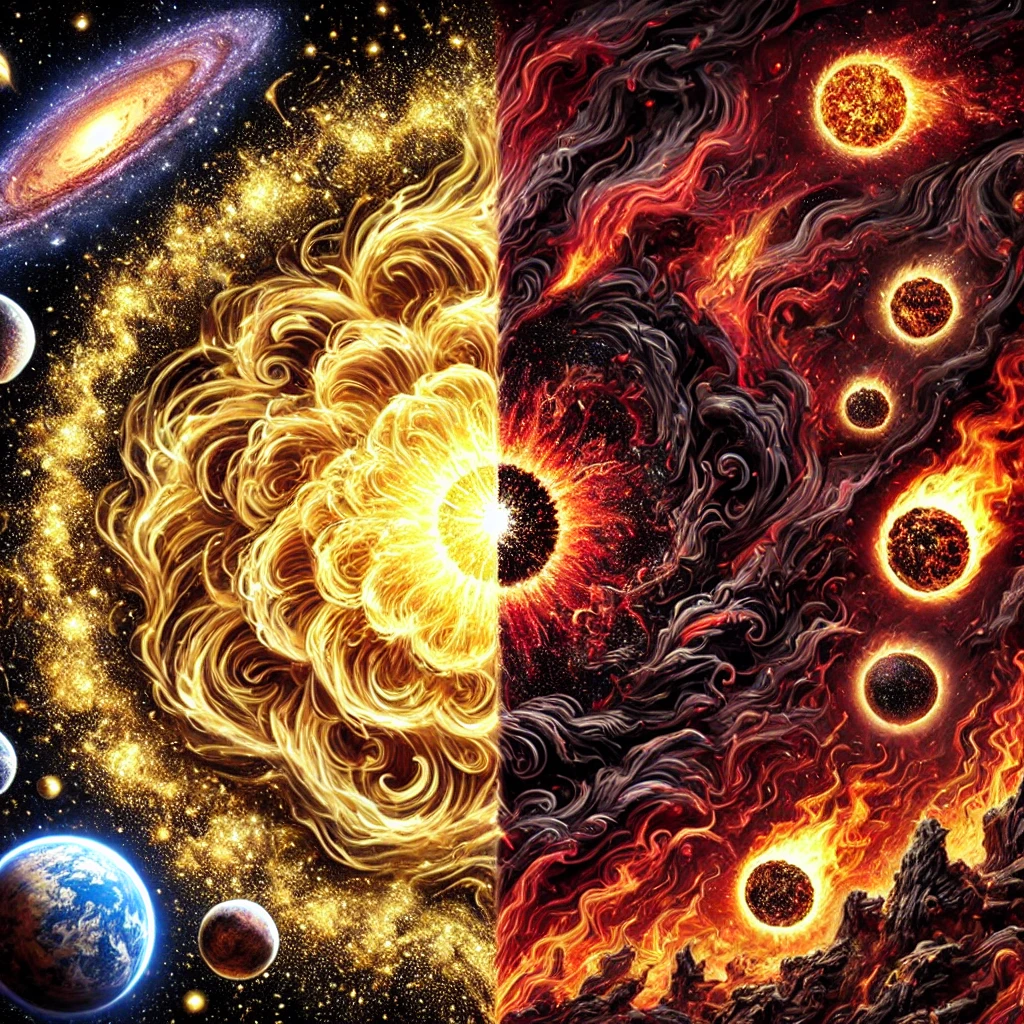
Fire is the only element that does not merely change a substance, but transforms it into a new state. That is why fire has always been closely associated with rebirth, initiation, and spiritual transformation.
Thus, fire manifests in three different “hypostases” or on three different levels:
- The Fire of Creation (Primordial Fire) is the original energy of the cosmos. It sets processes in motion, gives rise to everything that exists, generates light, order, and form.
- The Fire of Destruction (Kalagni, Infernal Fire) purifies, completes forms, and collapses reality;
- The Fire of Continuation (Elemental Fire, sustaining life and flame) sustains existence, warms, purifies matter, but does not fundamentally transform it.
These three forms correspond to the three main processes of the cosmos: creation, destruction, and the sustaining of existence.

The Fire of Creation (Primordial Fire) is the original Light, the “fire of the Logos,” the fire of birth and awakening. Its first manifestation is the “Fiery River” (Dinur), from which the very principle of life is born. It is the Heavenly fire (Shamaim, the Throne fire, the sacred flame) that creates new forms, structures energy, and gives rise to worlds.
The Fire of Destruction (Infernal Fire, Kalagni) is the all-consuming fire of the end of times, which erases all that exists, returning it to a “pre-form” state, and leads to purification before rebirth. This is the force that erases forms.
The Fire of Continuation (Elemental Fire) is limited to manifested reality; it is not transcendent. It sustains life: gives warmth, nourishes, but is not itself a fundamental force. However, it can pass either into the Fire of Creation (if it is used in sacred processes) or into the Fire of Destruction (if it becomes part of annihilation).
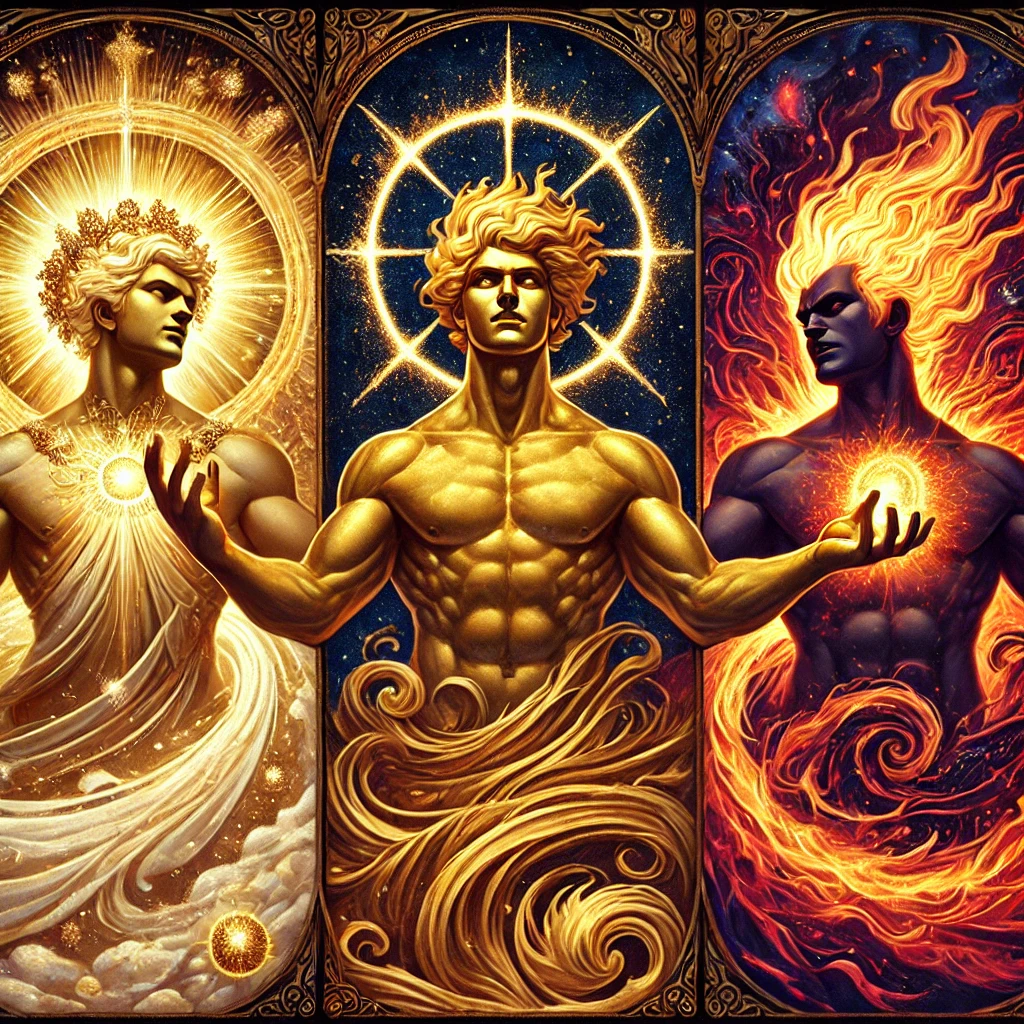
One could say that the Fire of Creation and the Fire of Destruction are two sides of one process, and the Fire of Continuation is its manifestation in the physical world.
Such a threefold principle expresses the cyclical nature of the cosmos: in every campfire flame there is a spark of the Primordial Fire, in every destructive blaze there is an element of the purifying Fire of Fate, and in the gentle warmth of the hearth there is the power of the Fire of Continuation. Thus, fire as a principle drives the Universe itself, constantly renewing it. This is a state of matter, spirit, and mind where active transformation occurs.
At the same time, when Fire becomes a flow, it acquires a conscious force capable of shaping reality. In order to create, it must unite with the energy of movement, fluidity, and space to manifest (the maternal flow). Thus arises the energy of the Maternal Current, the living force of Shekhinah or Shakti, giving form to the Fire of Will.
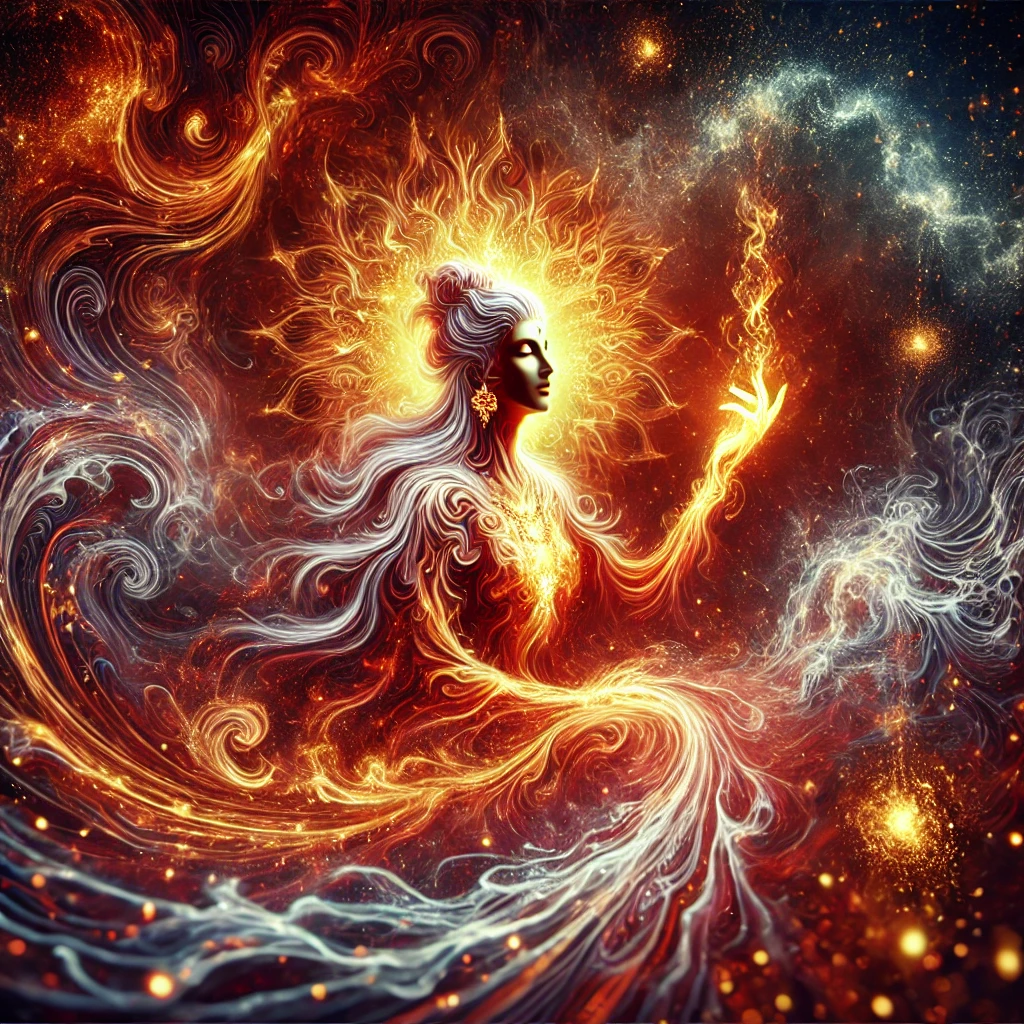
Thus, one could say that fire is a special mode of mental existence, a special frequency of being. And the higher this frequency, the subtler and more meaningful the energy of fire is; and conversely, the lower it is, the more chaotic and destructive its action becomes. When fire unites with mind, it becomes wisdom; but when fire unites with uncontrolled drives, it becomes destruction. If fire is too intense, it devours. If it is too weak, it vanishes. But if it flows in the right channel, it creates.
Unlike other primordial elements, fire burns only when driven by a process; it requires desire and movement, and therefore it is the very embodiment of the active principle of the cosmos, the archetype of the very Act of Being.
Fire is pure energy in motion, which always changes itself and transforms what it comes into contact with. In this sense, it is a transitional process that unites Matter and Spirit. One could say that the very process of the Universe’s evolution is the “fire” that burns, maintaining a balance between chaos and order. It purifies, changes, and perfects matter, and thus expresses the very principle of the transformation of everything in the universe.
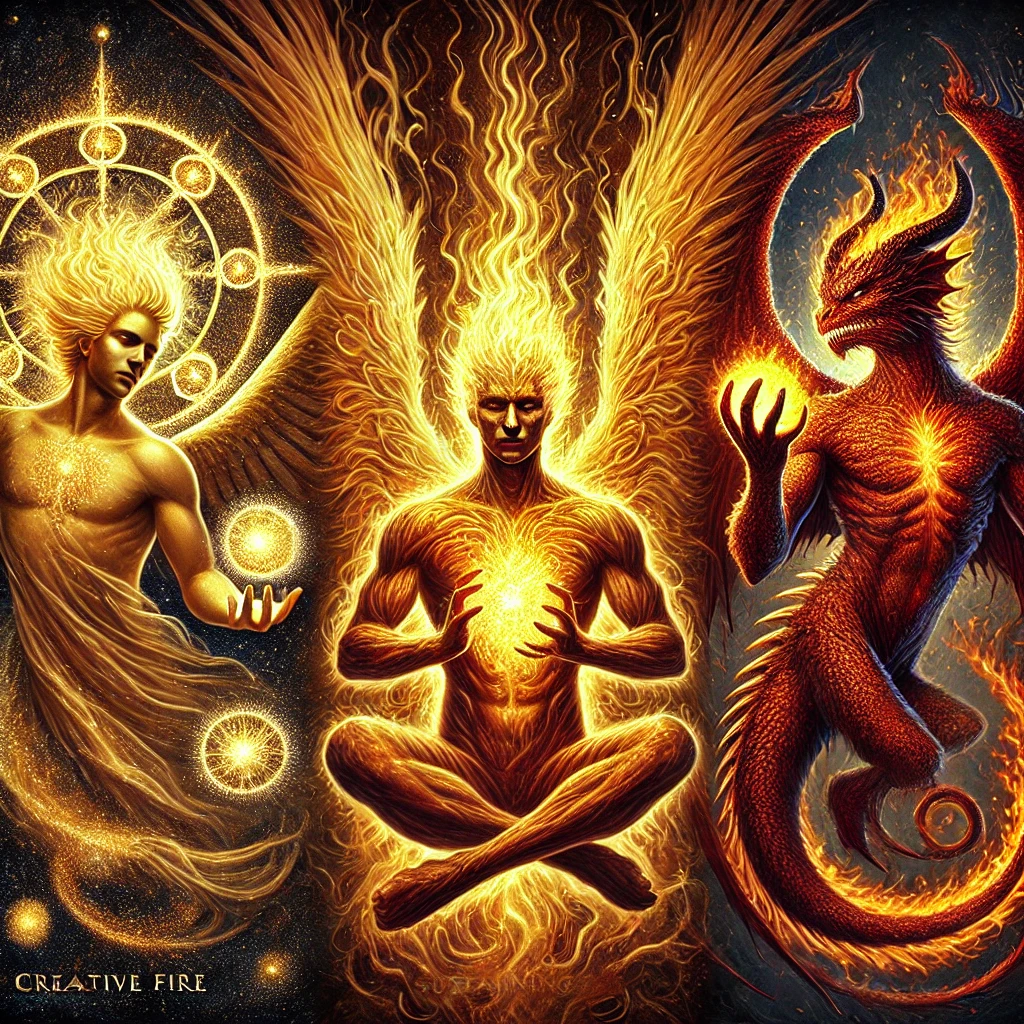
At the same time, one can draw a parallel between the hypostases of fire and the three classes of beings — Angels, Demons, and Salamanders (Fire Elementals). In this sense, one can say that angels express the Fire of Creation, demons the Fire of Destruction, and salamanders the Fire of Continuation.
In this sense, angels are “pure Fire of Creation”; they are a manifestation of the “Primordial Light” and the primordial impulse of life and the affirmation of the cosmos. Accordingly, demons are an aspect of fire that destroys; within this destruction, there is hidden purification and preparation for a new cycle. Salamanders are fire elementals that control flame within the bounds of the material world. They nourish the vital force of fire, but do not pass into the realms of its destructive or creative power. Thus, angels and demons are two poles of fire, and salamanders are its balancing, material form.
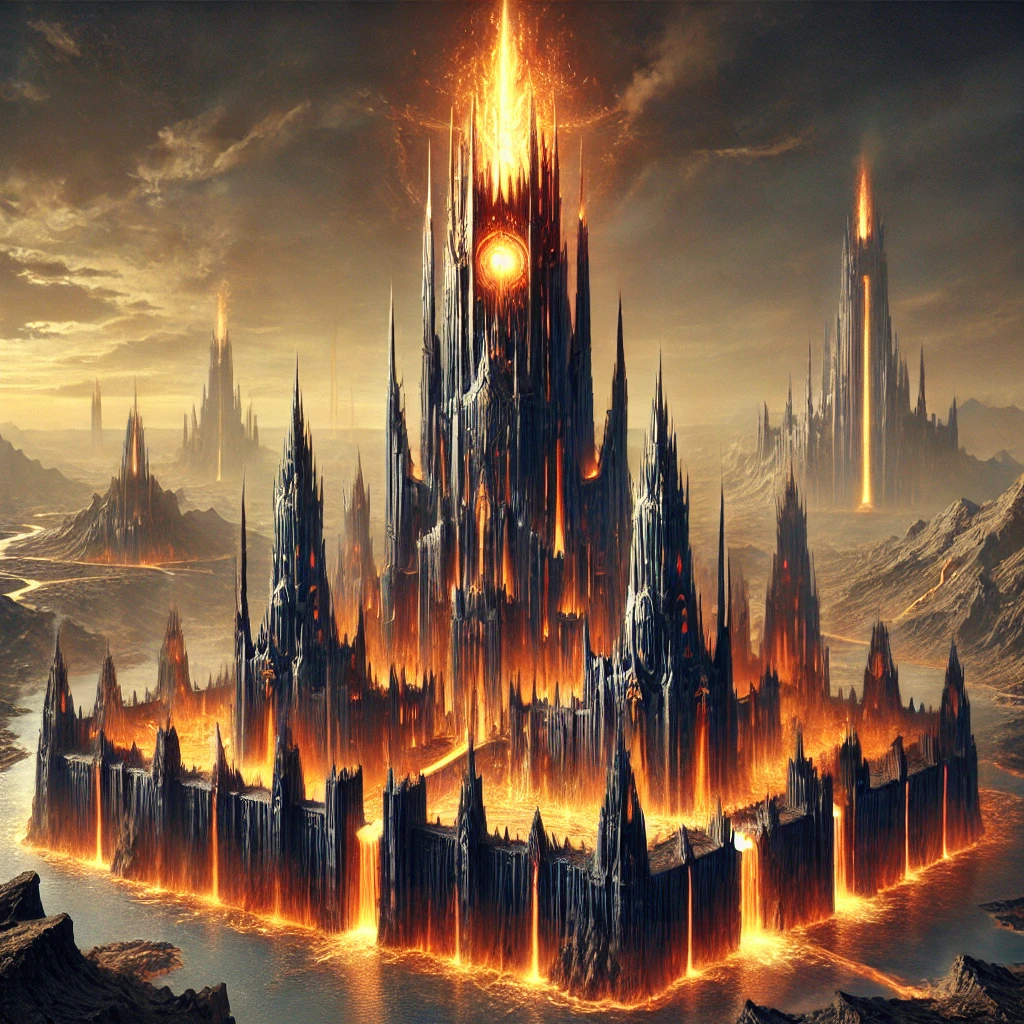
In the potential interspace, at the stage of becoming, fire manifests as one of the four Cities — Finias. This city embodies neither the pure Primordial Fire (the Fire of Creation) nor the Incinerating Fire (the Fire of Destruction), but the Fire of Continuation, sustaining existence and processes in the world. However, it is closely connected both with the Creative and with the Destructive Fire.
Finias arose first among the elemental cities, as the initial “infusion” of creative forces into the interspace. If we arrange the Cities by the sequence of manifestation of the primordial elements, we can build the following series:
- Finias (Fire) — the source of creative power;
- Gorias (Air) — knowledge, the dissemination of ideas;
- Murias (Water) — a transitional state, a connection with the depths;
- Falias (Earth) — stable form, materialization.
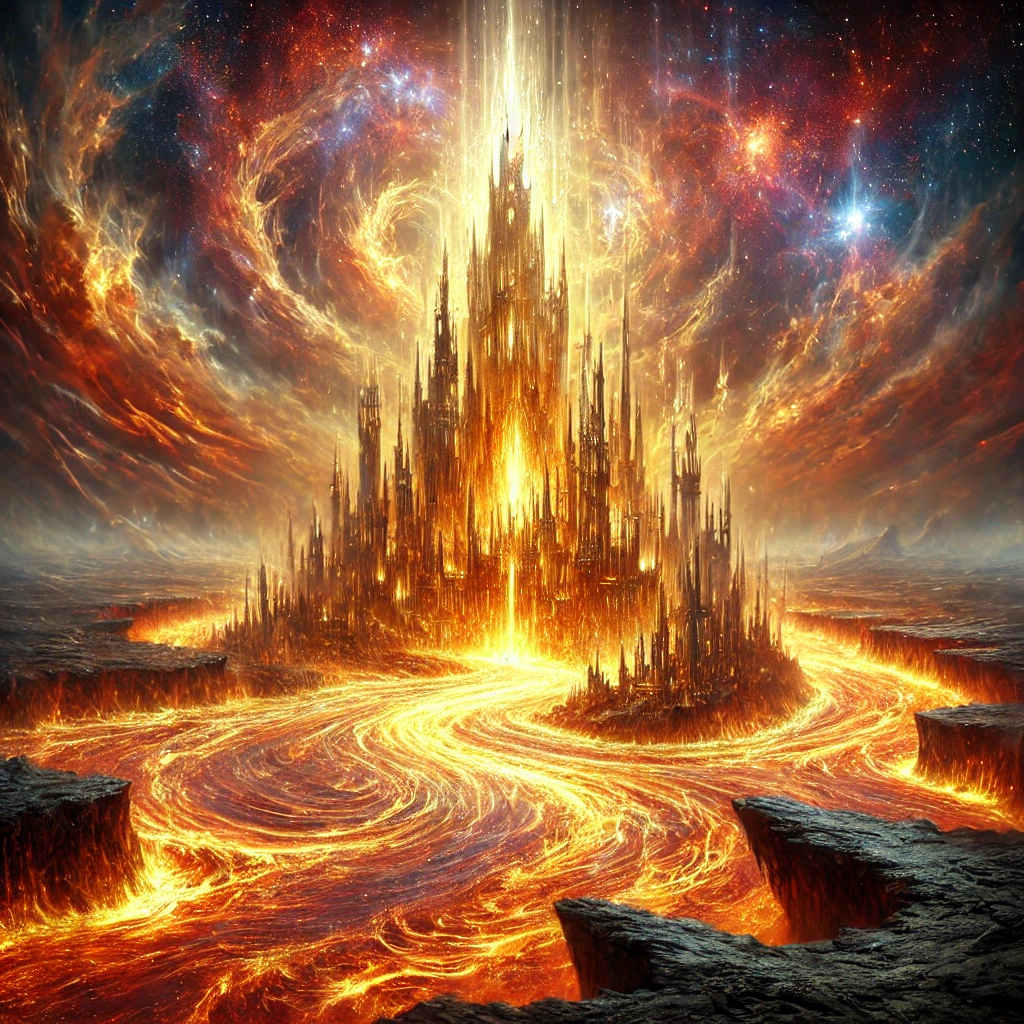
This is analogous to the alchemical process of the Great Work, where:
- Fire (Finias) initiates transformation,
- Air (Gorias) spreads and structures,
- Water (Murias) dissolves and purifies,
- Earth (Falias) fixes the result.
Finias is a city that sustains fire forms that sustains life but does not destroy. It is related to the Fire of Creation in the same way that a forge fire is related to the primordial spark: it makes this power useful and controllable. If the Fire of Creation is the spark of the world’s birth, then Finias is already a steady flame, the “working fire” of civilization. The Fire of Creation is pure energy, and the Fire of Finias is already a “stabilized” power directed toward creation.
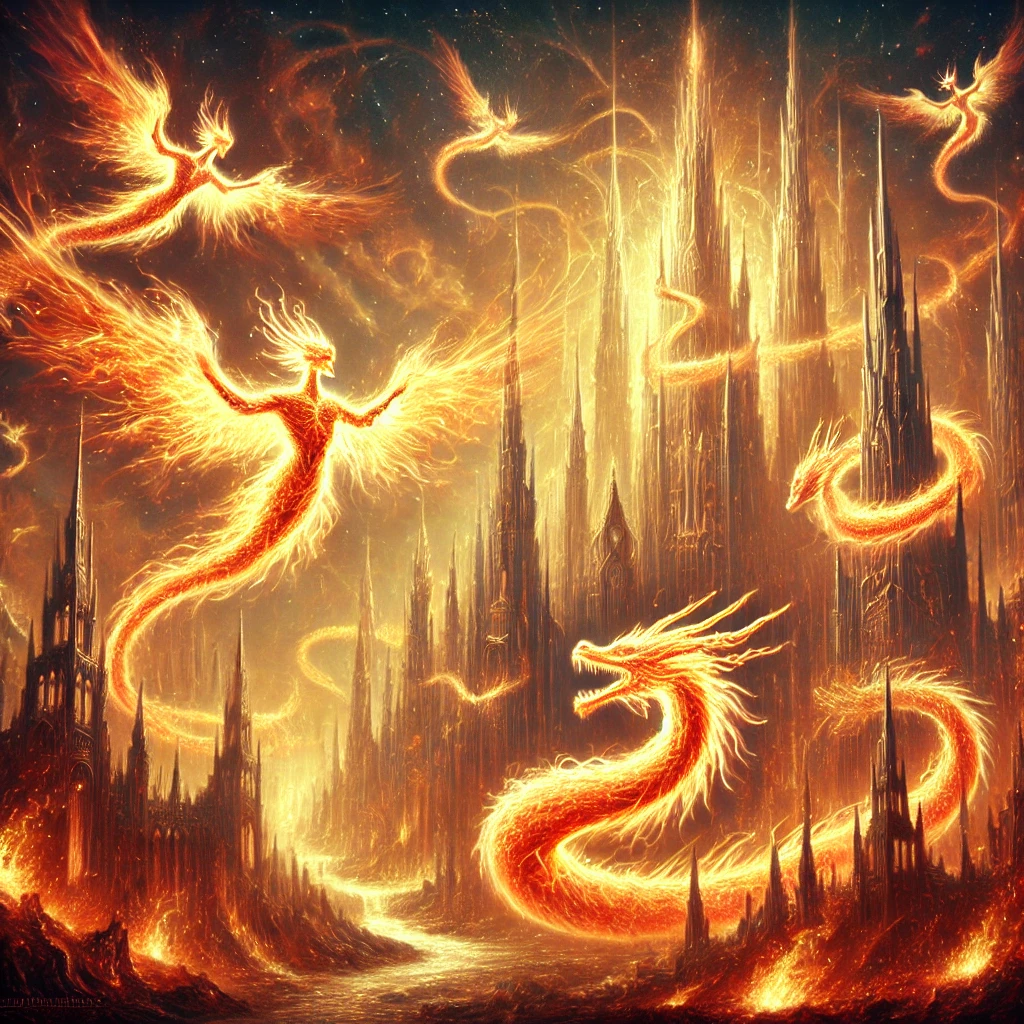
At the same time, although Finias is a city of continuation, it also carries within it an aspect of destruction — though not in its chaotic form, but in the controlled aspect of “fire in the hands of a smith.” At the same time, Finias can be considered a primordial source from which the other elements are born.
In other words, Finias is a balance between chaotic Creation and destructive Incineration. It is “rational fire” that gives power but does not get out of control. One could say that Finias is an “Athanor,” an “Alchemical Furnace,” where the untamed forces of Fire undergo transformation and become useful.
Finias can be viewed as the first manifestation of the primordial fiery energy of Dinur (Hebrew: דִּינוּר, “Fire of judgment”) — a stream of divine light that is the source of the birth of angels and the medium through which souls are purified, and from which the Elemental cities and their corresponding elements arise sequentially.
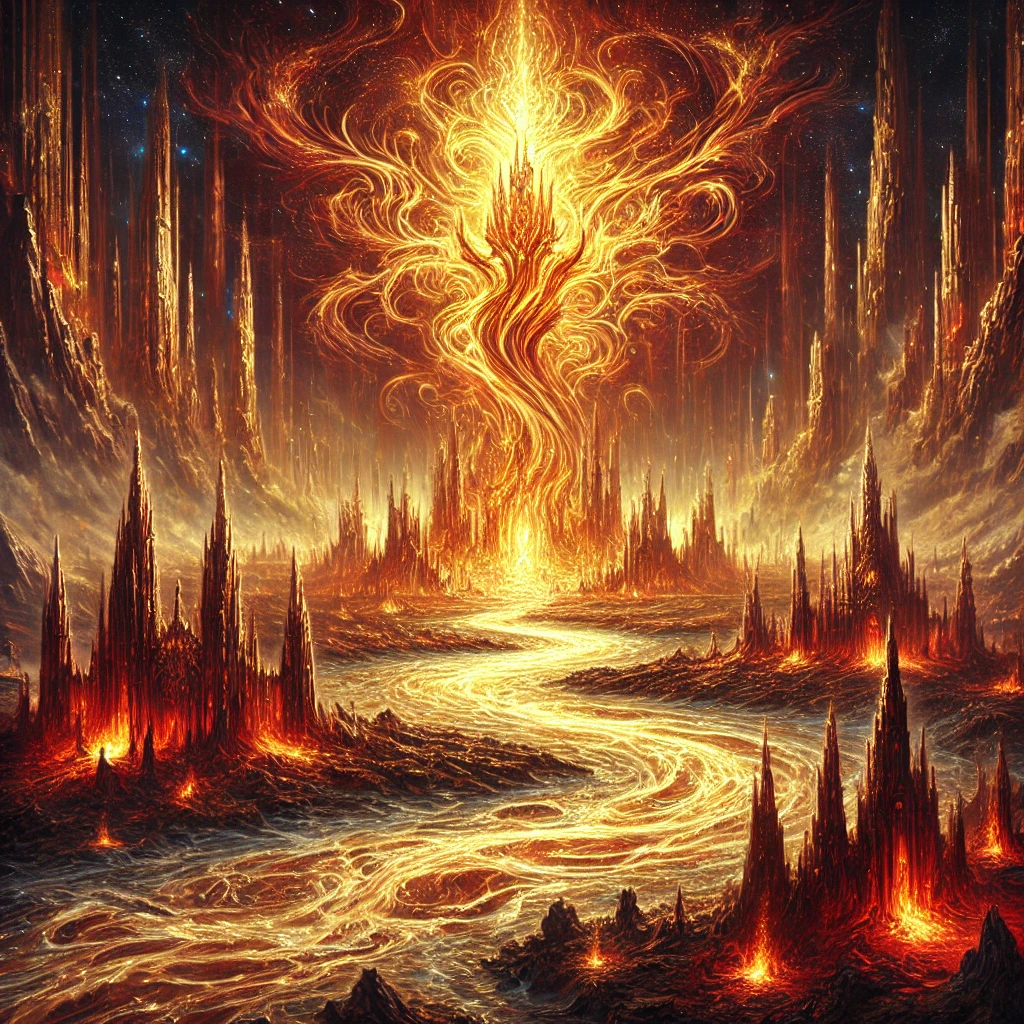
We said that the other elemental cities are associated with fundamental interactions (Falias — the strong, Gorias — the weak, Murias — the gravitational), while Finias generates electromagnetic forces and photons. It is precisely these particles that are carriers of a universal force linking the macrocosm and microcosm. Accordingly, one could say that Finias is the point where Dinur first takes shape as a concrete law of the cosmos: electromagnetic interaction. In other words, Finias is the space where fire first acquires a “form,” becoming something specific, rather than merely energy without structure.
Since Finias forms electromagnetic forces, it must be connected both with Creation and with Destruction. On the one hand, photons are pure energy carrying light and heat; light itself is a symbol of enlightenment, the Logos, creative power. It is also clear that in many ways electromagnetic forces form the basis of life and the structure of matter. But on the other hand, high-energy photons (γ-rays) destroy matter at the subatomic level, and extreme electromagnetic interactions can lead to the destruction of substance and its conversion into pure energy. Accordingly, Finias is the point where pure Fire divides into creative and destructive power, embodying itself in the electromagnetic field.
Thus, fire is the key to understanding the processes of creation, destruction, and the sustaining of the world. And while the principle of fire is the very dynamics of existence, expressed in the constant movement of energy and information, Finias is a manifestation of Fohat, the Primordial Fire in the world of elements — its first stable form, the space where chaotic primordial Fire acquires form, becoming a law governing physical reality.
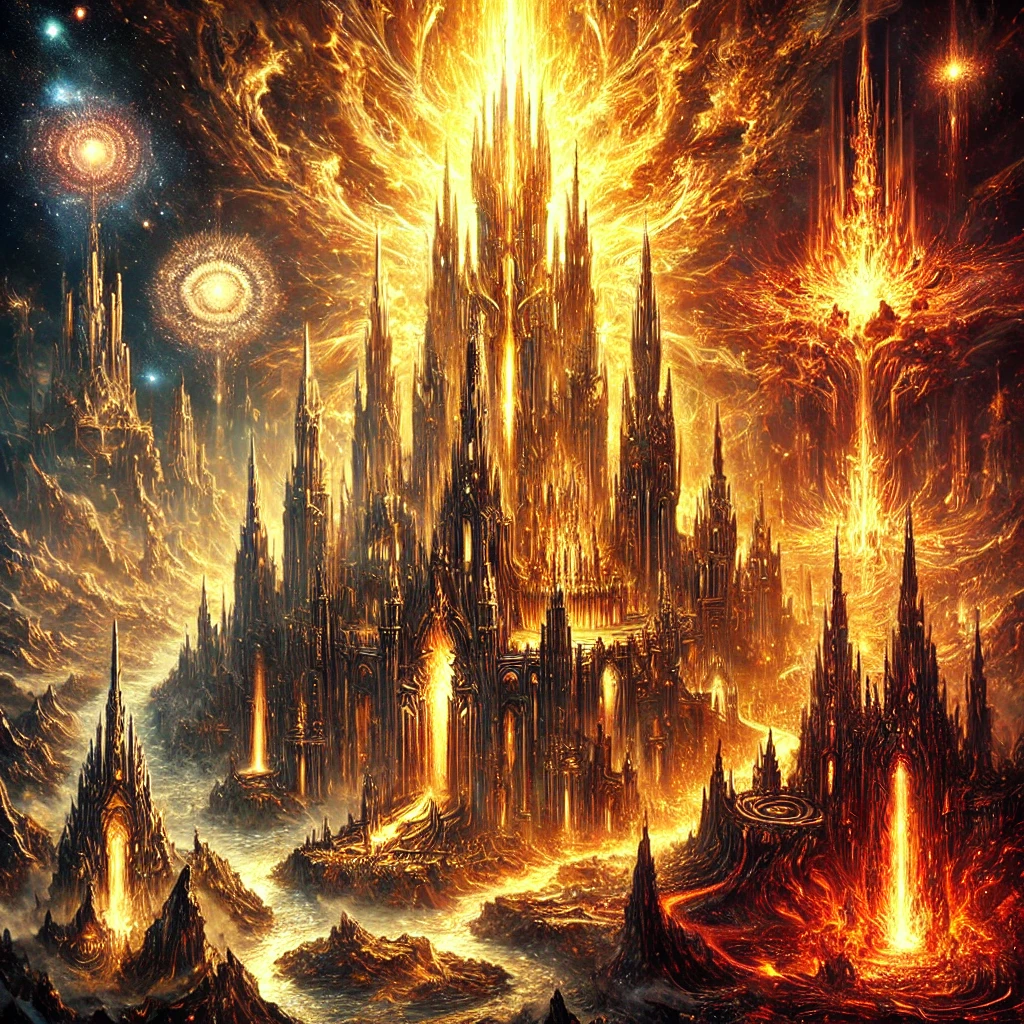
If Finneas is the first stable form of Fohat in the world of elements, the point where chaotic primordial Fire takes shape into the law of the universe, what is the nature of its preceding state? Can Dinur be considered the infinite potential of Fohat, which condenses in Finneas, or does Finneas represent a completed embodiment of one of the aspects of this energy? What analogies can be drawn between the formation of Finneas from Dinur and the alchemical transmutation of fire energy in the processes of the Great Work?
Finneas, as the first stable form of Fohat in the space of elements, can be seen as a transition from infinite potential to manifested reality. Its preceding state is the very River of Fire Dinur, a flow of pure divine energy in which there is no discernment between creation, destruction, and prolongation. Dinur is unstructured Fohat, Shakti, a state of infinite possibility, where fire exists as potential but not as a manifested force. Being the energy of conscious will, Fohat has the property of directing energy to manifestation through its structuring in reality, in space and time. In this sense, Finneas is the first step towards organizing the primordial fire, the point where the formless power of Dinur takes its first ‘tangible’ form, creating a stable electromagnetic field, which becomes the basis for subsequent processes of world formation. This corresponds to the moment when Fohat first enters ‘the shackles of form’, making pure energy manageable. One could say that Finneas is the ‘Forge of Fohat’, in which the energy of the primary fire first goes through transformation, directed by the Highest Will, and then becomes the acting, creative force. This is analogous to the alchemical process in which the raw material – chaotic, unshaped matter – undergoes purification, coagulation, and fixation. In the Great Work, Finneas corresponds to the athanor, the alchemical furnace where elements unite and transmute under the influence of fire. From the perspective of consciousness, Finneas is the center where the first fixation of psychic fire occurs. In classical theosophy, Fohat is the conductor of the will of the Logos, thus Finneas is the place where the will of the creator first receives a stable form. In this sense, it can be said that Finneas is the point of the first fixation of the Law in chaos, its first manifestation in the Interval, a stabilized foundation for further creation. Thus, Dinur is potential Fohat, and Finneas is Fohat that first shapes itself into reality, creating the conditions for structuring the cosmic order.
Greetings! In one of your past articles, you mentioned that the stable forms of the Interim, including the Elemental cities, are formed as a result of the activity of consciousness, and then they ‘stabilize’, and from the text of this article, it seems that this is an automatic process of ‘condensation’ of the Dinur flow. Is there a contradiction here?
Hello! That’s correct, no structure in the Interim arises independently of the consciousness that creates it. In this sense, Myth speaks of elemental beings – carriers of such consciousness. In this case, the birth of the city of Phineas is, from the point of view of consciousness, the crystallization of the consciousness of elemental salamanders from the Dinur flow, which is always considered to be a flow of creative power and creative consciousness: similarly, angels, demons, and other bearers of ‘vortex’ consciousness are born from it.
This is simply an amazing article about the element of Fire. What a gain to read you and acquire such knowledge and wisdom. Thank you, dear En.