
Elements and the Interworld
We have repeatedly discussed an important component of the interspace is the so-called “Elemental cities” or, using Enochian terminology popular in modern times, the “Watchtowers“.
Since the Interworld is a conventional category that unites utterly heterogeneous, multi‑level spaces based on a common principle of perception, one of its “slices” or “domains” is the “Elements” — subspaces that arise from the selective perception of one of the fundamental properties of the world — its activity, applicability, inertia or mobility — while excluding the other qualities from perception.
It is important to understand that, from the standpoint of traditional cosmology, the Primary Elements are precisely properties, qualities of perceived reality, not its “substance”, not its material. Therefore one can speak of a “world of Fire“, a “world of Air“, a “world of Earth” or a “world of Water“, meaning a particular “slice” of reality in which all its structures possess the corresponding quality. In other words, within each Element all material is of one kind, manifests similar qualities, and is entirely devoid of the properties of the “opposing” Element.
The first to coherently describe the corresponding aspects of reality as “subspaces”, “cities” were the ancient Celts, who spoke of the “Great Cities” Falias, Finias, Murias and Gorias, each of which had a ruler, a druid, and a social structure. These accounts were developed by Paracelsus in his Book on Nymphs, Sylphs, Pigmies and Salamanders and on Other Spirits, where he asserted that elementals are an important “part of God’s creation” and proposed studying them as he studied the rest of the natural world. Similar descriptions can be found in the books of the Lemegeton – in “Theurgy of the Goetia” and “Ars Almadel” – and also in the “Diaries” of John Dee. At the same time, in Dee’s original writings there is no evidence that he, Kelley, or the “angels” ascribed the squares of the Great Tablet to the elements, as the Golden Dawn later did.
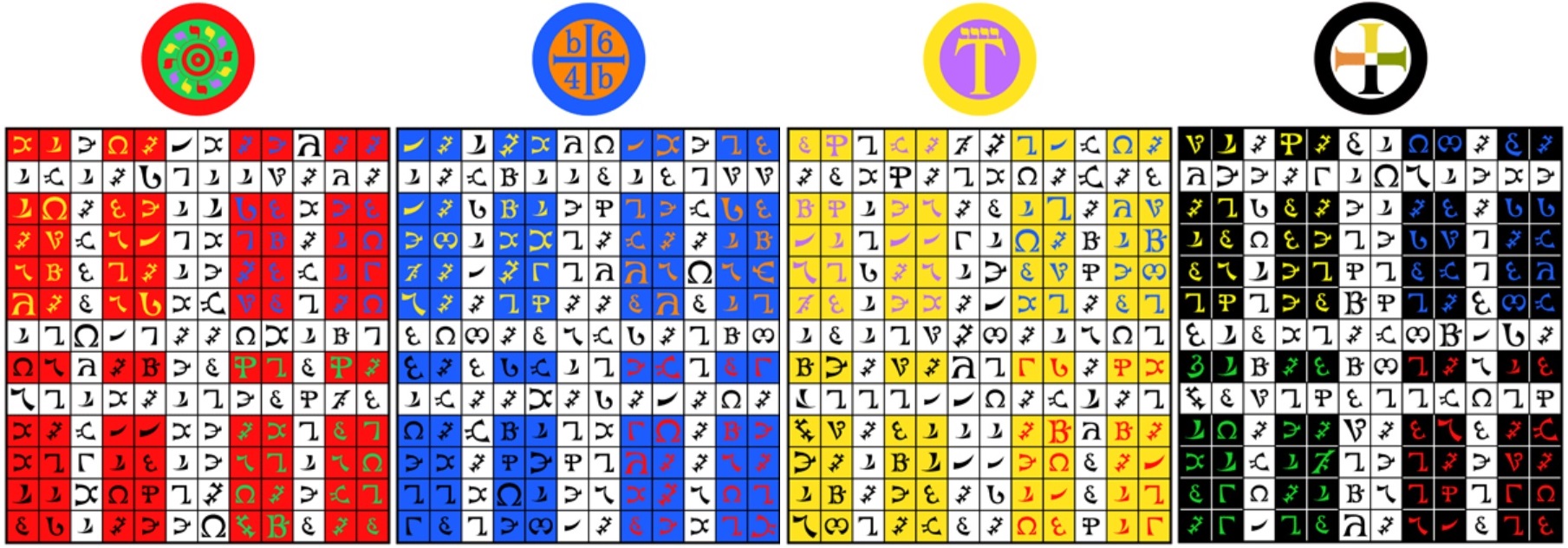
Nevertheless, despite numerous mentions, no coherent picture of the nature, structure and interrelations of the “Elemental cities” has been assembled. One can find numerous chains of astrological, kabbalistic and theosophical correspondences for the “Towers“, yet there is an obvious lack of practical, systematic experience in their investigation.
The available information has largely been obtained from the “semantic universe” of the Enochian tablets, the nature of which, as we have often noted, is similar to a symbolic code that produces different images depending on the mind interpreting it. Another layer of experience with the “Cities” consists of visionary insights and dream immersions into the Interworld, which are also often marred by misinterpretations resulting from individual peculiarities in decoding imagery. Finally, the third and most significant source of information is supplied by trained exteriorizations (the so‑called scrying), carried out by committed magical researchers who not only have experience perceiving the Interworld but have also built authority in Elemental Magic.
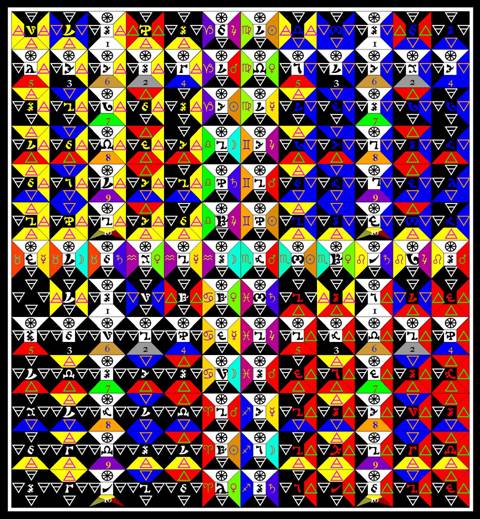
This practice was widely employed in the Golden Dawn, where a common ritual was the “Opening of the Watchtower” — a rite for cleansing space and invoking the Guardians of the four quarters — within which the practitioner uses magical tools representing the elements to call the “angels” of the quarters.
The notions derived from fragments of such experience indicate that the “Cities” or “Towers” have a complex structural organization, and their “population” includes gods, ministering forces (angels and “Gatekeepers”), elementals, as well as fairies and elementers associated with them. The god of each Element is its governing foundation, while the elementals form the body, the material basis; all “external” connections are provided by ministering spirits, above all the “grey” Epiklets.
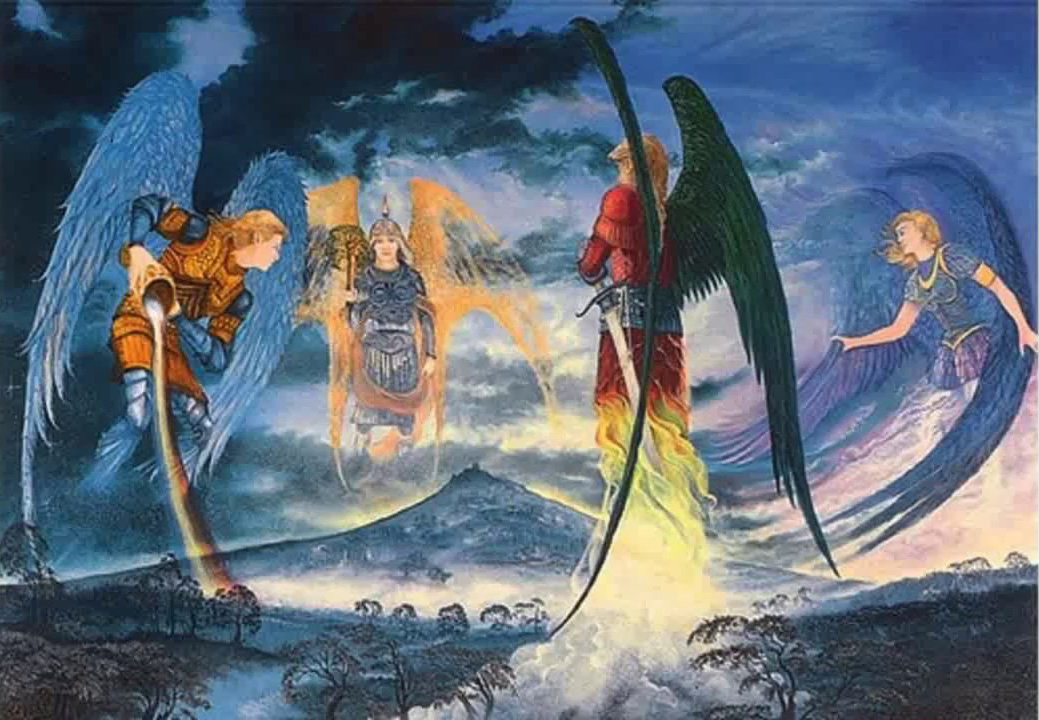
At the same time, since these beings (alongside the Fomorians — hrimthursas, one of the most ancient groups of primeval beings) often appear as ‘Enochian’ spirits, and also as the “princes” and “angels” of the Lemegeton, a significant portion of information about the structure of the “Towers” has been drawn from these, not entirely reliable sources.
The study and systematization of information about the “Watchtowers” is an extraordinarily important and highly “white‑spotted” task of magical cartography of the Interworld — crucial both for a clear understanding of the character and consequences of interactions that occur in visions or dreams, and for the mapping of afterlife routes through the Interworld. Regrettably, since Ancient Egypt there have been virtually no serious attempts at such cartography within the Western tradition.

Can we say that these Elemental cities exist objectively, outside the perception of mages, or do their forms and manifestations change depending on the type of consciousness that interacts with them? If their essence really resembles code that is compiled differently by various operators, does this mean that their true nature remains fundamentally incomprehensible, and we are always only dealing with interpretations?
The existence of Elemental cities, like other structures of the Interim, cannot be reduced to either a completely independent reality or a mere projection of consciousness, as they represent a peculiar stabilized ‘nodes’ of the probability field, acquiring forms related to both the ‘internal’ principles of the primary elements and the consciousnesses interacting with them. In other words, though they are stable points in the Interim, their form is adaptive and the depth of perception depends on the level of development of the operator’s consciousness. They indeed exist outside the perception of mages, but not as unchanging objects, but as ‘structural schemes’ capable of taking different forms depending on the interacting consciousness. The analogy with code, compiled by different operators, is quite accurate. The structure of the Elemental Cities is not a specific object, but an algorithm that manifests in one form or another depending on the way of interaction with it. However, this does not mean that their nature is fundamentally incomprehensible; rather, it indicates that we cannot fix their singular correct description. We are always dealing with interpretations. In other words, there are ‘constant’ aspects of the Cities, but their perception is changeable. This is precisely why their study requires developing not only the skills of scrying but also an understanding of the nature of the primary elements, as they ultimately embody their principles in the space of the Interim.