
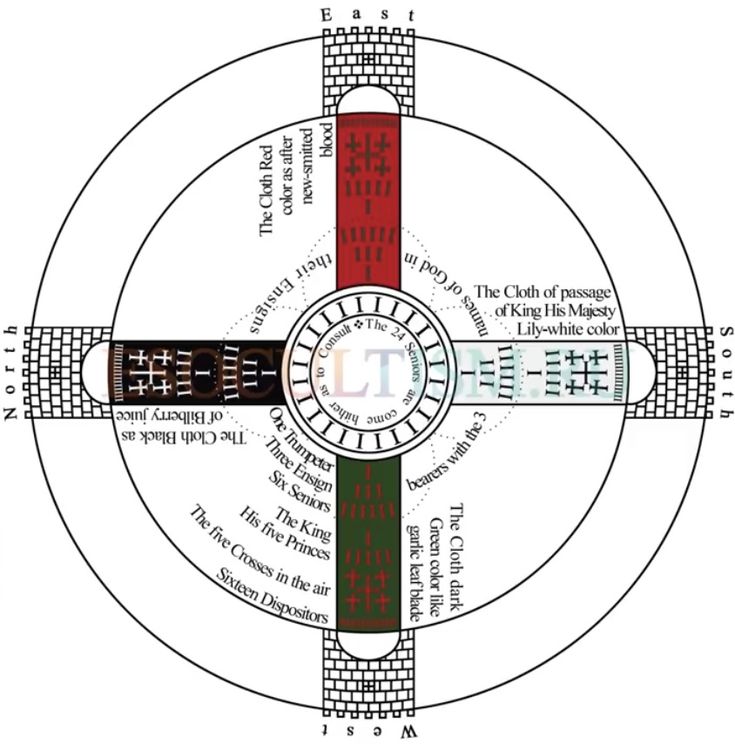
The Watchtowers of the Almadel
“Ars Almadel”, “The Art of the Almadel” — the fourth of the books of the Lemegeton, serving as a key for making contact with the so‑called “Spirits of the Heights” — Epiklets dwelling on the four “corners” of the cosmos.
The book’s name (variants such as “Almandel”, “Almandal”, “Alimandel”, and others occur) is also the name of its central instrument — a special Table of Invocation — and comes from the Arabic “al‑mandal” — “circle“, “disc”.
Unlike the Theurgy of Goetia, the spirits described by the Almadel are “more exalted”, a point underlined by the term “High Chorai” (from Gr. chora — place, region, land), applied to describe their position. Note that in antiquity “chorai” referred to suburban areas, agricultural lands forming the periphery of the city‑polis, and for the context of the Almadel, it is important that the chora was also part of the defensive system of the polis.
Thus, in this case, we are speaking of regions of the interworld which, on the one hand, lie “removed” from the practitioner — that is, from our world — and on the other, occupy a certain liminal, borderland position. This feature links the Epiklets of the Almadel with the Gatekeepers of the Goetia. Although such correspondences are nowhere stated explicitly, there are also obvious analogies between the spirits of the Almadel and the “angels” of the Watchtowers from Dee‑Kelly’s vision.
Moreover, relating the spirits to the “agricultural” connotation of the chora reveals in them certain calendrical functions, in particular a relation to the seasons and seasonal cycles; notably, they are compared to the equinoxes and solstices. Elemental correspondences of the chora are also possible. At the same time, only for the First (Eastern) chora are the “natural” functions connected with growth and development described more or less clearly, whereas for the others it is said that they “may also bring misfortunes and parch.” On the basis of the mention of the “12 parts” of the cardinal points, attempts were made at astrological interpretation of the “chorai”, which, however, proved practically ineffective.
The “exalted” status of the spirits of the Almadel led many commentators to ascribe to them a “more angelic” nature than the goetic Demons, and some even suggested that the Lemegeton should be studied and practised “in reverse order”, from the later books to the earlier, increasing the spirits’ darkness. Experience, however, shows that, as with the Enochian angels, the “light” character of the Almadel’s Epiklets is exaggerated, and their benevolent intentions are greatly overrated.
The Almadel’s technique is very similar to the methods employed by John Dee: a wax pentacle, covered with Names of Power and surrounded by candlesticks, serves as the Altar of Invocation.
The book lists twenty names of spirits (five for each “High chora“) to be called for certain “beneficent” ends. Among these names are ones very similar to the familiar names of planetary Archangels, and they are of both Hebrew and Greek origin. The latter, as in the “Testament of Solomon”, is apparently due to the multilayered nature of the surviving texts (most manuscripts of the Almadel date to the 15th–16th centuries and are evidently compiled from several earlier sources). Many of the Names used on the Almadel “table” itself and in its invocations also occur in the spells contained in Solomon’s Greater Key.
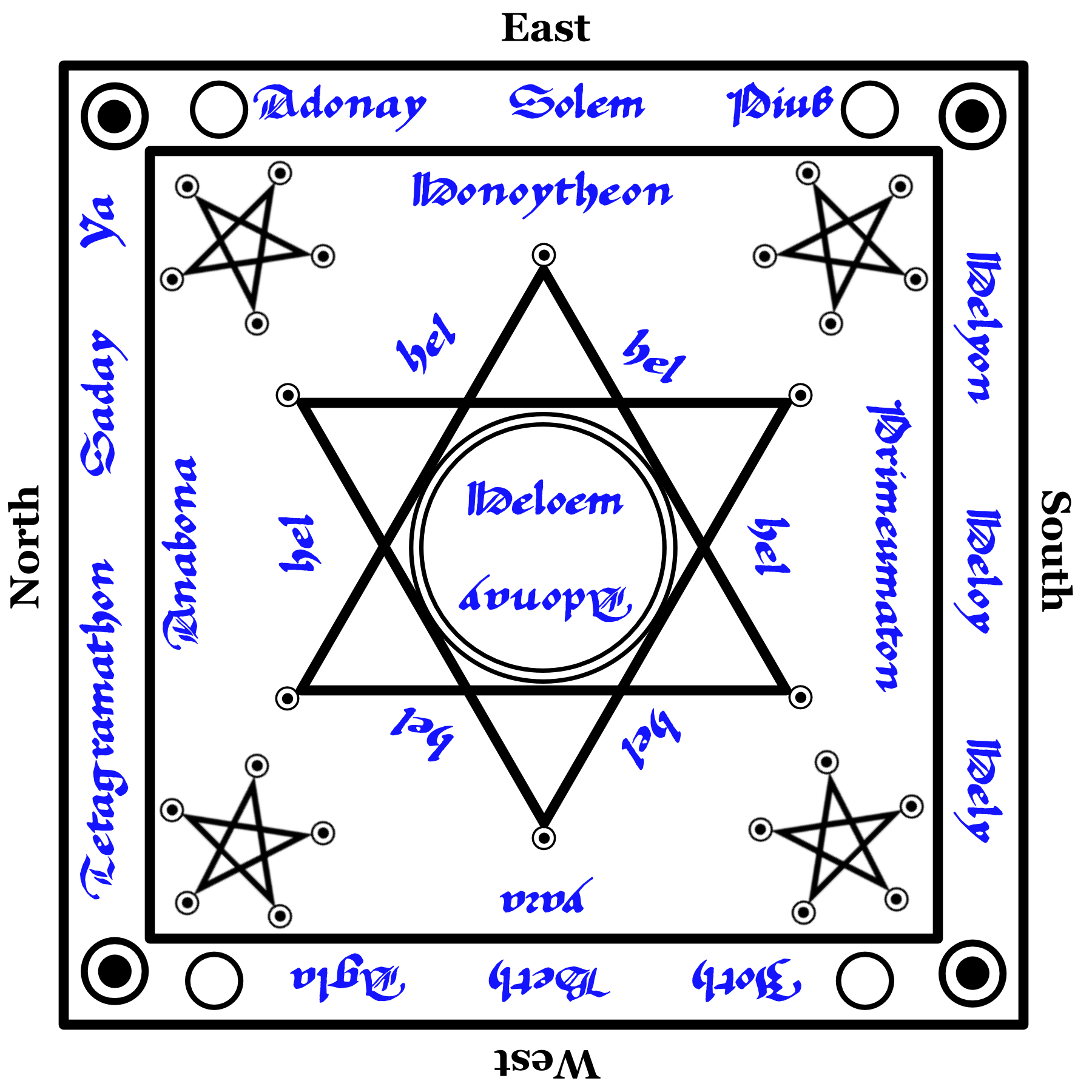
A characteristic name of the Almadel is ‘Pine’, which apparently derives from the Latin Pius, “the Merciful”, and is a translation of the Hebrew רהמן — one of the sacred Tetragrammatons belonging to the world of Assiah. The root ר‑ח‑ם appears in many Hebrew (and Arabic) words and indicates mercy and compassion. Note that on the opposite side of the Almadel table stands the Tetragrammaton יהוה, clearly balancing רהמן. The Almadel’s orientation toward Assiah is further confirmed by the Hexagram that forms its basis.
Thus, the study of the Almadel system complements the Theurgy of Goetia with elemental correspondences for the Subcelestial spirits, and the “angels” of this system may be viewed as transitional Epiklets occupying an intermediate position between “wandering” spirits and Gatekeepers. And although, like other groups of Grey Spirits, these “angels” are not especially friendly to humans, interaction with them can be useful for discovering those areas of mental growth that are rooted in the ministering aspect of natural powers. Like other “spirits of the watchtowers” and the “angels” of the Heptameron, the spirits of the Almadel form part of the elemental component of the Interworld, providing the basis for the manifestation of the energy of the Prime Elements in the manifested worlds. At the same time, if the Heptameron places more emphasis on the planetary aspects of the ministering spirits of the Cities of Elements, the Almadel focuses on the “cardinal” entities that connect those cities with the Horizon. Constituting part of the vast population of the interworld, the spirits mentioned in the “Ars Almadel”, and those like them, should become the subject of study and classification in the Geography of the Interworld.
Leave a Reply