
The Testament of Solomon and the Gates of the Horizon
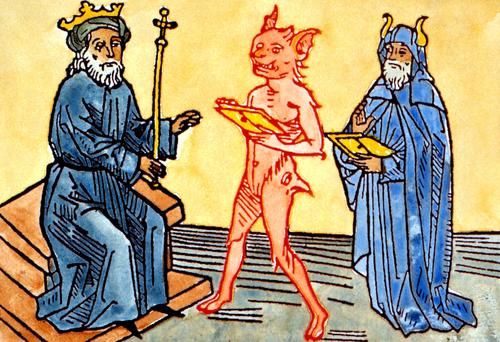
Despite its obvious Judaic, biblical context, the grimoire literature of the Solomonic cycle is largely rooted in the Hellenistic Gnostic Tradition. It was in this milieu that the first known work of this system arose — the The Testament of Solomon. The oldest manuscripts of this work date to the late first century CE and are written in Greek. Although scholars lack a unified view on the origin, authorship, and cultural substrate of the Testament, it clearly belongs to a wider body of literature that has come down to us in the form of Solomon’s “Keys” and “Clavicula”.
Ideologically, the Testament demonstrates a fusion of the Egyptian, celestial Magical tradition with Kabbalistic and Mesopotamian demonolatry-based approaches. This ideology is clearly visible both in the Lemegeton and in the lesser works of the cycle.
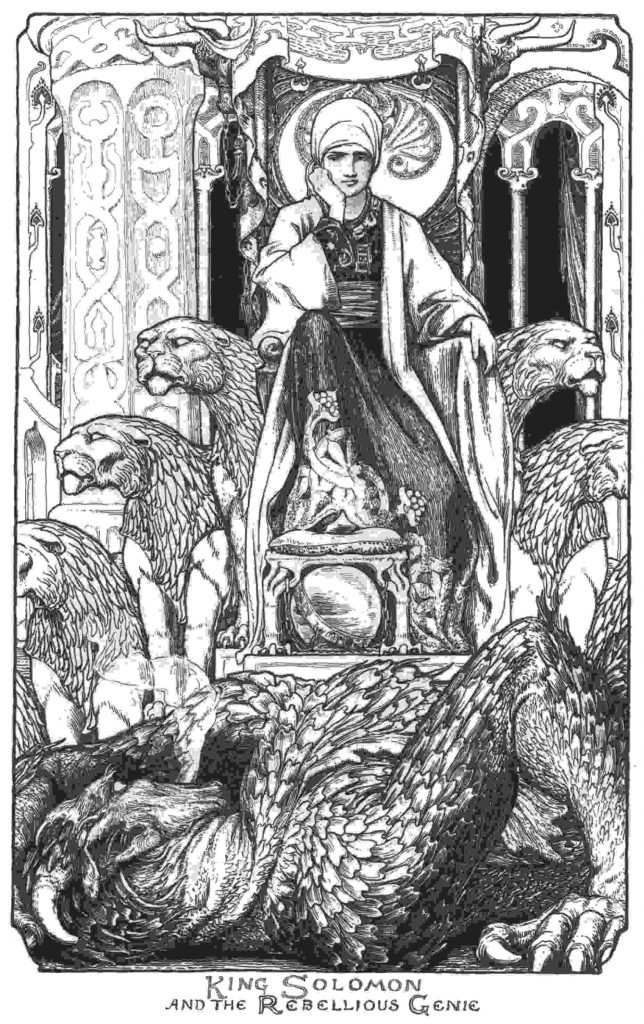
Rethinking zodiacal and planetary influences and discerning connections between particular “stellar” combinations and the activation of certain “infernal” manifestations are among the consequences of this fusion.
The Testament marks the start of the process by which European magi developed the teaching of the Gates of the Horizon, and the study of those Gates and their Gatekeepers.
Structurally, the Testament is a collection of Solomon’s conversations with demons under his command, in which those demons reveal their characteristics and (importantly) describe the angelic forces that bind them and the ritual approaches for doing so.
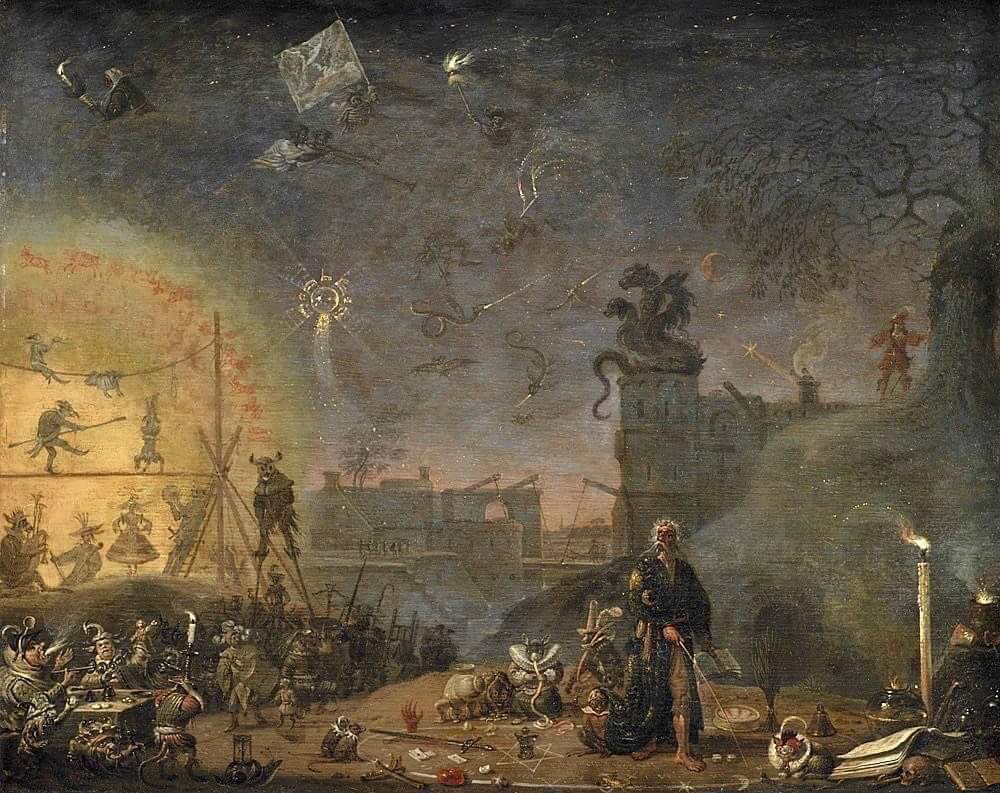
Although the initiatory impulse for this act of evocation is attributed to Archangel Michael, who gave Solomon the famous ring capable of binding demons (and in fact functioning as the Great Seal), the very method of interrogation described in the Testament underlies the modus operandi of later ritual procedures. Modern demonology usually skirts the possibility of such direct questioning, preferring astrological calculations or psychological explanations. Yet for traditional Magic the act of evocation has been and remains the criterion of success for both the Magus’s development and his resistance to demonic influences.
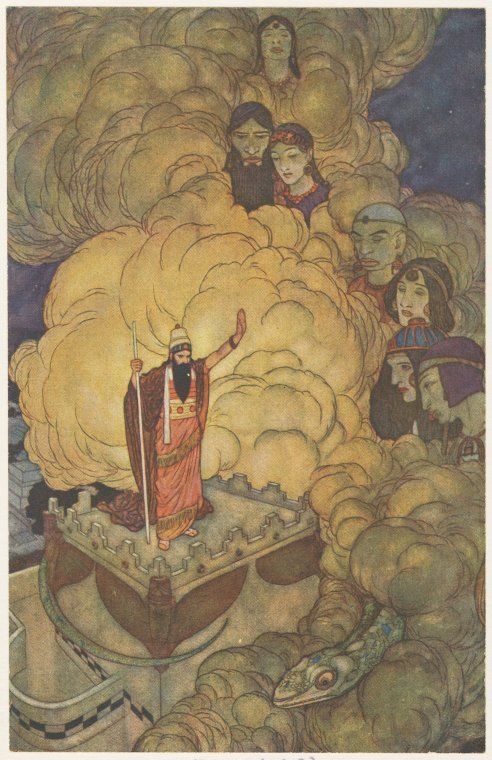
Among the demons mentioned in the Testament, we will discuss only a few.
The “initial” link in the evocative chain proved to be the demon Ornias (Όρνίας), whom Solomon sealed first and who then helped bind the “prince” Beelzebul (Βεελξεβούλ). The name Όρνίας means ‘Irritating,’ and, like many names in the Goetia and other demonographies, is an epithet describing the demon’s situational manifestation. Considering the demon’s connection with the sign Aquarius, his opposition to Uriel, the angel of Netzach and Venus (and also of the north), and taking into account his markedly sexual (including homosexual) activity and androgynous nature, Ornias can be identified with Belial. One of Belial’s epithets — Seveb (“Turncoat”, סבב) — also has the meaning “to surround,” which parallels the meaning of the word Όρνίας.
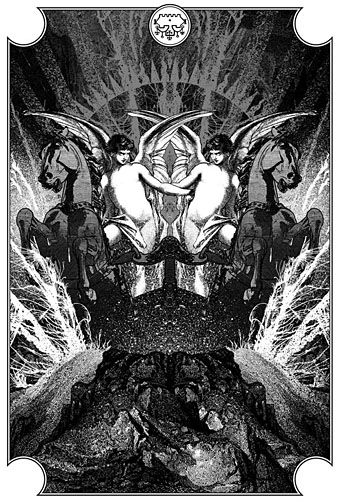
The presentation of archdemons under masked epithets is generally characteristic of grimoire literature: the True Grimoire likewise operates with Lucifer appearing under the epithet “Clauneck” (Clauneck, “Stooped”).
Understanding Belial’s role as the initiator of events in the Solomonic cycle allows one to chart a path for effectively resisting destructive forces: by redirecting the socializing forces into a productive channel and overcoming the soul-dispersing “external unity,” it becomes possible to create a new kind of association — the magical families and covens — which thus fulfill the “Covenant of Solomon.”
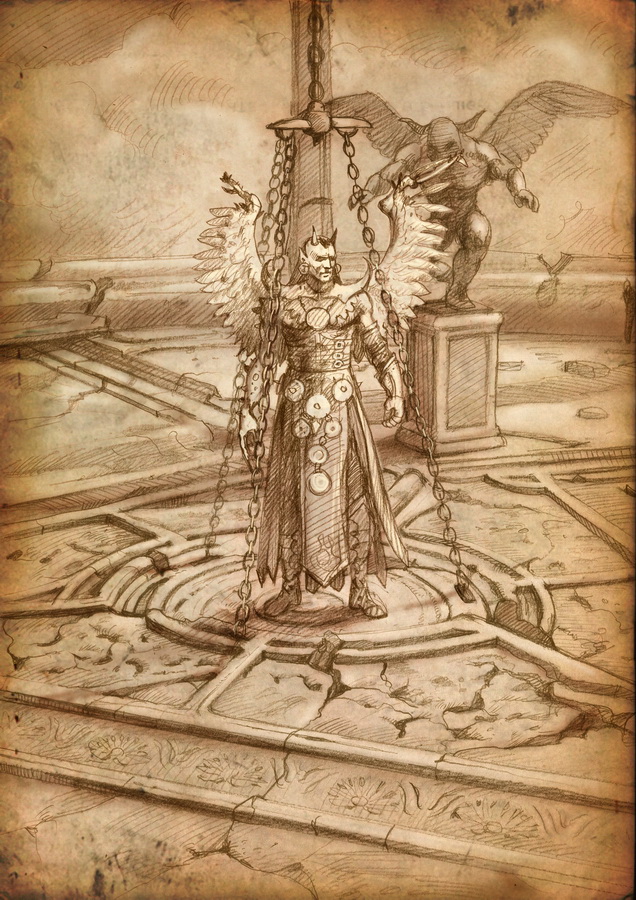
Important groups of demons described in the Testament are the “Seven Demonesses,” who embody the “evil” planetary aspects (and also the Pleiades), and the thirty-six spirits of the zodiacal decans.
This latter group was later described in detail in the “Keys,” and the ideology behind its treatment formed the basis for the classification of demons in the Lemegeton.
The Testament of Solomon, combining astrological notions with the study of destructive forces in the macro- and microcosm, creates a distinct doctrine later developed by grimoire traditions — Goetic astrology. Although the idea of “evil planets” and negative influences of stars and constellations is ancient, the Solomonic cycle introduces a psychocosmic element into the concept, brought to its fullest expression in the Lemegeton. Departing from classical astrological views, Solomonics treats zodiacal allusions primarily as descriptions of the Earth’s place in the macrocosm and of man’s place in society, and attempts to account for that disposition when mapping the forces active at a given time in both the macro- and psychocosm. In other words, when, for example, Bael is assigned to the “spirits of Aries,” the Testament means that the forces of this demon distort the creative, procreative energy characteristic of the period of the constellation’s influence, and that Bael’s qualities resemble the energies of Aries.
Accordingly, the thirty-six decanal demons mentioned in the Testament embody certain features of each of the Gates of the Horizon. Since these spirits, the “world rulers of darkness,” express the essence of the Gates themselves, they are not Gatekeepers, and therefore, as they themselves say, they cannot be “captured or compelled,” but they can be studied for traits that help map ways to resist the Gatekeepers. Analysis of their names and self-descriptions can be an invaluable aid to the Magus striving for control over his mind.
In various versions of the Testament of Solomon the lists of “rulers” differ, but two variants exist — an “Egyptian” and a “Greek” — of which the former is likely original and the latter an attempt at translation and adaptation.
On the whole, the Testament of Solomon is not only a source of prime historical importance that allows one to trace the roots of many goetic ideas and approaches, but it is also a practical grimoire; ritual work with it can open numerous possibilities for self-study, self-improvement, and self-transformation.

Leave a Reply