Subcelestial spirits
In our discussions of Ceremonial Magic we have already mentioned the “Grey” Spirits with which the evoker most often interacts, although the bulk of magical literature insists on a black-and-white division into “Angels” and “Demons.” This binary division is especially popular with many adherents of the Enochian system, who repeat after their “angels” that all other approaches are “from the fallen spirits.”
Meanwhile, many magical and religious texts (for example, the very Books of Enoch) contain mentions or even direct indications that certain spirits did not take part in the confrontation between God and Satan and “remained neutral.” Such an indication accords perfectly with magical experience, according to which the majority of “demons” that can be evoked do not come from “hell” but from the subcelestial.
Let us reconsider this question.
The process of creation, that is, the creation of a dense medium in which potential reality can be actualized effectively, consists in the division of the unity of the Great Spirit into the knower and the known aspects. The extreme degree of differentiation of the known aspect is a set of energies which, crystallizing, forms what is commonly called “matter.” It is clear that, having originated from the primordial Unity and being drawn from It, matter is in an unstable state and strives to return to the bosom of the Absolute.
To keep it in the created differentiated state, a powerful centrifugal current arises — Dinur — whose constituent elements include “materializing” spirits — Angels.
At the same time, the impulse of the “lower” worlds to flow back into the “upper” ones generates an opposing stream — the dematerializing powers of Demons.
Lacking a source of Power in the form of the deity’s direct Light, these spirits must make do with “reflected” Light, taking it from the inhabitants of the “lower” worlds — that is, preying on them.
Moreover, the primary impulse to division, that is to Creation, produces its own imprint: a “pure” division, unbalanced and unformed — the abyss of the Qliphoth.
Thus, among ministering spirits one can distinguish:
- materializing forces (Angels),
- binary dematerializing forces corresponding to them (the Demons themselves, or “fallen Angels”),
- the “echo” of creation — the Qliphoth (also called Demons).
Within each group one can also identify several important subdivisions.
As for the second group, it is essential for the Magus to distinguish within it the spirits of the “upper threshold” — those dwelling where Spirit and matter touch (“at the threshold of the Heavens”) — the “subcelestial” spirits, that is, those inhabiting the ascending flow, and the “subterranean,” or spirits of the “lower threshold” (that is, those expressing the very primary resistance of matter to its differentiation). It is obvious that the first subdivision is closest to the “heavenly powers” and the Primeval Fire, while the third is closest to the spirits of the Qliphoth.
A special group of “threshold spirits” is formed by the so-called Gatekeepers, or “goetic demons” — Grey by their nature — forces called to ensure the exchange of powers across the Threshold, but in practice provoking an outflow of energy from the sefirot into Qliphothic spaces.
In the same way, among the Angelic hierarchies three groups are distinguished (themselves subdividing into “nine orders”) depending on their degree of remoteness from the Primary Source.
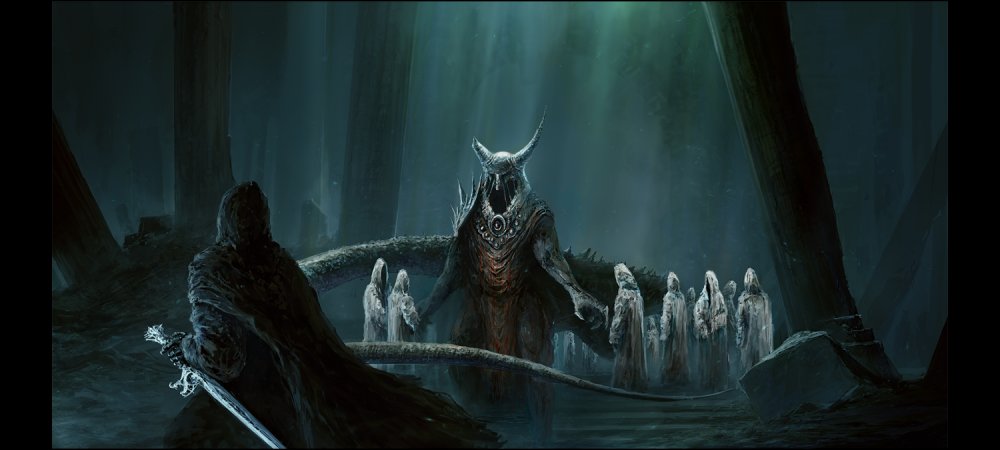
The overwhelming majority of spirits with which magi of all ages interacted were, of course, “demons,” yet not Qliphothic, but spirits of the Ascending flow. Tradition calls such spirits “Forces” (Potestates) or “Rulers” (Epiklets), who are closely connected with the “ministering” and with the “free” (or, more precisely, Archontic) hierarchies.
Be that as it may, it was some spirits of the “upper threshold” that, apparently, appeared to John Dee and Edward Kelley as angels (it should be noted that most “Enochian angels” were, in all likelihood, neither angels nor demons but belonged to an entirely different category of beings), while the spirits of the “lower threshold” were sealed by Solomon in a copper vessel. The “subcelestial” spirits are the focus of the Heptameron system and related currents.
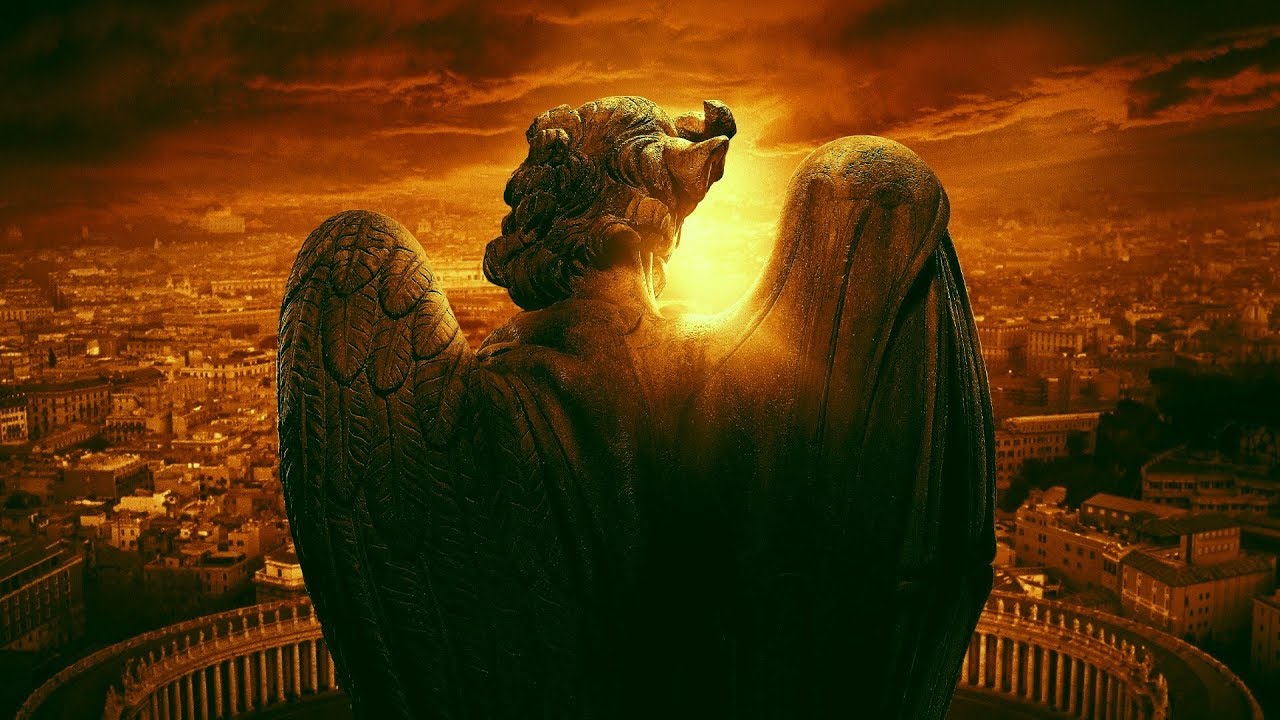
But to interact with Angels one must overcome the resistance of the upper threshold, which can be extremely dangerous, just as overcoming the lower threshold in the reckless attempt to reach the Qliphoth can be.
Thus, whatever the megalomania of magicians and their evoked spirits may claim, the sphere of ceremonial interaction is usually limited to spirits of the Ascending flow — spirits that, of course, possess cosmic scope and authority, but are incapable of carrying a person up to the heavens or guiding them through the hells; they allow only limited contact, depending on the operator’s power, authority, and prudence.
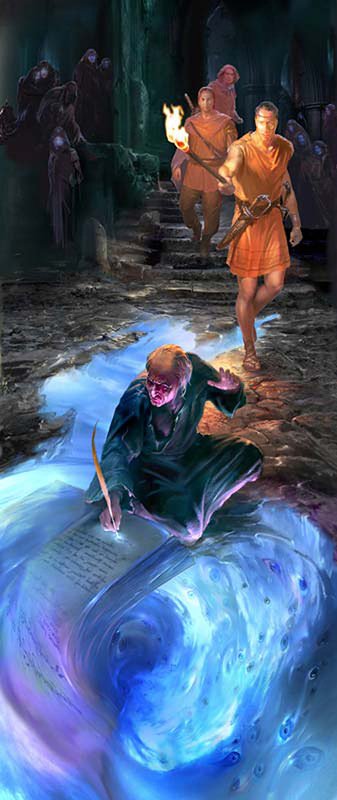
“And what justified goal could prompt one to overcome the ‘lower limit’ in the madness striving to reach the klippot?”
In my opinion, none. However, the human desire for self-aggrandizement often drives them to the most insane and absurd actions.
I apologize for yet another naive question. I know about the tetragrammaton law of the evolution of human consciousness. What law does interworld development follow? Is there such a law? Are the demonic-angelic currents cyclical? Do they have focal points?
Isn’t human consciousness the progenitor of other consciousnesses? I mean the consciousnesses of spirits as well. What are their origins?
I will allow a naive assumption. Interworld development follows the laws that a person in the interworld adheres to. A person is the main focal point in most of Earth’s worlds. The demonic-angelic currents, referring back to the legend of the Guardians of the Seals, are more vector-based in the present. And their focal points are people, the earth, homes, etc. I believe that human consciousness is at least a carrier of other consciousnesses, and surely if it can be a carrier, it can also be the progenitor of other consciousnesses, but only within the framework of Earth.
Thank you, Palom. I certainly mixed up a lot, as always. For example, I attributed the properties of the tetragrammaton to the quaternary. But that’s how it is… Sometimes my thoughts just rush and there’s no time to recall terms)).
Very interesting post. Highlighting for myself, I understood that “The Edge of Heaven” is the place of maximum tension of Powers. The Angelic Power has its classification (choirs) depending on the tension. Can I denote Tiferet at this point (point of contact) on the Tree of Sefirot?
We need to denote Tiferet at this point (point of contact) on the Tree of Sefirot. Only the tension of Powers can emit Light outward, necessary for inner perfection. Maximum tension of Powers allows the Light of Tiferet to penetrate through the Screen (Masach), i.e., to comprehend the “Edges of Heaven” beautifully :).
Allow me to assume. If by analogy, one side of a person’s body is under the influence of a “demonic” force, the other under an “angelic” one. The upper sphere contributes to materialization, the lower to the outflow of powers. If we consider that the Worlds are within us and we ourselves contribute to unlocking ourselves (them), then the Magician activates this power within themselves… for interaction. But which side has which power? If we consider that the “angelic” whirl is evolutionary (right-sided), and demonic is involutionary, then for myself, the left side (according to reflection in the mirror) is a descending flow. If I’m wrong in my judgment, please correct me.
Not always the desire to cross the lower threshold is a result of being overwhelmed by madness. If we don’t take into account various unhealthy schools like “The Red Dragon” of Thomas Carlsson, there are movements where the desire to cross the lower threshold has quite a constructive basis. For instance, the school of Isaac Luria includes the practice of penetrating the Klippot with the aim of “gathering the scattered sparks of Divine Light, to then return them to the Creator.”
Enmerkar, it turns out from your point of view that Enochian spirits are not angels in the same sense as Michael or Gabriel, but they are also not demons in the same sense as Asmodeus or Belial? Here, however, it seems to me that not everything is so simple. Indeed, the concept of angel is an elastic one (Crowley casually suggested calling any inhabitants of the Subtle World angels, from elementals to Gods). If one adheres to more specific classifications, then as I understand it, if we impose your concept of the upper limit on the Tree of Life, it seems that the upper limit is the boundary between the World of Yetzirah and the World of Briah. But, as I understand it, the World of Briah is the “place” of habitation for Archangels (a somewhat different level). The sphere of habitation and action of Angels (Choirs of Angels) is precisely the World of Yetzirah. And in this case, it turns out that direct contact with Angels is still possible (whether it is possible for an average practitioner is another question). In Enochian magic, by the way, there is a notion of Cherubs (or “Sphinxes”). But Cherubim are one of the ranks of angels, corresponding to Yesod.
And what place do Olympic Spirits (Oech, Hagit, Ofiel, Ful, Aratron, Betor, Faleg) occupy from your point of view? As I understand it, they are close to the Upper Limit. And what place do Sorat, Taftaratat, Bartzabel, etc. occupy? To which limits are they closer?
Olympic spirits, according to the “Arbatal’s” own words, dwell “in the heavenly dome”, that is – on, or rather in the Upper Limit itself, and they were already mentioned earlier: https://en.enmerkar.com/magic/magiya-arbatelya. As for Border Spirits, they are, accordingly, located on the “lower” side of the Upper Limit, which we have also mentioned: https://en.enmerkar.com/myth/vtorichnye-prichinnosti.
Hello. A long time ago, I visited a real, seemingly empty world in the middle of space, judging by its energy. I saw a monolith dedicated to the first Olympic Games, with inscriptions resembling the Greek language. How are the Olympic Games, spirits, and gods connected in your mythology?
Hello.
The Gods of Olympus is a general name for the Heavenly gods in Greek mythology (just as, for example, the Gods of Asgard for the Scandinavians or the Gods of Iriy for the Slavs). The term “Olympian spirits” was used by “Arbatel” and Agrippa, who published it, in relation to “planetary” archontic beings. I think this term was simply adopted to emphasize the celestial nature of these beings.