Archangels — Guardians of the Tree of Life
In fact, all mythological systems originating from the Sumerian-Babylonian source have always shown a marked interest in ministering spirits rather than free spirits.
This is understandable — living historically in regions rich in opportunities for contact with demonic vortices, these peoples naturally sought a way to counterbalance them.
That way was found in the Angelic hierarchies.
Traditionally, post‑Sumerian mythologies focused on those hosts of ministering spirits that, by materializing our world and making it denser, make it less accessible to demonic vortices. It is these spirits that received the name “Angels.”
It is well known that the very word “Angel” means “messenger.”
This function is expressed in the performance by these spirits of a “secondary” creative act, which in monotheistic religions is attributed to God the Creator.
Thus, from the standpoint of traditional religion, Angels are messengers who carry out “in particular” what God accomplishes in the whole.
Christianity, having departed from the Judaic tradition, ascribes to angels a certain freedom of choice, which, obviously, contradicts their ministering nature.
As mentioned, the principal task of all angelic hierarchies is the materialization of Malchut — the “egoistic” Sefira that embodies the Principle of attraction in its fullness. Accordingly, by bringing this Sefira out of the sphere of action of dual-planar beings, the Angels protect it.
Therefore it is clear that Angels are involutionary, descending vortices, yet direct — that is, they give their object the ability to resist the outflow of power.
Among the numerous hierarchies of ministering spirits, there has traditionally been a focus on the Order of Archangels — Bnei Elohim or Malakhim, according to the sephirotic division.
The names of some (in the early Christian tradition — seven) Archangels are well known: Michael, Gabriel, Raphael, Uriel, Jehudiel, Selaphiel, Barachiel.
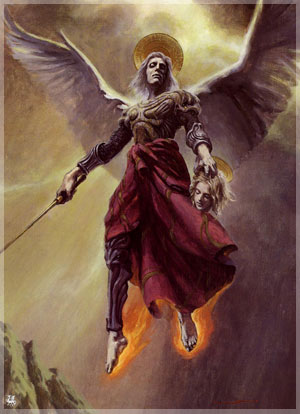
The first four Angels are considered “biblical,” that is, their names are explicitly given in Scripture, while the last three are known from ecclesiastical tradition tracing back to Judaic proto‑kabbalistic teachings.
The Christian doctrine of the “angelic orders” goes back to the writings attributed to Dionysius the Areopagite (more precisely, to an author writing under that disciple’s pseudonym) and to the gnostic tradition.
He was the first to enumerate seven names of Archangels: Michael, Gabriel, Raphael, Uriel, Chamuel, Jophiel, Zadkiel.
The Orthodox tradition mentions eight Archangels: Michael, Gabriel, Raphael, Uriel, Selaphiel, Jehudiel, Barachiel, Jeremiel, while the Catholic list (by a papal bull) is seven: Michael, Gabriel, Raphael, Uriel, Selaphiel, Jehudiel, Barachiel.
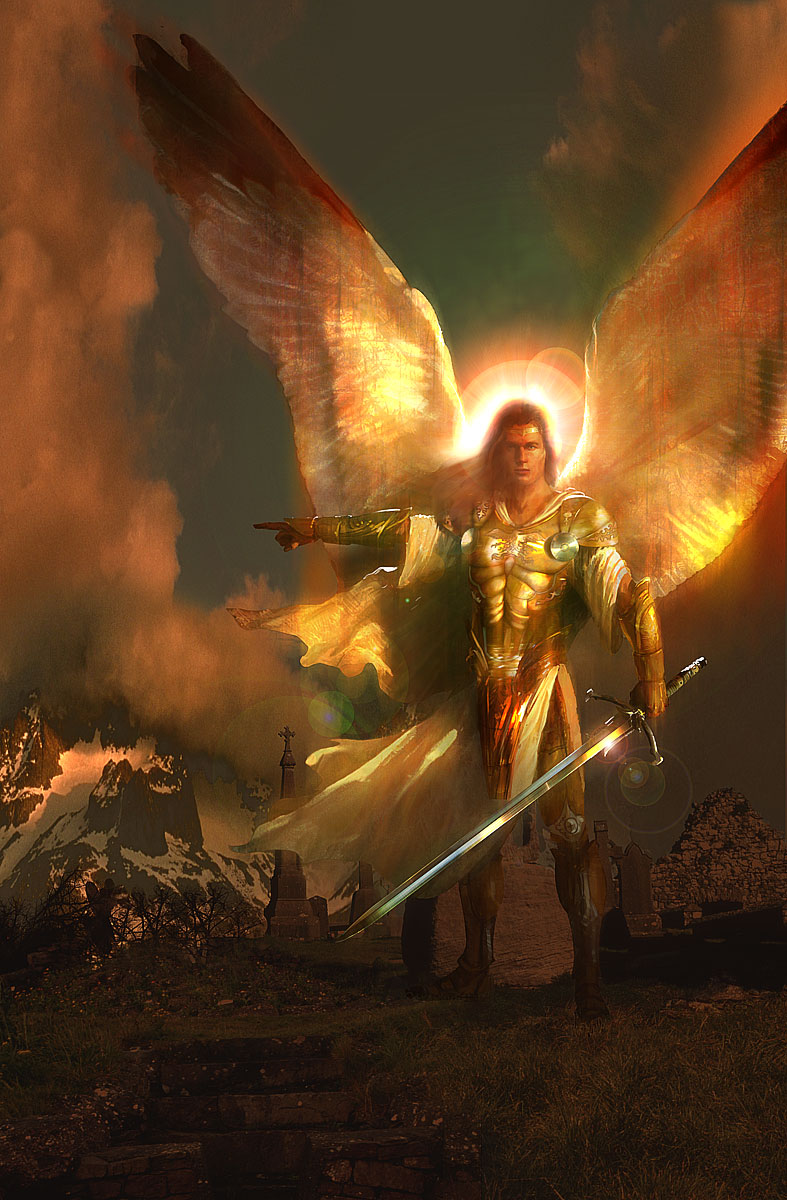
Since Archangels as a whole belong to the Sefira Tiferet, it is not surprising that among them the “chief” is considered to be the very Spirit of that Sefira — Michael.
“Mi‑ka‑el” (Heb. מיכאל) literally means the interrogative “Who is like God?” in the sense “no one is equal to God.”
But the variant “Who is like El” is also admissible. “El,” traditionally translated in Russian as “God,” is not unambiguous in its original meanings and has undergone many historical changes. Thus the expression “Archangel Michael” is sometimes rendered as: “The senior messenger endowed with the authority of El,” or “the senior authorized envoy of El.” In the context of the Old Testament Michael is the chief messenger of the Most High and the defender of the people of Israel.
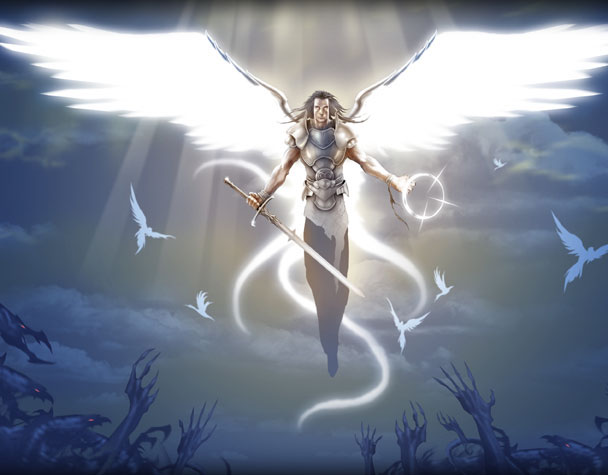
Archangel Michael — archistrategos (Greek αρχιστρατηγός, “commander‑in‑chief”) — is the leader of the host of Angels who stand as guardians of the world. In Christianity it is usually held that the armed cherub at the gates of paradise was Archangel Michael. This episode is included in his hagiographic depictions in Orthodox icons. On several icons the halo of Archangel Michael is formed of foliate decoration, symbolically indicating that he is the heavenly guardian standing at the gates of paradise. Medieval compendia likewise bear witness to this.
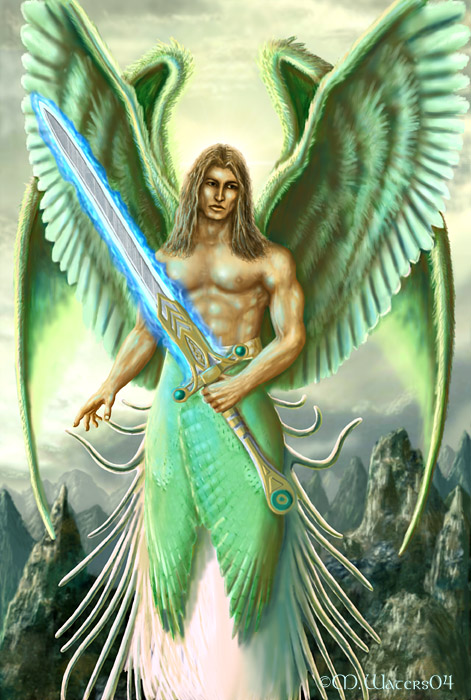
It is also believed that Michael assisted four other great angels — Gabriel, Uriel, Raphael and Metatron — in burying Moses, and that he contended with Satan over the possession of the body. Occultists often equated Michael with the Holy Spirit, the Logos, God and Metatron, and in the book of Baruch III it is said that Michael “holds the keys of the kingdom of heaven.”
Belief in Michael’s constant advocacy for the Jewish people was so strong that, despite Talmudic prohibitions against addressing angels as intermediaries between the Most High and humans, Michael occupied a recognized place in liturgy as a sanegor (defender). This also explains the following injunction: if a person is in need, he should pray directly to God, not to the angels.
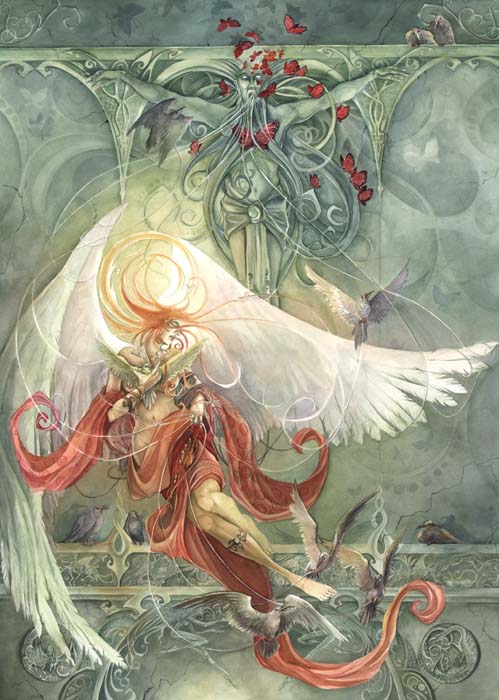
The binary counterpart to Michael is Gabriel (the name means “God is my strength” or sometimes “Man of God”). Gabriel, described as a being with 140 pairs of wings, is the steward of Eden and ruler of the cherubim. He is also the angel of the Annunciation and the Resurrection, an angel of mercy, vengeance, death and revelation. Gabriel is regarded as the chief messenger of God to humanity and is most often depicted in that role, usually shown together with the person to whom a given message is addressed. Gabriel was typically portrayed as a majestic figure in rich vestments, sometimes crowned and holding a scepter. According to Christian tradition, Gabriel reveals God’s secret knowledge and announces to the Virgin Mary the glad tidings of the Birth of Jesus Christ (the Annunciation).
In early depictions Gabriel’s right hand is usually extended in greeting while the Virgin Mary sits impassively. However, beginning around the 14th century, the roles seem to reverse: Mary comes to the fore as if she has already become the Queen of Angels, and Gabriel appears merely one of her attendants. In these later canvases Gabriel carries a lily, symbolizing the purity of the Virgin, or a scroll on which the opening words “Ave Maria” are written in Latin.
There is a common notion that because Michael corresponds to the Principle of the Sun and Gabriel to the Moon, the latter Angel is of feminine gender. It is said that Gabriel sits at the left hand of God, whose dwelling is considered the seventh (and sometimes the tenth) heaven. Gabriel’s feminine essence is also confirmed by a known Christian story in which she took a constantly protesting soul from paradise and instructed it for nine months while it remained in the mother’s womb.
 Gabriel is one of the four angels standing at the four sides of God’s throne and performing the duties of guardians at the four ends of the world. These four archangels (Gabriel, Michael, Uriel and Raphael; in the Russian tradition Gabriel, Michael, Uriel and Raphael), who are still invoked in the prayer said upon going to sleep, are frequently mentioned together. These four names were engraved on a single gold tablet found in the tomb of the wife of Emperor Honorius — without doubt a borrowing from the Jewish tradition. On one gnostic gem there is a Greek inscription: “Michael — the highest, Gabriel — mightier,” which attests to an early adoption of Jewish foundations of angelology.
In addition to the duties already ascribed to Gabriel, he also often acts as an instrument of the Most High. Thus, after visiting Abraham with two other angels he departs to destroy Sodom and rescue Lot.
According to Muslim tradition, it was Jibril (Gabriel) who revealed and conveyed to Muhammad the contents of the Qur’an. He is often presented as the intermediary between Allah and the Prophet.
In fact, the position occupied by Michael among the Jews is taken by Jibril among Muslims. Jibril pronounced before the Prophet the command of Allah: “Read!” Because of this he is revered by Muslims as the “guardian of heavenly treasures (Revelation).” He is one of the angels who directly commune with Allah (al‑Mukkārabīn). Together with three other angels Jibril will survive the Day of Judgment, when all other creations perish.
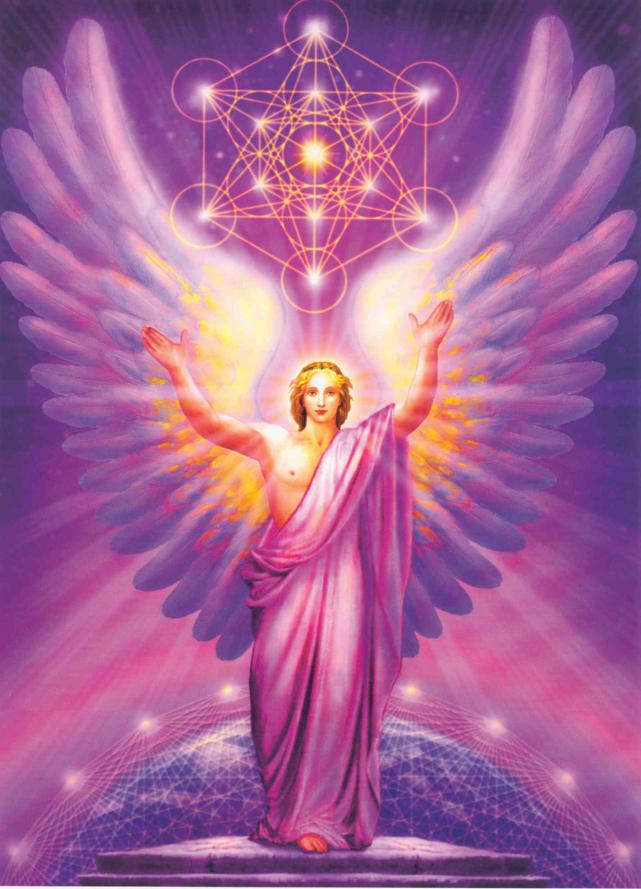
The Michael‑Gabriel binary is balanced by the enigmatic figure of the Angel Metatron (Heb. מֶטָטְרוֹן or מַטַּטְרוֹן) — “He Who Stands at the Throne.”
It is thought that the name of this Archangel is formed from the Hebrew root מטטר (mttr), which may mean “keeper” or “mediator.” In that case Metatron appears as a mediator between God and humans.
Metatron is mentioned in the Talmud and in aggadic literature as occupying a very special position among the angels. Being superior in rank and standing in immediate proximity to the Most High, he receives His commands, which he executes either himself or through other angels beneath him.
Associated titles include “Prince of the Presence” (literally “Prince of the Face of God”) and “Prince of the World.”
Mystics suppose that the Name of God is contained in Metatron; they base this on the verses: “Behold, I send an angel before thee, to keep thee in the way, and to bring thee into the place which I have prepared. Beware of him, and obey his voice; provoke him not; for he will not pardon your transgressions: for my name is in him.” In Hebrew these words can also mean that Metatron acts in the name of God, which accords with ancient conceptions of all angels.
Metatron is said to dwell in the seventh heaven and to be the tallest of angels, save perhaps for Anafiel. The Zohar describes his size as “equal in breadth to an entire world.” In rabbinic literature Adam’s size before his fall is described in similar terms.
Obviously, this figure, like any synthesis, has no independent existence; in all traditions the actions of Metatron and Michael are identified, which is understandable, since the action belongs to the active pole of the binary. In the Kabbalah Metatron is sometimes called the “Middle Pillar,” emphasizing his synthetic function and his role as the Archangel of Keter.
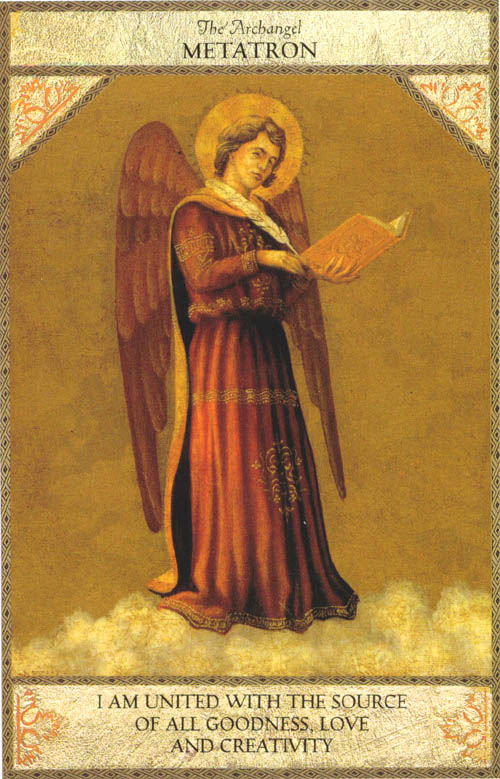
The myth of Metatron is extraordinarily complex, and there are at least two versions. According to one, Metatron came into being when God created the world and was immediately endowed with all his numerous duties. According to the other, he was the first man named Enoch; a righteous, good man who visited the Heavens several times and was once transformed into a fiery angel. Some later books accept the first version, some the second, and some combine both. There are even two variants of pronouncing the name Metatron: one of seven letters (מיטטרון), the other of six (מטטרון), the latter lacking the Hebrew letter yod. Kabbalists explain that the six‑letter name represents the Metatron who was Enoch, while the seven‑letter name represents the primordial Metatron.
Gematrically the name מיטטרון corresponds to the Name of the Most High — שדי, which is the basis for calling Metatron the “Small Yahweh,” whence one of Metatron’s seventy names — Yahoel (יהואל).
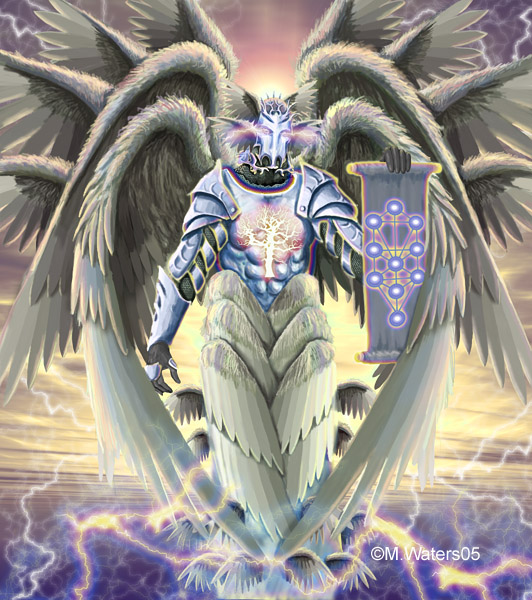
One of Metatron’s chief functions is the recording of all events that occur in the world. He is regarded as the celestial scribe who keeps the Book of Life and the Book of Destiny, recording all human deeds. In this capacity he resembles the Egyptian god Thoth or the Greek Hermes.
The Midrash says that he records the merits of the righteous and the deeds of sinners, thereby participating in the heavenly judgment. In some traditions he is called the “Angel of Faces”, because he stands directly before God, reflecting His will.
In certain sources he acts as the direct voice of God, His herald in the material world. Some Midrashim say that it was Metatron who spoke to Moses on Mount Sinai (and not God Himself). This resonates with the concept of the Logos in Christianity and the Islamic idea of the Kalam (the Divine Word).
He is also associated with the path leading to the Garden of Eden and guards its entrance.
In some gnostic traditions Metatron is associated with Christ or his highest manifestation in the heavenly spheres. In some texts he is regarded as the Son of Man in a heavenly dimension.
Thus we see that angelology, grown out of sparse mentions of ministering spirits in biblical texts, has developed into a fairly sophisticated spiritual‑mystical doctrine with its own traditions and experiential lore.
Chamuiel – could it be Samuel?
In traditional ecclesiastical transcription – Chamuiel; it can also be read as Samuel or even Samael.
The archangel Chamuel is not mentioned in the Bible; perhaps he is called something else there?
He is not mentioned in the Russian translation; many names there are translated metaphorically. In biblical history, this angel mixed languages during the Tower of Babel incident; he is also mentioned in the apocrypha, for example, in the Book of Enoch.
Many associate Chamuel with the Christian Salaphiel. How correct is this, or are they two different Archangels???
It is more correct to identify Chamuel with Varachiel, as both are Angels of Mars.
Interesting material, but I got confused with the names of the Archangels; maybe there is some source to explain these discrepancies.
Angels – just angels. but some are more human and closer.
Please be kind and let me know from which sources the name of the archangel “Chamuel” is taken? I couldn’t find it in the Book of Enoch or the Bible…
“Chamuel” is the Slavic interpretation of the name “Samuel” or “Samael”, which is traditionally used for the Angel of Vengeance. To avoid confusing the angel with the Old Testament prophet, it was customary in Slavic translations to write “Chamuel” as the name of the angel, while Samuel is the name of the prophet.