
Nahash and the Archons
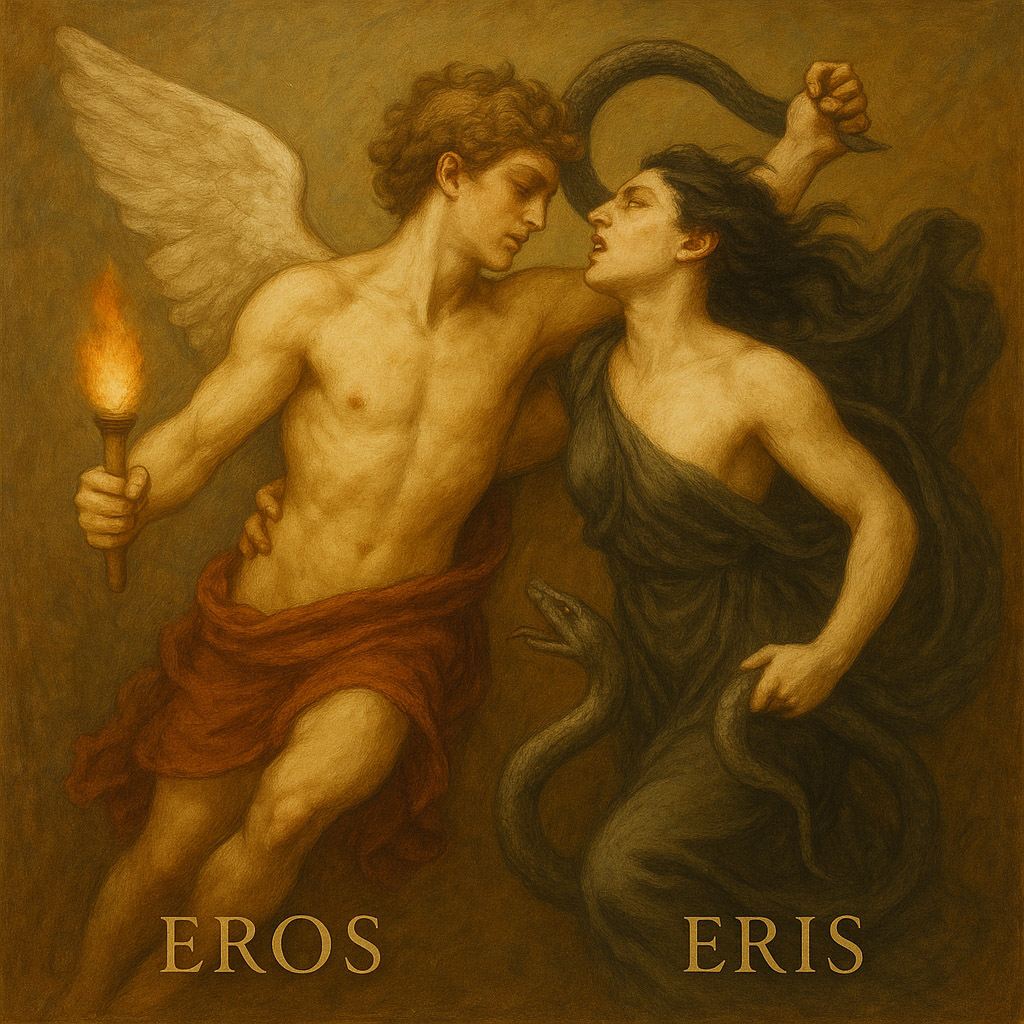
As mentioned, from the point of view of the Myth we are considering, reality is born as a result of the interaction of the primary pair of forces — Attraction and Repulsion, which manifest in many forms and at many levels, and in their “original” sense are described as Eros (Chaya) and Erida (Nahash).
Both forces are absolutely necessary; while a dynamic balance is maintained between them they are beneficial and conducive to evolution. However, when either force tilts the balance in its favor and attempts to become absolute, the equilibrium becomes distorted, giving rise to the primary destructive pair — Lilith and Lucifer — the forces of consumption and alienation, respectively.
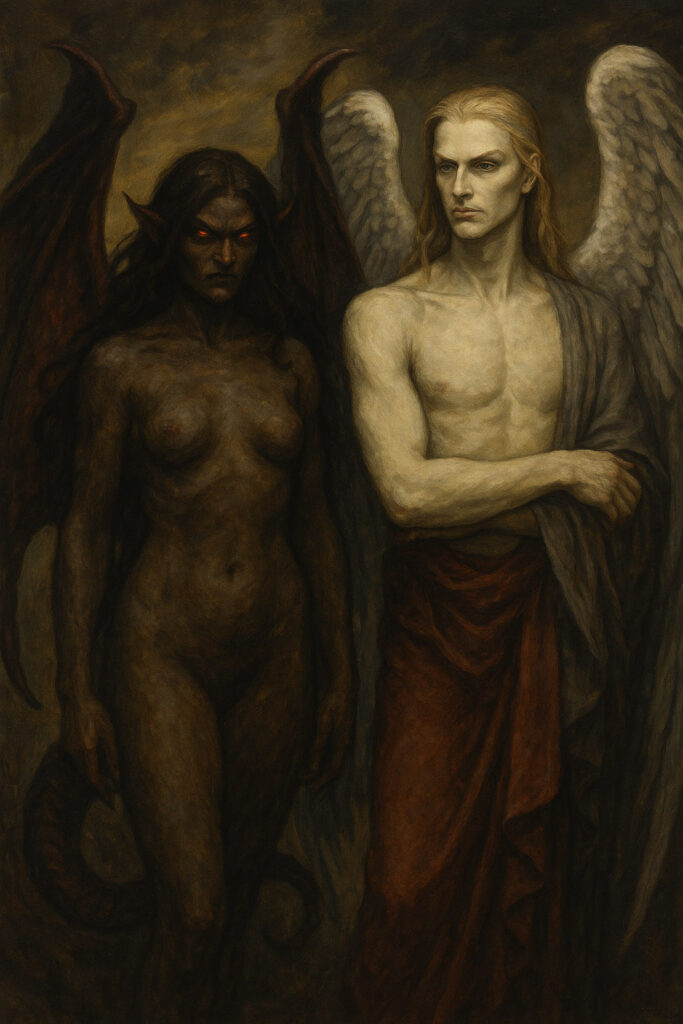
However, such an imbalance appears not only at the level of mental tendencies but also in the form of cosmogonic processes, and in this sense it is described as yet another pair of forces — Barrenness (Achamoth) and Blindness (Ialdabaoth).
And it is precisely this latter pair of forces that takes on special significance now, when the balance of energies in our world shifts toward reduced production of energy of consciousness and the rise of a “weakened” pneuma.
Thus, Archontic forces can be regarded as the “objective” level of distortion of the primary energies, whereas demonic destructors represent the “subjective” level.
Therefore, the division of the primordial medium — the birth of discreteness and separateness — which we have discussed, is a natural manifestation of the universe’s primordial forces; yet in our manifested world it is distorted, lacking harmony and balance.
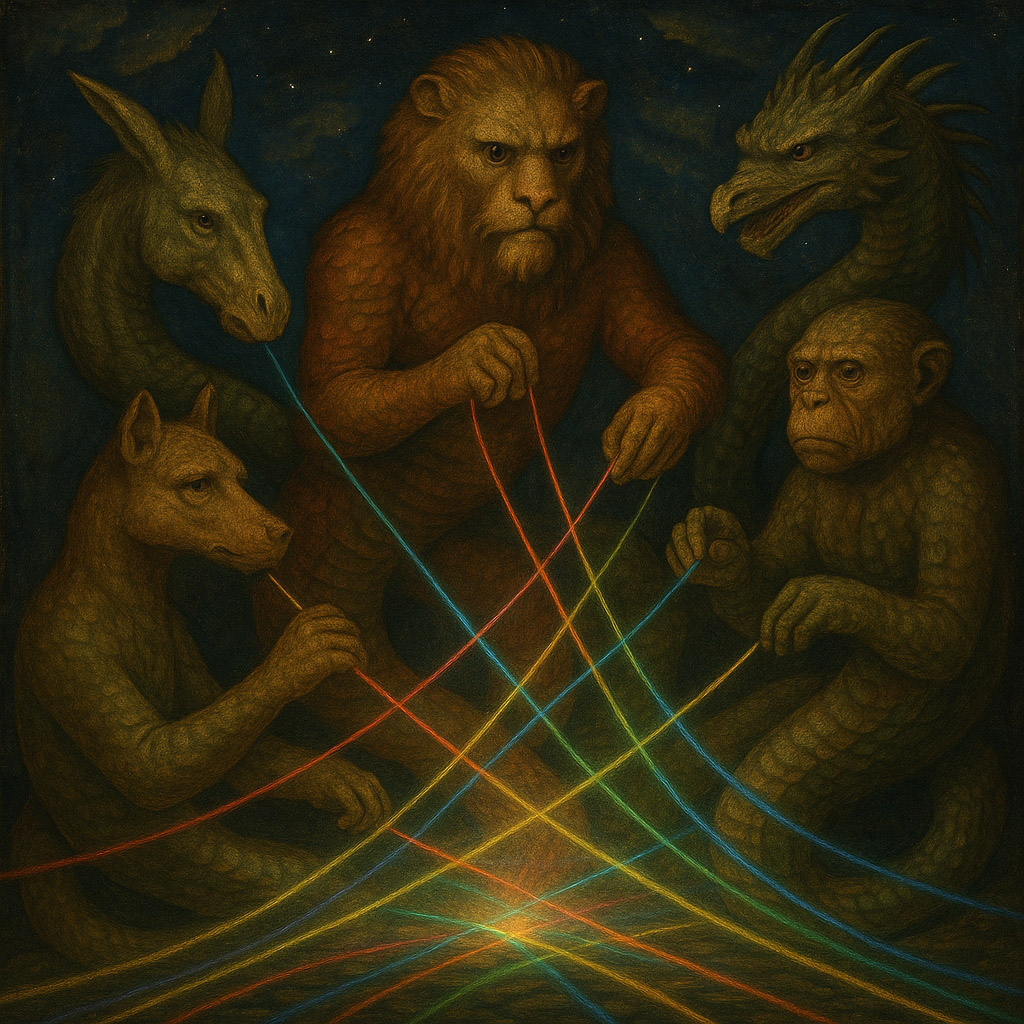
Accordingly, the Archons — as the “authors” of heimarmene, reality asserted through opposition — can in many respects be regarded as manifestations of Nahash: the “children” of Erida, who in this sense constitute the alter ego of Sophia-Achamoth.
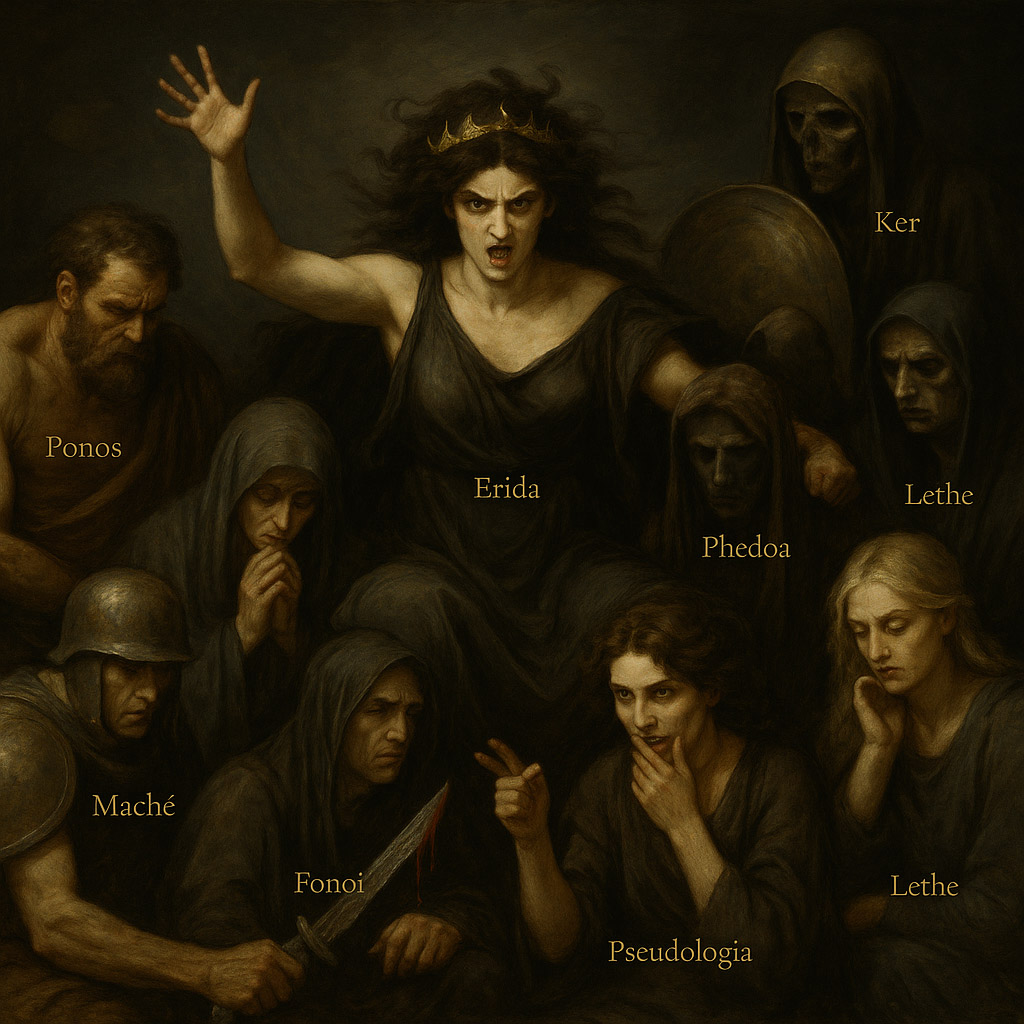
And therefore it is not surprising that the ancient Greek description of the “offspring” of the Goddess of Strife closely resembles later gnostic lists of the Archons. First in this list stands Ponos (Πόνος), the personification of exhausting toil and suffering. Next follows Limos (Λιμός) — hunger, and Oizys (Ὀϊζύς) — sorrows and misfortunes, reflecting the consequences of need and conflict. Erida is also the mother of warlike entities: Machai (Μάχαι) — battles, and Phonoi (Φόνοι) — murders and executions. She also gave birth to Neikea (Νείκεα) — quarrels and lawsuits, leading to discord, as well as Pseudologia (Ψευδολογία) — lies and deceit, and Ate (Ἄτη) — recklessness and blindness, often leading to destruction, as well as the Keres (Κῆρες), spirits of cruel death (especially on the battlefield), and Lethe (Λήθη) — forgetfulness. Thus, the children of Erida personify all those destructive forces that arise when the attraction of Eros yields to the force of repulsion.
Since traditionally Nahash (נָחָשׁ) is identified with the “Serpent of contradictions,” it is not surprising that the iconography of the Archons also includes serpentine features: they are often depicted with serpentine bodies and heads resembling various animals.
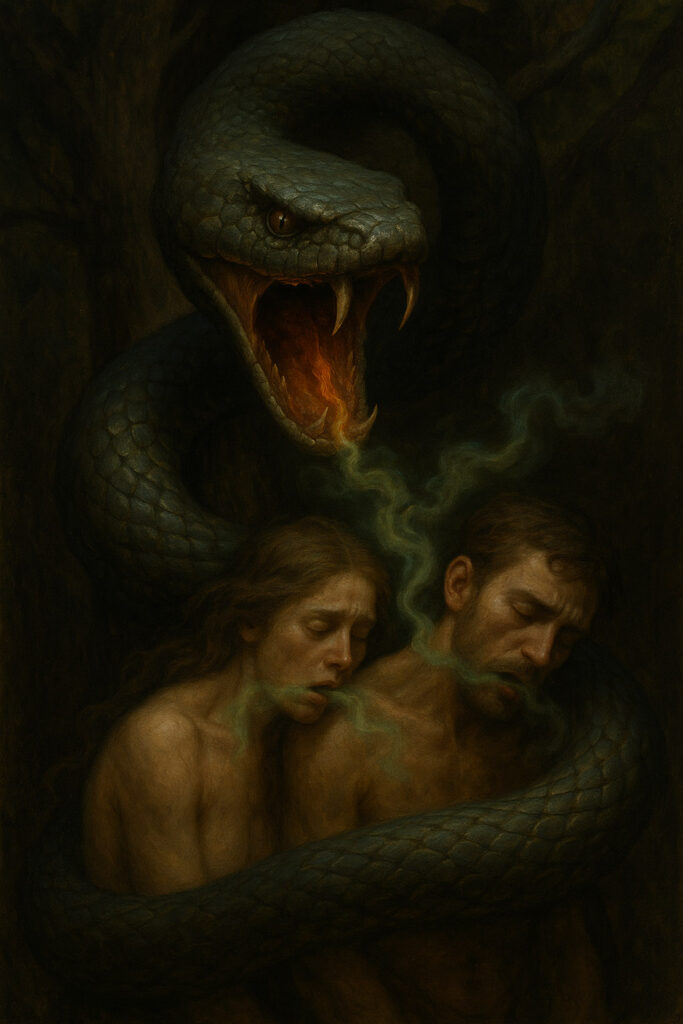
In this context one can also see a direct parallel between the gnostic concept of heimarmene and the Kabbalistic idea of zuhama — the source of Yetzer hara. According to these notions, zuhama (זוהמא) is translated as “impurity,” “filth” — and this is precisely the “spiritual poison” the Serpent infused into humanity. In the “Zohar,” zuhama is described as a special substance of decay and sin that entered the world at the moment of the Fall: materialism, corruptibility, and the inclination to evil, which were transmitted to the entire human race and became the main cause of mortality and the imperfection of the world.
Thus, when the Archons “shatter” the unified reality, isolating qualities and properties that underlie the perception of a given world, they perform a cosmogonically necessary task; but when they insist that the picture of this world is final, its laws immutable, and its processes rigidly determined — then they turn from creators into jailers.
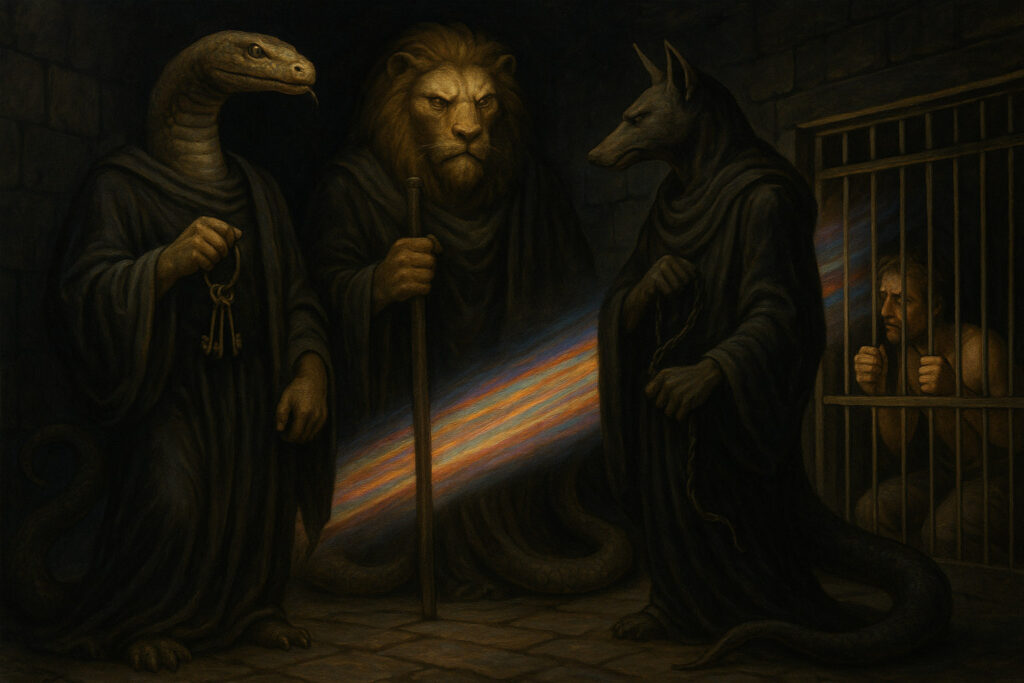
And then the “force of the body,” the mind’s tendency to rely on its vessels, becomes a source of enslavement — one of the roots of Yetzer hara.
Therefore it is important to understand that although without Nahash there is no distinction, and without the Archons there is no experience, distortion arises when the differentiation created by the Force of the Threshold “forgets” its purpose and treats a particular spectrum — as the entire field.
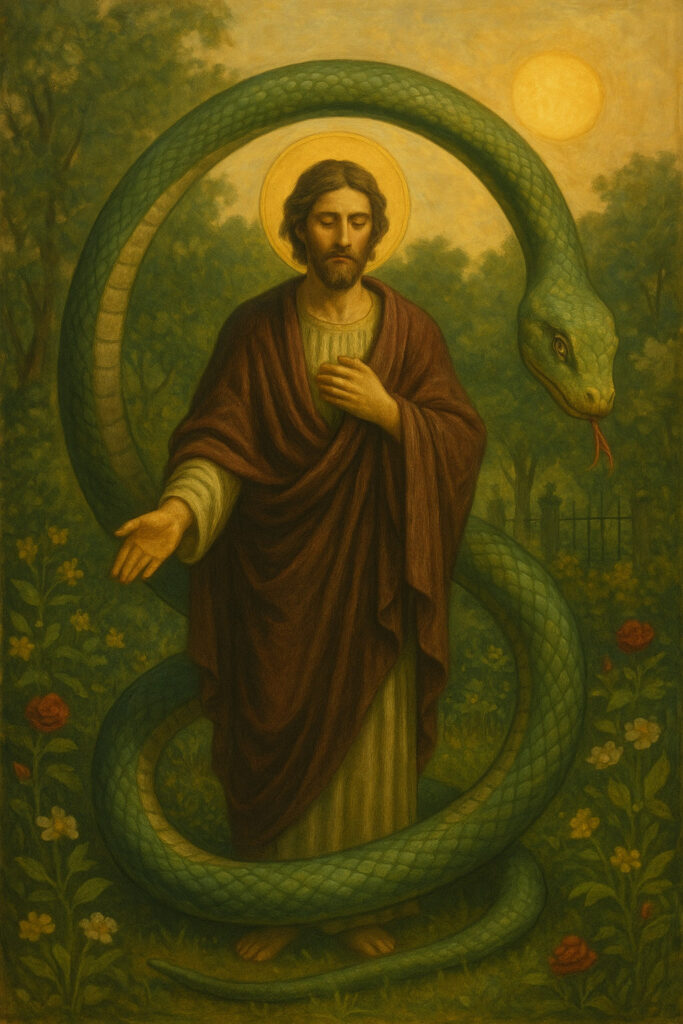
Accordingly, the task of the Magus’s mind is to restore Nahash’s role as a semi-permeable boundary through which Chaya can be perceived; we should broaden interactions between energies so that their delineation becomes articulation rather than fragmentation. It is precisely such a “purified” Nahash that is also known as “Yechida” — a “true” individuality that does not oppose unity. Then the Archons themselves become the keepers of the Garden of materiality, in which discreteness serves wholeness, and the world, remaining a particular world, is illuminated by the sun of the Pleroma.
Are there any analogs of geniuses for demons among the listed archons?
Archons are not distortions of some powers; they are a consequence of the very limitations of the principle of materiality, and therefore they cannot be “corrected”; although they are opposed by luminal, pleroma forces, this opposition is not ontological, as in the case of angels and demons, but only in influence on the process and “external” consciousness: Archons enslave it, holding it in the manifested world, while luminal forces manifest as a response to the consciousness’s striving for freedom and perfection.
Thank you!