
Heimarmene as a Simulation of Reality

Lately, an ever-growing number of people who seriously reflect on the nature of reality have been drawn to the hypothesis of a “simulated” reality — that is, to the idea that the perceived objective world is not independent and allows interpretations different from the familiar picture. At the same time, various scientists and thinkers attribute the source of such a simulation to a “superintelligence,” a “supercomputer,” or the informational nature of the Universe itself. Traditional worldviews, however, have long described this ‘arbitrariness’ of the objective world, and in their explanations they combine both approaches — the “self-sustaining” informational activity of the world and its external control.
From the standpoint adopted here, the objective field of reality is an aggregate of energies — properties, basic modes of being — from which “objects” are assembled in acts of perception. An object, on this view, is a picture: a stable conglomerate of connections in the field of mind, recognized and stabilized by description. In other words, the perceived and lived “real” world is the result of a choice of how to assemble — of ascribing a hierarchy and an order of description arising in the interaction between the subjective field of consciousness and the objective field of energies.

At the same time, the energies themselves are not objects of consciousness; they are merely possibilities and prerequisites for forming objects in the perceptual field. Hence beings perceive only what they tune their perception to. Between the inexhaustible field of possibilities and the living mind, there always stands a mediator — the rendering policy, which tradition calls heimarmene.
The same segment of the objective field, the same set of energies, can be interpreted or assembled as “noise” or as “structure,” as a “natural phenomenon” or a “sign,” as a “threat” or an “opportunity” — all depending on cognitive habits and perceptual patterns.

Thus, heimarmene is, in fact, the stable perceptual inertia: the habit of assembling the world according to the same template. It forms gradually, slowly, and very persistently — out of countless repetitions of reactions, out of fears and desires, out of descriptions and representations, out of a practically verified picture of the world. It is imprinted in the very stream of mind, carried “from life to life,” and, once fixed, begins to appear as an unshakable reality.
Therefore, although the same portion of energies can be described in an enormous number of ways — that is, serve as the basis for completely different objects and entirely different realities — in practice, perceptual freedom is strongly constrained, and beings are conditioned to operate within a narrow range of possible descriptions.
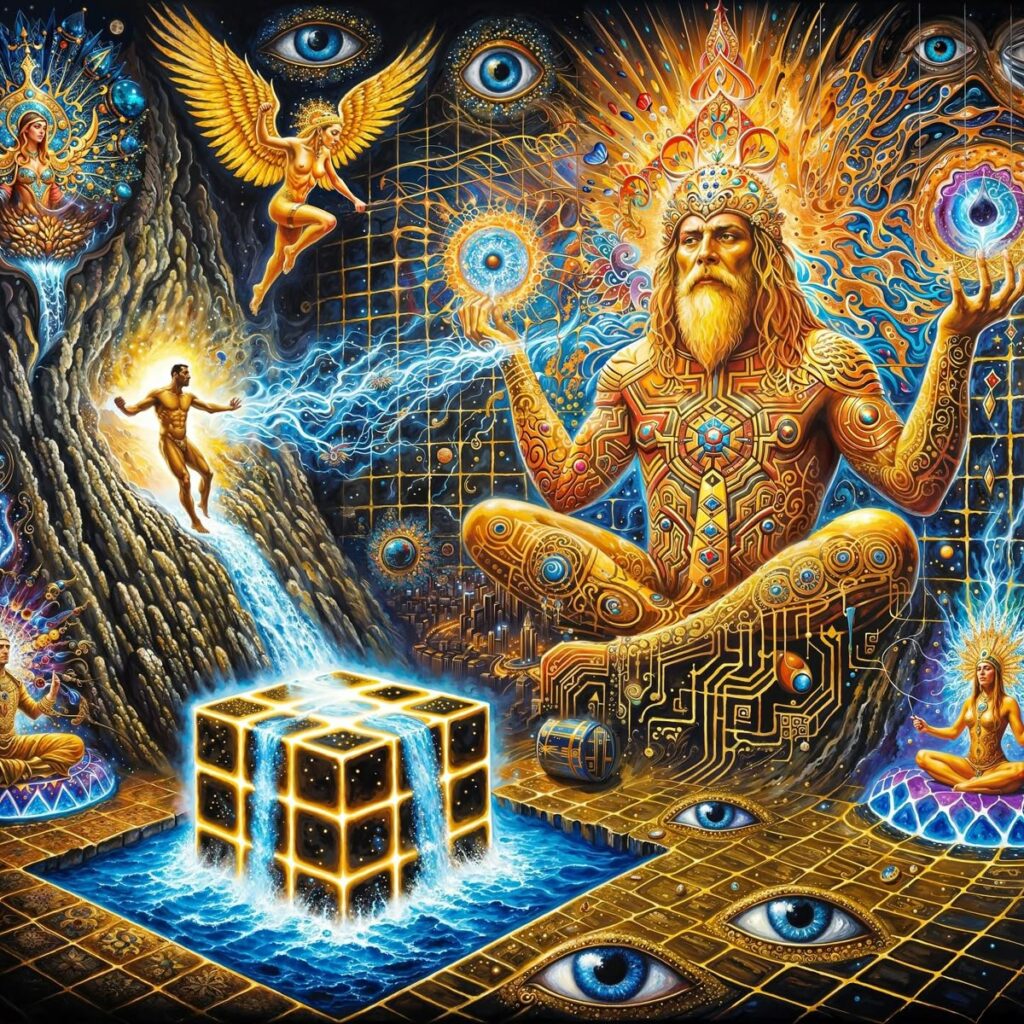
In Gnostic terminology, the cause of this narrowing of the perceptual range is called the Archons — not necessarily as personified rulers, but primarily as systemic attractors that keep the perceptual rendering within a narrow corridor of established “rules,” narratives, affect economies, and collective templates.
From this perspective, their task is not to “lie,” but to stabilize a single way of seeing — to reduce the richness of energies to a repeatable set of scenes and actors.
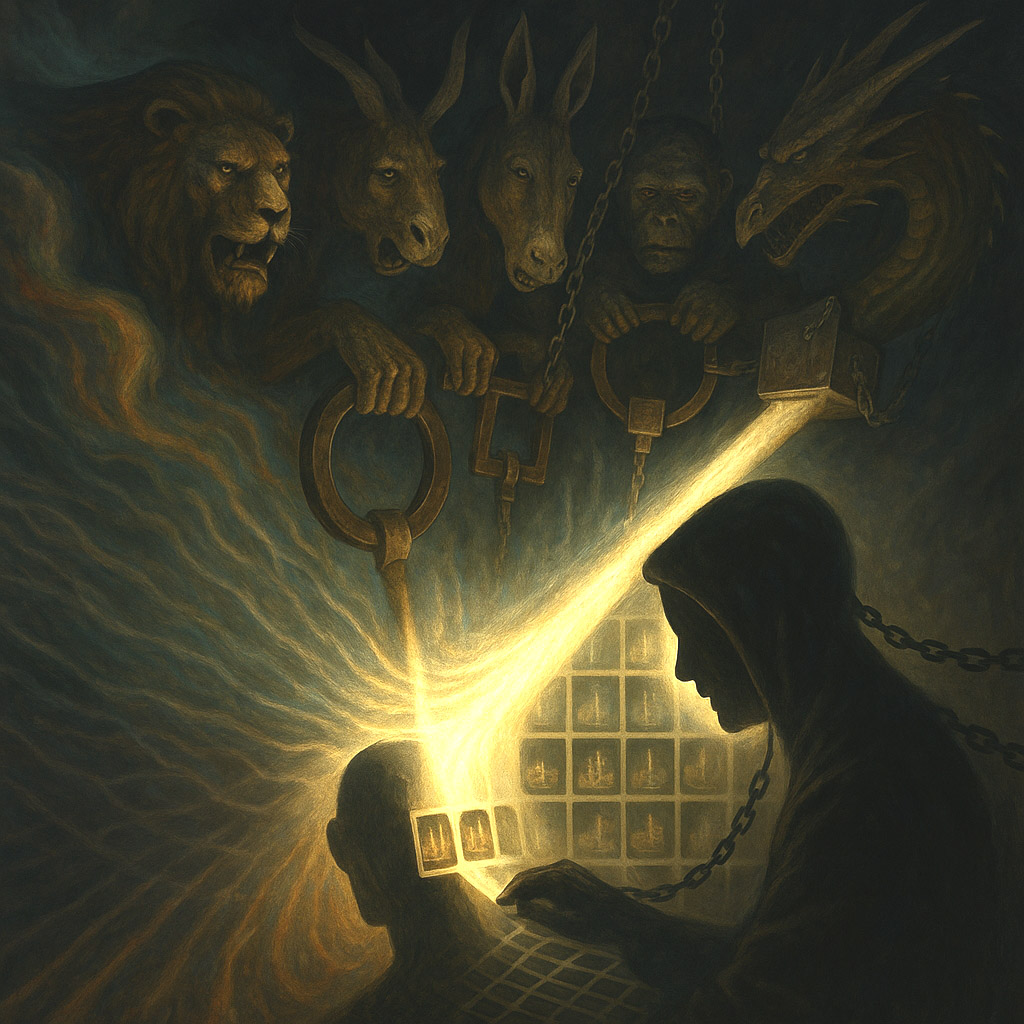
This is how a simulation is born: as a special and originally arbitrary mode of assembly that becomes “fixed” and is then taken for the only possible world.
In this sense, “simulation” is an apt technical image. The common pool of energies, potentials, logoi, and eidōs is, in this terminology, a library of forms; reshimot is a cache — traces of trajectories already played; heimarmene is the default render priors; the Archons are moderators who convert those priors into a consensus; and the stream of mind, or the monad, is the agent whose attention chooses the basis in which what happens is “decoded” or “compiled.” Although this vocabulary is modern, it does not contradict Tradition: as above, so below — form is always a result of tuning. We do not see what “is in itself,” but what our cognitive filter admits into view.
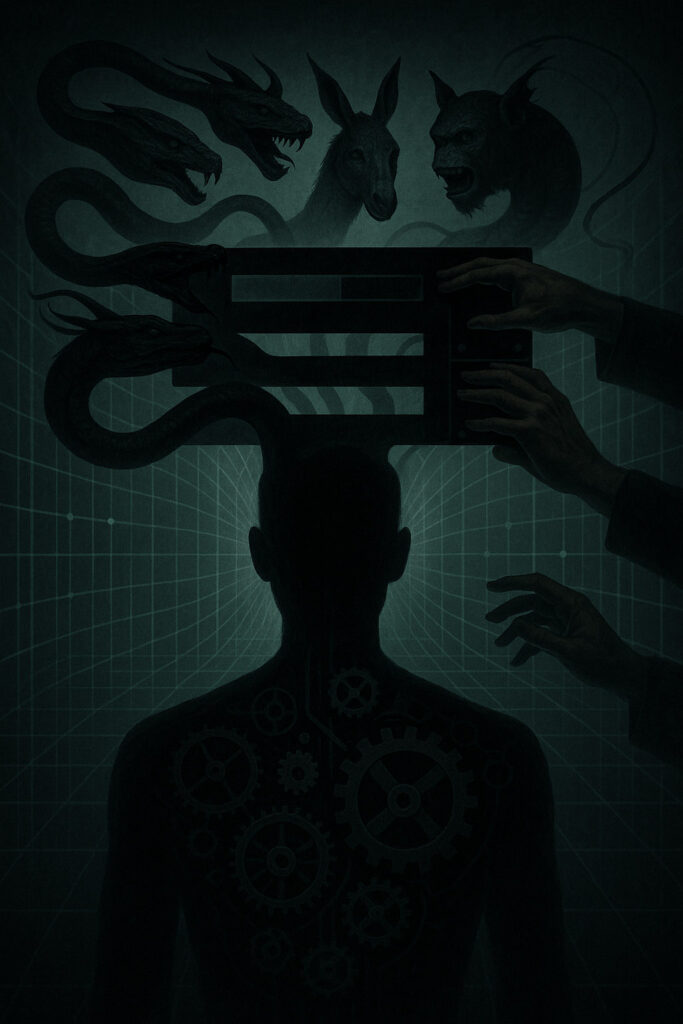
At the same time, the Archons act as “reality filters” only at certain stages. Gradually, each stream of mind also accumulates its own habits and perceptual tendencies, karmic inclinations and limitations; thus, in practice, heimarmene is to a significant degree a self-perpetuating simulation, into which “moderators” intervene only occasionally to prevent “loopholes” and “failures” in the “matrix.”
On the biological level, the brain always works predictively, filling in missing elements according to its priors; on the physical level, the environment “selects” stable patterns where objects appear stable. Any act of cognition inevitably “creates coarse structures,” discarding an abyss of micro-details for the sake of a few manageable macro-variables.

However, the factual inevitability of rendering does not by itself imply a narrowing of perceptual freedom. The true “prison” is precisely heimarmene, which forbids spontaneity and creativity, suppresses changes of frame, curtails inquiry, and imposes ill-suited extrapolations and “automatic completions”; these tendencies ultimately produce subjects poorly adapted to variable, branching timelines. Such a subject always “lags behind”: it confirms the habitual far more readily than it notices the new.
Accordingly, the power of the Archons consists in “moderating” the costs of attention: what to treat as fact and what as “noise”; how to connect points into narratives; which emotions to trigger and how much time to allot to them. Thus, simulation in the Traditional sense is, above all, “costly switching”: the basis in which mind is trained to see objects becomes too costly to change, and so it grows accustomed to naming only that basis “reality.”
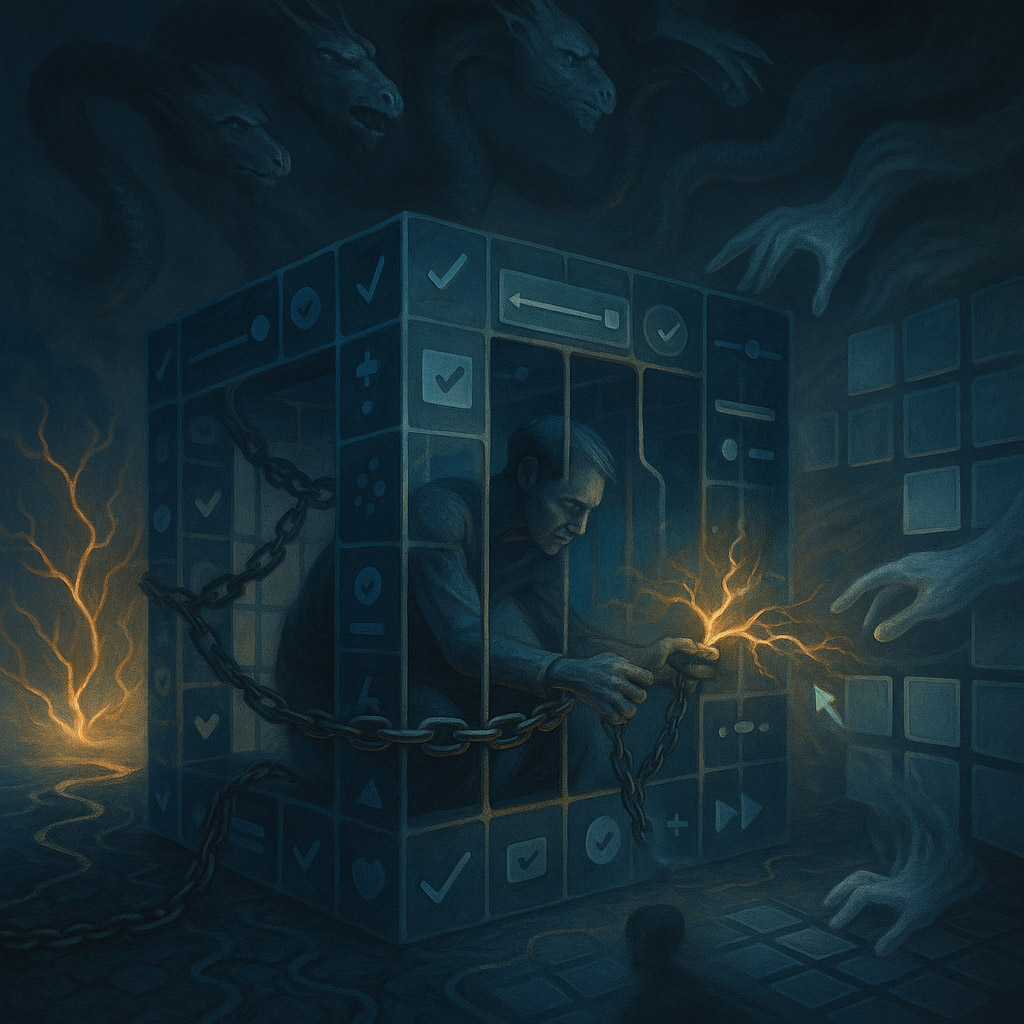
On these premises, the way out of this mode of limited perception lies primarily in expanding rendering freedom. Various practices of meta-attention can help: learn to see a basis as a frame; work with languages (choosing new names that will bring forth new phenomena); retrain reward systems so that “understanding” costs more than the habit of a superficial glance; bodily and cognitive practices that restore the body to its role as a perceptual system rather than merely an engine or passive support; and targeted, structured actions that consolidate new priors of perception at the level of affect and memory. It is important to understand that changing the description — which leads to a change in the “objective field” — is not a change in the nature of objects, but a change in the matrix of their perception. We have already said that this is precisely where the key to Magic lies: the ability to create effective world-descriptions that do not close off paths to freedom but, on the contrary, imply an eventual exit from the need for description as such.
Thus, heimarmene is an obscuring rendering strategy that makes one of many possible worlds the only one perceived. Therefore the primary aim of any magical practice is not so much to “leave the game” (that is important as the ultimate goal) as to learn to play while remembering that the field is broader than the current board, and that each new game costs more than any victory in the old.

Thank you.