Principles, Laws and Imprints
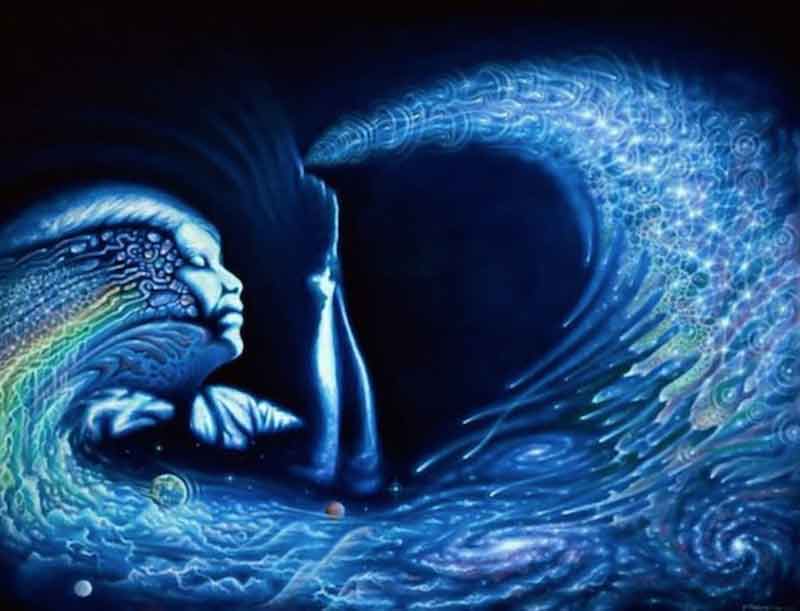
The concept that the world we observe is only conditionally real, like a picture or a collection of descriptions, is common to many schools and traditions of magic.
At the same time, since Magic is a path of action, it is important for the Magus to understand how this picture is structured and by what laws it functions. Thus the magical description occupies an intermediate position between idealism and materialism, acknowledging, on the one hand, the world’s capacity to affect the magician (and ability to affect as a reality criterion), and on the other hand the mind’s ability to change the world.
To describe such a conception of the world order, the Magical Myth uses several interrelated categories: Logoi (general principles of form), Ideas (eidoses — the specific expressions of those principles in particular conditions), Matrices (or nomoi, Me — the internal regularities and rules by which an object is cognized/formed), and Imprints (reshimoth — the “traces” of the mind’s influence on being).
Let us examine how the Myth describes the relationships among these categories.
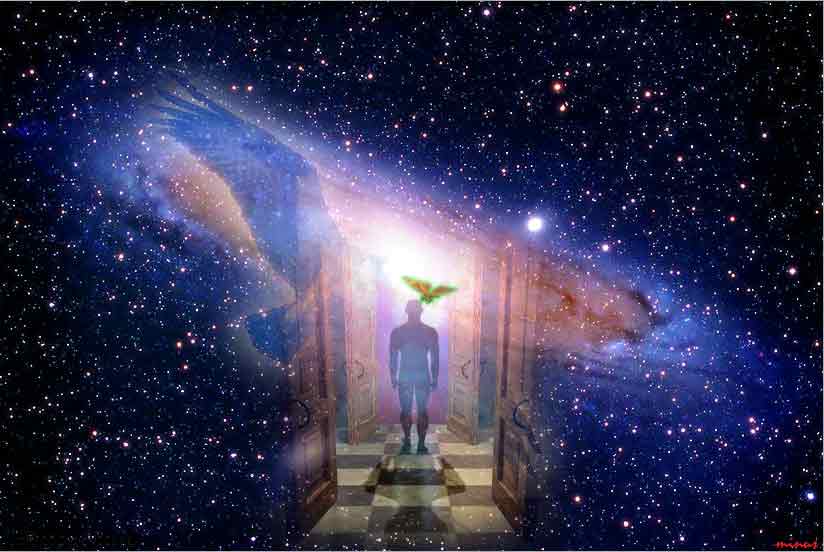
As we have already said, the manifested world is conceived as the result of the differentiating principle’s (mind’s) action upon a potential field (the environment). In this sense the world is “illusory,” because its manifestation is dependent on the subject’s activity — the mind.
Meanwhile, as the mind “knows” (or, equivalently — creates) the world, it constantly moves from the general to the particular, and from the particular back to the general (“Ascendit a terra in coelum, iterumque descendit in terram, et recipit vim superiorum et inferiorum” — the Emerald Tablet), establishing general laws and particular features of manifestation.
When the mind works with general principles, when it attends to the basic regularities of manifestation — it is in the realm of logoi. In this sense logoi can be understood as highly abstract, synthetic ideas that outline the general regularities of cognition/creation.
Describing the manifestation of a given logos within a set of concrete conditions, the mind is in the domain of Ideas, eidoses — a concrete instantiation of a logos. In other words, if a logos is, for example, the general idea of relations that gives rise to an image as such, then an eidos is the principle forming a table.
Finally, when attempting to understand the “internal regularities” of the existence or cognition of a given object, the mind enters the realm of “models” — nomoi (Me) — the rules and laws by which that object is constructed and relates to other objects.
Thus, for example, perceiving the general properties of an object on which food can be placed, the mind operates with the logos of the table; thinking of the “ideal image” of a particular table — with its eidos; and analyzing how and from what one could make such a table — with the nomos.
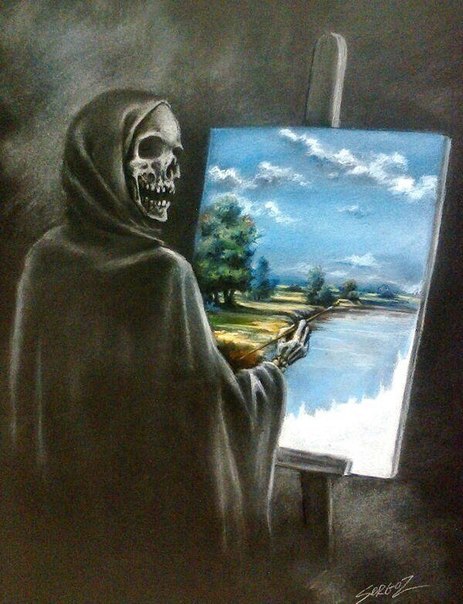
However, a question arises: after the mind has “extracted,” known/created a particular object, and then has shifted its focus to other areas of the environment — what happens to that object? Does it disappear or does it continue to exist? To answer this question the Myth introduces another category — the notion of “imprints” — “reshimo.” The Magi discovered that when the mind interacts with the environment it leaves its “imprint” there, a trace of its influence, a kind of potential matrix, a “memory” of the interaction that took place. Thus the environment exists as an aggregate of such reshimoth, each of which can be quickly and easily actualized when the mind contacts them again. Therefore, from the perspective of Magic, objects not in the field of mind do not vanish but continue to exist as reshimoth, as possibilities of existence.
The concepts described have great significance in the practical life of the magician.
First, the idea of an “anthropic principle” — that reality does not exist separately from its observer, a view characteristic of magicians and mystics since ancient times — allows one to reduce the energy expended on “taking that reality too seriously,” and thus frees up energy for changing it.
Second, the notion of “ideal images” of logoi helps avoid errors caused by the religious perception of these images as objects of worship, thereby increasing the mind’s freedom.
Third, understanding the importance of the environment for the manifestation of any object makes it possible to deliberately shape the conditions for the desired manifestation, and thus also to save energy and resources.
Fourth, the concept of “imprints” plays an important role both in seeking ways to influence objects and in finding ways to free oneself from unwanted influences.
Thus the Myth, when accepted as a map subject to critical analysis and empirical verification, allows the Magus to effectively structure one’s practice on the Path toward their goal — full self-realization and liberation.

Dear Ermenkar, can we consider science, for example, physics, as a kind of magic?
Magic is not something separate, not a special science; Magic is the science and art of effective living. If a person is able to find within themselves the true source of their desires, and effectively realize those desires that come from their own nature, then they are a magician, and their life is Magic.
Such a question: when a writer exerts effort and creates a fictional character, does it exist only as a resolved thing? Or does its existence not matter, only the imprint of creativity ‘history’ of the writer?
Everything depends on the amount of energy spent on this creativity and the internal elaboration of the character itself. As a rule, of course, only the imprints of the creative act of the writer remain, but one can easily imagine a situation where a resolved character acquires some vitality.